
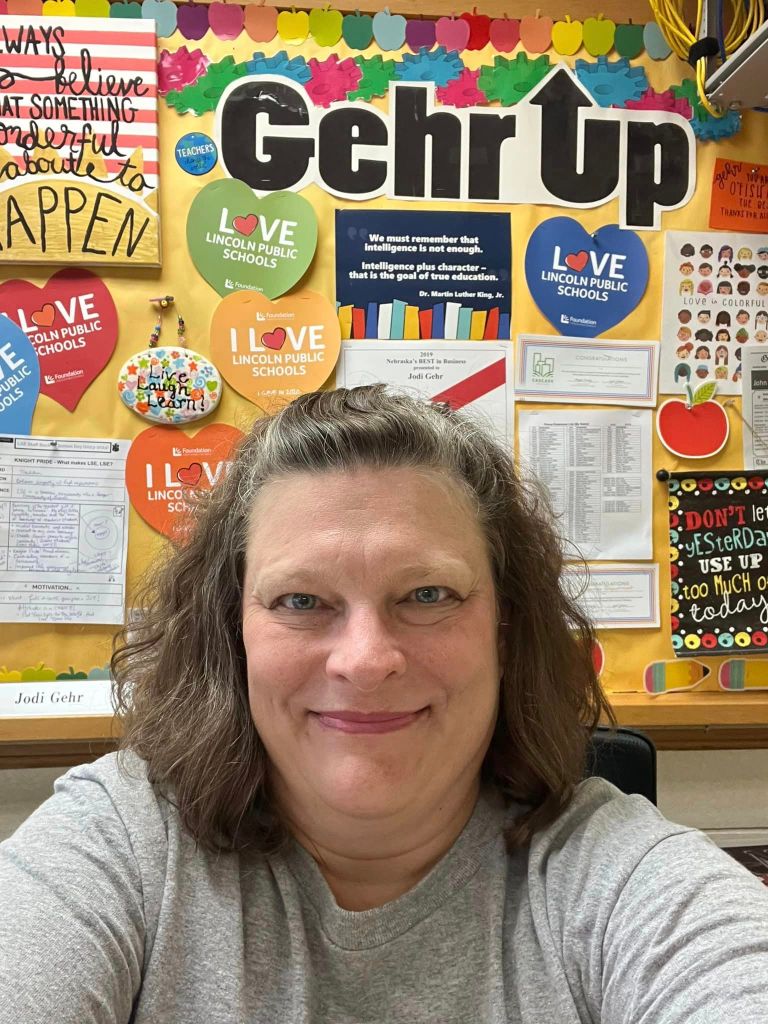
This Labor Day, a day of rest after starting my 27th year of teaching, is an opportunity to reflect on the first four weeks of the 2023-2024 school year. Our first week back to school, sans students, is solely intended for teacher professional development, meetings, reconnecting with coworkers, and planning for new classes.
At our LSE Staff Back to School Day, teachers were asked to consider what Knight Pride means, and what makes Lincoln Southeast High School uniquely LSE. My response, in a word, is tradition. Celebrating and learning from our history helps shape who we are. Carrying a strong tradition into each new year, adapting to new challenges, and balancing empathy with high expectations capture our essence. We have cultivated close relationships in each of our departments creating a smaller community, a school family, within the larger community of Lincoln. This is #knightpride!


Why are we here?
Remembering our purpose can be helpful when teaching day-to-day gets challenging. The purpose of my work, believing that learning is the greatest gift of being human, is what makes me come alive. Fostering curiosity, wonder, and the love of learning with co-teachers and students is my motivator.
How do we show our passion and purpose?
In The Monastic Way, September 2023 issue, Joan Chittister writes, “Good work is work that develops us as we develop it.” Modeling curiosity and wonder by committing to my own learning shows students that learning is a purposeful, lifelong endeavor. Each year, I commit to creating lessons that inspire curiosity while also communicating the connections between what we are learning and the value to my students’ lives. Students must understand their why.
What outcomes do we desire?
Relationships with former students are the greatest reward from my years of teaching. Seeing these young adults share their Knight Pride as LSE alumni at school events and as contributing members of their community is a great joy. I wish for all my students—that their life is better because of what they learn; that they have aha moments now and, in their future; that they build career and life skills; and that they become lifelong learners. Joan Chittister shares, “Work is the gift we give to the world. That’s why it’s so important that what we do for a living has value, not simply for ourselves but for the world at-large.”
What will be your motivation mantra this school year?
Life is short, fill it with purpose and joy. “Put your lips to the world. And live your life (from Mornings at Blackwater Pond by Mary Oliver.)

“Work is the mark of the conscientious human. We do not live to outgrow work. We live to work well, to work with purpose, to work with honesty and quality and artistry.”
Joan Chittister, The Monastic Way
A good teacher embeds the wonder of life into their lessons; learning is not just about inspiring curiosity of the subject taught, but towards learning and life. Of course, not everything can be taught, some things must be learned. I was not taught how to be a teacher; I had to learn by experience. Life experiences will fill in the gaps from “what you missed that day you were absent from fourth grade.” (See poem below)
“We work to become, not to acquire, ” writes Elbert Hubbard. And this is what I have learned–learning never ends. Each school year is an opportunity to bring new ideas into the classroom, and to experiment with creative lessons and strategies. We are always becoming!
What You Missed That Day You Were Absent from Fourth Grade

Mrs. Nelson explained how to stand still and listen
to the wind, how to find meaning in pumping gas,

how peeling potatoes can be a form of prayer. She took
questions on how not to feel lost in the dark.

After lunch she distributed worksheets
that covered ways to remember your grandfather’s

voice. Then the class discussed falling asleep
without feeling you had forgotten to do something else—

something important—and how to believe
the house you wake in is your home. This prompted

Mrs. Nelson to draw a chalkboard diagram detailing
how to chant the Psalms during cigarette breaks,

and how not to squirm for sound when your own thoughts
are all you hear; also, that you have enough.

The English lesson was that I am
is a complete sentence.

And just before the afternoon bell, she made the math equation
look easy. The one that proves that hundreds of questions,

and feeling cold, and all those nights spent looking
for whatever it was you lost, and one person

add up to something.
      —Brad Aaron Modlin
What You Missed That Day You Were Absent from Fourth Grade
More reflections on why I teach:
Teaching during a pandemic: Work is the Friend of the Soul: #TeacherStrong and Grateful
In honor of Laura Ingalls Wilder and childhood dreams: Why I Teach
Cultivating an attitude of gratitude: Gratitude for Teaching: A Mirror to the Soul


 Being Benedictine
Leave a comment