Since the beginning of time, peoples of all cultures and religions have beheld the beauty of the earth, endeavoring to understand the universe and their place in it. We long for this sacred knowing. Just a century ago, we could not have conceived of the technology and space exploration that would produce photographs and telescopic images, inspiring such awe and wonder, my word for 2023. We are imbued with the grandeur of God.
Hildegard of Bingen, the 12th Century Benedictine Abbess and founder of German scientific natural history, captures this wonder:
“Glance at the sun. See the moon and the stars. Gaze at the beauty of earth’s greenings. Now, think. What delight God gives to humankind with all these things. All nature is at the disposal of humankind. We are to work with it. For without we cannot survive.”
Hildegard of Bingen
Since 1990, the Hubbel Telescope has captured the wonder of our universe’s distant past, more than 13.4 billion light-years away, capturing images of black holes, galaxies, and the birth and death of stars, changing how we look at our cosmos.
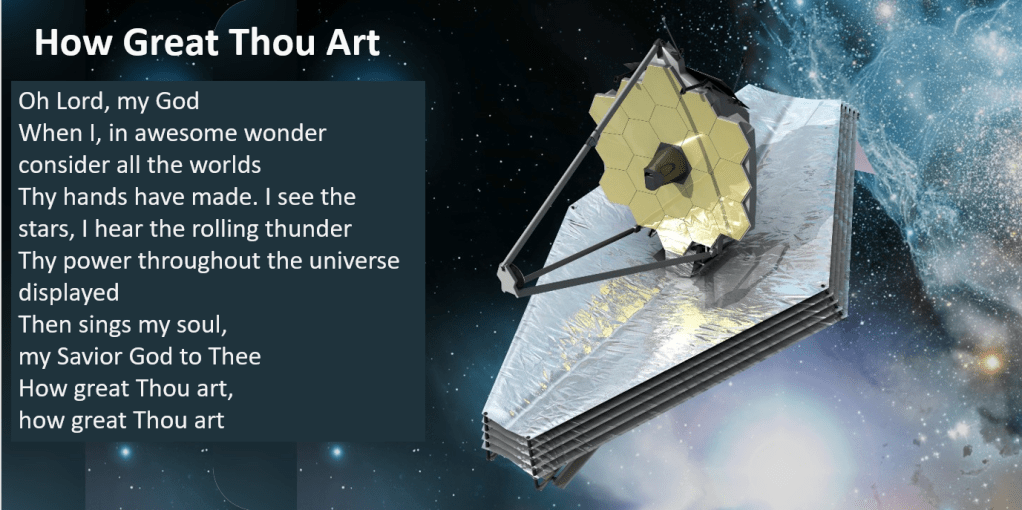
The James Webb Telescope launched on Christmas Day, 2021, has even greater potential, using infrared capabilities to see through dusty regions of space viewing objects that are too old, faint, or distant for the Hubble Space Telescope.
It is astounding to behold the images of what is beyond us, but, perhaps, even more profound are the images captured on Christmas Eve, 1968, of Earth. The three astronauts of Apollo 8 completed the first manned orbit around the moon, becoming the first humans to see, and photograph, the Earth from space.
The first color photograph taken beyond Earth’s orbit was later titled Earthrise. The film “Earthrise” tells the story of this image captured by the Apollo 8 astronauts—Bill Anders, Frank Borman, and Jim Lovell—and recounts their experiences, exploring the beauty, awe, and grandeur of the Earth against the blackness of space.
The vast loneliness is awe-inspiring and it makes you realize just what you have back on Earth. The Earth from here is a grand oasis in the big vastness of space.”
Astronaut Jim Lovell, Apollo 8
Looking beyond, looking upon, looking around, and within—all are filled with wonder.
“…take a look around you. Ponder how the solid-seeming ground beneath your feet is quietly shaking with the force of billions of years of cosmic collisions. Go outside…watch the wind blow through the trees … The endless comings and goings of galaxies, stars, and planets create a melding of songs that you are part of too. It’s a reminder that the world always has been, and always will be, worthy of wonder.”–Adam Frank, The Constant Fire
In awesome wonder, may your Christmas be filled with reminders of the beautiful mystery that surrounds you.May your prayer begin with “How Great Thou Art.”
I am one who sees the fullness of darkness and light. I see golden. I see through the eyes of a child, as well as the wise and wondering woman. I see myself reflected in beauty and patterns, knowing there is a big and a small picture.
I am one who is looking forward while also considering the past. Both/and. The wise woman and the apprehensive child. I am one who sees there is more than meets the eye, and that things aren’t always as they seem.
I am one who reflects what is. When I change my stance, what I see in myself may be different. The sculpture embodies stability. It stands firm, but the images that result can be changed. It captures the essence of being Benedictine—there is stability and movement.
I am one who is responsive, seeing beyond what is.
Consider using images and collage to learn more about who you are. What does A Golden Threshold mean to you? Meditate on the image and see what intuitively comes to you about darkness and light, about embracing both as a golden moment. Is there a threshold moment in your life that could use this way of seeing?
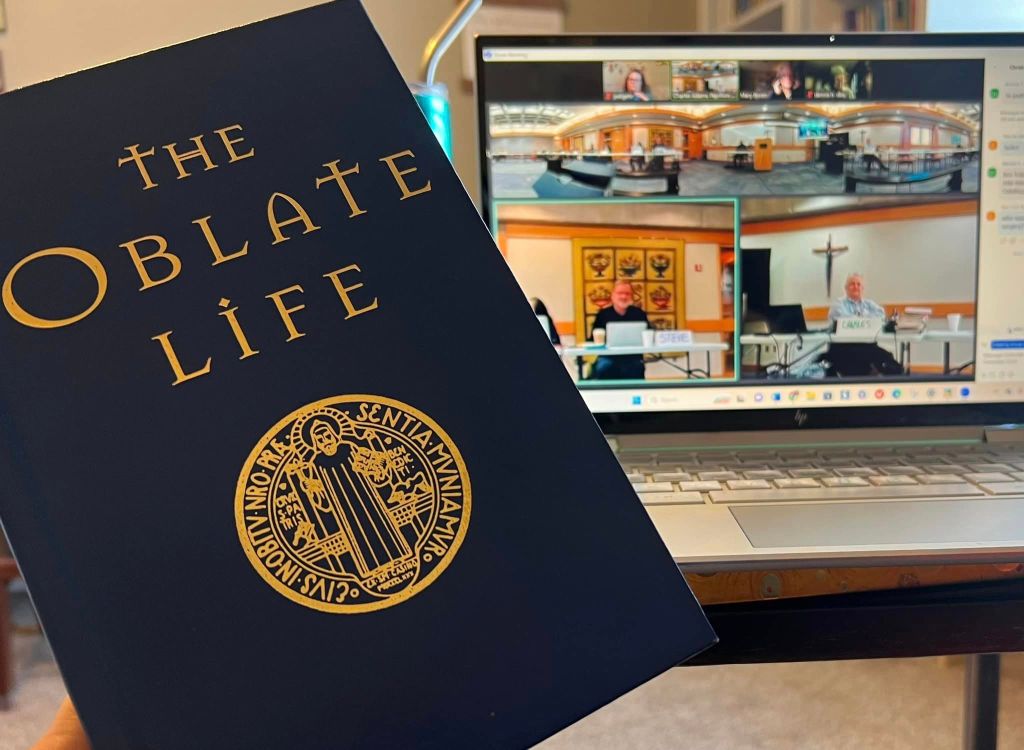
Source: The Oblate Life, edited by Gervase Holdaway, OSB, 2008
Men and women who have made monastic vows, called monks, practice stability by committing to a specific monastery. “The monk is an archetype, whether we live in a monastery or not, we have a sense of what it means to be a monk. We long to be together with God in solitude.” (Fr. Mauritius Wilde, OSB)
Being Benedictine as an oblate is making a commitment to a monastery, living the core values of obedience, conversion of life, and stability while following the Rule of St. Benedict as monks “in the world,” meeting monthly to practice Lectio Divina and discussing a spiritual reading. In the age of Zoom meetings (in which I, gratefully, participated this month), it is a good reminder that it is the monastery that I am drawn to—to the sacred rhythm of prayer and respect for silence, the theme of our discussion (December 2023.)
Grateful for the option of Zooming in to Oblate meetings, but it’s never quite the same. I love to go to our monastery and retreat center.
“If we are to learn about silence and cultivate its art form, the monastery is the first place to visit, for it is within the ancient tradition of monasticism, that we can begin to understand the relevance and the need for silence as a discipline, and a way of life. It is highly relevant that the very first word of the rule of Saint Benedict is listen.”—Susie Hayward, Silence, The Oblate Life
In silence, we can be transformed. “We will begin to see the ‘world’ differently, our breathing will become more rhythmical, surrounding color will intensify and brighten and our eyes will see more clearly and with greater perception.” (Hayward) We become more attentive. We notice the details around us, and we notice what is happening within us.
I had this experience during a contemplative prayer retreat over 20 years ago, my first visit to the monastery and retreat center that has become such an important part of my life. Even during our meals, we sat in silence, which contributed to a heightening of my senses—the quiet and stillness provided a backdrop through which I appreciated the color and tastes of ordinary foods—lettuce, tomatoes, bread, pasta, butter, milk. It was pure ecstasy to look, touch, and taste—to interact with my food. This sentiment—the sensitivity to physical, tangible cues—carried over into watching fish swim in the pond, grasshoppers jump from one station of the cross to the next, a candle flickering. All things seemed to be created for me. Every movement, color, taste, and sensation seemed special, whereas just days before it was ordinary.
Silence magnifies an experience. The practice of silence helps cultivate attentiveness to others and to how God is working in our lives. Thomas Merton writes, “By learning to listen… we can find ourself engulfed in such happiness that it cannot be explained: the happiness of being at one with everything in that hidden ground of Love for which there can be no explanations.” This type of interior silence must be cultivated. Visiting a monastery where there is silence can help, but one can create physical spaces in our own homes to remind us that times of silence are needed.
Hayward writes that “without silence, God has no voice.” No doubt silencing the noise of our daily lives can help us be more aware of the divine—in creation, in others, in words we read, in the thoughts that run through our mind, and in the story we tell ourselves. Indeed, silence allows us to experience the sacred, but many of us have felt God working, “God’s voice,” through the written or spoken words of others. In discussion, we wonder—do we really need absolute silence to hear God?
Perhaps Hayward means that we need to silence ourselves—to shut our mouths, to let go of thoughts and stories, and to be truly present wherever we find ourselves. If we are in conversation with another, there is sound, not silence, but we can practice interior silence by deeply listening to the other and standing witness to another’s story. It is important to remember that the first word in the Rule of St. Benedict is “Listen.” We must practice silence, both in words and thoughts, in the presence of the divine, including others.
Hayward writes about “the experience of feeling the total ‘presence’ of another person, in such a profound way that ‘in that moment’ we will have felt absolutely heard, totally cared for and completely understood.” What a gift to be heard and to hear others without the noise in our heads! She continues, “Listening reflectively in this attentive and empathic way allows each person to respond to the other fruitfully.”
God is working in this ‘total presence,’ the compassionate listening to another’s story. May we practice silence, to listen, see, and fully experience the humility of unknowing all that we think we know, to experience a oneness with our Creator, with creation, and with all those whom we share both.






 Being Benedictine