
What do a threshold, a cow, fire, and water have in common?
St. Brigid of Kildare!
Recently I was introduced to St. Brigid while preparing for a Celtic Christianity pilgrimage and she could not have arrived at a more apt time for me. Admittedly, I’ve fallen down the rabbit hole (or holy well?) of the legends and stories of St. Brigid, a 5th-century abbess and founder of monasteries. St. Brigid is known by many names —Bhride, Bride, Brighid, Brigid, Bridget—and many titles including Muire na nGael (Mary of the Irish) Brigid of the Mantle, Brigid of the Fire, and Mary of the Gael. Brigid is recognized as the patron of midwives including new beginnings, birth, thresholds, and transformation. She has also been linked to fire, blacksmiths, wells, healing waters, springs, and poets. This year, 2024, is the 1500th anniversary of the death of St. Brigid with many celebrations and for the first year has been declared a national holiday in Ireland.

The Threshold
Legend holds that Brigid was born in the doorway of a barn at dawn, at the threshold between light and dark, inside and outside, winter and spring. She is celebrated on February 1, the anniversary of her death, and the same day as the Celtic Feast of Imbolc. Imbolc, a celebration of the Celtic sun goddess Brigid is the halfway point between the Winter Solstice and Spring Equinox in the Northern Hemisphere. Imbolc, which literally means “in the belly”, celebrates the change of seasons, a threshold time of welcoming more sunlight in the day. What is hidden in the earth’s dark belly is beginning to stir—darkness gives way to light and spring is coming!
It is not by chance that these two celebrations are on the same day. The stories we hold of St. Brigid are a blending of archetype, legend, and history, an amalgamation of the threshold time when Celtic traditions were being adapted and/or replaced by Christianity. St. Brigid has been described as a bridge between the pre-Christian and Christian traditions.
Legend has it that Brigid was at the birth of Jesus as the midwife to Mary. “In these tales, the woman born on the threshold crosses back and forth over the boundaries of chronology, her prodigious wonderwork seemingly extending to time itself.” (Jan Richardson) Brigid has come to be known as Mary of the Gael in Ireland representing a Mother Mary figure and the feminine dimension of the Divine. The birthing imagery continues with the legend of St. Brigid’s white cow.
The White Cow
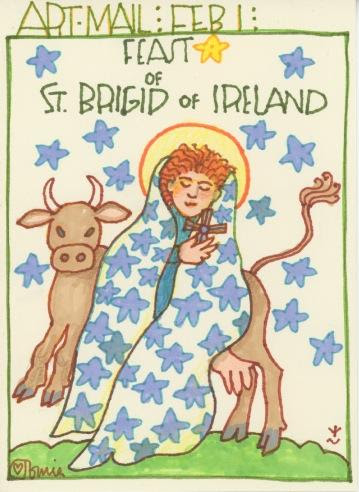
Brigid was well known for her hospitality and generosity. She would often give away her father’s possessions and all the milk or butter her white cow could produce. But Brigid’s cow, a symbol of the goddess, would give as much milk as needed, and then some. After giving all the butter she had churned to the poor, but before she could be scolded, the crock was miraculously refilled.
Her knack for creating abundance continued when she requested land for her monastery. Brigid was told she could have as much land as her mantle would cover. When she laid it on the ground, it grew in proportion to the land she needed, earning her the name Brigid of the Mantle.
Fire
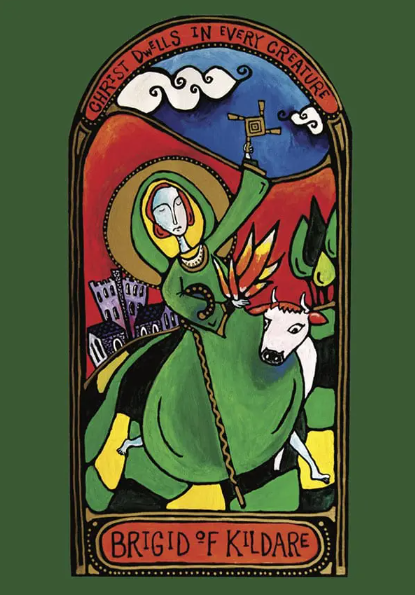
As patroness of smithcraft and blacksmiths, another symbol of Brigid is fire. In the Christian tradition, the flame is a symbol of the Holy Spirit and of transformation. When consecrated as a nun (and some say ordained a bishop) “a flame stretched from her head to the heavens.” An icon commissioned by the Parish of Kildare (image at top of page) portrays Brigid holding a bishop’s crozier and an open book with the flame of learning leaping from its pages. A perpetual flame burned in pre-Christian times as a sign of Brigid and the importance of the work of the monastery. For more than one thousand years the flame was tended to by the nuns of Kildare until it was extinguished in the 16th century during the Reformation. In 1993, the flame was reignited as a beacon of hope, justice, and peace for Ireland and our world.
Water and The Holy Wells
Thousands of holy wells, many dedicated to St. Brigid, are a pilgrimage destination in Ireland. On St. Brigid’s Day it was a tradition to visit the nearest holy well to ask for healing and fertility in the family, with livestock and crops. Those who were suffering from illness would offer rosaries, icons, letters, and more with prayers for their healing. Celts believed that the festival of Imbolc and sites like holy wells were a “thin place” where God’s presence could be deeply felt.
During an online retreat with Christine Valters Painter, The Seeds are Rumbling, she suggests that Brigid may be considered the patron of our creative life, offering generously from the wells of inspiration from which we draw, breathing new life and ideas into us, inviting us to be an artist of everyday life.
“We need to honor what is on both sides of the doorway: to celebrate the whole of our lives, the self we are leaving behind as well as the self toward which we are going.”
Rev. Amy Zucker Morgenstern, On the Threshold
Lessons from St. Brigid
The past weeks have been a pilgrimage to the Holy Well of Brigid (and I’ve fallen in head first) drawing on the wisdom of the many stories and legends. Brigid has come to me in the perfect time, my last semester of teaching high school business classes—a threshold space between working full-time and having more flexibility to work on SoulFully You projects, planning and leading retreats, writing more, and pursuing creative ventures.
Standing on the threshold is not easy—one feels here and there. Flooded with memories of the past 27 years of teaching and excited (but nervous) for the future, I still have a job to do. I have 15 weeks of classes to teach and I want to stand fully in this present moment.
Extending hospitality, as St. Benedict instructed in The Rule and modeled by St. Brigid, can be practiced towards all that is uncertain in the future, and trust that we will be transformed in the process. The threshold moment requires an acceptance of what has been, what is, and what possibilities may come. To live fully, we must dance between surrender and welcome, remaining open to possibilities, and trusting in the abundance to come.
May the power of Brigid inspire you,
The grace of Brigid attend you,
The flame of Brigid enliven you,
The story of Brigid engage you.
May the God who provides her all these gifts
Provide them also to us,
That we may go into the world
With her lavish generosity
And her creative fire.
–Jan Richardson
I look forward, in gratitude, to the alchemical process of the creative fire—how it might bring warmth to others and myself as I cross this threshold, a new season in my life. What lessons does Brigid hold for you—are you at a threshold space or needing transformation in a part of your life? Feel free to share in the comments.
More Reading:
So many sources:
Through the Year with Tomie De Paola
In the Sanctuary of Women: A Companion for Reflection and Prayer, Jan L. Richardson
Illuminating the Way, Christine Valters Paintner
The Seeds are Rumbling Retreat with Christine Valters Paintner—sponsored by Mercy of the Sea Retreat and Conference Center and Abbey of the Arts
St. Brigid Offers Healing for Today’s Divided World, U.S. Catholic


 Being Benedictine
February 6, 2024 at 11:15 am
A wonderful reflection on how St. Bridget models threshold. I think we are always experiencing threshold moments in our daily lives if we pay close enough attention. They might be narrow thresholds, but there nonetheless. And sometimes the thresholds seem very wide, like when we retire from or leave one job and are ready to walk into a vast, but uncertain future, as you are Jodi. And yet, these are such times of beauty and grace. May it be for you.
LikeLiked by 1 person
February 6, 2024 at 1:29 pm
Thank you!! Yes indeed, threshold moments are part of life. Thank God—I cannot imagine how dull life might be if we weren’t growing or being challenged in one way or another. I love the ritual involved in marking thresholds.
LikeLike
February 9, 2024 at 4:50 pm
Hi ! I’m a Benedictine and love your Web site. Please could you put a dear friend on your prayer list ? His name is Tony Yagodinski and he is handicapped and now has cancer. His family is gone, but I assured him many of us Benedictines will pray for him in their place. God bless you and many thank you s !! Alice A. Nolan Obl. S.B.
LikeLiked by 1 person
February 9, 2024 at 5:08 pm
Thank you! Prayers and positive intentions for your friend. I, also, have two friends recently diagnosed with cancer. May they have peace and healing.
LikeLike