Search

Being Benedictine

Living SoulFully as an Oblate of St. Benedict

Month

December 2025

O Antiphons: O Come, O Come, Emmanuel!

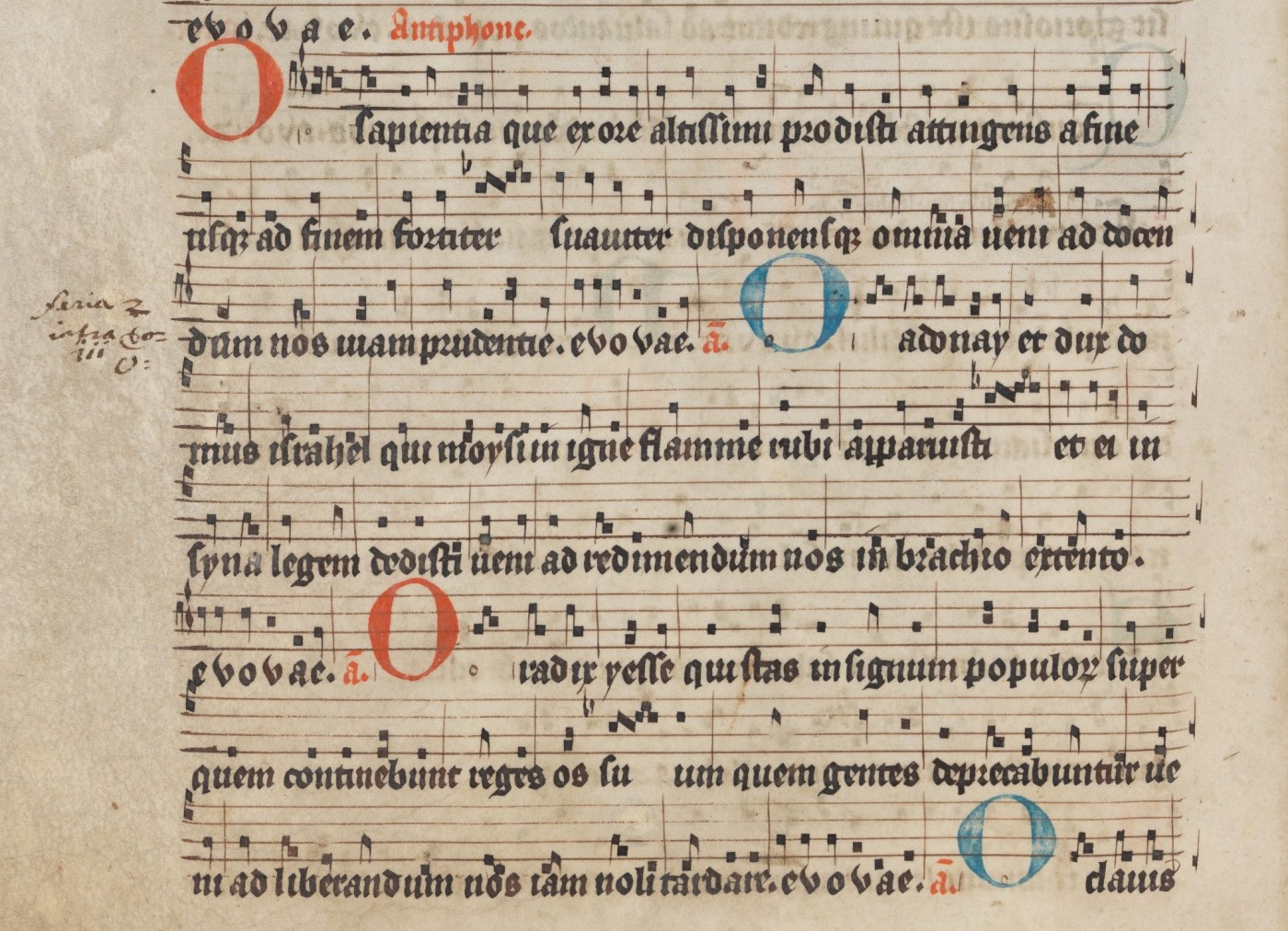
The traditional Advent hymn “O Come, O Come, Emmanuel,” which many are familiar with, is a paraphrase of the lesser-known O Antiphons written by Benedictine monks in the Middle Ages. One of the oldest liturgical rituals in the Church, the O Antiphons have been sung since at least the 8th century. These short prayers, starting with O followed by a title given to the Messiah from Old Testament prophecies, are sung before the Magnificat during Evening Prayer from December 17–23, the last seven days before Christmas. Each antiphon describes God in terms of Old Testament traits and images.

Images and symbols that appear in dreams, art, literature, or scripture carry both personal and universal meaning. Serving as a bridge between the unconscious and the conscious, images can nourish our spirit. “Images open windows through which we can see realities formerly hidden from us. Images want to infuse themselves into us and to change us from the inside out, ” writes Anselm Grün.

Images are an essential part of rituals, prayer, self-reflection, and creativity. When practicing SoulCollage®, one of my favorite spiritual practices, images can guide us to a new level of awareness and reveal a deeper understanding of thought and feeling. Perhaps this is what attracts me to the tradition of praying the O Antiphons.


“Reflecting on the words and images prepares us to let Christ himself enter into us…We are all an image, an icon, of God. It is our task to become ever more like this unique image of God.”

Anselm Grün, A Time of Fulfillment: Spiritual Reflections for Advent and Christmas

The O Antiphons use images to help us envision the Christ we long for, and to draw us into a more profound connection to the God of history. “In the O-Antiphons the art of interpreting Old Testament text as images for the coming of Jesus Christ into the world becomes apparent.” (Anselm Grün) The repeated word “Come!” expresses our deepest longing for Christ. When we accept that we are not God, we yearn for fulfillment, for all that a Messiah can bring, not just in the hereafter but in the here and now. We long for wisdom, freedom, hope, peace, belonging, light, healing, salvation, dignity, protection, love, and accompaniment. Each of these longings is addressed in the O Antiphons.

For an extensive examination of our longings and the use of images in praying the O Antiphons, I highly recommend A Time of Fulfillment by Anselm Grün, a Benedictine monk from Münsterschwarzach Abbey, the motherhouse of the monastery of which I am an oblate.

Feel free to download and share any of the images in this reflection, or follow Being Benedictine on Facebook to share daily posts. Join the monks of St. John’s Abbey for each of the O Antiphons as Benedictine monks have done for 1300 years.

St. John’s Abbey sings O Antiphons: Holy Wisdom—

December 17th – O Sapientia (O Wisdom)
December 18th – O Adonai (O Lord)
Continue reading “O Antiphons: O Come, O Come, Emmanuel!”

Naming the Darkness Within: An Advent Reflection

December 2025 Oblate Reflections

Presentation Leader: Fr. Jim Secora – Advent “He is Coming”

“The people who walked in darkness have seen a great light.” (Isaiah 9:2)

We seek the light. In total darkness, our eyes can see a single point of light up to 5 miles away. This is the lesson of Advent, shared by Fr. Jim Secora, a retired priest and Benedictine oblate. We must accept the darkness, become comfortable with it, and not run from it. We must confront the darkness in the world and from within.

We live in a generation of darkness, as many generations before us have. There is much suffering—with refugees, immigrants, those lacking good health care, those who cannot afford necessities, who are sick, or have personal suffering. Advent calls us to confront the darkness. We cannot appreciate the light around us until we do.

Gaudete Sunday, the third Sunday of Advent, is a reminder of the joy we have and of the joy to come. The light of Christ is here and is coming—both are true. Miracles happen every day when we pay attention.

The fear of uncertainty, the unknown, leads to personal darkness. Even Jesus felt it. And he faced it head-on. We must practice trusting, letting go, and sitting in discomfort. If we don’t have an opportunity to see the need for light in our lives, why do we need Christmas? Fr. Jim suggests.

In small groups, we shared our personal experiences in response to the following questions—

1. Name the experiences of darkness that you find in the world, the church, the lives of people, and if only if you are comfortable, any area of darkness that you have or are experiencing. Where or when have you experienced light piercing the darkness?

2. The people of Israel sought out John because he offered them a vision of salvation. Where in the life of the world do you see the need for a savior? Where in my life, do I need to experience a rebirth of Jesus and his gift of salvation?

3. What is the star you are following now? And where is that star in its present radiance in your life leading you?

Much of our personal darkness comes from a feeling of helplessness. We want our discomfort relieved, our problems fixed. We live in a cloud of doubt and uncertainty, where we can’t “fix it” and no one else can “fix it” for us either. We forget that often the fear of the unknown may be worse than the reality that may be to come. But this presents the question: What do we trust in?

During my greatest fear, waiting for a life-changing health diagnosis, I experienced this desperation. And the only answer, the only peace is to trust in the breath of the Divine. Taking one deep breath at a time, I was more aware of the connection to the greater Source of peace. The breath prayer is the start of a surrendering practice, a continual turning it over to God, a reminder that we cannot assume to know how things will turn out or that we know what is best. This spiritual practice is impossible without humility.

“We have made ourselves the love of our lives and found little to adore at the altar of our egos. We have made ourselves our own gods and have forgotten God in the process…Joy, the deep-down awareness of what it means to live well, to live productively, to live righteously, is made out of self-giving, simplicity, and other-centeredness…Joy is not about what happens to us, the manger indicates. It is the meaning we give to what we do that determines the nature, the quality of the lives we live.”

-Joan Chittister, The Liturgical Year

It takes humility to surrender our “me” to “we.” We need a redemption of me. The stars we can follow are trust, acceptance, joy, and peace. Practicing gratitude for the present moment, finding peace, joy, and strength in whatever situation we are in, not wishing that we were somewhere else. Our star is directly above our present moment.

More reflections on Advent.

The Light Shines in the Darkness

Holy Darkness: An Advent Meditation

You Are A Sanctuary for the Divine ~ Sprigs of Rosemary Online Advent Retreat

An Advent Call of Humility: Mary and Zechariah

Flood the World with Love: An Antidote to Darkness

© Jodi Blazek Gehr, Being Benedictine Blogger

Our Lady of Guadalupe, Our Sacred Mother

Mary, the quintessential mother, emerges in many of my collage creations. On the Feast of Our Lady of Guadalupe, December 12, I am reminded how Mother Mary appears in many forms across religions and cultures. She brings visions and messages uniquely tailored to those who receive them, like Juan Diego.

On the site of an ancient shrine to the Aztec mother goddess, on Tepeyac Hill near Mexico City, a young Nahuatl Indian named Juan Diego had a vision of a young Indian woman. Speaking in his native tongue, she directed him to take roses to the bishop and tell him to build a church on the hill. The bishop dismissed the story, but the young maiden appeared to Diego once more, identifying herself as the Mother of God. She instructed him to gather roses that grew at her feet, during the winter no less, and take them to the bishop. When Diego opened his coat, roses tumbled out and a colorful impression of Our Lady, with dark skin, was imprinted on the fabric.

“My dearest son, I am the eternal Virgin Mary, Mother of the true God, Author of Life, Creator of all and Lord of the Heavens and of the Earth.”

Our Lady of Guadalupe to St. Juan Diego on Mount Tepayac, 1531

This story has been told for five hundred years, standing as an “image of divine compassion for a demoralized people. Speaking to Juan Diego in his own language, (Mary) presented herself in terms of compassion and solidarity, not power and domination.” (Blessed Among Us, December 12, 2020) The image of Our Lady attracts millions of pilgrims each year at the basilica in Mexico City, one of the world’s most visited sacred sites.

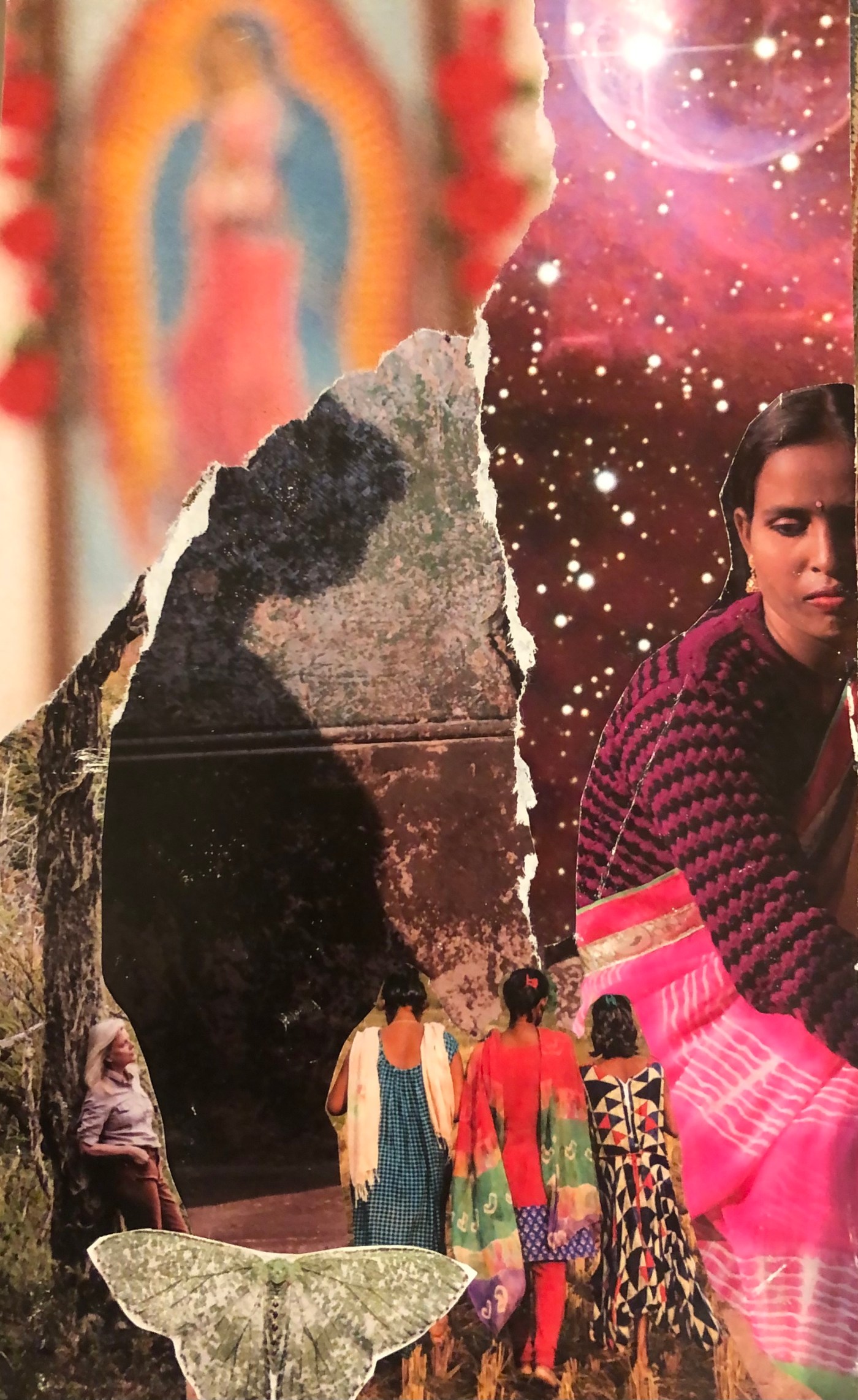
One of the Mary cards I created during a Full Moon retreat with anam caras, women friends on the spiritual journey, features Our Lady of Guadalupe and her role in the life of all women, particularly those who are marginalized and suffering. In the upper left corner is an image of Our Lady of Guadalupe, framed by roses that bloomed out of season.  Our Lady watches over us—Mother of the Universe, outside time and space. Whether you call her Tonantzin, “Sacred Mother” in Nahuatl, the language of Juan Diego, or Holy Mother, Mother Mary, the Mother of God, or the Virgin Mary, she offers a divine motherly love and protection available to all. Mary empowers women to give that same love and compassion to others.

Continue reading “Our Lady of Guadalupe, Our Sacred Mother”

Blog at WordPress.com.

Up ↑