Search

Being Benedictine

Living SoulFully as an Oblate of St. Benedict

Month

March 2026

The Day St. Benedict Died

The day St. Benedict died, he was ready. 

In the Rule of St. Benedict, he instructs, “Keep death daily before your eyes” as a way of life. At the Abbey of Montecassino, where St. Benedict wrote his Rule for monks, there is a statue in the courtyard depicting the moment of St. Benedict’s death.
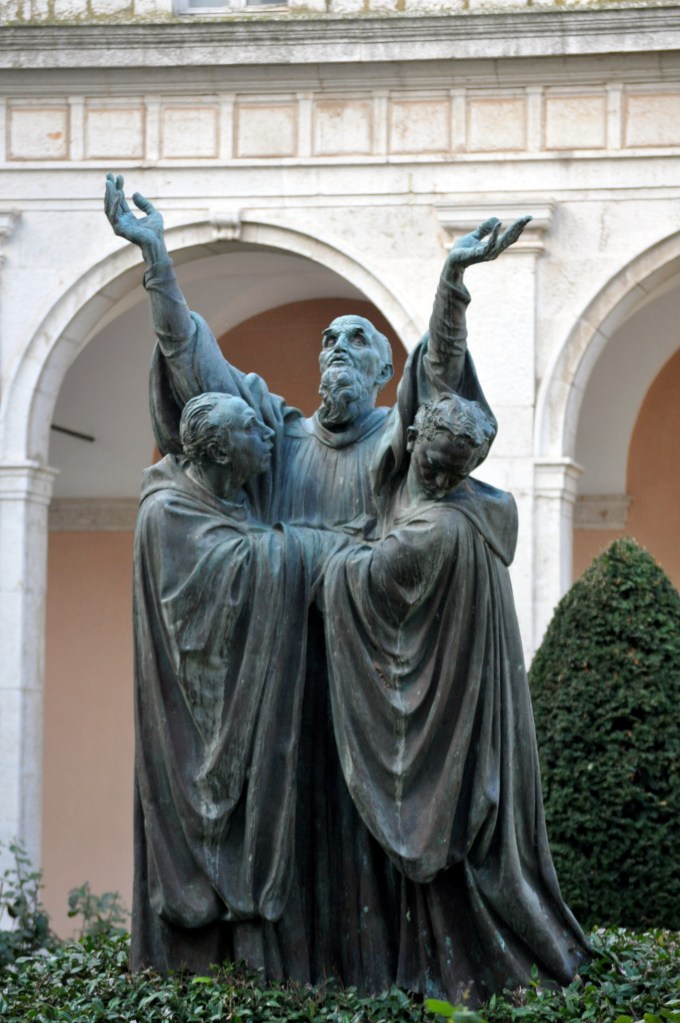
Montecassino Abbey, the statue depicts the passing of St. Benedict. Photo by Jodi Gehr, 2017.

On March 21, Benedictines around the world celebrate the “transitus,” St. Benedict’s passing from one state to the next, from death into life. Death is not seen as final, but rather a transition into eternity with God.

St. Gregory the Great writes about St. Benedict’s last days:

“Six days before he died, he gave orders for his tomb to be opened. Almost immediately, he was seized with a violent fever that rapidly wasted his remaining energy. Each day his condition grew worse until finally, on the sixth day, he had his disciples carry him into the chapel where he received the Body and Blood of our Lord to gain strength for his approaching end. Then, supporting his weakened body on the arms of his brethren, he stood with his hands raised to heaven and, as he prayed, breathed his last.” (St. Gregory the Great, Book Two of Dialogues, chapter 37).

The advice to keep death always in our minds is the core of being Benedictine and living soulfully. Perhaps this sounds morbid, but it encourages me to live each moment with wonder and gratitude, with purpose, on purpose, and to be attentive to the present moment.  Practicing gratitude, having no regrets, living with death daily before your eyes, as St. Benedict writes, and leaving something beautiful from a life well lived, help prepare us for a more peaceful transition from here to eternity. St. Benedict’s life and death are an exemplar for how we are to be Benedictine.

Continue reading “The Day St. Benedict Died”
How To Bear Discomfort Well

I do not bear discomfort well, I said, half-seriously, half-jokingly, to my son-in-law, John, the other day, as I took a little longer to get out of the car than the rest of the family. We both laughed as John noted that his wife shares this same trait at times. Like mother, like daughter.

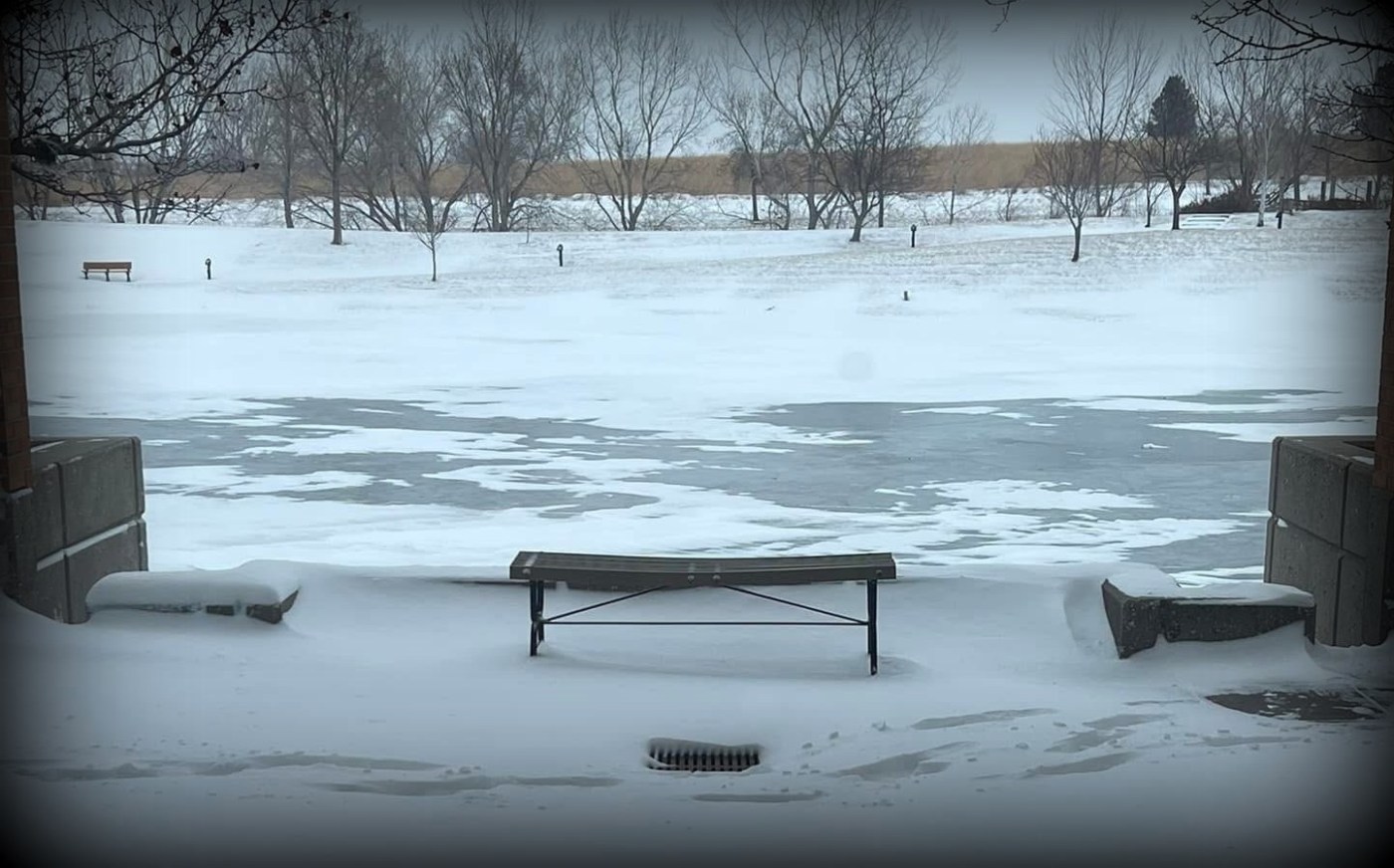
It was a cold day in Nebraska, so we had to bundle up to go out, but once we were in the car, and the heat kicked in, I broke out into a sweat. Struggling in the back seat, off comes the coat. Two minutes later, we arrived at our destination. I wrestled my coat back on to re-enter the frigid temperatures. (An aside: Nebraska weather is a burden of extremes, from hot to cold. Our low temperature today is 12 degrees; on Saturday, 89 degrees is forecasted—how is one to cope?)

To add to my discomfort, several weeks ago, I sprained the peroneal tendons in my right foot. I will spare you the details, but it is reminiscent of the broken arm I experienced three years ago. Let’s just say—it adds to my discomfort, and I repeat, I don’t bear discomfort well. I feel a little guilty (and more discomfort) about admitting this out loud to John and writing it now. There are so many people suffering throughout the world—from war, displacement, poverty, hunger, trauma, poor health, grief, and every imaginable and unimaginable discomfort.

It is a lot for each of us to bear—our own discomfort and the wounds of the world that we also carry in our thoughts, physical bodies, emotional responses, and spirits. So much discomfort, uncertainty, ambiguity, and waiting can make us irritable and impatient—and there is so much to activate our discontent these days.

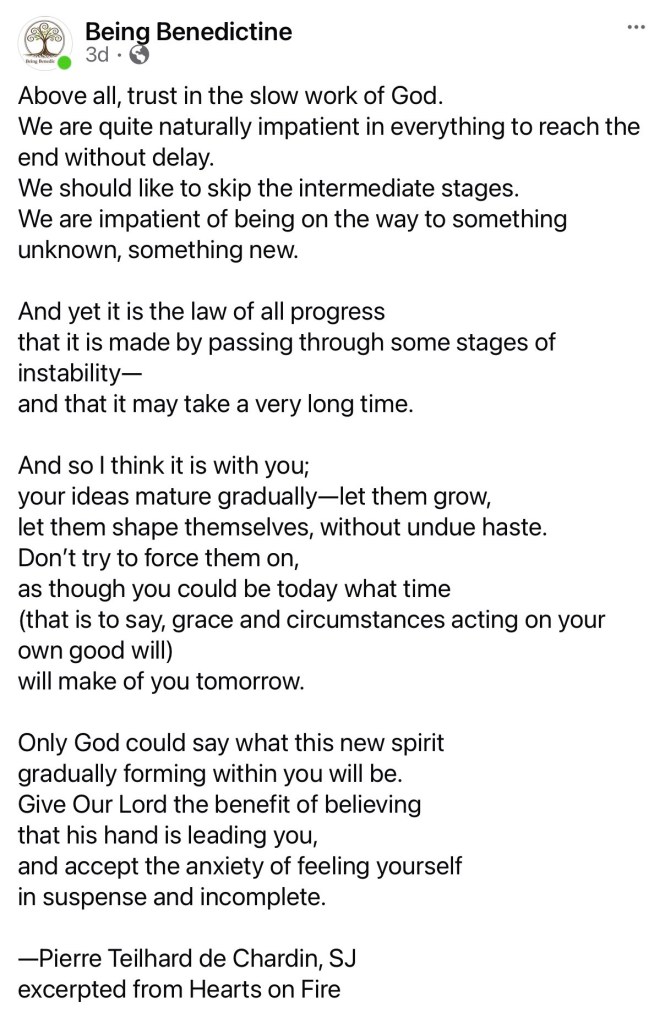
Recently, on my Being Benedictine Facebook page, I shared some wisdom from Pierre Teilhard de Chardin. Within 24 hours, the post had 130 times the average likes, comments, and views of a typical post.

This idea of waiting, and the discomfort that results, seems to resonate with many these days. It is increasingly challenging to “trust in the slow work of God,” and we need constant reminders that this is how we must cope.

Continue reading “How To Bear Discomfort Well”

International Women’s Day & A Prayer of Longing

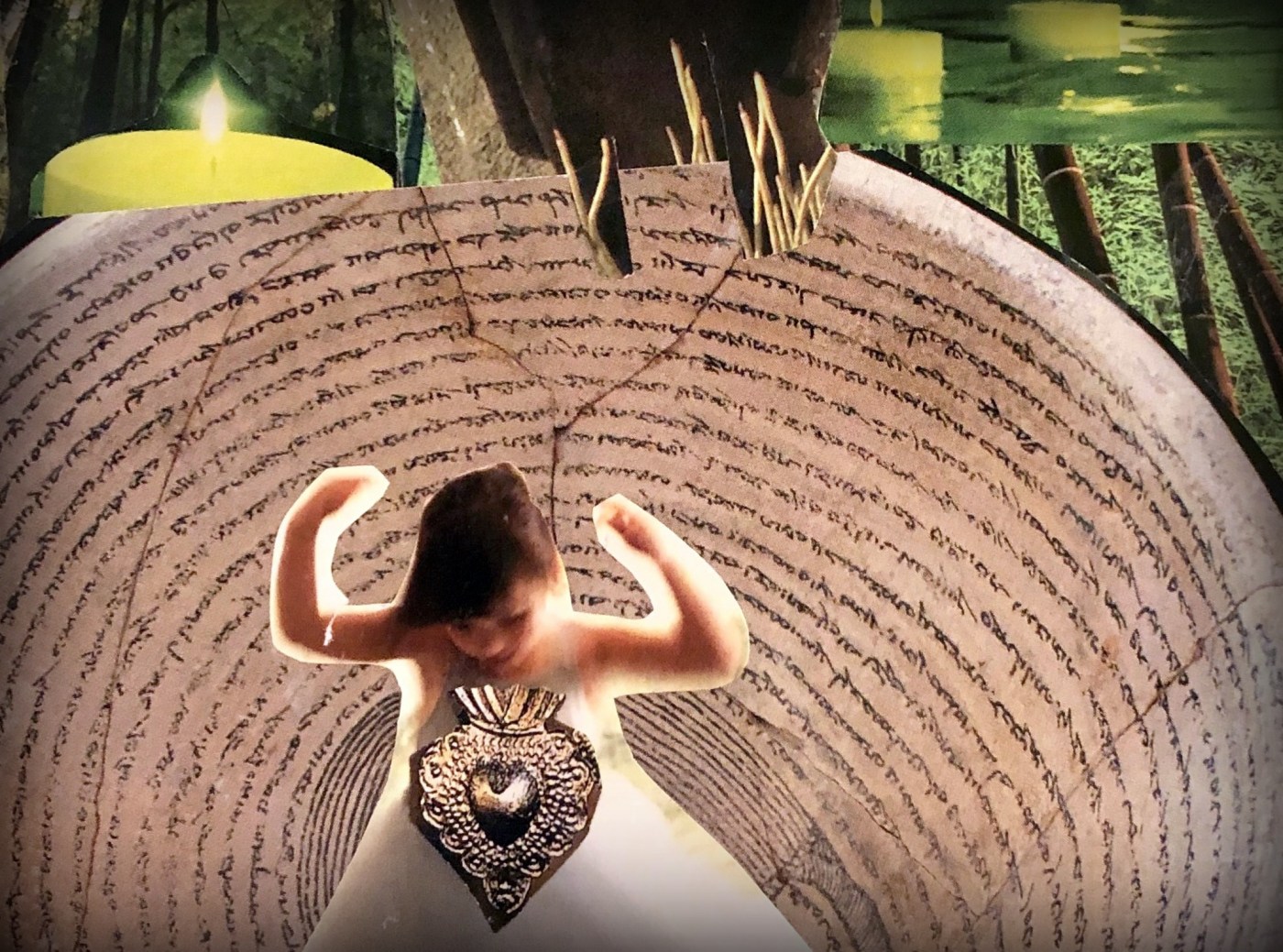
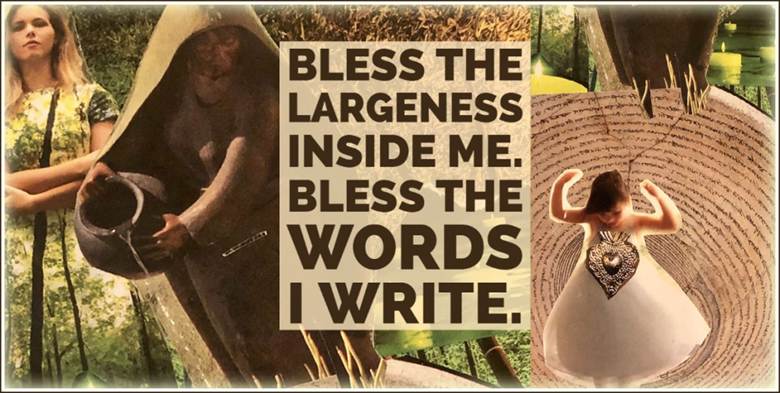
“Lord our God, hear my prayer, the prayer of my heart. Bless the largeness inside me, no matter how I fear it. Bless my reed pens and my inks. Bless the words I write. May they be beautiful in your sight. May they be visible to eyes not yet born. When I am dust, sing these words over my bones: she was a voice.” –Ana, The Book of Longings

In The Book of Longings by Sue Monk Kidd, Ana writes this prayer of longing on the incantation bowl her aunt Yaltha has gifted her. 

“Do you know what an incantation bowl is?” Yaltha asked. “In Alexandria we women pray with them. We write our most secret prayer inside them…Every day we sign the prayer. As we do, we turn the bowl in slow circles and the words wriggle to life and spin off toward heaven.”

On International Women’s Day, we celebrate the social, economic, cultural, and political achievements of women. We honor the women who have a “secret prayer inside them” to improve the quality of life for women, to raise awareness of discriminatory treatment, and to seek inclusiveness and equality for future generations.

In The Book of Longings, Sue Monk Kidd, one of my favorite writers, shared that she wanted “to write a story that encouraged us to follow our longings and bring forth the largeness inside ourselves…to portray how much women’s voices and stories matter.”

Ana’s prayer of longing is to have a voice, to be heard, and truly listened to. Ana lives during the time of Jesus when women’s stories were not valued or heard, often intentionally silenced and oppressed. Like Ana, we long for our authentic selves to be seen and heard. When we are listened to, we know that we are loved.

“All my life, longings lived inside me, rising up like nocturnes to wail and sing through the night. That my husband bent his heart to mine on our thin straw mat and listened was the kindness I most loved in him. What he heard was my life begging to be born.”-Ana, The Book of Longings

Listening is an important theme in The Book of Longings. St. Benedict thought it was so important to listen that it is the first word in the Rule. “Listen carefully, my son, to the master’s instructions, and attend to them with the ear of your heart.” John McQuiston II, in Always We Begin Again, The Benedictine Way of Living, paraphrases, “Listen with the heart and mind.” These instructions to listen to God extend to the many ways God may speak to us—through our daily circumstances, unique situations, the people in our lives, and in our hearts and minds through the voice of truth within us.

Continue reading “International Women’s Day & A Prayer of Longing”

Blog at WordPress.com.

Up ↑