Search

Being Benedictine

Living SoulFully as an Oblate of St. Benedict

Being Benedictine in the 21st Century: Spiritual Seekers in Conversation

You are invited to “Being Benedictine in the 21st Century: Spiritual Seekers in Conversation,” planned for June 26-28, 2020 at Mount St. Scholastica in Atchison, KS. This opportunity marks the first-ever gathering of professed Benedictines, Oblates, staff, volunteers, friends and benefactors of Benedictine ministries and monasteries, and any seeker who has read The Rule of St. Benedict and experienced a conversion of heart.

The Rule of St. Benedict, a text written in the sixth century for monks living in community, contains wisdom that can be applied to the questions and pressing needs of the 21st century for those seeking purpose, inclusivity and connection—Catholic and Protestant, professed monks, religious leaders, Benedictine Oblates and spiritual seekers, young and old, married and single. Many have found the Rule, relevant 1500 years later, to be a guidebook for growing a deeper relationship to God and others. Benedictine values, including listening, community and consensus building, hospitality, humility, prayer and good work, provide an antidote for troubled times. Continue reading “Being Benedictine in the 21st Century: Spiritual Seekers in Conversation”

Transitus of St. Benedict: Happy Feast Day!

Happy Feast Day of St. Benedict!

transitius

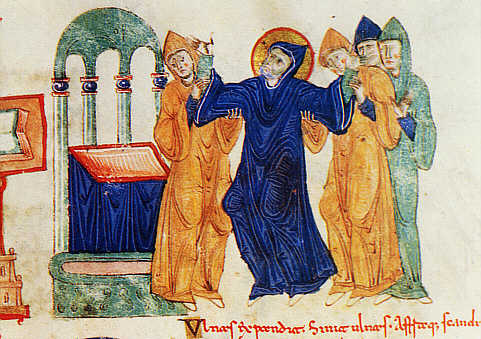
On March 21, Benedictines around the world celebrate the “transitus of St. Benedict, the day Benedict entered eternity. “Transitus” in Latin means passing from one state to the next—death is not the end of life, but the transition into eternity with God.  It is one of two days that St. Benedict is recognized on the Benedictine calendar.

Since this feast day is always during Lent, another commemoration date was set when Pope Paul VI declared St. Benedict the Patron of Europe at the rededication of the Church at Monte Cassino on July 11, 1964. July 11 is the Feast of St. Benedict for the Universal Church. Only Mary, the mother of Jesus and John the Baptist are remembered with both their birthdays and their day of entry into heaven. Continue reading “Transitus of St. Benedict: Happy Feast Day!”

I Don’t Know Nothin’

I don’t know nothin’.

Eight years ago today, my father-in-law Marv passed away—so today, more than usual, I am thinking of him and missing our kitchen table conversations. We would talk about politics and religion, the economy and education, and the best brands of Cabernet for the cheapest prices. After sharing his wisdom, attempting to solve world problems, and philosophizing over a glass of wine, Marv would throw up his hands in disbelief and exclaim, “What do I know? I don’t know nothin’.”

131207_10200564020853354_135052895_o
Marv and I enjoying some cheap Cabernet in Las Vegas.

He had thoughts, opinions and plenty of experience, but, self-admittedly, he felt he still didn’t know much. Marv said it often enough that it was the opening line in the eulogy my husband gave for his dad’s funeral. This phrase, “I don’t know nothin’” holds so much meaning, far beyond a simple or flippant segue into another subject, rather I believe he was saying “I have ideas, but I will stay open to other possibilities.”

I’m sure there was a time or two when he knew exactly how things should be, but they didn’t turn out the way he expected, as so often happens. Perhaps he meant—I surrender needing to know. Perhaps he meant—I don’t know it all. I don’t know the big picture. I don’t have all the answers. I thought I knew a lot, but now, I wonder if I know much at all. I am humbled by what I do not know. Continue reading “I Don’t Know Nothin’”

You Are Free: 2019 Word(s) of the Year

I’ve written before about choosing a “Word of the Year.” This year, I chose a phrase to serve as my spiritual mantra—three life-changing words that came as a gift of grace when I felt torn between two possibilities and needed to make a difficult decision.

For me, the process of discernment, especially when I have strong feelings or attachments, often begins with compulsive mental role-playing. I replay conversations—what was said, what was meant, what could have been said, and now what? Once I am able to slow down my thoughts, create some space, and breathe, I can face a decision more calmly and with a spiritual perspective. I write out my thoughts and feelings, ask questions of myself and God, and listen to what might be beneath the words. I write as prayer, knowing that, so often, an answer is revealed.

The decision I needed to make felt particularly heartbreaking. Feeling desperate, I reached out to a spiritual companion and asked for prayers.

Asking for prayers was admitting I needed help.
Asking for prayers was an act of vulnerability, humility, and surrender for me.
Asking for prayers helped me to be even more prayerful about my situation. I surrendered to God for the answer that my obsessive thinking would not bring.
Asking for prayers opened me for the words that came. Continue reading “You Are Free: 2019 Word(s) of the Year”

From who we are to who we might become

February 2019 Oblate Lectio Divina and Discussion

Topic: Conversion

Luke 5:27-32Jesus saw a tax collector named Levi sitting at the customs post. He said to him, “Follow me.” And leaving everything behind, he got up and followed him. Then Levi gave a great banquet for him in his house, and a large crowd of tax collectors and others were at table with them. The Pharisees and their scribes complained to his disciples, saying, “Why do you eat and drink with tax collectors and sinners?” Jesus said to them in reply, “Those who are healthy do not need a physician, but the sick do. I have not come to call the righteous to repentance but sinners.”

Jesus saw something in Levi—that he was both a tax collector and open to an invitation to follow him. Levi worked with the oppressive Roman Empire, likely judged as greedy and affluent at the expense of others, but Jesus saw his potential.

So often we see people or situations as either/or, not both/and. We see the tax collector, or a politician, or social media as either good or bad, quickly making blanket statements or judgments to categorize into one or the other. But Jesus does not see Levi as one or the other, he sees Levi, and us, as both/and—as who we are and who we might become. Continue reading “From who we are to who we might become”

In a Pair of Red Shoes

“And if God sees fit to hold me
Anyone that’s ever known me
Know I’d walk the gold streets only
In a pair of red shoes.”

My friend, Colleen, loved red shoes. But I didn’t know this about her until her Aunt Bea shared a story at her funeral.

Colleen 1
SoulCollage® card remembering Colleen.

What a silly thing to say at a funeral, but for “some reason” I told Bea that I loved the beautiful red shoes she had on. Sometimes things fly out of my mouth without any consideration to how they might sound—and today was no exception.  But, of course, there was a reason.

Aunt Bea immediately connected the shoes to Colleen.  Just a few months earlier, Colleen had borrowed those red shoes on an evening when she and her sisters were going out dancing, something they loved to do together.  Aunt Bea commented how much Colleen loved to dance; telling us that Colleen believed when you dance you have to wear high-heeled shoes.  It was a nice story of when Colleen was joyful and doing what she loved most—dancing.  There is comfort in storytelling and remembering. Continue reading “In a Pair of Red Shoes”

St. Scholastica: A Woman of Great Love

“From the little known of Scholastica, it is clear that she was a strong woman who was deeply devoted to her religious life. She is celebrated by Benedictine women’s religious communities around the world as a woman who could “do more because she loved more” (Gregory the Great). She was a witness to the truth that love bears all things, believes all things, hopes all things, endures all things. Love never fails (1 Cor. 13:7-8).”-Benedictine Sisters of Erie

In celebration of St. Scholastica’s Feast Day, February 10, I share an edited previous post about St. Scholastica, St. Benedict and the value of spiritual friendships.

I received the gift of the Holy Spirit when I was nine years old. It took many months of catechism class to prepare to receive the sacrament of Holy Confirmation in the Catholic Church. There were dozens of questions about doctrine and faith to study, like:

What is a sacrament?  A sacrament is an outward sign made by Christ to give grace.
What is grace? Grace is any gift from God.
How many persons are there in God? There are three Persons in God. Continue reading “St. Scholastica: A Woman of Great Love”

In Praise of Words and Less Words

Sometimes I just don’t know when to shut up. Words, words, and more words.

I love words—to write them and to read them. I have been considering how I use words after reading The Power of Words by Joe Kay at Living Gracefully. It ­shined a light on the word wars often waged in my head, in conversation, in writing—either on social media or my personal journaling.

In some ways, I give words too much power. I think if I keep talking I might find just the right words to communicate my point better. Maybe my words weren’t effective, or they weren’t heard the way I intended, or my words were rejected—so I try again with more words, thinking “this time” I will be understood or be able to help another understand. Maybe “this time” we will come to an agreement or reach a hoped-for reconciliation.

But words do have power, Kay writes “Martin Luther King, Jr., understood the power of words. He spoke so beautifully and prophetically about his dream of a world in which everyone is treated as an equally beloved child of God.

mlk

Words have the power to inspire us, touch us, and transform us for better or worse, depending upon which words we choose to allow inside of us. They can bring us more peace, love and justice, or they can increase our levels of division, fear and hatred. In the last few months, we’ve been reminded how easy it is to get sucked into the pool of hateful words. Continue reading “In Praise of Words and Less Words”

A Wild and Precious Life: Mary Oliver

 Mary Oliver. She must have loved life.  She deeply reflected upon it and wrote about it so eloquently. She suffered and enjoyed and made peace. And she wrote about it all. 

living in this world.jpg

She encouraged us to slow down and enjoy each moment. 

“For how many years did I wander slowly through the forest. What wonder and glory I would have missed had I ever been in a hurry!”  Leaves and Blossoms Along the Way: A Poem

She encouraged us to see the holy that is wholly visible.

“God, or the gods, are invisible, quite understandable. But holiness is visible, entirely.” Leaves and Blossoms Along the Way: A Poem Continue reading “A Wild and Precious Life: Mary Oliver”

Blog at WordPress.com.

Up ↑