
It’s been a little over a month since I’ve returned from Rome. I’ve reported on official business of the Oblate Congress in a four-part blog series on Being Benedictine. Continue reading “Rome: Packing and unpacking can be a lot of work”
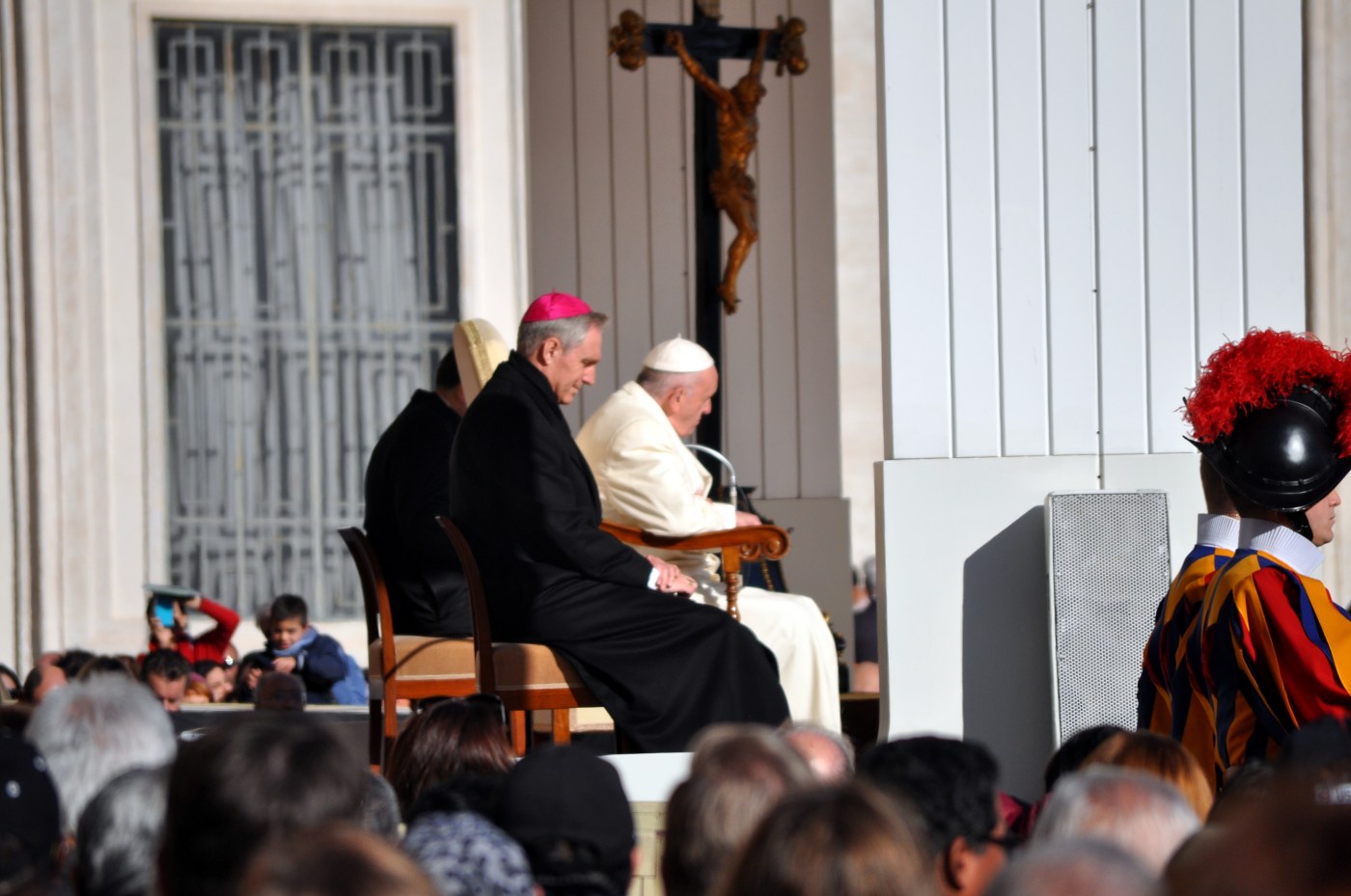
Hearing from speakers, having small group discussions, sharing meals and worshipping in daily prayers and Mass were on the agenda for 5 out of the 6 days of the conference. The exception, Wednesday, November 8, was a special day for the participants of the 4th World Congress of Benedictine Oblates.

Our morning started with attending the General Audience of Pope Francis at St. Peter’s Square. We were delighted to be seated on the platform, very near where the Holy Father was also seated. His message on the Eucharist was followed with a welcome for visiting groups with a special mention of Benedictine Oblates. For many oblates, this was one of the most magical moments of the week. Continue reading “Pilgrimage Day for the World Congress of Benedictine Oblates, Part 4”

Attending the 4th World Congress of Benedictine Oblates was an opportunity to experience a sense of community with and to learn from our oblate family around the world.

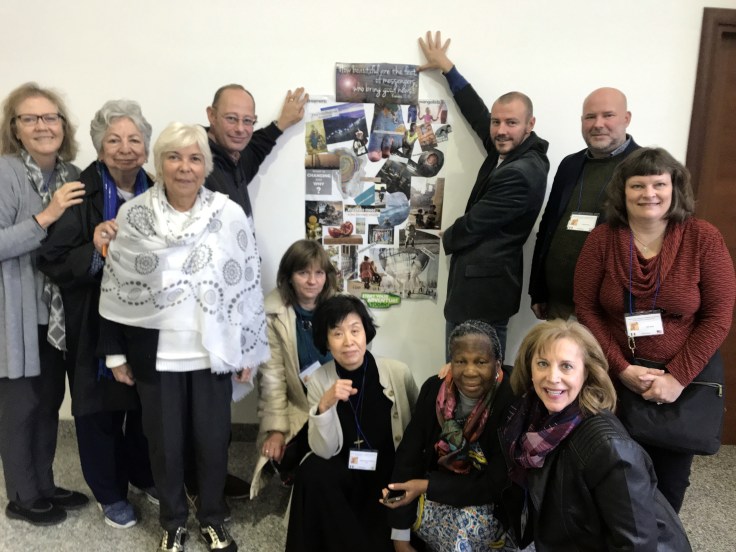
An important component of the Congress was meeting in small groups during the six-day event. We discussed the values embraced in Benedictine spirituality, addressed obstacles we face, including program formation, diminishing monasteries, and promotion of the oblate way of life, and brainstormed a vision for the future.
Our conversations touched on a number of challenging questions: What does it mean to be an oblate? As an oblate, how can I change my way of life to be a good example? What can our oblate groups do locally, regionally or internationally to ensure the future of Benedictine spirituality? What personal skills or abilities can I offer my oblate program?

The 4th World Congress of Benedictine Oblates continued with Mass celebrated by Emeritus Abbot Primate Notker Wolf, OSB. Originally from the Benedictine Archabbey of St. Ottilien, Wolf served as the ninth Abbot Primate from 2000-2016 and was the initiator of the World Oblate Congresses. He has written many books, speaks a number of languages and is a well-known musician, playing everything from classical to jazz. He graced us with a beautiful thank you gift by playing his flute at a special luncheon in his honor.


I was blessed to meet Abbot Notker at Christ the King Priory in Schuyler just a few months ago. Upon his retirement, he was gifted with a trip around the world to visit monasteries that had supported his ministries through the years. I was struck by how friendly and joy-filled he is. When we met again at the Congress, his hands were full so he said, “I cannot hug you, but I give you a kiss instead.” And he kissed my cheek. A very kind man, indeed, with a heart for oblates. Continue reading “4th World Congress of Benedictine Oblates, part 2”

Greetings from the 4th World Congress of Benedictine Oblates at Fraterna Domus in Rome, Italy!
Benedictine Oblates from every continent, 36 countries in all, have gathered in the Eternal City to consider the Congress theme: “A Way Forward—The Benedictine Community in Movement.” The conference started on Saturday, November 4 with a welcome from Fr. Edward Linton, Director of International Benedictine Formation and a monk from St. Meinrad Archabbey in Indiana. The first day we enjoy good food, Benedictine hospitality, time to connect with those we know and those we hope to know better and, of course, prayer. Continue reading “4th World Congress of Benedictine Oblates, part 1”

Confession: I feel a little guilty for taking nine days off during the school year.
Truth: But not enough that I wouldn’t seize this once-in-a-lifetime opportunity to travel to Rome.
It’s unheard of for a teacher to take off two weeks during the school year. First, we only get eleven days off for sick or vacations days per school year. Second and more importantly, it’s a lot of work to be gone, planning what students will do, securing a trusted substitute teacher to deliver curriculum, and “letting go” of controlling my classroom. (Perhaps this has something to do with being a bit of a perfectionist, control-freak, as I’m learning about Enneagram, Type One.) Usually, teachers take time off for a wedding or funeral, a child starting college, an important doctor’s appointment, but a two-week long trip? Nope. Continue reading “Rome: Confessions, Truths and Carpe Diem!”

A new blog post from Fr. Mauritius Wilde, Prior of Sant’ Anselmo in Rome, that honors both friendship, which God touches, and loneliness, which can only be filled with God. It captures the essence of the book Anam Cara, by John O’Donohue, which I treasure. He writes, “You should never belong to something that is outside yourself…(it is) important to find a balance in your belonging.” Read the rest of Fr. Mauritius’ blog HERE.
He refers to the friendship of God, who is with us from the beginning as our “secret companion”, our truest friend. Christ is our true companion, nearer to us than any other. There is a danger to become too attached to our friendships, but we must not forget the Source of all friendships, our friendship in Christ. It is too easy to forget that God is our great love, our best friend.

Lord, You Know Me
It is wonderful to have a friend who knows you well, with whom you have walked for many years. With whom you can share everything; who knows your story. With whom a conversation does not start at zero, you can just jump into it. To have a person who understands and who knows you, is a great gift of God.
However, sometimes not even a friend can reach my heart. This is an odd experience. Sometimes we are just left with ourselves, left alone. We cannot find a partner that adequately responds to our feelings, our story, our thoughts, situation or needs. But these moments that can be filled with darkness and sadness can also turn into a very precious experience. The situation breaks us open to realize that our loneliness is not an accident, but the reflection of our deepest call as human beings that goes beyond what another human being can grasp or understand. We realize that our loneliness touches the dimension of God; it is a result of the fact that we are immediate to God. This is the monk’s moment. The term monk stems from the Greek word “monachos” which means “single, solitary”.
Through God’s grace, we are able in these moments of aloneness to talk to Christ or to God and find his ear. And his response is always exactly what we need. We realize: HE understands, HE knows. His presence resonates with everything I utter and express. I feel understood, appreciated, loved. I feel liked by him as by a good friend. But even better, and in a perfect way. Nothing is missing. Read more at WildeMonk.

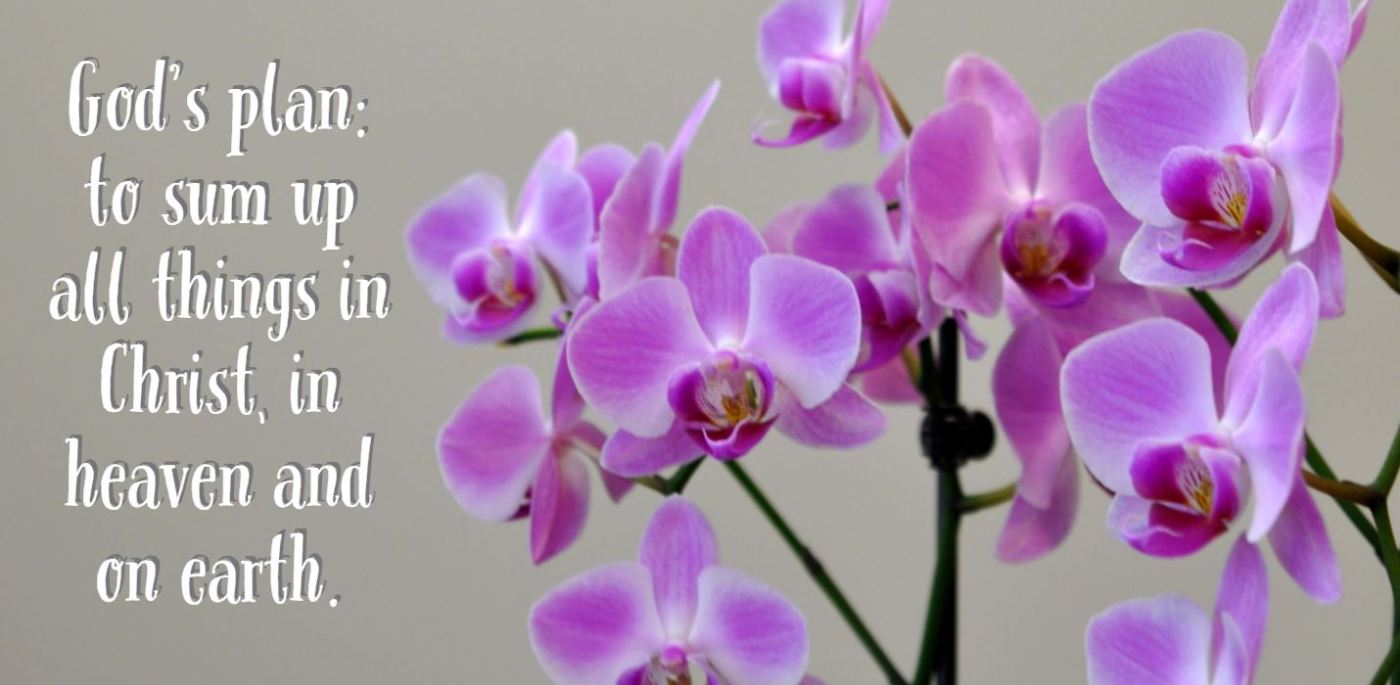
When we see problems, we want solutions. When there is chaos, we desire peace. As over-thinking humans, we think that our incessant thinking will bring us to our desired goal. And the sooner, the better. There is no time to wait around for peace, to slowly work through issues or to wait for answers to present themselves. We want peace and we want it now. But is this God’s way? Fr. Mauritius shares,
“There are some words in our prayers that I just love. Words such as “gather together”; we monks chant them regularly in a hymn. These words resonate with my longing for unity and peace. In these times when our countries and our world seem to be more torn than ever, this longing is even stronger. It moves me to strive for unity and collaboration, in our small worlds, in our communities, in our families, and in the teams in which we work. When we live and work together as one, things flow better and we are happier and more successful.
However, one time while praying the hymn, I paid closer attention. It says, that all things are gathered together in Christ. Both the original Greek and Latin have a term that comprise the word “head” (recapitulare). The gathering happens in Christ, who is the head. He does the gathering together. This immediately gave me relief. I cannot do it. He will do it. He will gather us all. But, how does he do it?” Read more at WildeMonk.

Happy Feast of St. Henry, patron saint of Benedictine Oblates!
Saint Henry II was born in 973 in the village of Hildesheim, Bavaria, German. (Note: Hildesheim is the same hometown as Fr. Mauritius Wilde, Prior of Sant’ Anselmo formerly of Christ the King Priory. They also attended the same school!) Henry served as the Duke of Bavaria (995) and as the Holy Roman Emperor (972-1024), crowned by Pope Benedict VIII. As emperor, Henry, who had considered the priesthood, was devoutly religious. He shared his faith by rebuilding the many churches that had been destroyed, building monasteries, and supporting them with both money and land.
According to the Life of Saint Benedict, as told by Saint Gregory the Great, Oblates were received by Saint Benedict in Subiaco even before the monastery at Monte Cassino was founded. A monk during the 11th century wrote:
“There are a great many of the faithful, both poor and rich, who request confraternity with us. We give unto all of them participation in whatever good is done in our monastery, be it by prayer or almsgiving. Let us make special prayer for them, both while they live and after their death.”
According to historians, many people committed themselves to God and to follow the Rule of St. Benedict by uniting themselves to famous monasteries such as Cluny, Hirschau, Saint Blase, and others. St. Henry II was one such individual. Tradition states that Henry wanted to be a Benedictine and lived as an Oblate. Once when he was suffering from a severe illness in the monastery of Monte Cassino, St. Benedict cured him by a wonderful miracle. Continue reading “St. Henry II: Patron Saint of Benedictine Oblates, July 13”


 Being Benedictine