Search

Being Benedictine

Living SoulFully as an Oblate of St. Benedict

Category

Books and Poetry

10 Reasons Benedictines Love Silence

I carefully consider everything that I write and share here, especially the more personal or contentious reflections. I rarely write and post on the same day. Not so with my speech. I find myself saying often enough, “Did I just say that out loud?” Words fly out of my mouth much faster than they flow from my pen or keyboard.

 Perhaps this is why I enjoy journaling and writing so much. It slows my mind down. In silence, I can be more deliberate, careful, and organized in what I share. A healthy respect for silence could save me some angst in times when my mouth works faster than my mind.

At our annual oblate retreat, with the theme “Building Community Through Our Oblate Promises,” the importance of silence was the topic of the opening session led by Fr. Thomas Leitner, the administrator of St. Benedict Center and a monk who lives at the monastery across the road. Throughout the weekend, we would learn about and practice silence.

Why is silence so fundamental to Benedictine spirituality?

Silence is the way to self-knowledge. A discipline of silence confronts us with ourselves. “Silence is a way for us to put up with ourselves the way we are. Not everything that comes to mind at times of silence is pleasant. Repressed needs and wishes may come up, repressed anger, and perhaps missed opportunities,” Fr. Thomas shared. Silence gives our wounds space to surface, allowing us time to wrestle with and soothe our pain in healthy ways. Silence allows us to see ourselves unfiltered without the influence of others.

In The Interior Castle, St. Teresa of Avila uses imagery of a castle for our soul, emphasizing “how necessary this room (of self-knowledge) is…we shall never completely know ourselves if we don’t strive to know God.” She writes that God dwells within us, and to know God, we must first know ourselves. Hard, but necessary, work to “know thyself,” as the ancient Greek maxim suggests.

Silence connects us to the Divine. Seventh-century bishop and theologian, St. Isaac of Syria, writes:

We enter this “treasure house,” our very soul, through the practice of prayer. Some of us may be conditioned to think of prayer as a transactional bubble-gum-machine approach to asking God for what we want. We put in a coin; God supplies the big gumball. Our prayers are “answered.” Yet this is not the kind of prayer that leads to self-knowledge or to a connection with God. Consider a poem by the 19th-century Danish theologian Søren Kierkegaard that points to a different kind of prayer.

Silence builds confidence and leads to self-respect.

“As my prayer became more and more devout and interior,” I come to know myself with greater depth. This knowing builds my confidence: I have been created just as I am, in the image of God. I forgive myself for weaknesses and celebrate my gifts. I seek less approval from others. I have “less and less” to say to justify, convince, or plead my case of worthiness to myself or others.

Teacher, writer, and friend, Parker Palmer, writes,One of our most debilitating illusions (is) that the answer to our problems is always ‘out there’ somewhere, never ‘in here.’ It’s an illusion that’s constantly reinforced by educational and religious institutions that make us dependent on “experts” and “authorities.” We need not look for knowledge in others; we can trust our own interiority, the Divine Expert Within. I can grow in self-respect, knowing God is within me, intimately speaking to me when I am silent long enough.

Continue reading “10 Reasons Benedictines Love Silence”
My Story of The Okoboji Writers’ Retreat

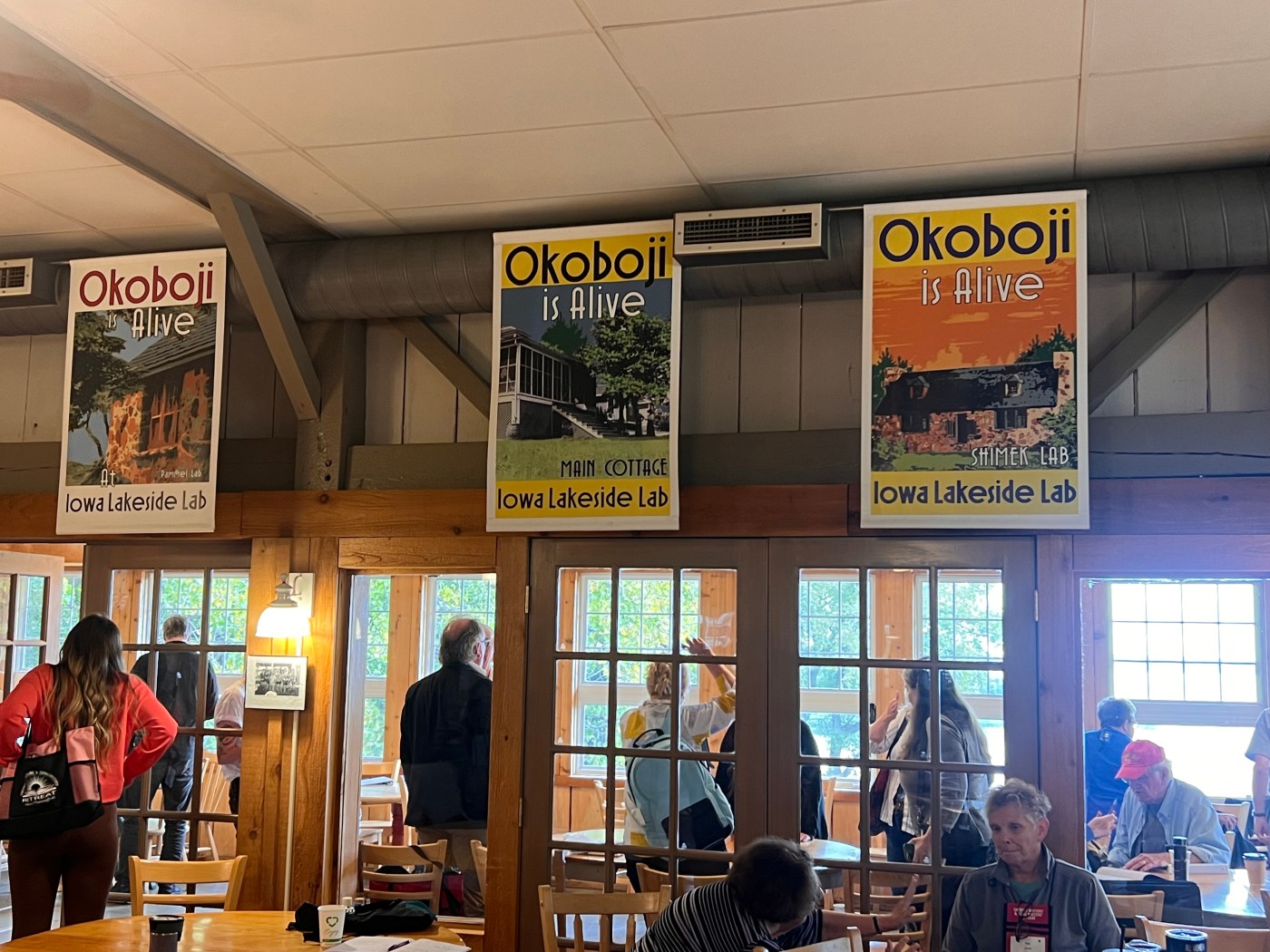
Growing up in Nebraska, I was always a little jealous of the families who vacationed every summer at Lake Okoboji. It seemed like something people of means and importance did—going to the same place each year because it was so fantastic and familiar, renewing connections made the year before.

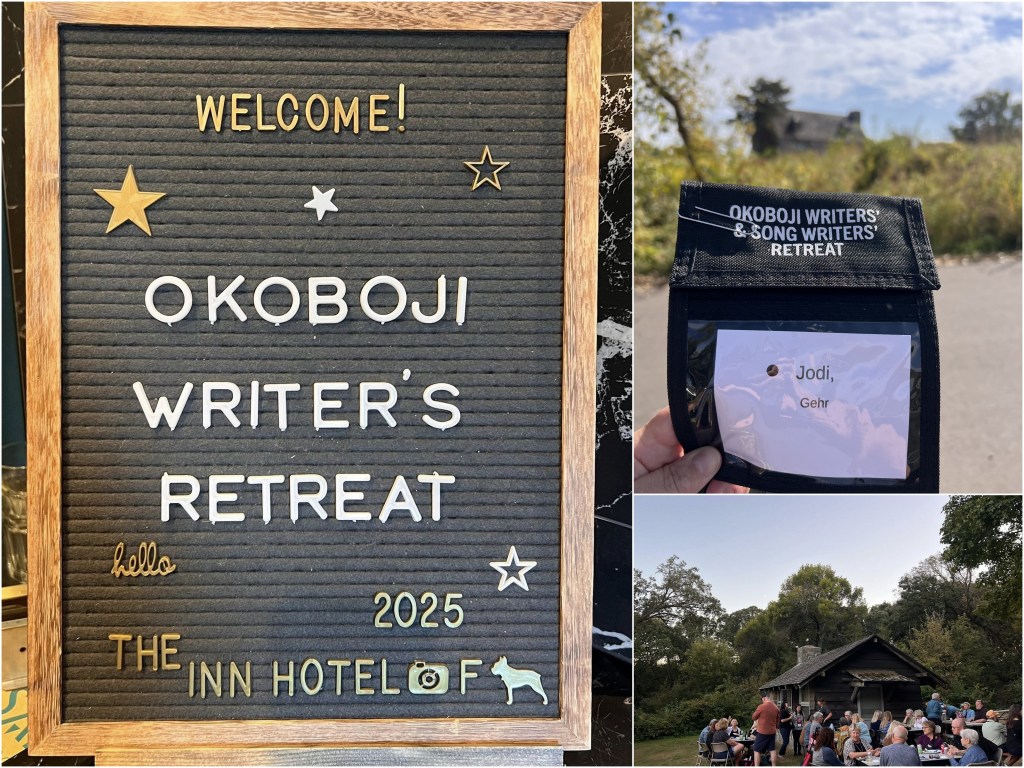
I was certainly impressed by the stories I heard. And it was storytelling that took me to Lake Okoboji for the first time in my 59-year-old life for the Okoboji Writers’ and Songwriters’ Retreat.

With countless ideas for creative writing projects, I took my grown-up self, with memories of keeping childhood diaries, attending high school journalism camp, and writing for the Daily Nebraskan in college, to explore the dream of writing a book. In my adult years, I have filled hundreds of journal pages, written nineteen chapters for a potential book, and shared 269 blog post reflections at Being Benedictine. I am SO excited about what I learned at the Okoboji Writer’s Retreat, which will help guide me in my next steps. I will be long impacted by the creativity, gratitude, humor, music, enthusiasm, political discussions, inspiration, spontaneous mentoring, and connections formed at OWR.

Some deep-in-my-soul takeaways:

Continue reading “My Story of The Okoboji Writers’ Retreat”

Ooh, I Wonder

Ooh, I wonder
What is to come, out of this darkness
I’ve been moving moving moving moving through the darkness…
I wonder when the light is cracking open..

(Wonder by S. Nutting/ K. Longaker)

The first verse to the song Wonder by Ma’Muse poses questions about the “dark night of the soul” that most of us experience at some point in our lives. Whether it is melancholy, depression, fear, or grief that grips us, we wonder: When is this going to end? What is going to come out of this darkness? What comes next? When will we see relief from our suffering? When will there be more light than dark?

The song continues.

I thought this candle had long gone out…
But today today today today I can see
There’s still a flickering flickering

Today I saw a flickering, just a little light cracking open, after some weeks of darkness.

I had just finished reading a new poem from Ana Lisa de Jong, when Wonder came up in my Spotify playlist. The poem, Ceaseless Wonders, offers insights into when light may come.

CEASELESS WONDERS
Wonders never cease,
while we are sleeping
or awake in rumination
wonders are not ceasing
Wonders will not cease
until wonders are not needed,
meanwhile wonders are the signpost
to the Wonderful.
Wonders in the breath,
which has exhaled us into being,
and wonder in the
breath that keeps us living.
Wonder in the breath
of the fresh new morning,
the birds who sing of the
restoration of creation.
Wonders will not cease
while time keeps unfolding.
Time left ahead
assures us of wonder’s returning.
And wonders never cease
as darkness precedes the morning,
the morning star
points us to light’s dawning,
and the rounding sun,
which hardly falters in its momentum,
though wonders seem far flung
and courage is ebbing.

-Ana Lisa de Jong, Living Tree Poetry, February 2025

The synchronistic moment of the song and poem coming together was itself, a glimpse of light, my 2025 word of the year. Experiencing synchronicity is a holy surprise, an inkling of something more, a nudge to pay attention, to look and listen deeply. Perhaps this is a glimpse, a reminder, that darkness will pass with time because darkness always precedes the morning. Wonders will not cease/while time keeps unfolding. Time left ahead/assures us of wonder’s returning.

During this time of darkness, wonders never cease, are not ceasing, will not cease. The wonder is our breath. We can use our breath as prayer—the literal inhale and exhale, that takes us from one moment to the next, from this day to the next, from night into morning. We continue to

Burn burn burn burn on the inside
Burn burn burn burning like a bright light
Burn burn burn burn on the inside
This light’s still burning, burning bright
I thought this candle had long gone out…
but today i can see, there’s more than a flickering

Our longing for hope, peace, and light becomes the prayer. And in times of darkness, our purpose is not to question our lack of courage or hope, but instead to bring wonder as fuel to burn like a bright light, to keep the flame alive. Yes, I wonder and I wonder.

Atoms of Delight: A Pilgrimage to Iona

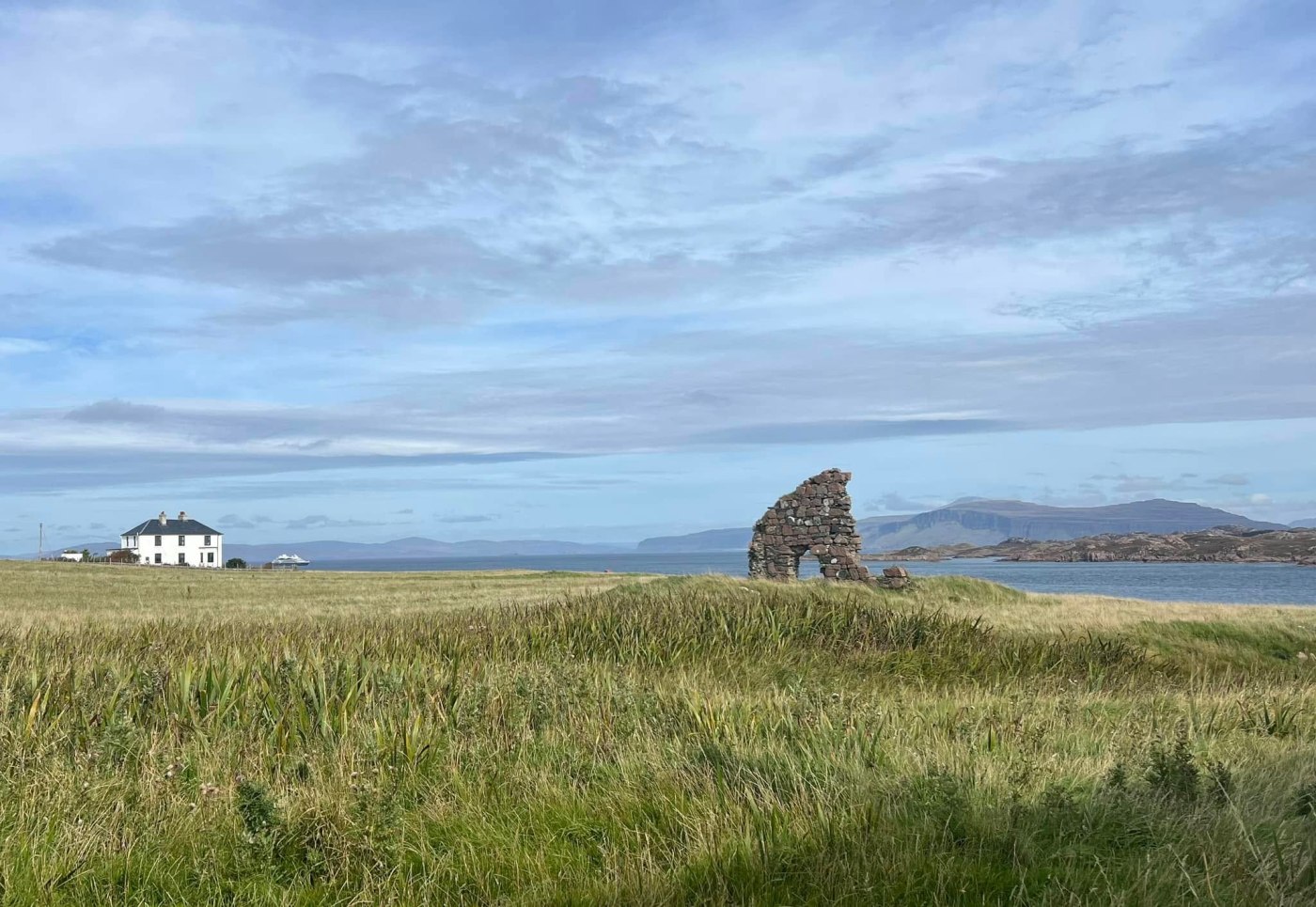
It was truly a dream to visit the sacred sites of Iona on a Celtic spirituality pilgrimage to Ireland and Scotland. Getting to Iona is a pilgrimage in itself, yet the journey has been made countless times since the 7th century. Most tourists visit for only a day, like we did, traveling from the coastal town of Oban, Scotland to Craignure on the Isle of Mull, then taking an hour-long bus ride on winding, narrow roads to the other side of the island arriving at the village of Fionnphort. From there, a foot ferry delivers you to the island of Iona. The day’s last ferry departs around 4:30 in the afternoon for the two-and-a-half-hour trip back to Oban. If the ferry is missed at the end of the day, staying overnight on the island is your only option.

Both the ferry and bus ride provided tremendous views. Our bus needed to occasionally pull over to the side of the narrow roads when meeting other vehicles.

Iona is the birthplace of Christianity in Scotland where St. Columba established an Abbey in 563. It might seem like a lot to get to this holy isle, only three miles long and one and a half miles wide, but walking the ground where St. Columba did 1500 years ago, where Benedictines established a monastery in 1204, the place where artists, sculptors, and writers have been inspired for centuries, is a holy, singular experience.

While I longed for more time to wander the beaches and secret coves, the time allowed for visits only to the most well-known sites closest to the ferry landing. Still, our pilgrimage group was able to participate in a meaningful community prayer for peace and reconciliation at the Abbey and visit the Nunnery ruins, St. Oran’s chapel, museums, gardens, and quaint shops including a bookstore, a “must-see” destination on my mini-pilgrimage to Iona.

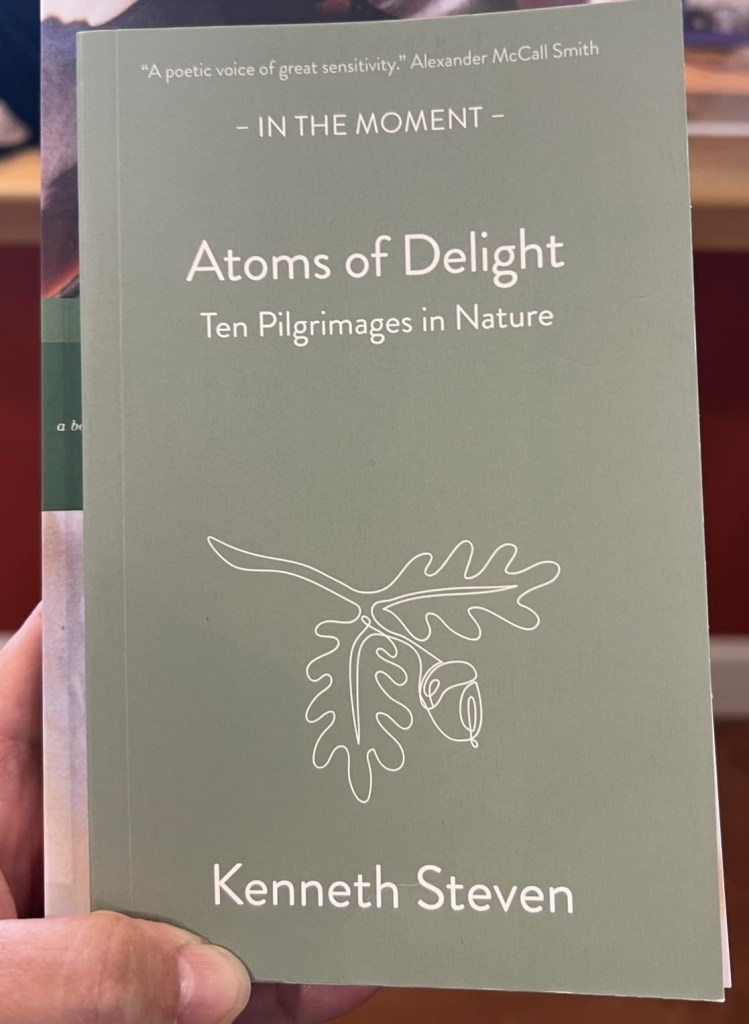
Months earlier, when I was planning the sites to visit in Ireland, a Benedictine Oblate friend, poet and photographer, Pat Leyko Connelly, reached out about some of her favorite experiences from her trips to Ireland. Pat and I connected through our shared love of Benedictine and Celtic spirituality, and she was generous in sharing tips about places to see in Ireland. When she learned I would also visit Oban and Iona in Scotland, she exclaimed that I must meet with her poet friend Kenneth Steven. Pat could not say enough wonderful things about his poetry. She also hoped I could bring back his newest book “Atoms of Delight” from the bookstore on Iona for her. Kenneth and I exchanged several messages and hoped to connect when I was there (unfortunately, our schedules didn’t allow it, but hopefully there is a next time!)

Visiting a bookstore is one of my favorite things to do, and I was just as excited about browsing book titles on this holy ground as praying in the abbey. The little bookstore was at the end of the walking trail, Sràid nam Marbh (‘Street of the Dead’,) where pilgrims have been walking for centuries. I quickly found THE book, took a photo of it to send to Pat, found another book by John Philip Newell for my friend Ellen, packed both of them away for my journey back to Oban, and later loaded them with all the souvenirs and other books I had purchased for the journey back home.

Continue reading “Atoms of Delight: A Pilgrimage to Iona”

Blog at WordPress.com.

Up ↑