Search

Being Benedictine

Living SoulFully as an Oblate of St. Benedict

Category

Saints

Ireland: I Had to Go Back

Vacation planning is a lot like lesson planning in the classroom and preparing for SoulFully You retreats and workshops I lead. I always over-plan. When my friend Sara invited me to go on a Celtic Christianity pilgrimage, I dove headfirst into researching all the possible places we could spend four days before the pilgrimage began. I found enough possibilities for a four-week vacation!

Visiting the monastic ruins of Glendalough, the holy wells of St. Brigid, and the High Crosses of Monasterboice, to name a few sacred sites on the pilgrimage, was all I had hoped for. But I hadn’t expected to be so enamored by the diversity and beauty of Ireland’s landscape, its rich culture and history, and the hospitality of locals and tourists.
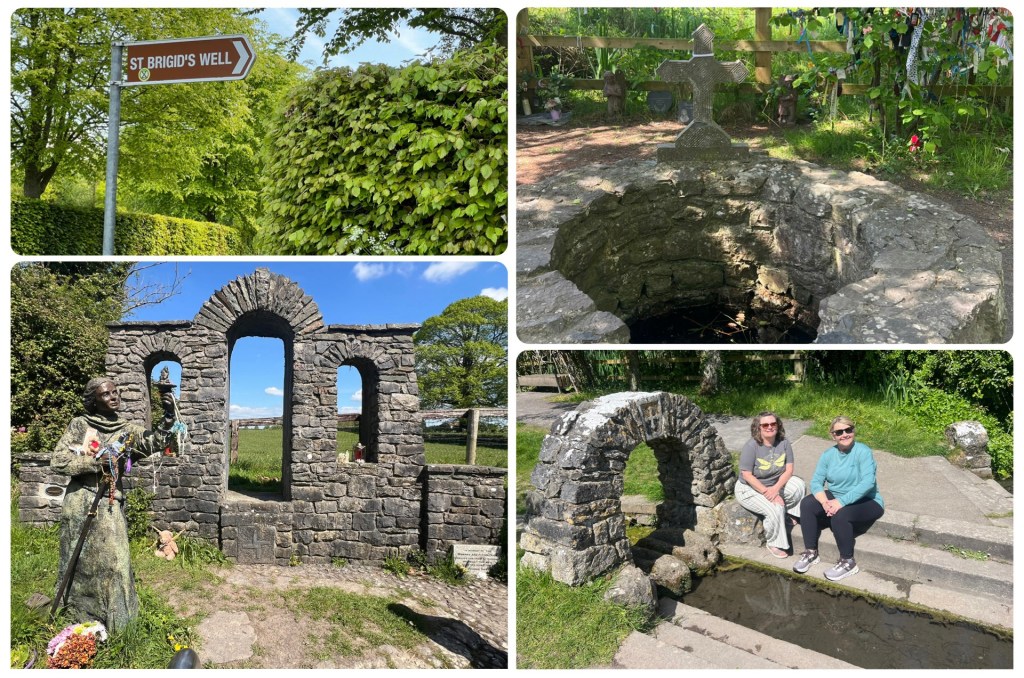
St. Brigid’s Holy Well in Kildare. I visited in Fall 2024 and again with Joe, Dave, and Kris (pictured with me.)

So often, I found myself saying, “Joe would love this.”  I knew I needed to come back with my husband, that he would enjoy the Irish pubs, beautiful scenery, and visiting with locals. And, of course, I was thinking about all the places I had learned about that I still wanted to see.

And so it happened, I asked my husband whether he would like to go in May or September the following year. (See how I did that?) We decided on May, the best time to see wildflowers blooming in the Burren. I pulled up my research spreadsheet and got to work planning a two-week vacation. Again, over planning is my gift, so we decided on a few days shy of three weeks. Our friends, Dave and Kristine, who we met when our daughters were five years old (that’s 26 years ago!) would join us for most of the trip, and to my delight they let me plan the itinerary!

When deciding where to go, I knew I had to return to Solas Bhride in Kildare, the “thin place” where one of our pilgrims, Mike, had a medical emergency and passed away. The Sisters of Solas Bhride Centre & Hermitages had been so compassionate and hospitable, offering a gathering place for prayer and reflection, serving tea and cookies, and welcoming us to experience the presence of Brigid throughout the center, in its garden, labyrinth, and sacred art.

I enjoyed visiting with Sr. Rita Minehan and when I purchased her book Rekindling the Flame: A Pilgrimage in the Footsteps of Brigid of Kildare, she eagerly signed it. I learned even more about the sacred sites of St. Brigid nearby, including the Cathedral, the parish church, a holy well, and the village itself.

With the help of Sr. Rita’s book, we planned a pilgrimage day to Kildare, returning to Solas Bhride, where Mike crossed life’s greatest threshold, from the here to the hereafter. Sr. Rita welcomed my husband and me, sharing local art and memorabilia from “St. Brigid: A Woman, A Life, A Legacy,” a celebration of the 1500th anniversary of the death of St. Brigid, and the first year that the Feast of St. Brigid was declared a national holiday in Ireland. More about St. Brigid here.

Continue reading “Ireland: I Had to Go Back”
Feast of St. Brigid and Holy Wells

A Celtic saint and pre-Christian goddess, Brigid was a 5th-century abbess and founder of monasteries. One of Ireland’s three patron saints along with St. Patrick and St. Columba, St. Brigid is known by many names —Bhride, Bride, Brighid, Brigid, Bridget—and many titles including Muire na nGael (Mary of the Irish) Brigid of the Mantle, Brigid of the Fire, and Mary of the Gael.

February 1, St. Brigid’s death anniversary, is the same day as the Celtic Feast of Imbolc. Imbolc, a celebration of the Celtic sun goddess Brigid is the halfway point between the Winter Solstice and Spring Equinox in the Northern Hemisphere. Imbolc, which means “in the belly”, celebrates the change of seasons, a threshold time of welcoming more sunlight in the day.

It is not by chance that these two celebrations are on the same day. St. Brigid has been described as a bridge between the pre-Christian and Christian traditions. The stories we hold of St. Brigid blend archetype, legend, and history, an amalgamation of the threshold time when Celtic traditions were being adapted and/or replaced by Christianity.

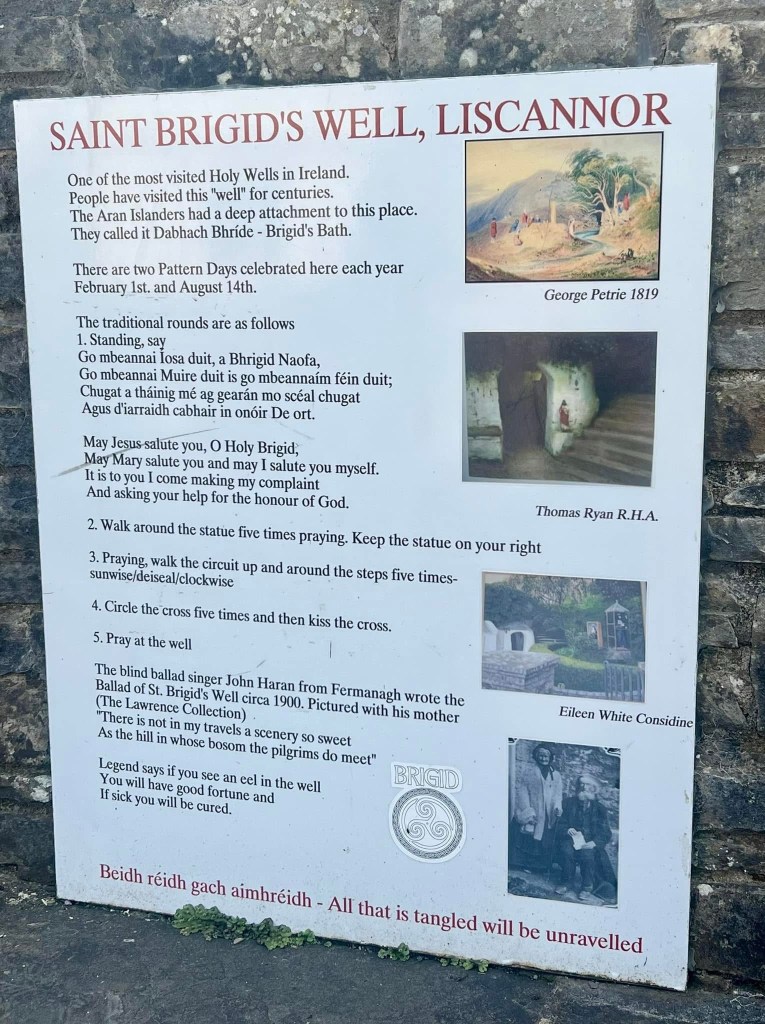
Thousands of holy wells, many dedicated to St. Brigid, are a pilgrimage destination in Ireland. On St. Brigid’s Day, it was a tradition to visit the nearest holy well to ask for healing and fertility in the family, with livestock and crops. Those suffering from illness would offer rosaries, icons, letters, and more with prayers for their healing. Celts believed that the festival of Imbolc and sites like holy wells were a “thin place” where God’s presence could be deeply felt.

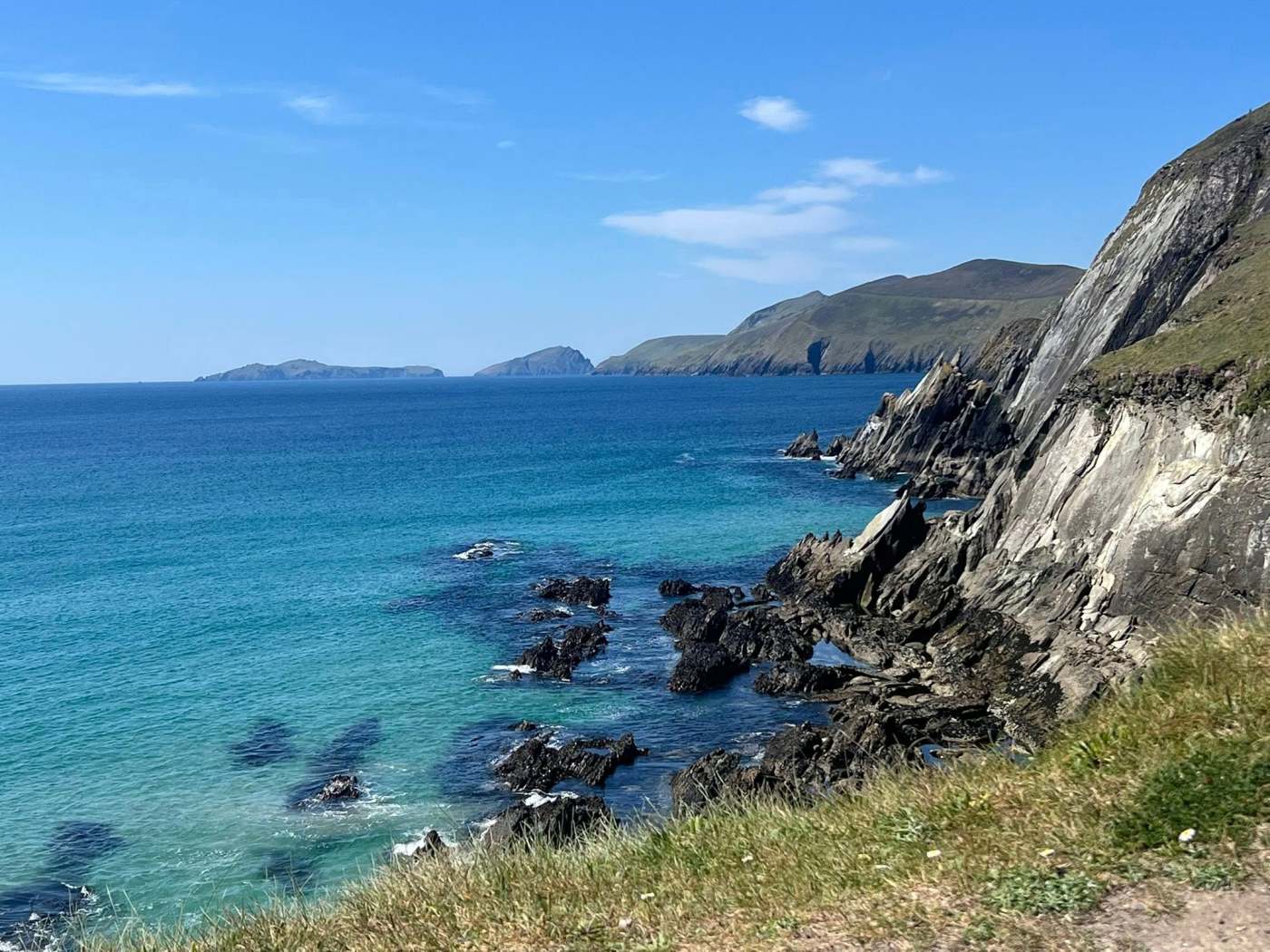
A highlight of a 2024 pilgrimage to Ireland included visiting two holy wells dedicated to St. Brigid. Near the Cliffs of Moher, in Liscannor, we visited one of the oldest of the 3000 holy wells in Ireland, one of the few still flowing with water, known for its healing powers. Hiking near the Cliffs with the Atlantic Ocean to the west, and cows and sheep grazing to the east, would have been what Brigid and the many pilgrims have experienced over the past 1500 years.

Continue reading “Feast of St. Brigid and Holy Wells”

All Saints of the Order of Saint Benedict, Feast Day: November 13

Happy Feast of All Saints of the Order of St. Benedict!

The number of Benedictine saints, including Sts. Benedict, Scholastica, Hildegard, and Henry, is large: “At the beginning of the fourteenth century the order is estimated to have comprised the enormous number of 37,000 monasteries giving the Church no less than 24 popes, 200 cardinals, 7,000 archbishops, 15,000 bishops, and over 1,500 canonized saints.” (Catholic Encyclopedia) Seven more centuries have only added to this sanctified group. You can find them listed here, from Abbo to Zosimus, all gathered under one faith and one Rule.

Benedict Gaughan (Being Part of the Benedictine Family, The Oblate Life) gathered feedback from their Oblate family about what it means to be a part of their community. Christine Michael shared, “Being part of the Benedictine family means that I can benefit from the tried and tested wisdom of Benedictines over the countless generations. The Benedictine ethos transcends all boundaries of tradition; a Benedictine is a Benedictine whether Anglican or Catholic, and from whatever part of the world.”

This sentiment resonates with words from our new Abbot Primate of the Benedictine Confederation, Jeremias Schröder OSB, of St. Ottilien Archabbey, who wrote, “Uniformity is not the goal of the Benedictine way. In a world that often seeks to simplify and streamline differences, the Benedictine tradition reminds us that true community is not about making everyone the same, but rather about embracing each person’s unique journey in faith.” He continues,

Benedictine life celebrates the beauty of individuality within the context of unity in Christ. Just as St. Benedict envisioned, our calling is to live together in love and respect, cherishing the distinct gifts God has given each of us. May we all strive to build communities rooted not in conformity, but in a shared commitment to love, faith, and mutual support.”

This is what I love about Being Benedictine. I don’t have to fit my faith in a box, I am part of the Benedictine circle where all are invited to learn, grow, and love.

We are all called to be saints, to grow in holiness, and to become closer to God by loving our neighbor.and self. Pope Francis in his 2013 Angelus wrote, “The Saints are not supermen, nor were they born perfect. They are like us, like each one of us. They are people who, before reaching the glory of heaven, lived normal lives with joys and sorrows, struggles and hopes. What changed their lives? When they recognized God’s love, they followed it with all their heart without reserve or hypocrisy. They spent their lives serving others, they endured suffering and adversity without hatred and responded to evil with good, spreading joy and peace. This is the life of a Saint.”

A tree gives glory to God by being a tree.

-Thomas Merton

Being SoulFully You is discovering and becoming all that God has created you to be. Thomas Merton writes, “For me to be a saint means to be myself.” The call to be holy is the call to be more fully myself, just as a tree gives glory to God by being a tree. It is sacred work to ponder what the saints have offered as role models on our journey to becoming more holy.

Photo: The doorway to St. Hildegard of Bingen Abbey church in Rudesheim, Germany. More here.

© Jodi Blazek Gehr, Being Benedictine Blogger

The Two Teresas and a Message of Peace

May today there be peace within. May you trust God that you are exactly where you are meant to be. May you not forget the infinite possibilities that are born of faith. May you use those gifts that you have received, and pass on the love that has been given to you. May you be content knowing you are a child of God. Let this presence settle into your bones, and allow your soul the freedom to sing, dance, praise and love. It is there for each and every one of us.Saint Terese of Lisieux

During a season of uncertainty and anxiety, I typed out the prayer above, laminated it, taped it to my desk at school, and posted it in the bathroom I got ready in every day. While waiting for additional tests after receiving a cancer diagnosis, this prayer brought peace that excessive research and reason could not. What soothed my soul was a daily routine of silent meditation and praying the words written by Saint Thérèse of Lisieux (1873-1897), also known as the “Little Flower” whose Feast Day we observe on October 1. As with Lectio Divina, one word or phrase might speak to me differently, and I could carry it throughout the day. This practice helped me keep my sanity when literally nothing else helped.

Twelve years have passed since I was diagnosed with chronic lymphocytic leukemia (CLL). Thankfully, medical treatment has not been required, and if I continue to be symptom-free, I only need to visit my oncologist every six months. As healthy months turn into years, I think about my diagnosis less. There are periods when I even forget that I have CLL, but the diagnosis changed my life forever. I am deeply intentional about living Soulfully; living with purpose, on purpose; being attentive to the present moment; practicing gratitude; making good choices and having no regrets; keeping “death daily before your eyes,” as St. Benedict writes; and leaving something beautiful from a life well-lived. But somewhere along the way, I stopped reading this prayer every day.

Set The World On Fire by Vinita Hampton Wright; translation of prayer by Carmen Acevedo Butcher. Original:
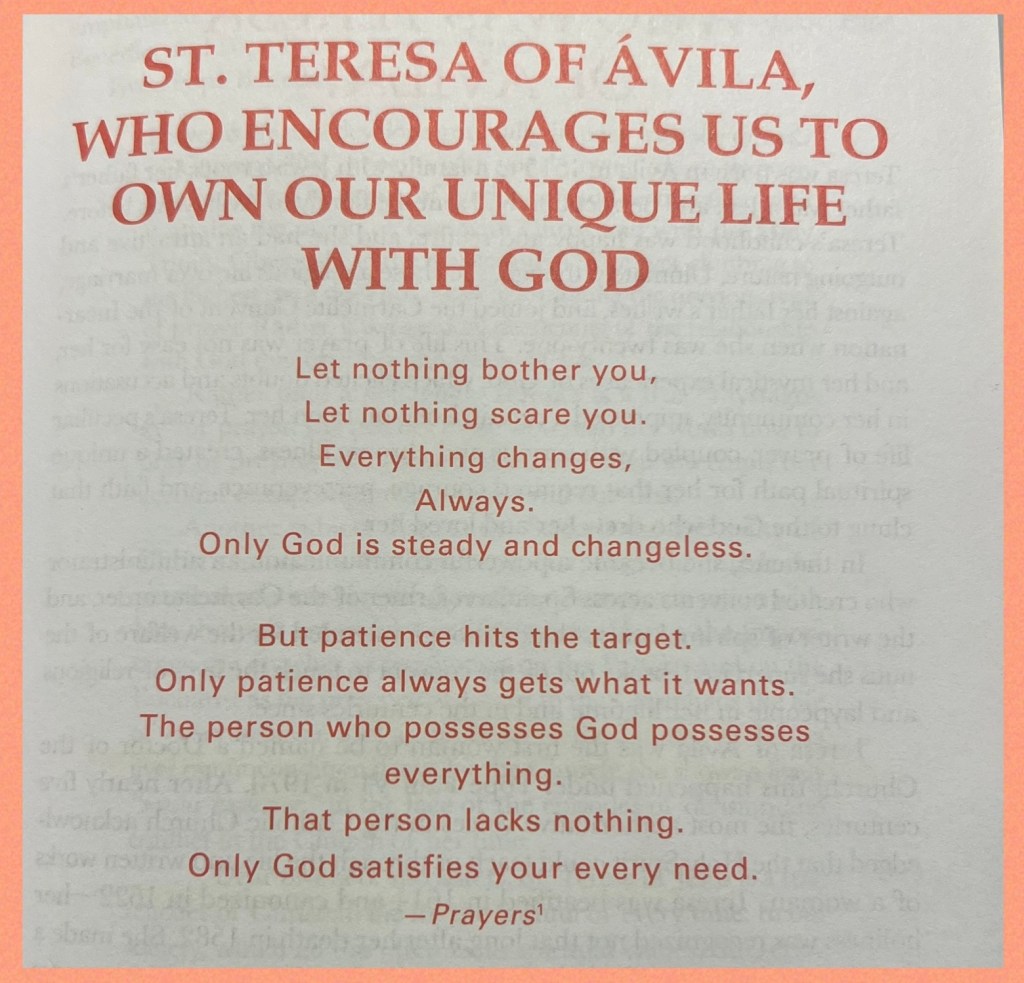
Let nothing disturb you, 
Let nothing frighten you, 
All things are passing away: 
God never changes. 
Patience obtains all things
Whoever has God lacks nothing; 
God alone suffices.

 
— St. Teresa of Avila

Continue reading “The Two Teresas and a Message of Peace”

St. Brigid of Kildare: Standing on the Threshold

What do a threshold, a cow, fire, and water have in common? 

St. Brigid of Kildare! 

Recently I was introduced to St. Brigid while preparing for a Celtic Christianity pilgrimage and she could not have arrived at a more apt time for me. Admittedly, I’ve fallen down the rabbit hole (or holy well?) of the legends and stories of St. Brigid, a 5th-century abbess and founder of monasteries. St. Brigid is known by many names —Bhride, Bride, Brighid, Brigid, Bridget—and many titles including Muire na nGael (Mary of the Irish) Brigid of the Mantle, Brigid of the Fire, and Mary of the Gael. Brigid is recognized as the patron of midwives including new beginnings, birth, thresholds, and transformation. She has also been linked to fire, blacksmiths, wells, healing waters, springs, and poets. This year, 2024, is the 1500th anniversary of the death of St. Brigid with many celebrations and for the first year has been declared a national holiday in Ireland.

The Threshold

Legend holds that Brigid was born in the doorway of a barn at dawn, at the threshold between light and dark, inside and outside, winter and spring. She is celebrated on February 1, the anniversary of her death, and the same day as the Celtic Feast of Imbolc. Imbolc, a celebration of the Celtic sun goddess Brigid is the halfway point between the Winter Solstice and Spring Equinox in the Northern Hemisphere. Imbolc, which literally means “in the belly”, celebrates the change of seasons, a threshold time of welcoming more sunlight in the day. What is hidden in the earth’s dark belly is beginning to stir—darkness gives way to light and spring is coming!  

Continue reading “St. Brigid of Kildare: Standing on the Threshold”

I Wonder About Hildegard and A Spoiler Alert

I wonder about Hildegard.

Recently I shared this image and quote attributed to St. Hildegard of Bingen:

The quote and image so resonated with me, that I shared it on my Being Benedictine Facebook page. Just as I was posting it, two finches, as seen in the image, landed just a few feet away near the birdfeeder I received as a Mother’s Day gift, hung just the day before.  (For more on my love of birdwatching, see Birds Are Still My Prayer.)

I love synchronicities like this, little holy surprises—the same birds, the same colors, the same postures, at the same moment I shared the image. It’s a whoa, you-need-to-pay-attention kind of moment. Curious, I began a deeper dive into what context Hildegard had made the statement.

I love Hildegard. I was enthralled with my visit to the Abbey of St. Hildegardin Germany on pilgrimage in 2019. I love that she was a 12th-century mover and shaker, truly a woman who used her voice. Hildegard, a German Benedictine nun, was a mystic and theologian, prophet and artist, poet, playwright and composer, healer, naturalist, and pharmacist. She became a Benedictine abbess, was both challenged and received affirmation from church clergy, bishops, and popes, moved her monastery of sisters to be independent of the male monastery, and, throughout her life, had visions of the Divine that she was reluctant, but ultimately encouraged, to share in writing.

But spoiler alert: The quote in the image is NOT a direct quote from St. Hildegard. It is from an article written ABOUT Hildegard. Here is some context I discovered that contains (closely) the quote from the shared image:

“We often look to someone like Hildegard or to other great people throughout the ages as if what they have is not ours to have; we admire them, honor them, study them. We want to make use of them, and we allow them to consummate our inner light for us. We allow them to be the still point of our turning world. We feel incapable, yet the world wants to infuse us and to be infused by us. At that point no one can help us, not angels, not men, not Hildegard, not Jung, not Rilke. We cannot live securely in a world which is not our own, in a world which is interpreted for us by others. An interpreted world is not a home. Part of the terror is to take back our own listening, to put our ears to our own inner voices, to see our own light, which is our birthright, and comes to us in silence.” (Source: Hildegard of Bingen, Warrior of Light, Elaine Bellezza, Gnosis magazine, vol 21, 1991)

The quote, incorrectly attributed to Hildegard of Bingen in sermons, social media posts, and even books, has been widely shared. There is no doubt that the image and quote need to be attributed correctly—to Elaine Bellezza not Hildegard of Bingen.  

Continue reading “I Wonder About Hildegard and A Spoiler Alert”

The Feast of St. Scholastica and Spiritual Friendships

 “Friendship is the linking of spirits.  It is a spiritual act, not a social one.  It is the finding of the remainder of the self.  It is knowing a person before you even meet them.”  

Joan Chittister

St. Scholastica, whose feast we celebrate on February 10, is the twin sister of my patron saint, St. Benedict. Legend holds that Scholastica and Benedict had a close relationship and were both deeply committed to God, despite not being able to spend much time together.

The story of St. Scholastica, from the books of Dialogues by Saint Gregory the Great, shows the commitment they shared to God and each other: 

“Scholastica, the sister of Saint Benedict, had been consecrated to God from her earliest years. She was accustomed to visiting her brother once a year. He would come down to meet her at a place on the monastery property, not far outside the gate.

One day she came as usual and her saintly brother went with some of his disciples; they spent the whole day praising God and talking of sacred things. As night fell they had supper together.

Their spiritual conversation went on and the hour grew late. The holy nun said to her brother: “Please do not leave me tonight; let us go on until morning talking about the delights of the spiritual life.” “Sister,” he replied, “what are you saying? I simply cannot stay outside my cell.”

0035

When she heard her brother refuse her request, the holy woman joined her hands on the table, laid her head on them and began to pray. As she raised her head from the table, there were such brilliant flashes of lightning, such great peals of thunder and such a heavy downpour of rain that neither Benedict nor his brethren could stir across the threshold of the place where they had been seated. Sadly he began to complain: “May God forgive you, sister. What have you done?” “Well,” she answered, “I asked you and you would not listen; so I asked my God and he did listen. So now go off, if you can, leave me and return to your monastery.” 

Reluctant as he was to stay of his own will, he remained against his will. So it came about that they stayed awake the whole night, engrossed in their conversation about the spiritual life.

It is not surprising that she was more effective than he, since as John says, God is love, it was absolutely right that she could do more, as she loved more.

Three days later, Benedict was in his cell. Looking up to the sky, he saw his sister’s soul leave her body in the form of a dove, and fly up to the secret places of heaven. Rejoicing in her great glory, he thanked almighty God with hymns and words of praise. He then sent his brethren to bring her body to the monastery and lay it in the tomb he had prepared for himself.

Their minds had always been united in God; their bodies were to share a common grave.”

On the Feast of St. Scholastica, I remember my dear friend, Colleen, whose birthday was on this day. It is such a special connection to know that Colleen and I were spiritual twins (since my birthday is July 11, the feast day of St. Benedict.) In 2002, Colleen and I met at St. Benedict Center, both of us seeking a contemplative prayer practice. We quickly became “anam caras,” soul companions–we read spiritual books and prayed together and could talk for hours about our spiritual journeys. I was blessed by my friendship with Colleen, Joyce and so many other soul friends in the years since then.

The lessons I have learned from my spiritual friendships, and the lives of St. Benedict and St. Scholastica are many:

Spiritual friendships never end.  ♥  Neither death nor distance can separate us from the love of another.  ♥  There is no such thing as loving too much.  ♥  Spiritual friendships are a gift from God.  ♥   We support each other in living out God’s purpose in our life.   ♥   Spiritual connections with friends enrich one’s prayer life and guide the other back to God when one is temporarily lost.   ♥   Spending time together is important, but friendship resides in the heart.   ♥   We pray for and with each other.   ♥  We cry with each other.   ♥  We laugh together.   ♥  We listen to, plan with, comfort and challenge each other.   ♥  We are grateful for each other and we say it.   ♥  “Our minds are united in God.”

Joyce, Colleen and me at St. Benedict Center.

The Red Shoes

Colleen, loved red shoes. But I didn’t know this about her until her Aunt Bea shared a story at her funeral. What a silly thing to say at a funeral! But for “some reason” I told Aunt Bea that I loved the beautiful red shoes she had on. Sometimes words fly out of my mouth without thinking how they might sound—and today was no exception.  But, of course, there was a reason.

Colleen 1
SoulCollage® card remembering Colleen.

Without missing a beat, Aunt Bea shared that just a few months earlier, Colleen had borrowed those red shoes on an evening when she and her sisters were going out dancing, something they loved to do together.  Aunt Bea commented how much Colleen loved to dance; telling us that Colleen believed when you dance you have to wear high-heeled shoes.  It was a lovely story to imagine a time when Colleen was joyful and doing what she loved most—dancing.  There is comfort in storytelling and remembering.

Continue reading “The Feast of St. Scholastica and Spiritual Friendships”

St. Cecilia, Patron of Music—November 22 Saint of the Day

“The aim and final reason of all music should be nothing else but the glory of God and the refreshment of the spirit.”

Johann Sebastian Bach

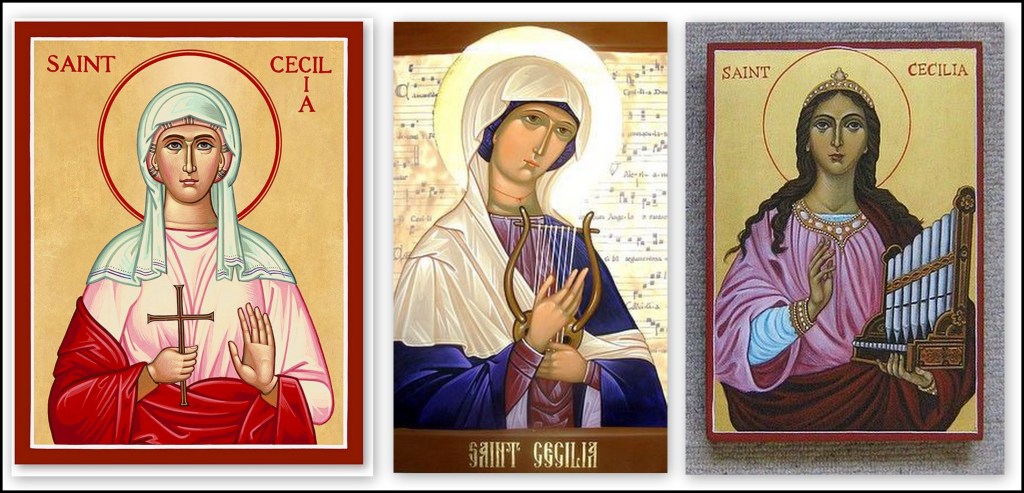
St. Cecilia—November 22, Saint of the Day

St. Cecilia is a Roman martyr and the patron of music and musicians. It is written that Cecilia dedicated herself to virginity, but instead was forced by her parents into marriage. As musicians played at her wedding, Cecilia “sang in her heart to the Lord”. Memorializing St. Cecilia is remembering that music is a pathway to connect to the Divine, a way to seek comfort, to praise and to pray.

“Singing is soulful. It is prayerful and it is powerful. I love to sing (in the privacy of my own car). I love to listen to others sing, from the liturgical chant of Benedictine monks to contemporary Christian artists. Whether it is the melody or insightful lyrics that I find a connection with, music can create a mood, help recognize or express a feeling, or bring me to a place of prayerful listening.

journey is my own
SoulCollage Card–This Journey Is My Own (blog post link below.)

When monks sing, they believe they are singing with the angels, and we are just to join in. The beauty of singing familiar songs and hymns is allowing our mind and heart to beat as one. Songs that capture what we could have not so artfully written, become our prayer. To sing, or sing with another, is to elevate the soul, to connect with the Divine.” (from a previous blog post, Music as Prayer ♫ This Journey Is My Own)

St. Cecilia was memorialized in the church of Santa Cecilia in Trastevere, founded in the 3rd century after Cecilia was martyred. The church is believed to be on the site of the house where she lived and died. Since 1527, a community of Benedictine nuns has lived in the monastery next door. In 1599, Cecilia’s body was found in incorrupt with deep cuts in her neck just as she had died. A sculpture by Stefano Maderno of Cecilia’s body lies in front of the choir.

When I visited Rome during the World Oblate Congress, we made an unscheduled stop at St. Cecilia’s in the Trastevere region. It was a profound experience, one that I cannot quite capture in words. Instead, I share some photos of my visit.

Continue reading “St. Cecilia, Patron of Music—November 22 Saint of the Day”

St. Scholastica: A Woman of Great Love

“From the little known of Scholastica, it is clear that she was a strong woman who was deeply devoted to her religious life. She is celebrated by Benedictine women’s religious communities around the world as a woman who could “do more because she loved more” (Gregory the Great). She was a witness to the truth that love bears all things, believes all things, hopes all things, endures all things. Love never fails (1 Cor. 13:7-8).”-Benedictine Sisters of Erie

In celebration of St. Scholastica’s Feast Day, February 10, I share an edited previous post about St. Scholastica, St. Benedict and the value of spiritual friendships.

I received the gift of the Holy Spirit when I was nine years old. It took many months of catechism class to prepare to receive the sacrament of Holy Confirmation in the Catholic Church. There were dozens of questions about doctrine and faith to study, like:

What is a sacrament?  A sacrament is an outward sign made by Christ to give grace.
What is grace? Grace is any gift from God.
How many persons are there in God? There are three Persons in God. Continue reading “St. Scholastica: A Woman of Great Love”

Blog at WordPress.com.

Up ↑