September 2023 Lectio Divina and Oblate Reflections
Lectio Divina—Chapters 19 and 20, Rule of St. Benedict
Book Discussion—The Oblate Life, edited by Gervase Holdaway, OSB, 2008
Being Benedictine is to believe that the Divine Presence is everywhere, as the opening of Chapter 19 in the Rule of St. Benedict states.
“We believe that the divine presence is everywhere and “that in every place the eyes of the Lord are watching the good and the wicked” (Proverbs 15:3). But beyond the least doubt we should believe this to be especially true when we celebrate the divine office.”
Chapter 19, The Rule of St. Benedict
What is the Divine Office?
The Divine Office, also known as the Liturgy of the Hours or Opus Dei, the “Work of God”, is a daily prayer of psalms, readings, hymns, and prayers. Traditionally during a week, with prayers seven times a day, all 150 Psalms are recited by monks. The Psalms are prayers that Jesus and his disciples recited as part of the Jewish liturgy expressing the depth of human experience and emotion from joy, anger, thanks, praise, suffering, sorrow, contrition, petition, and more.
Fr. Mauritius suggests we can learn how to approach the tensions in our lives and the conflicts in our family, community, and world by looking at the recommendations for selecting a leader of a monastic community in The Rule of St. Benedict, Chapter 64. This chapter suggests that good leadership requires living the values of sound judgment, wisdom in teaching, pure motives, moderation, prudence, loving behavior, discernment, and as the retreat title suggests, soberness and mercy, among others.
Leadership starts with leading oneself. Cultivating the values of being sober and merciful can help us be our better selves in tough times. So often we want to escape or numb ourselves to any pain we may feel—to simply run away from our feelings, people, or situations. At other times we might become overwhelmed by distress or completely absorbed by worries. Neither of these approaches is effective to deal with conflict and anxiety but practicing soberness can provide a middle way—a more balanced, Benedictine way to help us accept our reality as it is, yet not becoming attached to it.
To be sober (Latin: sobrium) is to have an attitude of acceptance, to be temperate, and to take people, things, and activities just as they are. We can become “drunk with anxieties” of daily life, but as one who can compulsively think, ponder, wonder and what-if, this tendency can block one from seeing the truth of the way things truly are. It’s as if an alternate reality is created, one that takes us far away from the present moment.
Emotions can make us drunk; they can completely absorb us. Being sober and vigilant (1 Peter 5:8) is the absence of being drunk on emotion or being overcome with anxiety. By practicing mindfulness, we learn soberness tastes better—the purity and truth of circumstances are clear. One begins to sense when something is just too much—emotions, noise, activity, food, or drink—and is more able to set boundaries for what disturbs. Wanting more of this sobriety is craving what is real—the present moment, an ecstatic peace for only God can fill us with. To be sober is to be free. We must remain vigilant, alert, and open, for what God fills us with, for moments when Christ is revealed in our daily lives.
This retreat weekend is one of the last before I begin a new school year, so there is no shortage of uncertainty or anxiety. What I have learned about soberness is wisdom I will carry with me, a reminder to be gentle with myself while also being watchful and mindful of my tendency to be absorbed in emotion and the circumstances of a school day, whether it is a conflict with a student or colleague, disappointments of unmet expectations, or a frantic pace and frequent interruptions.
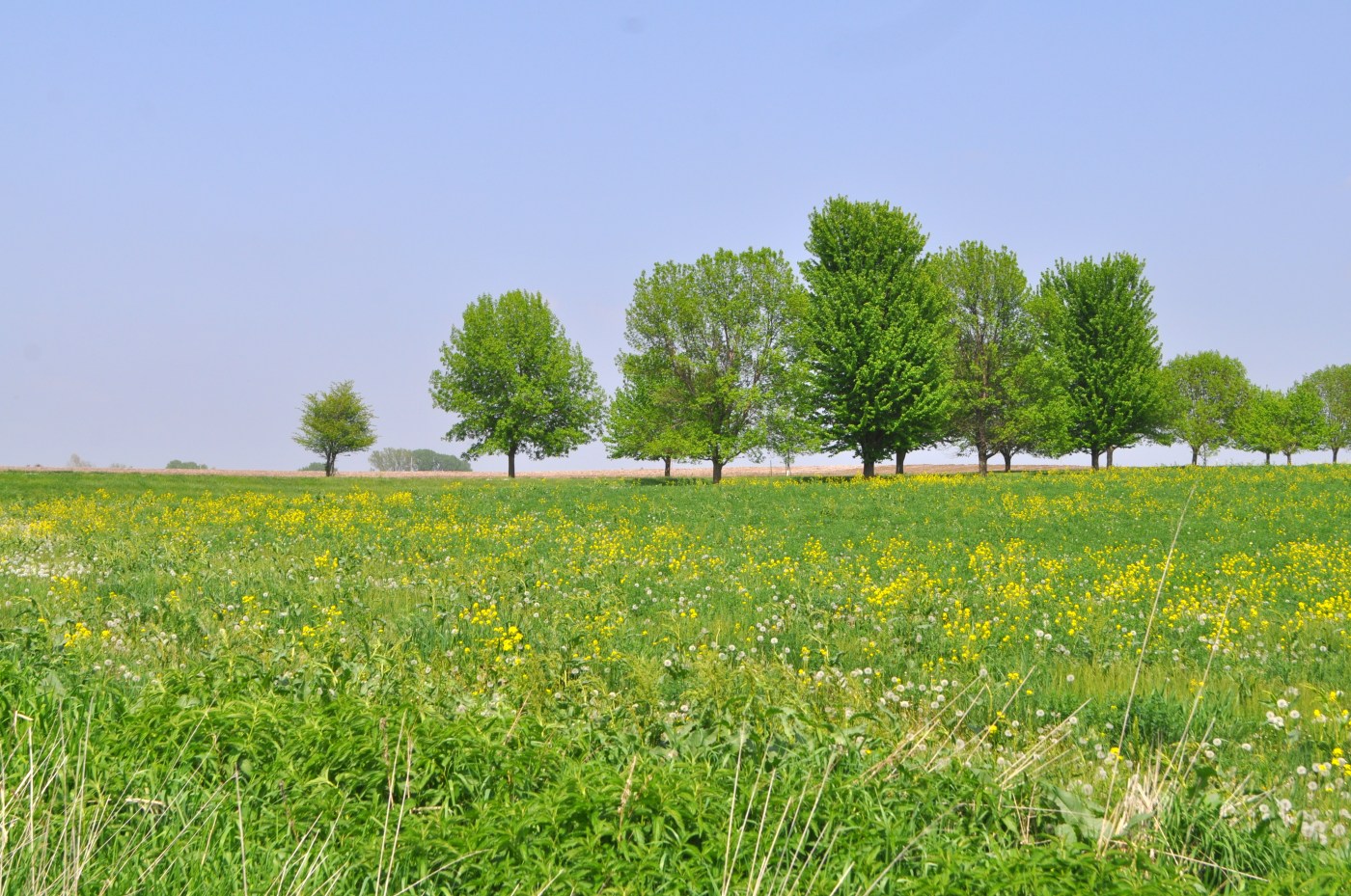
“If one tree fruits, they all fruit–there are no soloists. Not one tree in a grove, but the whole grove; not one grove in the forest, but every grove; all across the county and all across the state. The trees act not as individuals, but somehow as a collective….what we see is the power of unity.”
Robin Wall Kimmerer, Braiding Sweetgrass
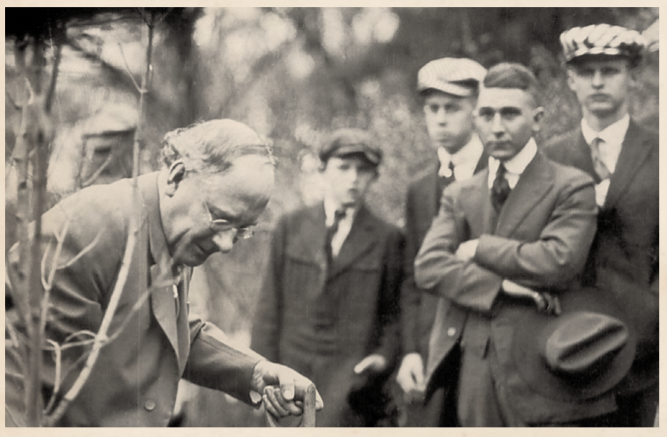
Planting trees is a big deal in Nebraska…so important that the planting and preservation of trees are celebrated with an actual holiday. Arbor Day, which started in my home state of Nebraska, has been celebrated for 150 years and is now observed in all fifty states and in several countries.
Each generation takes the earth as trustees.
—J. Sterling Morton
The founder of Arbor Day, J. Sterling Morton, was a transplant to the Nebraska Territory from Detroit in the mid-1850s. He was a journalist and newspaper editor, who later served as President Grover Cleveland’s Secretary of Agriculture. Morton understood the importance of trees to agriculture, for windbreaks to keep soil in place, for fuel and building materials, and for shade from the hot sun.
He believed in getting everyone, particularly students, involved in planting trees. An estimated one million trees were planted in Nebraska on April 10, 1872, encouraged by contests between counties and promotion in schools. “Students of different grades met at their respective school rooms in the morning for the purpose of planting at least one tree. Each tree that was planted was labeled with the grade, the time planted, and was to be specially cared for by that grade.” (The History of Arbor Day)
On the final Friday of April every year thereafter, Arbor Day has been celebrated, and this year for the 150th time! Throughout the year the Arbor Day Foundation works to “help others understand and use trees as a solution to many of the global issues we face today, including air quality, water quality, a changing climate, deforestation, poverty, and hunger” through conservation and education programs.
Arbor Day Lodge is open for tours–we were just there a few months ago! Many activities and, of course, lots of trees in Nebraska City, Nebraska.
Celebrating Arbor Day is a reminder of our interconnectedness with all living things. In Laudato Si, Pope Francis encourages taking responsibility for the health of our planet by cooperating “as instruments of God for the care of creation, each according to his or her own culture, experience, involvements and talents” (Laudato Si, 14)
St. Benedict encourages us to “listen with the ear of the heart,” to see all of life as sacred, and to experience the connectedness we have with all of creation. Consider spending time listening to the trees. Perhaps we can be reminded that what happens to one, happens to all.
“There is now compelling evidence that our elders were right–the trees are talking to one another. They communicate via pheromones, hormonelike compounds that are wafted on the breeze, laden with meaning…The trees in a forest are often interconnected by subterranan networks of mycorrhizae, fungal strands that inhabit tree roots…They weave a web of reciprocity, of giving and taking…Through unity, surivial. All flourishing is mutual.”
Robin Wall Kimmerer, Braiding Sweetgrass
Trees fall with spectacular crashes. But planting is silent and growth is invisible.
-Richard Powers, The Overstory
The Overstory, the Pulitzer Prize-winning novel by Richard Powers, is a reminder of how destructive humans have been and how significant non-human elements are to the survival of our planet. The novel weaves together the stories of nine characters, their relationship to trees, and their awareness of and desire to stop the destruction of forests. The characters, each with a short story of their own, are the backdrop of a narrative that is less about them and more about trees.
“There would be neither an economic crisis in the world today, nor an ecological threat, were it not for the evil done by greed. Monastic poverty means being content with the simple things that sustain human existence in its inherent goodness. This poverty allows man to live in harmony with field and forest, without feeling the need to brutally strip the earth of her resources in order to realize an immediate gain.”
In honor of Arbor Day, I share “Benediction of the Trees”, written and performed by Derek Dibben. This prayerful song is a recognition that Nature blesses us with trees for our healing, enjoyment, leisure, and protection. Our very breath is dependent on the Benediction of the Trees.
Benediction of the Trees
From the Heart to the Heavens Rooted in the Earth Branching out above us Healing what was hurt
Reaching down to lift us Swing us in the breeze the air we breathe She gives us Benediction of the Trees
Home before our houses Cornered us inside Gentle arms around us Above the rising tide
Can you hear them calling? Like music in a dream The leaves are always falling A Benediction from the Trees
A shout becomes a whisper A Sermon into Song It’s useless to resist her She’s where we all belong
In our Sanctuary Forest Beneath the Pleiades Cicadas in the chorus Benediction to the Trees
As the moon reflects the sunlight From a million miles away I’ll try to get the words right So you can hear her say
In a melody familiar That brings us to our knees In Liturgy peculiar Benediction to the Trees
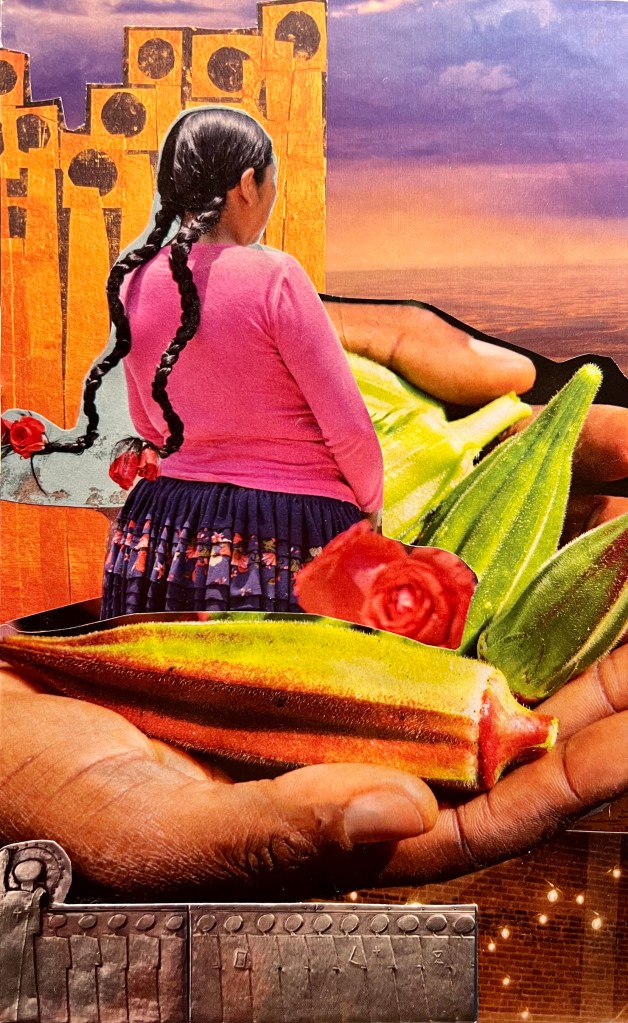
With some solitude and space this weekend, I reflected on the “Now I Become Myself” retreat that I led in December. Our closing blessing, serendipitously discovered by Sara, settled into my soul as a prayer, my heart’s longing to become more myself.
The blessing written by Rabbi Danya Ruttenberg, to follow, begged for images to be created into my own prayer card.
May you grow into your greatest, bravest, most loving self
May you stand tall and unafraid of the great, exquisite, bright light within you that is straining to get out.
May you trust that light, and may you hear the still small voice within that whispers to you about what you need and who you can be.
May you follow the light and the voice wherever it may take you–even to places you hadn’t guessed, hadn’t imagined, that haven’t been part of the plan.
May you remain always curious, open, and eager to grow.
May you walk through your life with wonder, radical amazement, and gratitude.
May you stay kind and gentle.
May you regard others with compassion, generosity, and the benefit of the doubt.
May you seek always to be of service to offer of yourself to those that need help–that need you.
May you speak out bravely against injustice.
May you make of your life a blessing.
May your thoughts, actions and very being be an offering to the transcendent, to the great stream of life, to…the Holy One.
November 2021 Lectio Divina and Oblate Reflections
Sources: Lectio Divina, Mark 10:35-45
Book Discussion, Always We Begin Again by John McQuiston II, “Service”, page 53-54
Morning prayer
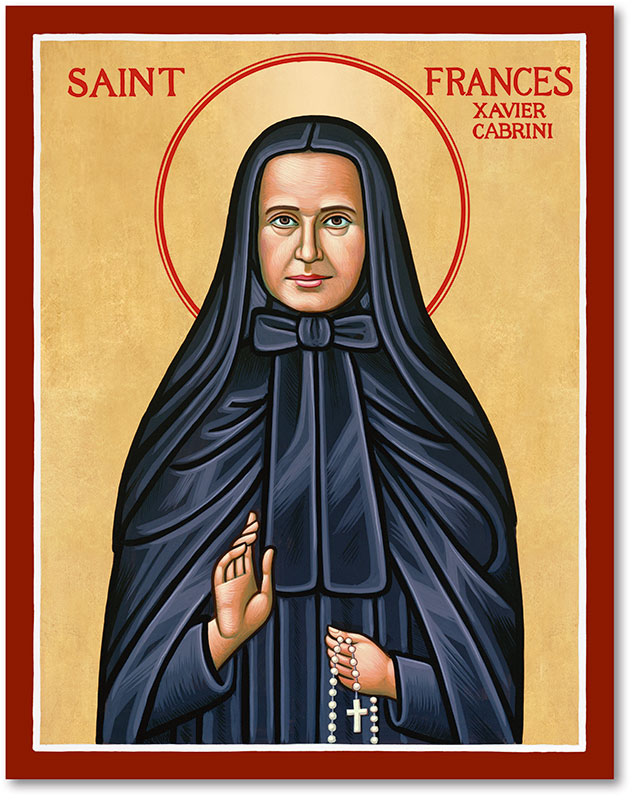
Saint of the Day: Francis Xavier Cabrini is a beautiful example of service to others and service to God. She humbly comforted the sick and infirm in the hospital and lent a helping hand to immigrants. She is a role model for our topic of service. For more information about Mother Cabrini.
Lectio Divina Reading: Mark 10:32-45
Some oblates meeting in person and some on Zoom.
Discussion
You do not know what you are asking. Can you drink the cup that I drink or be baptized with the baptism with which I am baptized?”
On their way to Jerusalem, Jesus shares with John and James what will inevitably happen to him. They certainly do not understand what they are requesting, to share in the glory of Jesus, and they do not want to believe that Jesus’ life will include suffering. “Grant that in your glory we may sit one at your right and the other at your left.” We must ask ourselves: Can we drink from the chalice that Jesus drinks? Or are we driven by ego, desiring the glory and honor for ourselves? Can we really DO life as Christ did? We may desire a journey with Jesus, the choice seat with God in glory and honor, but are we ready to face great suffering that accompanies it?
This applies to any part of our prayer life when we seek to follow Christ. We don’t know what we are in for! We must put ourselves wholly in the presence of Christ and be there for whatever happens–thy will be done. In the popular Christian song, Lord of the Dance, James and John are featured because they responded to the call of the Lord. With each passing verse, from morning to Sabbath to Good Friday, Jesus is the “Lord of the Dance.” We are called to that dance as well, as James and John were—we will have suffering. We are part of the dance, even when we find it difficult to consider the other first, to be more forgiving than self-centered, to accept that we aren’t just here for ourselves but to be of service to others.
Dance, then, wherever you may be,
I am the Lord of the Dance, said he,
And I’ll lead you all, wherever you may be,
And I’ll lead you all in the Dance, said he
Lord of the Dance, Ronan Hardiman
We are not in a good place spiritually when we are telling God what should be done, that we know what is best, our own power and glory. Bishop Barron addresses James and John’s ego-driven request in a Sunday Sermon, “Do You Really Want What God Wants?” Power and honor in themselves are not bad, but the problem is using power, not for God’s purpose, but for our own ego. Honor for its own sake is not helpful to others. Jesus flips the story on James and John…it isn’t all about you! You are here to serve. That is the dance you are called to.
Sources: Lectio Divina, Matthew 25: 14-30 The Parable of the Talents; Always We Begin Again-The Benedictine Way of Living, Stewardship, pages 49-51, John McQuiston II
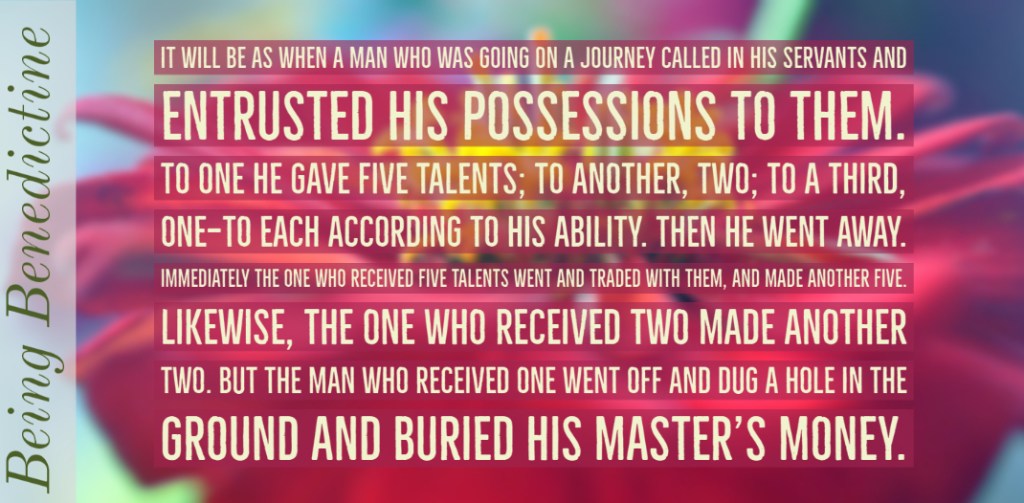
Our Lectio Divina discussion focused on The Parable of the Talentsviewed through the lens of stewardship. In the reading, three people are given talents of varying amounts.
The two servants who had received five and two talents had increased their talents two-fold. They were praised, ‘Well done, my good and faithful servant. Since you were faithful in small matters, I will give you great responsibilities. Come, share your master’s joy.’ (Mt. 25:21)
The one who buried his talent was scolded, judged as wicked and lazy, and his one talent was taken away. “For to everyone who has, more will be given and he will grow rich; but from the one who has not, even what he has will be taken away.
We assume wealth has to do with money. Often, we see talent and gifts as economic gains or monetary contributions. Advertisements encourage us to buy more, of course, but we seem not to know when what we have is enough. In the Rule of St. Benedict, everyone should get what they need, but this requires understanding the difference between needs and wants (RB:34). Sadly, our culture says the more we have, the better off we are. We desire what another has—in possessions, money, time, relationships, almost anything, afraid that someone is getting something more than us—but the talents in this story were not equally given—two, five, one.
February 2021 Lectio Divina and Oblate Reflections
Sources: Colossians 3:12-17; Always We Begin Again: The Benedictine Way of Living by John McQuiston II (pages 17-22)
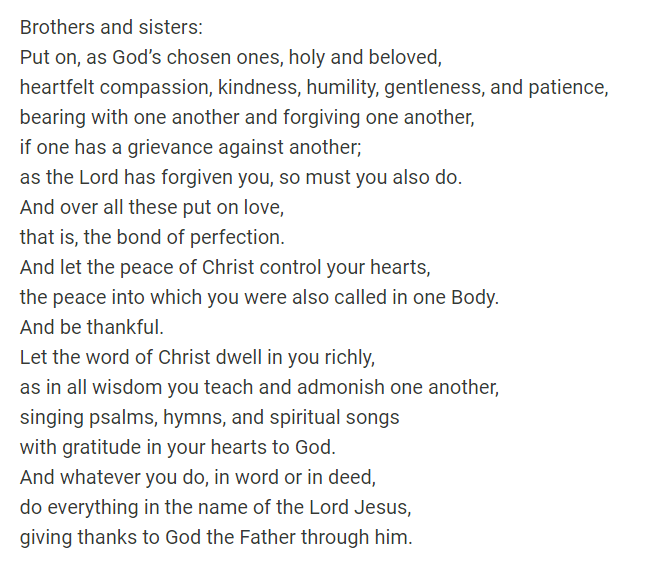
For our Lectio Divina practice, we read more deeply Colossians 3:12-17
We share aloud, some of the words and phrases that resonate with us:
God’s chosen ones, holy and beloved. Put on…heartfelt compassion, kindness, humility, gentleness, and patience.
Bearing with one another. Forgiving one another. Put on love….that is the bond of perfection.
Let the peace of Christ control your hearts. Be thankful.
Let the word of Christ dwell in your richly. Gratitude in your hearts.
Compassion: We think of compassion as feeling sorry for someone, but it is to feel with someone, to enter into the sufferings and joys of another person. Jesus had compassion for us, entering fully into our lives. He is one with us. We are called to emulate this kind of compassion with others. Sometimes there may not be much we can say to another, but we can give our presence, a physical touch. Wordless gestures are just as compassionate, perhaps even more so.
Sources: Mark 1:7-11; Always We Begin Again: The Benedictine Way of Living by John McQuiston II (Preface-p. 14)
For our Lectio Divina practice, we read more deeply Mark 1:7-11, the baptism of Jesus.
Words and phrases that resonate with us, shared in our discussion:
It is with great humility that John proclaims there is one more powerful than I. In an area of rabid individualism, it is hard to turn things over, to admit that I am not the fount of all wisdom. Even if we feel called to speak truth to power, to share our faith or ideas that may differ from another, we must humble ourselves as John did. John admits he is not to untie the sandals of Jesus, and even stoops down to show his humility. Indeed, there is one more powerful than I.
Both John and Jesus show humility. By going down into the water, Jesus foreshadows going down into the tomb. It is a descent, a submission to the obedience of the will of God, and then a rising. Jesus chose to be baptized; he did not have to be, but he chose to be weak, to become humble. This is the beginning of his service. He has been chosen to be Messiah. Jesus did not shy away from this service.
As part of Jesus’ baptism—the heavens were torn apart. Jesus’ identity was affirmed by the father; this is how we get our identity too. The heavens are torn apart for us as well. We live our lives in the balance of humility and knowing that we are made in the image of God.
Always We Begin Again—A new year, a new book.
We begin 2021 by reading the introduction and first section of Always We Begin Again: The Benedictine Way of Living by John McQuiston II (Preface through page 14.) The Rule of St. Benedict provided guidelines for monastic living by giving order to the monk’s day with a balance of prayer and work. Although it may be impossible to follow the Rule strictly while maintaining a life in the world, it is the longing of the Benedictine oblate to have a “creatively balanced framework for life.”
December 2020 Lectio Divina and Oblate Reflections
Sources: Luke 1:67-79; The Rule of St. Benedict, Chapter 72 Study Guide for The Rule of St. Benedict, Maria-Thomas Beil, OSB, page 180-185
For our Lectio Divina practice, we read more deeply the well-known Benedictus that is prayed every morning in the Divine Office, Luke 1:67-79.
Words and phrases that resonate with us, shared in our discussion:
Save us from our enemies….to show mercy….to set us free… without fear…. knowledge of salvation….forgiveness of our sins….the way of peace…promise….prepare his way…you, my child…tender compassion.
The Benedictus proclaims what God is doing and will do for us—not what we do. Many of us have grown up with the image of an angry God, but that is not the God we are shown in Scripture. We are promised a God of tender compassion, not a bookkeeper of judgments. Mercy is God’s loving response to suffering. God is not watching from afar; God is suffering with us.
The dawn from on high breaks upon us—God is breaking in with the incarnation and gives us hope. Benedict was not harsh, but practical, just as God is tender. God enters our history to experience our suffering with us, but we must expose our wounds for the tender compassion of our God to work. To prepare our heart, we must invite God in. Advent was a time to prepare our hearts for God to enter—although this task is never fully completed. We must live in perpetual Advent, inviting God in and humbling ourselves without fear, to receive the tender compassion of our loving God.