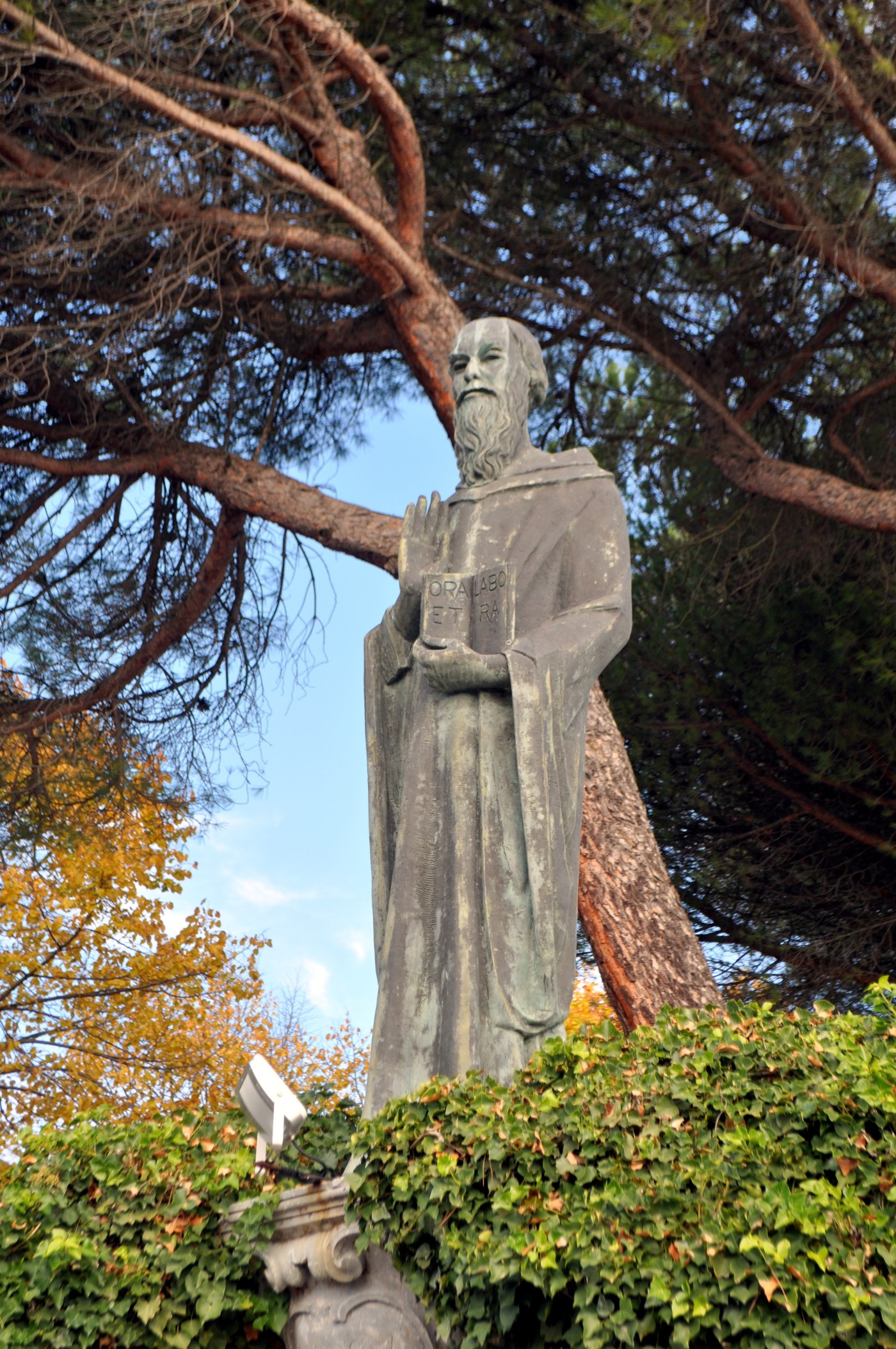
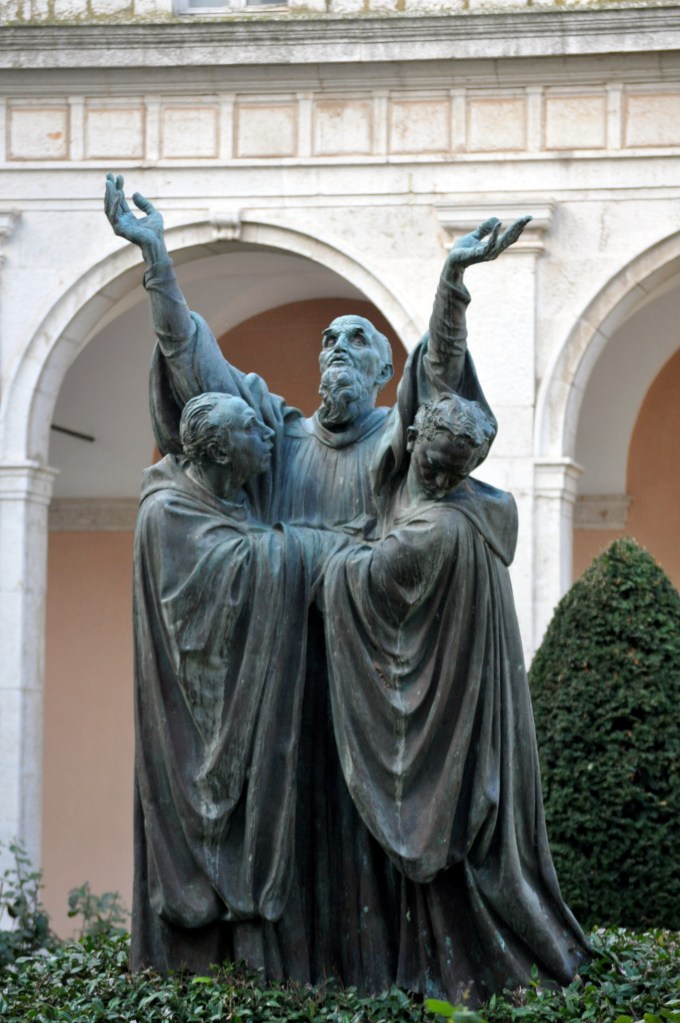
In the Rule of St. Benedict, he instructs, “Keep death daily before your eyes” as a way of life. At the Abbey of Montecassino, where St. Benedict wrote his Rule for monks, there is a statue in the courtyard depicting the moment of St. Benedict’s death.
Montecassino Abbey, the statue depicts the passing of St. Benedict. Photo by Jodi Gehr, 2017.
On March 21, Benedictines around the world celebrate the “transitus,” St. Benedict’s passing from one state to the next, from death into life. Death is not seen as final, but rather a transition into eternity with God.
St. Gregory the Great writes about St. Benedict’s last days:
“Six days before he died, he gave orders for his tomb to be opened. Almost immediately, he was seized with a violent fever that rapidly wasted his remaining energy. Each day his condition grew worse until finally, on the sixth day, he had his disciples carry him into the chapel where he received the Body and Blood of our Lord to gain strength for his approaching end. Then, supporting his weakened body on the arms of his brethren, he stood with his hands raised to heaven and, as he prayed, breathed his last.” (St. Gregory the Great, Book Two of Dialogues, chapter 37).
The advice to keep death always in our minds is the core of being Benedictine and living soulfully.Perhaps this sounds morbid, but it encourages me to live each moment with wonder and gratitude, with purpose, on purpose, and to be attentive to the present moment. Practicing gratitude, having no regrets, living with death daily before your eyes, as St. Benedict writes, and leaving something beautiful from a life well lived, help prepare us for a more peaceful transition from here to eternity. St. Benedict’s life and death are an exemplar for how we are to be Benedictine.
The commencement address given by professional football player Harrison Butker at Benedictine College, a small liberal arts college in Kansas, has generated some big social media buzz. The narrow vision of Catholicism, the limited view of gender roles in the family, and the many backhanded as well as overt insults that thread their way through the message left me stunned. I am concerned the speech will be interpreted as a reflection of the Benedictine tradition and the incredible monks, sisters, and oblates I know.
Being Benedictine, as I have come to understand, is a spirituality that is inclusive, loving, and accepting of all. The speech seemed judgmental, hurtful, and exclusive. Not wanting to jump to conclusions with just a few quotes taken out of context, I read the entire script more than a few times, looking for something redeemable, and anything resembling a celebratory graduation message.
This was as close as I could come:
Ladies and gentlemen of the class of 2024, you are sitting at the edge of the rest of your lives. Each of you has the potential to leave a legacy that transcends yourselves and this era of human existence. In the small ways, by living out your vocation, you will ensure that God’s Church continues and the world is enlightened by your example.
Unfortunately, the “potential to leave a legacy” is very narrowly defined in Butker’s speech, one that restricts women’s roles in their families while limiting “God’s Church” to those Catholics who believe in precisely the way that Butker does. In an already contentious political and religious environment, the message prompted a statement in response from the Sisters of Mount St. Scholastica, a founding institution and sponsor of Benedictine College:
The commencement speech has fostered division rather than promoting unity using the foolproof methods of taking a superior tone, insulting those who believe differently, and claiming to possess the truth as others are surely lost souls. Being Benedictine, in my experience, is a genuine attempt to meet others in love and compassion, listening with the intent to understand, encouraging inclusiveness, and respecting diversity. Yet, Butker claims, “The world around us says that we should keep our beliefs to ourselves whenever they go against the tyranny of diversity, equity, and inclusion.”
The tyranny? Diversity encourages learning, creativity, personal growth, social justice, and more. It is a blessing to share our faith and to have someone truly listen, especially those who might believe differently. How are we to learn or grow in compassion without diversity? Growing up in the Catholic Church, I was taught my religion was the “one, true faith” and, later, in a brief experience with fundamentalism, the assumed imminent rapture was used to convince others that they should urgently accept Jesus as their “personal Lord and Savior” so as not to be “left behind.” Neither of these religious messages was delivered in love. When one thinks they know for certain who God is, they feel entitled to judge that God is for them and not for others, or that their place in heaven is secured while others are surely burning in hell. Being certain about something is likely the biggest sign of ignorance and self-righteousness; being open to hearing who God is to another brings possibility, understanding, and appreciation of diversity. Not all Catholics, Christians, or Benedictines agree with this limited view of the love of Christ, but, sadly, this is what Christianity has come to look like to many.
I have been so inspired by the writing and work of Christine Valters Painter, a Benedictine oblate, author, and online abbess of Abbey of the Arts. The Abbey is a virtual global online monastery offering pilgrimages, online classes & retreats, reflections, and resources which integrate contemplative spiritual practice and creative expression with monastic spirituality. They provide support and resources in becoming a monk in the world and an artist in everyday life.
Learning from members of the community in the Monk in the World Guest Post series has been a source of affirmation that, indeed, one can live according to the Rule of St. Benedict not only in the monastery but in the life one chooses to lead.
I am so honored to have my blog post shared on Abbey of the Arts on the Feast of St. Benedict! The full text is below or at Abbey of the Arts.
“I am delighted to share another beautiful submission to the Monk in the World guest post series. Read on for Jodi Blazek Gehr’s reflection on being a Benedictine oblate.
St. Benedict is special to me for a few reasons. First, we share a birthday. I admit I was disappointed when I first discovered this. My parents had given me an illustrated book of the “Lives of the Saints” to commemorate my Confirmation. As any nine-year-old would do, I immediately looked to see who the saint was for July 11, my birthday. Perhaps Elizabeth, Mary, or Theresa would be my special saint.
Instead, I see an illustration of a man with a dark hood, a scary-looking bird, a crooked cane, and an unusual name I had only associated with Benedict Arnold. July 11, St. Benedict, Abbot, it said. I had never heard of him and surely did not know what an Abbot was. Through the years, I returned to this image of St. Benedict, thinking that I should have some connection with my patron saint.
Fast forward 26 years. With a full and busy life—married with a young daughter, a career as a high school teacher and club sponsor—I felt a deep longing for times of silence.I answered the call of my heart and responded to an advertisement for a silent contemplative prayer retreat. I discovered an oasis of peace just a few hours from home in the cornfields of Nebraska…called St. Benedict Center.
You are invited to “Being Benedictine in the 21st Century: Spiritual Seekers in Conversation,” planned for June 26-28, 2020 at Mount St. Scholastica in Atchison, KS. This opportunity marks the first-ever gathering of professed Benedictines, Oblates, staff, volunteers, friends and benefactors of Benedictine ministries and monasteries, and any seeker who has read The Rule of St. Benedict and experienced a conversion of heart.
The Rule of St. Benedict, a text written in the sixth century for monks living in community, contains wisdom that can be applied to the questions and pressing needs of the 21st century for those seeking purpose, inclusivity and connection—Catholic and Protestant, professed monks, religious leaders, Benedictine Oblates and spiritual seekers, young and old, married and single. Many have found the Rule, relevant 1500 years later, to be a guidebook for growing a deeper relationship to God and others. Benedictine values, including listening, community and consensus building, hospitality, humility, prayer and good work, provide an antidote for troubled times. Continue reading “Being Benedictine in the 21st Century: Spiritual Seekers in Conversation”→


 Being Benedictine