Search

Being Benedictine

Living SoulFully as an Oblate of St. Benedict

Tag

christianity

To Love and Be Loved: The Monk and The Marriage

But now faith, hope, and love remain, these three; but the greatest of these is love. –1 Corinthians 13:13

This scripture verse is one of the most frequently read at wedding ceremonies, but it is meant for more than those getting married. We are created to love and be loved—all of us, no matter who we are or our chosen paths in life, whether monk or married.

Our deepest longing is to be loved. Love is the thread that runs through all the world’s religions. In Christianity, the Great Commandment is to “love the Lord your God with all your heart, and with all your soul, and with all your mind” and to “love your neighbor as yourself.” 

Several years ago, during spiritual direction with Benedictine monk, Fr. Mauritius Wilde, we discussed, despite our different vocations, how much we have in common. We each have a holy longing—to love God, to have a healthy love for ourselves, and to give and receive love. Practically speaking, we are the same age, we are both teachers and retreat leaders, have one brother, have the same middle name (Marie—seriously, what are the odds on that?), we share similar Enneagram personality traits, and each of us professed our marriage or monastic vows 40 years ago, a day apart. I was married on August 17, 1985, and Fr. Mauritius entered the monastery as a novice on August 18, 1985.

After one of many conversations where one of us would say, “That is exactly how it is for me!” or “Me, too!”, I half-seriously, half-jokingly suggested that we write a book about how, setting the whole monk vs. being married thing aside, we experience our love of God and others in many of the same ways. Nearly forgotten, this idea resurfaced a year or so ago, and we decided that leading a retreat together would be a good beginning. Our theme would be love, specifically how the Rule of St. Benedict can help us grow in love and to discover our “inner monk.”
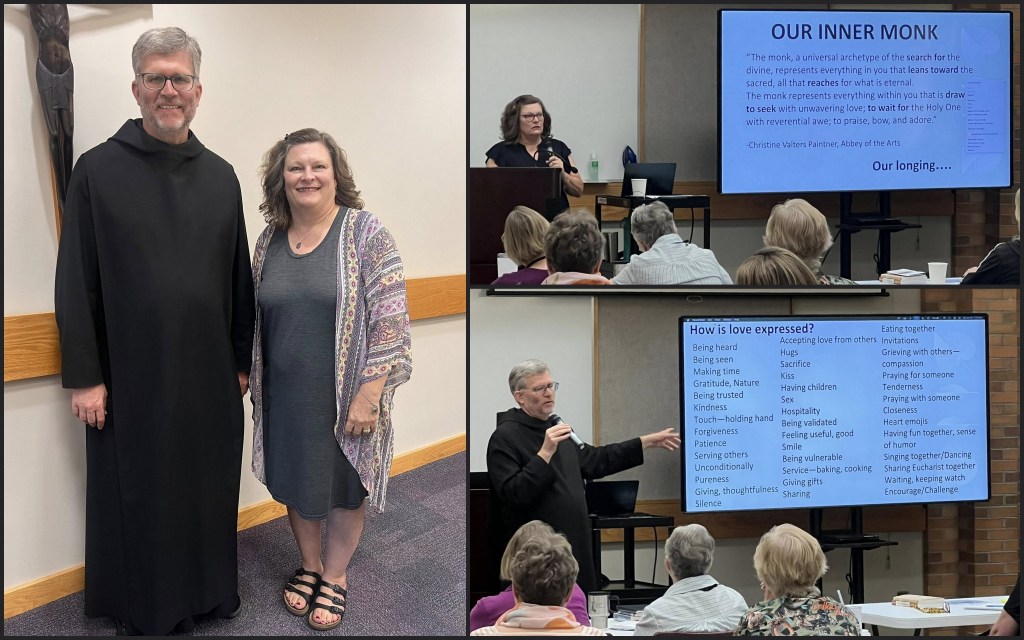
“The monk, a universal archetype of the search for the divine, represents everything in you that leans toward the sacred, all that reaches for what is eternal. The monk represents everything within you that is drawn to seek with unwavering love; to wait for the Holy One with reverential awe; to praise, bow, and adore.” -Christine Valters Paintner

The Rule of St. Benedict shows us the path of love, of nurturing the monk within while living in community. During our retreat, held in July 2025, we shared how the monk’s promises—stability, obedience, and conversion of life—are the foundation for learning and growing in the “school for God’s service.” (RB Prologue 45) For the monk, this place of learning is the monastery. For me, it begins in my family as wife and mother. But each of us is more than our role as a monk or a married person. Each can be transformed by practicing love in our friendships, workplaces, community, and environment.

Continue reading “To Love and Be Loved: The Monk and The Marriage”

All Saints of the Order of Saint Benedict, Feast Day: November 13

Happy Feast of All Saints of the Order of St. Benedict!

The number of Benedictine saints, including Sts. Benedict, Scholastica, Hildegard, and Henry, is large: “At the beginning of the fourteenth century the order is estimated to have comprised the enormous number of 37,000 monasteries giving the Church no less than 24 popes, 200 cardinals, 7,000 archbishops, 15,000 bishops, and over 1,500 canonized saints.” (Catholic Encyclopedia) Seven more centuries have only added to this sanctified group. You can find them listed here, from Abbo to Zosimus, all gathered under one faith and one Rule.

Benedict Gaughan (Being Part of the Benedictine Family, The Oblate Life) gathered feedback from their Oblate family about what it means to be a part of their community. Christine Michael shared, “Being part of the Benedictine family means that I can benefit from the tried and tested wisdom of Benedictines over the countless generations. The Benedictine ethos transcends all boundaries of tradition; a Benedictine is a Benedictine whether Anglican or Catholic, and from whatever part of the world.”

This sentiment resonates with words from our new Abbot Primate of the Benedictine Confederation, Jeremias Schröder OSB, of St. Ottilien Archabbey, who wrote, “Uniformity is not the goal of the Benedictine way. In a world that often seeks to simplify and streamline differences, the Benedictine tradition reminds us that true community is not about making everyone the same, but rather about embracing each person’s unique journey in faith.” He continues,

Benedictine life celebrates the beauty of individuality within the context of unity in Christ. Just as St. Benedict envisioned, our calling is to live together in love and respect, cherishing the distinct gifts God has given each of us. May we all strive to build communities rooted not in conformity, but in a shared commitment to love, faith, and mutual support.”

This is what I love about Being Benedictine. I don’t have to fit my faith in a box, I am part of the Benedictine circle where all are invited to learn, grow, and love.

We are all called to be saints, to grow in holiness, and to become closer to God by loving our neighbor.and self. Pope Francis in his 2013 Angelus wrote, “The Saints are not supermen, nor were they born perfect. They are like us, like each one of us. They are people who, before reaching the glory of heaven, lived normal lives with joys and sorrows, struggles and hopes. What changed their lives? When they recognized God’s love, they followed it with all their heart without reserve or hypocrisy. They spent their lives serving others, they endured suffering and adversity without hatred and responded to evil with good, spreading joy and peace. This is the life of a Saint.”

A tree gives glory to God by being a tree.

-Thomas Merton

Being SoulFully You is discovering and becoming all that God has created you to be. Thomas Merton writes, “For me to be a saint means to be myself.” The call to be holy is the call to be more fully myself, just as a tree gives glory to God by being a tree. It is sacred work to ponder what the saints have offered as role models on our journey to becoming more holy.

Photo: The doorway to St. Hildegard of Bingen Abbey church in Rudesheim, Germany. More here.

© Jodi Blazek Gehr, Being Benedictine Blogger

A Controversial Commencement Address and Being Benedictine

The commencement address given by professional football player Harrison Butker at Benedictine College, a small liberal arts college in Kansas, has generated some big social media buzz. The narrow vision of Catholicism, the limited view of gender roles in the family, and the many backhanded as well as overt insults that thread their way through the message left me stunned. I am concerned the speech will be interpreted as a reflection of the Benedictine tradition and the incredible monks, sisters, and oblates I know.

Being Benedictine, as I have come to understand, is a spirituality that is inclusive, loving, and accepting of all. The speech seemed judgmental, hurtful, and exclusive. Not wanting to jump to conclusions with just a few quotes taken out of context, I read the entire script more than a few times, looking for something redeemable, and anything resembling a celebratory graduation message.

This was as close as I could come:

Ladies and gentlemen of the class of 2024, you are sitting at the edge of the rest of your lives. Each of you has the potential to leave a legacy that transcends yourselves and this era of human existence. In the small ways, by living out your vocation, you will ensure that God’s Church continues and the world is enlightened by your example.

Unfortunately, the “potential to leave a legacy” is very narrowly defined in Butker’s speech, one that restricts women’s roles in their families while limiting “God’s Church” to those Catholics who believe in precisely the way that Butker does. In an already contentious political and religious environment, the message prompted a statement in response from the Sisters of Mount St. Scholastica, a founding institution and sponsor of Benedictine College:

The commencement speech has fostered division rather than promoting unity using the foolproof methods of taking a superior tone, insulting those who believe differently, and claiming to possess the truth as others are surely lost souls. Being Benedictine, in my experience, is a genuine attempt to meet others in love and compassion, listening with the intent to understand, encouraging inclusiveness, and respecting diversity.  Yet, Butker claims, “The world around us says that we should keep our beliefs to ourselves whenever they go against the tyranny of diversity, equity, and inclusion.”

The tyranny? Diversity encourages learning, creativity, personal growth, social justice, and more. It is a blessing to share our faith and to have someone truly listen, especially those who might believe differently. How are we to learn or grow in compassion without diversity? Growing up in the Catholic Church, I was taught my religion was the “one, true faith” and, later, in a brief experience with fundamentalism, the assumed imminent rapture was used to convince others that they should urgently accept Jesus as their “personal Lord and Savior” so as not to be “left behind.” Neither of these religious messages was delivered in love. When one thinks they know for certain who God is, they feel entitled to judge that God is for them and not for others, or that their place in heaven is secured while others are surely burning in hell.  Being certain about something is likely the biggest sign of ignorance and self-righteousness; being open to hearing who God is to another brings possibility, understanding, and appreciation of diversity. Not all Catholics, Christians, or Benedictines agree with this limited view of the love of Christ, but, sadly, this is what Christianity has come to look like to many.

Continue reading “A Controversial Commencement Address and Being Benedictine”

Blog at WordPress.com.

Up ↑