Search

Being Benedictine

Living SoulFully as an Oblate of St. Benedict

Tag

conversatio morum

To Love and Be Loved: The Monk and The Marriage

But now faith, hope, and love remain, these three; but the greatest of these is love. –1 Corinthians 13:13

This scripture verse is one of the most frequently read at wedding ceremonies, but it is meant for more than those getting married. We are created to love and be loved—all of us, no matter who we are or our chosen paths in life, whether monk or married.

Our deepest longing is to be loved. Love is the thread that runs through all the world’s religions. In Christianity, the Great Commandment is to “love the Lord your God with all your heart, and with all your soul, and with all your mind” and to “love your neighbor as yourself.” 

Several years ago, during spiritual direction with Benedictine monk, Fr. Mauritius Wilde, we discussed, despite our different vocations, how much we have in common. We each have a holy longing—to love God, to have a healthy love for ourselves, and to give and receive love. Practically speaking, we are the same age, we are both teachers and retreat leaders, have one brother, have the same middle name (Marie—seriously, what are the odds on that?), we share similar Enneagram personality traits, and each of us professed our marriage or monastic vows 40 years ago, a day apart. I was married on August 17, 1985, and Fr. Mauritius entered the monastery as a novice on August 18, 1985.

After one of many conversations where one of us would say, “That is exactly how it is for me!” or “Me, too!”, I half-seriously, half-jokingly suggested that we write a book about how, setting the whole monk vs. being married thing aside, we experience our love of God and others in many of the same ways. Nearly forgotten, this idea resurfaced a year or so ago, and we decided that leading a retreat together would be a good beginning. Our theme would be love, specifically how the Rule of St. Benedict can help us grow in love and to discover our “inner monk.”
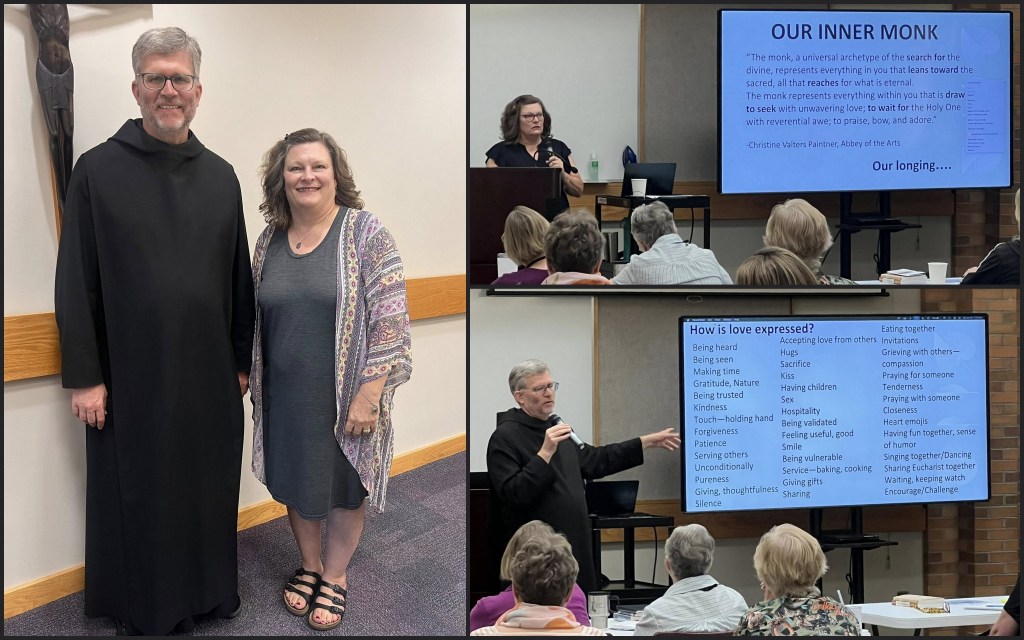
“The monk, a universal archetype of the search for the divine, represents everything in you that leans toward the sacred, all that reaches for what is eternal. The monk represents everything within you that is drawn to seek with unwavering love; to wait for the Holy One with reverential awe; to praise, bow, and adore.” -Christine Valters Paintner

The Rule of St. Benedict shows us the path of love, of nurturing the monk within while living in community. During our retreat, held in July 2025, we shared how the monk’s promises—stability, obedience, and conversion of life—are the foundation for learning and growing in the “school for God’s service.” (RB Prologue 45) For the monk, this place of learning is the monastery. For me, it begins in my family as wife and mother. But each of us is more than our role as a monk or a married person. Each can be transformed by practicing love in our friendships, workplaces, community, and environment.

Continue reading “To Love and Be Loved: The Monk and The Marriage”
Benedictine Spirituality of Work

November 2024 Oblate Reflections

Sources

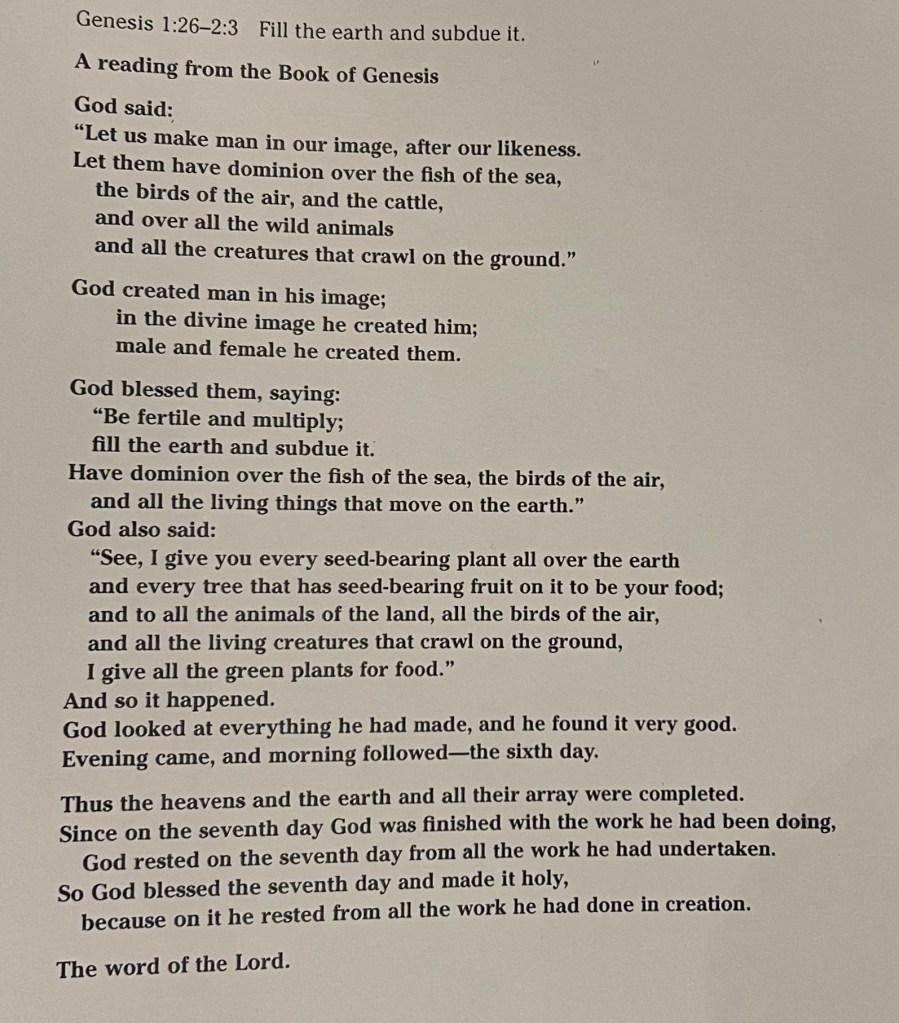
Lectio Divina—Genesis 1:26-2:3, Fill the earth and subdue it. 

Book DiscussionThe Oblate Life: Spirituality at Work, Dermot Tredget. Edited by Gervase Holdaway, OSB, 2008

Topics: Prayer, work, rest and study together provide a foundation for a Christian spirituality of work. St. Benedict recognized that work has a transformative power and for the monk is the principal means to seeking God. Our discussion flowed from words or phrases that resonated from sources listed above.

God created man in his image, in the divine image he created them.

We are created in the image of our Creator; we are creators, too, and it is our responsibility to contribute to the act of creation. Creation is not a once and done effort. Creation requires constant movement, growing, expanding, and even resting. We must ask ourselves if our work is valuable. Does my work add value to God’s creation? “We cannot speak about a spirituality of work without talking about an ethics of work.” (Dermot Tredget)

I give you every seed-bearing plant

In the image of our Creator, our work is to plant the seeds we are given which becomes our food. This isn’t quick and easy work; we need to rest, recover and have patience. We are in relationship with the Divine as co-creators. The Divine is not out of the picture. There is an unseen aspect of work–God is working even while we rest. Even further, what we see as useless toil may show value later. All is sacred.

Continue reading “Benedictine Spirituality of Work”

Is Barbie Being Benedictine?

Barbie is a big deal. The smash-hit movie “Barbie” has reached the coveted billion-dollar mark at the global box office and its director, Greta Gerwig, had the highest-grossing opening weekend ever for a film directed by a woman. Millions of women—from 20 something to 70 something—have donned pink attire with their besties or their daughters—and headed to the theatres for pre-movie selfies and a trip down memory lane.

Barbie is a big deal. And, yes, even some guys have gone to the movie and enjoyed it! Every major newspaper, magazine, and news organization has weighed in on a variety of Barbie themes from feminism, patriarchy and consumerism to mother-daughter relationships, authenticity, and existentialism. Since I saw Barbie with one of my besties, Katie, a few weeks ago, I have read dozens of commentaries on the film. One’s reaction to the movie, or, for that matter, any cultural, social, or political phenomenon, cannot be separated from our own interests, values, biases, and experiences.

My experience includes fond memories of playing with my Barbie dolls–selecting special clothes my parents told me Mrs. Clause had personally tailored, organizing my wardrobe suitcase and setting up camp with a Barbie drive-camper. My daughter celebrated a Barbie-themed birthday, loved her Pepto-Bismol pink bedroom with Barbie comforter and curtains, and had all the Barbie things, even a lunchbox. Barbie captured the imaginations of little girls, and when they became mothers, their little girls enjoyed them as well.

“We mothers stand still so our daughters can look back to see how far they have come,” the spirit of Handler, the inventor of Barbie, said to Barbie, played by Margot Robbie, in the film.

I absolutely loved the movie--from the set and costume design (I mean, a life-sized Barbie house!), the special effects, the song selections and dancing, the clever comedy/satire, the Birkenstocks and the many feminist themes that elevated the movie to one for serious discussion. Katie, and I shared laughs and tears, many de-briefing conversations, and a commitment to see the movie again. My one wish–that I can also see it with my daughter someday.

Oh, you know I created more than one! lol….for both myself and my daughter Jessica. You can create your own selfie here. https://www.barbieselfie.ai/step/1-upload/

But, this is what I have been considering: Is Barbie being Benedictine? Yes! I see a few themes in the Barbie movie that provide a glimpse of what it means to be Benedictine.

Barbie considers her death.

Early in the movie, Barbie asks her friends, “Do you guys ever think about dying?” This existential question is the impetus for Barbie’s (s)hero’s journey, one of curiosity, self-discovery, and transformation, depicted in religious literature, myths, and poetry since the beginning of storytelling. When Barbie’s perfect plastic curves are met with the disappointment of flat feet, cellulite, and clumsy accidents, she attempts to restore the status quo. She experiences a “dark night of the soul,” desperate only for life to go back to the way it was (as she lies face down, in humility, pining for untroubled times.)

When faced with our own mortality, we come face-to-face with the certain uncertainty of our lives. When Barbie adventures into the Real World, where events are not contrived, she is faced with the purpose and meaning of her life, eyes opened to embracing both joy and suffering, aging and death.

St. Benedict advises in his Rule, to Keep death daily before your eyes.” These thoughts of death make Barbie more human, real, authentic—once she realizes her own mortality, she cannot unsee it. Her old life has gone, and a new way must be birthed. Barbie is becoming.

Barbie listens.

In one of the most poignant scenes in the film, Barbie is overwhelmed with the stimuli of the Real World. She pauses to sit down on a bench to consider her next steps. This act of pausing to contemplate is the epitome of being Benedictine.

Continue reading “Is Barbie Being Benedictine?”

July 11: A Big Day for Being Benedictine

St. Benedict is special to me for a few reasons. First, we share a birthday. I admit I was disappointed when I first discovered this. My parents had given me an illustrated book of the “Lives of the Saints” to commemorate my Confirmation. As any nine-year-old would do, I immediately looked to see who the saint was for July 11, my birthday. Perhaps Elizabeth, Mary, or Theresa would be my special saint.

Instead, I see an illustration of a man with a dark hood, a scary-looking bird, a crooked cane, and an unusual name I had only associated with Benedict Arnold. July 11, St. Benedict, Abbot, it said. I had never heard of him and surely did not know what an Abbot was. Through the years, I returned to this image of St. Benedict, thinking that I should have some connection with my patron saint.

Fast forward 26 years. With a full and busy life—married with a young daughter, a career as a high school teacher and club sponsor—I felt a deep longing for times of silence. I answered the call of my heart and responded to an advertisement for a silent contemplative prayer retreat. I discovered an oasis of peace just a few hours from home in the cornfields of Nebraska…called St. Benedict Center.

Continue reading “July 11: A Big Day for Being Benedictine”

From who we are to who we might become

February 2019 Oblate Lectio Divina and Discussion

Topic: Conversion

Luke 5:27-32Jesus saw a tax collector named Levi sitting at the customs post. He said to him, “Follow me.” And leaving everything behind, he got up and followed him. Then Levi gave a great banquet for him in his house, and a large crowd of tax collectors and others were at table with them. The Pharisees and their scribes complained to his disciples, saying, “Why do you eat and drink with tax collectors and sinners?” Jesus said to them in reply, “Those who are healthy do not need a physician, but the sick do. I have not come to call the righteous to repentance but sinners.”

Jesus saw something in Levi—that he was both a tax collector and open to an invitation to follow him. Levi worked with the oppressive Roman Empire, likely judged as greedy and affluent at the expense of others, but Jesus saw his potential.

So often we see people or situations as either/or, not both/and. We see the tax collector, or a politician, or social media as either good or bad, quickly making blanket statements or judgments to categorize into one or the other. But Jesus does not see Levi as one or the other, he sees Levi, and us, as both/and—as who we are and who we might become. Continue reading “From who we are to who we might become”

Blog at WordPress.com.

Up ↑