Search

Being Benedictine

Living SoulFully as an Oblate of St. Benedict

Tag

holy wells

Ireland: I Had to Go Back

Vacation planning is a lot like lesson planning in the classroom and preparing for SoulFully You retreats and workshops I lead. I always over-plan. When my friend Sara invited me to go on a Celtic Christianity pilgrimage, I dove headfirst into researching all the possible places we could spend four days before the pilgrimage began. I found enough possibilities for a four-week vacation!

Visiting the monastic ruins of Glendalough, the holy wells of St. Brigid, and the High Crosses of Monasterboice, to name a few sacred sites on the pilgrimage, was all I had hoped for. But I hadn’t expected to be so enamored by the diversity and beauty of Ireland’s landscape, its rich culture and history, and the hospitality of locals and tourists.
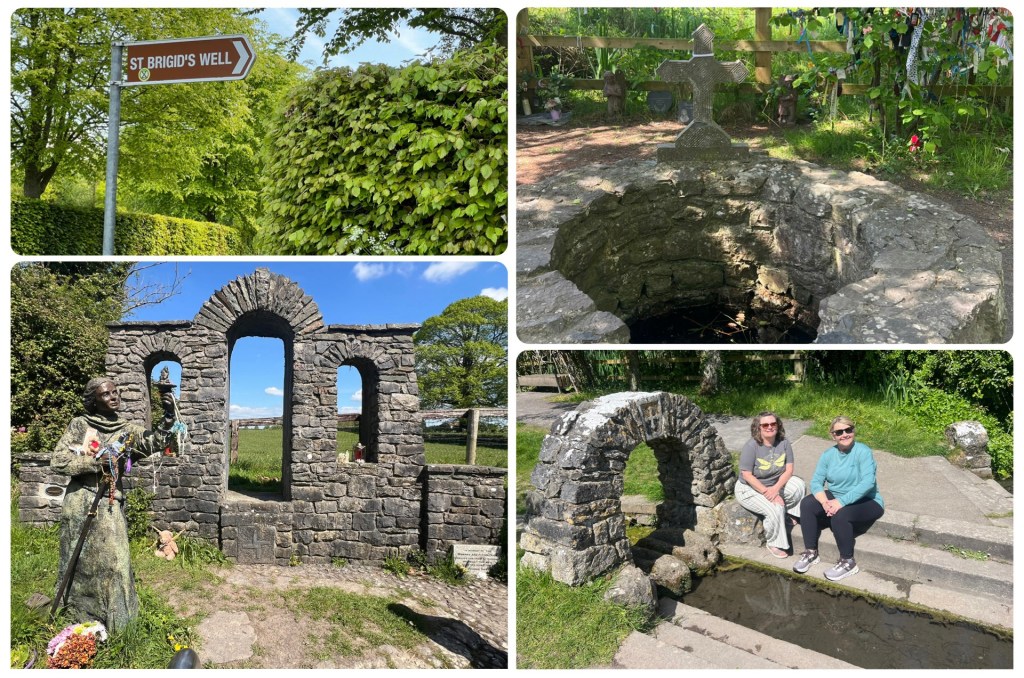
St. Brigid’s Holy Well in Kildare. I visited in Fall 2024 and again with Joe, Dave, and Kris (pictured with me.)

So often, I found myself saying, “Joe would love this.”  I knew I needed to come back with my husband, that he would enjoy the Irish pubs, beautiful scenery, and visiting with locals. And, of course, I was thinking about all the places I had learned about that I still wanted to see.

And so it happened, I asked my husband whether he would like to go in May or September the following year. (See how I did that?) We decided on May, the best time to see wildflowers blooming in the Burren. I pulled up my research spreadsheet and got to work planning a two-week vacation. Again, over planning is my gift, so we decided on a few days shy of three weeks. Our friends, Dave and Kristine, who we met when our daughters were five years old (that’s 26 years ago!) would join us for most of the trip, and to my delight they let me plan the itinerary!

When deciding where to go, I knew I had to return to Solas Bhride in Kildare, the “thin place” where one of our pilgrims, Mike, had a medical emergency and passed away. The Sisters of Solas Bhride Centre & Hermitages had been so compassionate and hospitable, offering a gathering place for prayer and reflection, serving tea and cookies, and welcoming us to experience the presence of Brigid throughout the center, in its garden, labyrinth, and sacred art.

I enjoyed visiting with Sr. Rita Minehan and when I purchased her book Rekindling the Flame: A Pilgrimage in the Footsteps of Brigid of Kildare, she eagerly signed it. I learned even more about the sacred sites of St. Brigid nearby, including the Cathedral, the parish church, a holy well, and the village itself.

With the help of Sr. Rita’s book, we planned a pilgrimage day to Kildare, returning to Solas Bhride, where Mike crossed life’s greatest threshold, from the here to the hereafter. Sr. Rita welcomed my husband and me, sharing local art and memorabilia from “St. Brigid: A Woman, A Life, A Legacy,” a celebration of the 1500th anniversary of the death of St. Brigid, and the first year that the Feast of St. Brigid was declared a national holiday in Ireland. More about St. Brigid here.

Continue reading “Ireland: I Had to Go Back”
Feast of St. Brigid and Holy Wells

A Celtic saint and pre-Christian goddess, Brigid was a 5th-century abbess and founder of monasteries. One of Ireland’s three patron saints along with St. Patrick and St. Columba, St. Brigid is known by many names —Bhride, Bride, Brighid, Brigid, Bridget—and many titles including Muire na nGael (Mary of the Irish) Brigid of the Mantle, Brigid of the Fire, and Mary of the Gael.

February 1, St. Brigid’s death anniversary, is the same day as the Celtic Feast of Imbolc. Imbolc, a celebration of the Celtic sun goddess Brigid is the halfway point between the Winter Solstice and Spring Equinox in the Northern Hemisphere. Imbolc, which means “in the belly”, celebrates the change of seasons, a threshold time of welcoming more sunlight in the day.

It is not by chance that these two celebrations are on the same day. St. Brigid has been described as a bridge between the pre-Christian and Christian traditions. The stories we hold of St. Brigid blend archetype, legend, and history, an amalgamation of the threshold time when Celtic traditions were being adapted and/or replaced by Christianity.

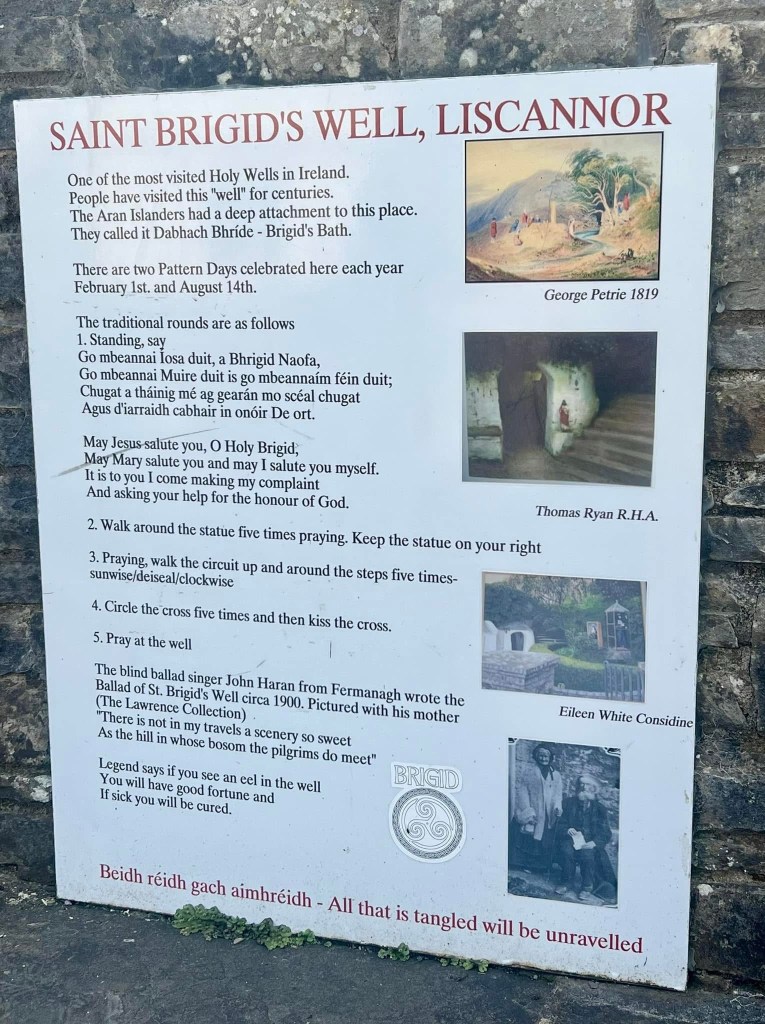
Thousands of holy wells, many dedicated to St. Brigid, are a pilgrimage destination in Ireland. On St. Brigid’s Day, it was a tradition to visit the nearest holy well to ask for healing and fertility in the family, with livestock and crops. Those suffering from illness would offer rosaries, icons, letters, and more with prayers for their healing. Celts believed that the festival of Imbolc and sites like holy wells were a “thin place” where God’s presence could be deeply felt.

A highlight of a 2024 pilgrimage to Ireland included visiting two holy wells dedicated to St. Brigid. Near the Cliffs of Moher, in Liscannor, we visited one of the oldest of the 3000 holy wells in Ireland, one of the few still flowing with water, known for its healing powers. Hiking near the Cliffs with the Atlantic Ocean to the west, and cows and sheep grazing to the east, would have been what Brigid and the many pilgrims have experienced over the past 1500 years.

Continue reading “Feast of St. Brigid and Holy Wells”

St. Brigid of Kildare: Standing on the Threshold

What do a threshold, a cow, fire, and water have in common? 

St. Brigid of Kildare! 

Recently I was introduced to St. Brigid while preparing for a Celtic Christianity pilgrimage and she could not have arrived at a more apt time for me. Admittedly, I’ve fallen down the rabbit hole (or holy well?) of the legends and stories of St. Brigid, a 5th-century abbess and founder of monasteries. St. Brigid is known by many names —Bhride, Bride, Brighid, Brigid, Bridget—and many titles including Muire na nGael (Mary of the Irish) Brigid of the Mantle, Brigid of the Fire, and Mary of the Gael. Brigid is recognized as the patron of midwives including new beginnings, birth, thresholds, and transformation. She has also been linked to fire, blacksmiths, wells, healing waters, springs, and poets. This year, 2024, is the 1500th anniversary of the death of St. Brigid with many celebrations and for the first year has been declared a national holiday in Ireland.

The Threshold

Legend holds that Brigid was born in the doorway of a barn at dawn, at the threshold between light and dark, inside and outside, winter and spring. She is celebrated on February 1, the anniversary of her death, and the same day as the Celtic Feast of Imbolc. Imbolc, a celebration of the Celtic sun goddess Brigid is the halfway point between the Winter Solstice and Spring Equinox in the Northern Hemisphere. Imbolc, which literally means “in the belly”, celebrates the change of seasons, a threshold time of welcoming more sunlight in the day. What is hidden in the earth’s dark belly is beginning to stir—darkness gives way to light and spring is coming!  

Continue reading “St. Brigid of Kildare: Standing on the Threshold”

Blog at WordPress.com.

Up ↑