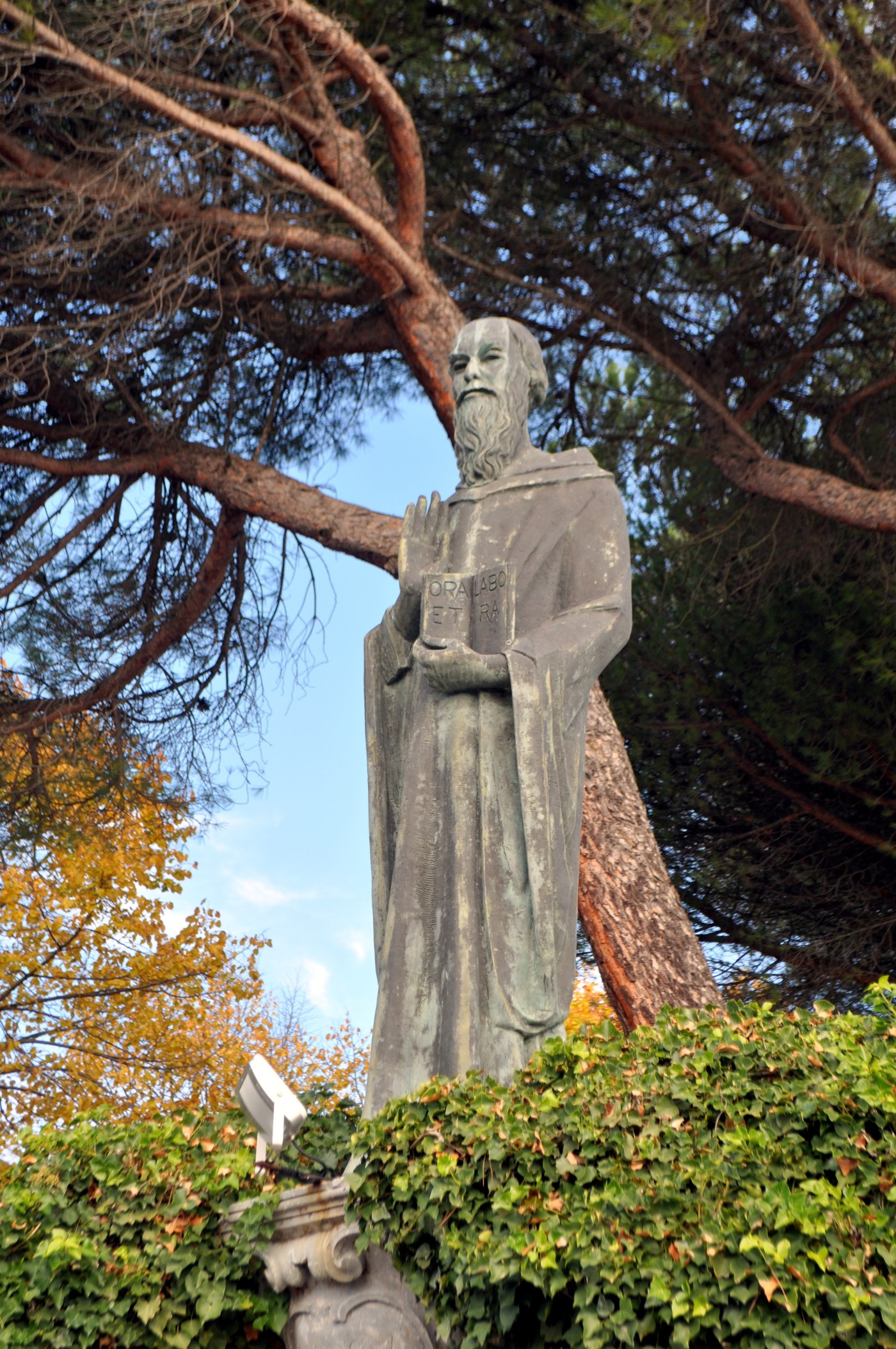
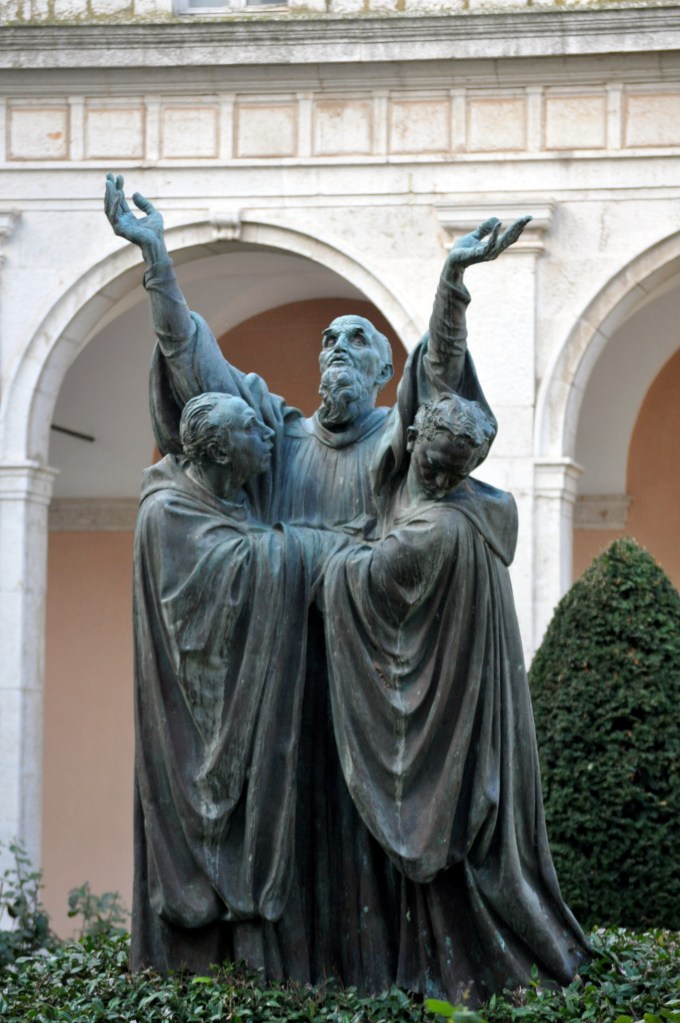
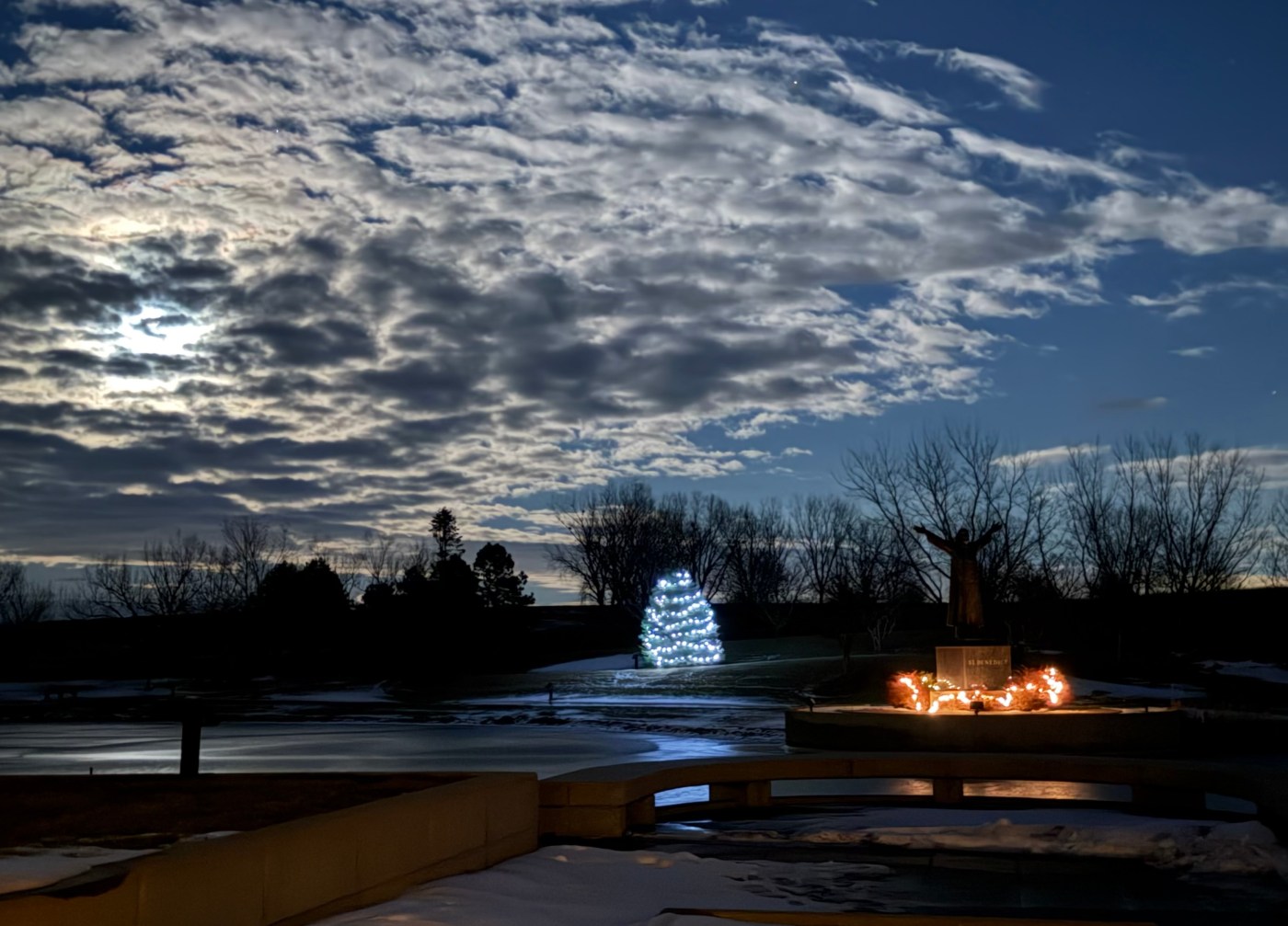
In the Rule of St. Benedict, he instructs, “Keep death daily before your eyes” as a way of life. At the Abbey of Montecassino, where St. Benedict wrote his Rule for monks, there is a statue in the courtyard depicting the moment of St. Benedict’s death.
Montecassino Abbey, the statue depicts the passing of St. Benedict. Photo by Jodi Gehr, 2017.
On March 21, Benedictines around the world celebrate the “transitus,” St. Benedict’s passing from one state to the next, from death into life. Death is not seen as final, but rather a transition into eternity with God.
St. Gregory the Great writes about St. Benedict’s last days:
“Six days before he died, he gave orders for his tomb to be opened. Almost immediately, he was seized with a violent fever that rapidly wasted his remaining energy. Each day his condition grew worse until finally, on the sixth day, he had his disciples carry him into the chapel where he received the Body and Blood of our Lord to gain strength for his approaching end. Then, supporting his weakened body on the arms of his brethren, he stood with his hands raised to heaven and, as he prayed, breathed his last.” (St. Gregory the Great, Book Two of Dialogues, chapter 37).
The advice to keep death always in our minds is the core of being Benedictine and living soulfully.Perhaps this sounds morbid, but it encourages me to live each moment with wonder and gratitude, with purpose, on purpose, and to be attentive to the present moment. Practicing gratitude, having no regrets, living with death daily before your eyes, as St. Benedict writes, and leaving something beautiful from a life well lived, help prepare us for a more peaceful transition from here to eternity. St. Benedict’s life and death are an exemplar for how we are to be Benedictine.
I do not bear discomfort well, I said, half-seriously, half-jokingly, to my son-in-law, John, the other day, as I took a little longer to get out of the car than the rest of the family. We both laughed as John noted that his wife shares this same trait at times. Like mother, like daughter.
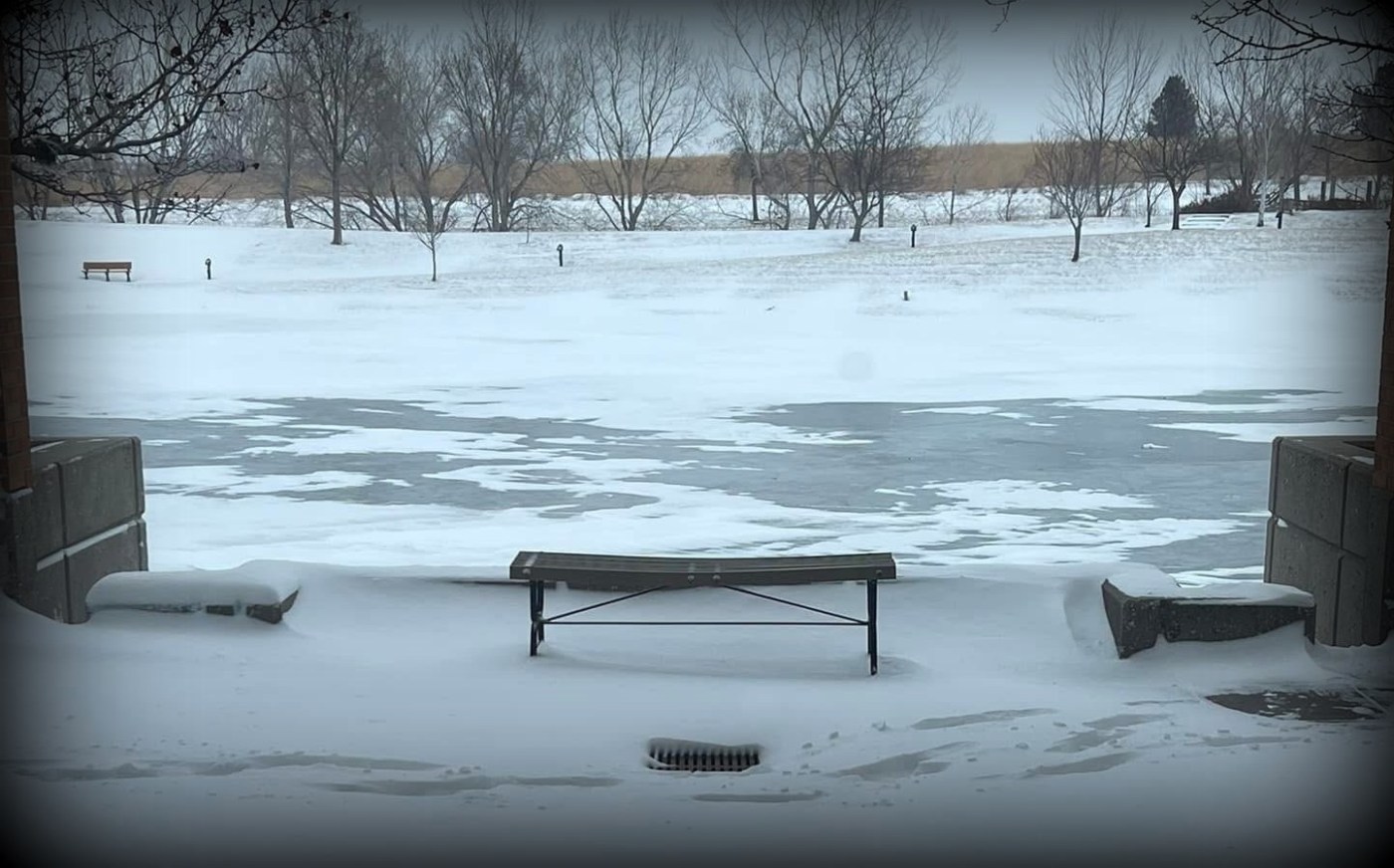
It was a cold day in Nebraska, so we had to bundle up to go out, but once we were in the car, and the heat kicked in, I broke out into a sweat. Struggling in the back seat, off comes the coat. Two minutes later, we arrived at our destination. I wrestled my coat back on to re-enter the frigid temperatures. (An aside: Nebraska weather is a burden of extremes, from hot to cold. Our low temperature today is 12 degrees; on Saturday, 89 degrees is forecasted—how is one to cope?)
To add to my discomfort, several weeks ago, I sprained the peroneal tendons in my right foot. I will spare you the details, but it is reminiscent of the broken arm I experienced three years ago. Let’s just say—it adds to my discomfort, and I repeat, I don’t bear discomfort well. I feel a little guilty (and more discomfort) about admitting this out loud to John and writing it now. There are so many people suffering throughout the world—from war, displacement, poverty, hunger, trauma, poor health, grief, and every imaginable and unimaginable discomfort.
It is a lot for each of us to bear—our own discomfort and the wounds of the world that we also carry in our thoughts, physical bodies, emotional responses, and spirits. So much discomfort, uncertainty, ambiguity, and waiting can make us irritable and impatient—and there is so much to activate our discontent these days.
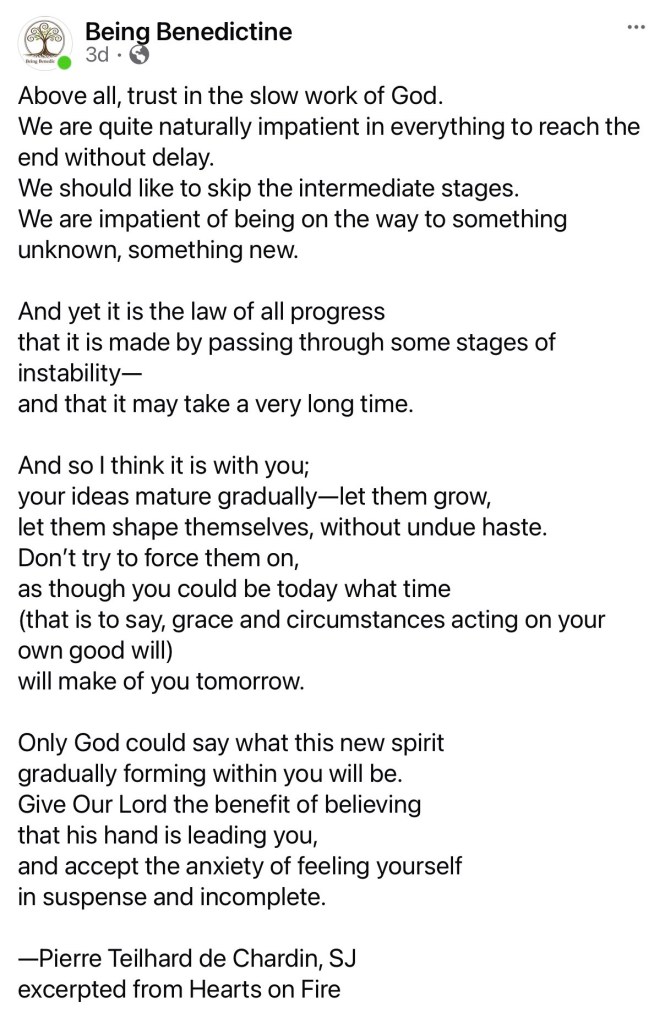
Recently, on my Being Benedictine Facebook page, I shared some wisdom from Pierre Teilhard de Chardin. Within 24 hours, the post had 130 times the average likes, comments, and views of a typical post.
This idea of waiting, and the discomfort that results, seems to resonate with many these days. It is increasingly challenging to “trust in the slow work of God,” and we need constant reminders that this is how we must cope.
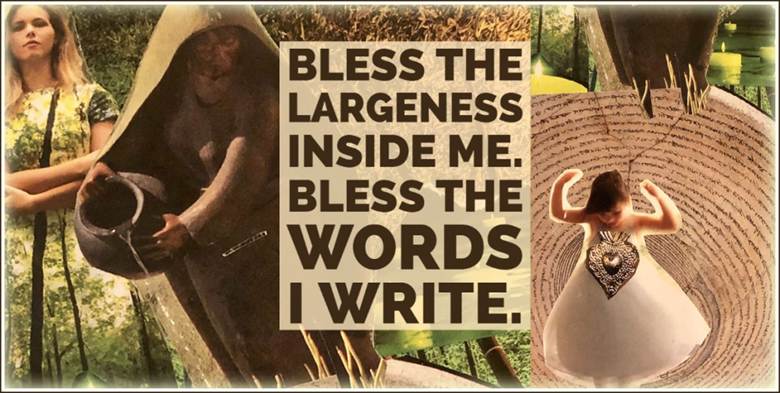
“Lord our God, hear my prayer, the prayer of my heart. Bless the largeness inside me, no matter how I fear it. Bless my reed pens and my inks. Bless the words I write. May they be beautiful in your sight. May they be visible to eyes not yet born. When I am dust, sing these words over my bones: she was a voice.” –Ana, The Book of Longings
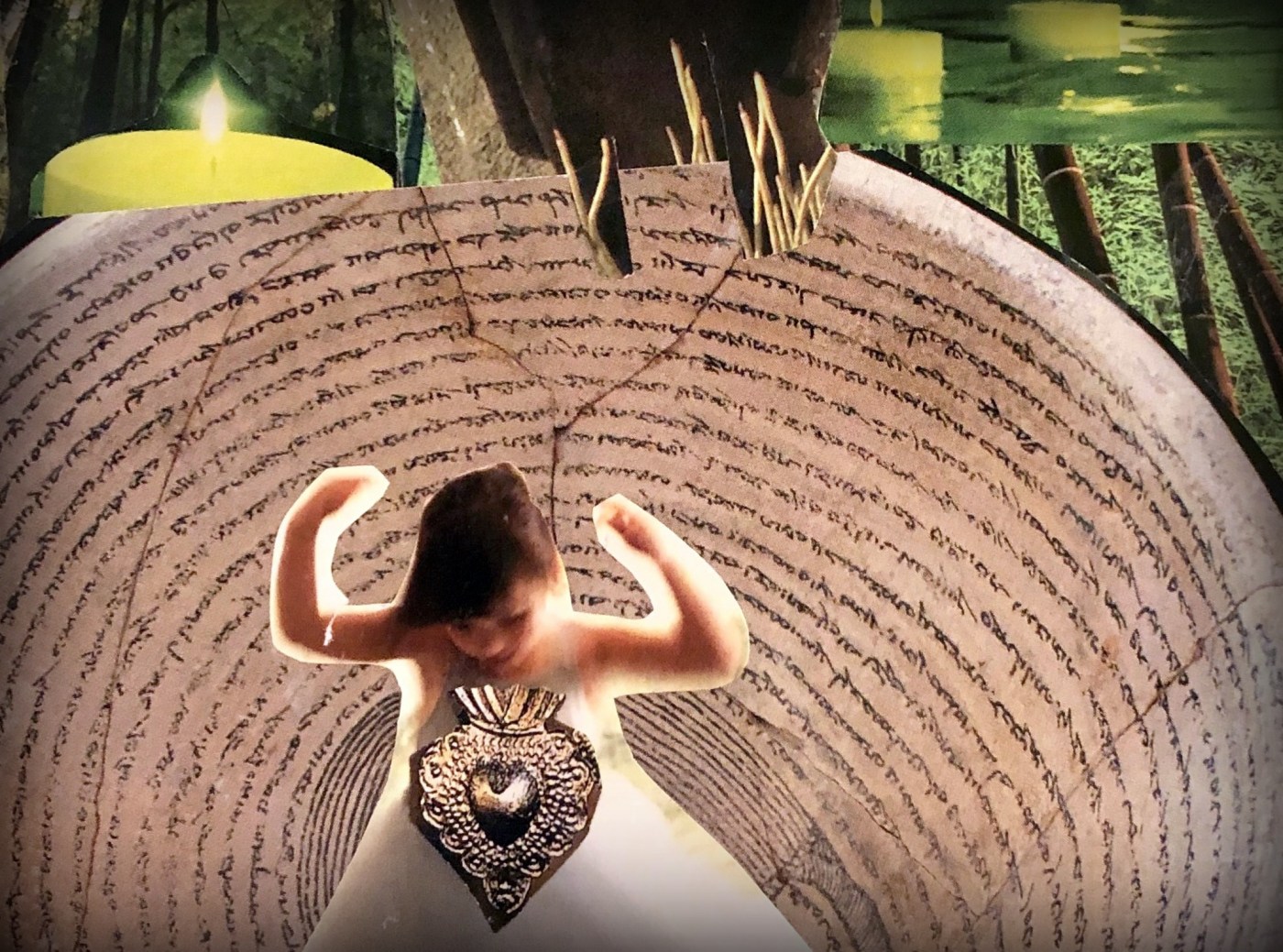
In The Book of Longings by Sue Monk Kidd, Ana writes this prayer of longing on the incantation bowl her aunt Yaltha has gifted her.
“Do you know what an incantation bowl is?” Yaltha asked. “In Alexandria we women pray with them. We write our most secret prayer inside them…Every day we sign the prayer. As we do, we turn the bowl in slow circles and the words wriggle to life and spin off toward heaven.”
On International Women’s Day, we celebrate the social, economic, cultural, and political achievements of women. We honor the women who have a “secret prayer inside them” to improve the quality of life for women, to raise awareness of discriminatory treatment, and to seek inclusiveness and equality for future generations.
In The Book of Longings, Sue Monk Kidd, one of my favorite writers, shared that she wanted “to write a story that encouraged us to follow our longings and bring forth the largeness inside ourselves…to portray how much women’s voices and stories matter.”
Ana’s prayer of longing is to have a voice, to be heard, and truly listened to. Ana lives during the time of Jesus when women’s stories were not valued or heard, often intentionally silenced and oppressed. Like Ana, we long for our authentic selves to be seen and heard. When we are listened to, we know that we are loved.
“All my life, longings lived inside me, rising up like nocturnes to wail and sing through the night. That my husband bent his heart to mine on our thin straw mat and listened was the kindness I most loved in him. What he heard was my life begging to be born.”-Ana, The Book of Longings
Listening is an important theme in The Book of Longings. St. Benedict thought it was so important to listen that it is the first word in the Rule. “Listen carefully, my son, to the master’s instructions, and attend to them with the ear of your heart.” John McQuiston II, in Always We Begin Again, The Benedictine Way of Living, paraphrases, “Listen with the heart and mind.” These instructions to listen to God extend to the many ways God may speak to us—through our daily circumstances, unique situations, the people in our lives, and in our hearts and minds through the voice of truth within us.
February 2026 Oblate Reflections, Christ the King Priory, Schuyler, Nebraska
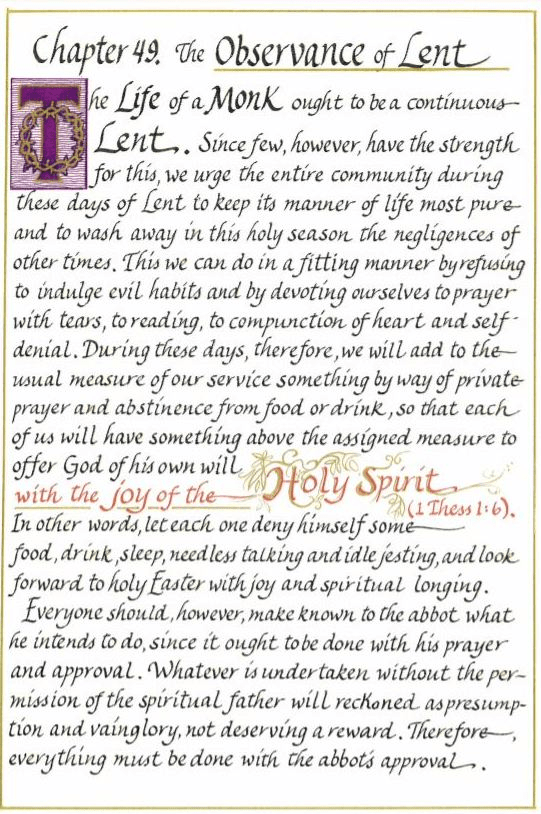
Theme: Love and Lent; Lectio Divina: Rule of St. Benedict: Chapter 49: Picturedabove: The oldest copy of the Rule of Saint Benedict, from the eighth century.
Benedictine Sisters Benevolent Association, St. Scholastica Monastery, Copyrighted 1990. Meredith Schifsky, Calligrapher; Mary Charles McGough OSB, Illuminator
What is your first thought when you consider the season of Lent? Many of us think of giving up sweets, donating to good causes, reading spiritual books or devotions, or going to Mass daily or more often. St. Benedict devotes an entire chapter of The Rule to how monks should practice Lent. He instructs that “the life of a monk should be a continuous Lent.” As an oblate, or lay member of a Benedictine monastery, seeking to live the life of a monk in the world, this can sound like a tall order. Fortunately, Benedict knows that we are only human, that everything must be done in moderation. He writes, “few…have the strength for this.”
We consider what he might mean by the ideal of a “continuous Lent” as well as other words or phrases that resonate with our oblate community during our Lectio Divina discussion.
St. Benedict Center–our monthly Oblate meetings are held in Schuyler, Nebraska More info here.
A continuous Lent. The holy season of Lent, Benedict writes, is a time “to keep its manner of life most pure and to wash away…the negligences of other times.” He offers specific ideas: avoiding evil habits, praying with tears, reading, compunction of heart, and self-denial. Unlike a New Year’s resolution, which we often resolve to add or subtract from our lives (and often lose track of what we resolved to do), a continuous Lent encourages us to keep checking in with our spiritual journey.
Our intentions are not one-and-done. We fall; we get up—again and again. Our spiritual lives can be likened to a spiral—a continuous journey in which we return to learn anew. Lent is a continuous preparation for Easter—a time of resurrection, new life, and beginning again. Even when our hearts are pierced by our own suffering and by the suffering of the world, there is a promise of something new being born, something resurrected. Joy will come again.
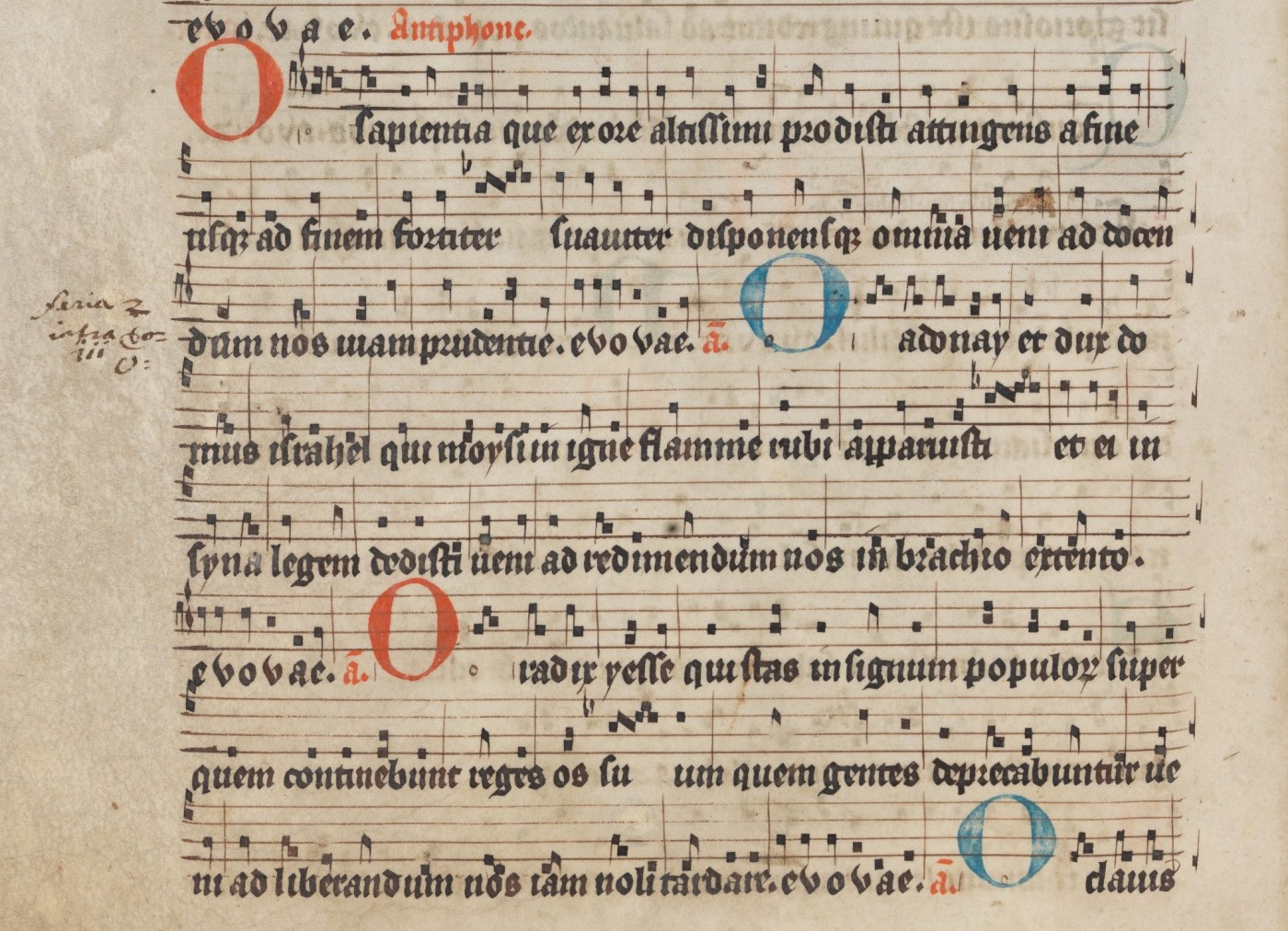
The traditional Advent hymn “O Come, O Come, Emmanuel,” which many are familiar with, is a paraphrase of the lesser-known O Antiphons written by Benedictine monks in the Middle Ages. One of the oldest liturgical rituals in the Church, the O Antiphons have been sung since at least the 8th century. These short prayers, starting with O followed by a title given to the Messiah from Old Testament prophecies, are sung before the Magnificat during Evening Prayer from December 17–23, the last seven days before Christmas. Each antiphon describes God in terms of Old Testament traits and images.
Images and symbolsthat appear in dreams, art, literature, or scripture carry both personal and universal meaning. Serving as a bridge between the unconscious and the conscious, images can nourish our spirit. “Images open windows through which we can see realities formerly hidden from us. Images want to infuse themselves into us and to change us from the inside out, ” writes Anselm Grün.
Images are an essential part of rituals, prayer, self-reflection, and creativity. When practicing SoulCollage®, one of my favorite spiritual practices, images can guide us to a new level of awareness and reveal a deeper understanding of thought and feeling. Perhaps this is what attracts me to the tradition of praying the O Antiphons.
“Reflecting on the words and images prepares us to let Christ himself enter into us…We are all an image, an icon, of God. It is our task to become ever more like this unique image of God.”
Anselm Grün, A Time of Fulfillment: Spiritual Reflections for Advent and Christmas
The O Antiphons use images to help us envision the Christ we long for, and to draw us into a more profound connection to the God of history. “In the O-Antiphons the art of interpreting Old Testament text as images for the coming of Jesus Christ into the world becomes apparent.” (Anselm Grün) The repeated word “Come!” expresses our deepest longing for Christ. When we accept that we are not God, we yearn for fulfillment, for all that a Messiah can bring, not just in the hereafter but in the here and now. We long for wisdom, freedom, hope, peace, belonging, light, healing, salvation, dignity, protection, love, and accompaniment. Each of these longings is addressed in the O Antiphons.
Feel free to download and share any of the images in this reflection, or follow Being Benedictine on Facebook to share daily posts. Join the monks of St. John’s Abbey for each of the O Antiphons as Benedictine monks have done for 1300 years.
Presentation Leader: Fr. Jim Secora – Advent “He is Coming”
“The people who walked in darkness have seen a great light.” (Isaiah 9:2)
We seek the light. In total darkness, our eyes can see a single point of light up to 5 miles away. This is the lesson of Advent, shared by Fr. Jim Secora, a retired priest and Benedictine oblate. We must accept the darkness, become comfortable with it, and not run from it. We must confront the darkness in the world and from within.
We live in a generation of darkness, as many generations before us have. There is much suffering—with refugees, immigrants, those lacking good health care, those who cannot afford necessities, who are sick, or have personal suffering. Advent calls us to confront the darkness. We cannot appreciate the light around us until we do.
Gaudete Sunday, the third Sunday of Advent, is a reminder of the joy we have and of the joy to come. The light of Christ is here and is coming—both are true. Miracles happen every day when we pay attention.
The fear of uncertainty, the unknown, leads to personal darkness. Even Jesus felt it. And he faced it head-on. We must practice trusting, letting go, and sitting in discomfort. If we don’t have an opportunity to see the need for light in our lives, why do we need Christmas? Fr. Jim suggests.
In small groups, we shared our personal experiences in response to the following questions—
1. Name the experiences of darkness that you find in the world, the church, the lives of people, and if only if you are comfortable, any area of darkness that you have or are experiencing. Where or when have you experienced light piercing the darkness?
2. The people of Israel sought out John because he offered them a vision of salvation. Where in the life of the world do you see the need for a savior? Where in my life, do I need to experience a rebirth of Jesus and his gift of salvation?
3. What is the star you are following now? And where is that star in its present radiance in your life leading you?
Much of our personal darkness comes from a feeling of helplessness. We want our discomfort relieved, our problems fixed. We live in a cloud of doubt and uncertainty, where we can’t “fix it” and no one else can “fix it” for us either. We forget that often the fear of the unknown may be worse than the reality that may be to come. But this presents the question: What do we trust in?
During my greatest fear, waiting for a life-changing health diagnosis, I experienced this desperation. And the only answer, the only peace is to trust in the breath of the Divine. Taking one deep breath at a time, I was more aware of the connection to the greater Source of peace. The breath prayer is the start of a surrendering practice, a continual turning it over to God, a reminder that we cannot assume to know how things will turn out or that we know what is best. This spiritual practice is impossible without humility.
“We have made ourselves the love of our lives and found little to adore at the altar of our egos. We have made ourselves our own gods and have forgotten God in the process…Joy, the deep-down awareness of what it means to live well, to live productively, to live righteously, is made out of self-giving, simplicity, and other-centeredness…Joy is not about what happens to us, the manger indicates. It is the meaning we give to what we do that determines the nature, the quality of the lives we live.”
-Joan Chittister, The Liturgical Year
It takes humility to surrender our “me” to “we.” We need a redemption of me. The stars we can follow are trust, acceptance, joy, and peace. Practicing gratitude for the present moment, finding peace, joy, and strength in whatever situation we are in, not wishing that we were somewhere else. Our star is directly above our present moment.
Mary, the quintessential mother, emerges in many of my collage creations. On the Feast of Our Lady of Guadalupe, December 12, I am reminded how Mother Mary appears in many forms across religions and cultures. She brings visions and messages uniquely tailored to those who receive them, like Juan Diego.
On the site of an ancient shrine to the Aztec mother goddess, on Tepeyac Hill near Mexico City, a young Nahuatl Indian named Juan Diego had a vision of a young Indian woman. Speaking in his native tongue, she directed him to take roses to the bishop and tell him to build a church on the hill. The bishop dismissed the story, but the young maiden appeared to Diego once more, identifying herself as the Mother of God. She instructed him to gather roses that grew at her feet, during the winter no less, and take them to the bishop. When Diego opened his coat, roses tumbled out and a colorful impression of Our Lady, with dark skin, was imprinted on the fabric.
“My dearest son, I am the eternal Virgin Mary, Mother of the true God, Author of Life, Creator of all and Lord of the Heavens and of the Earth.”
Our Lady of Guadalupe to St. Juan Diego on Mount Tepayac, 1531
This story has been told for five hundred years, standing as an “image of divine compassion for a demoralized people. Speaking to Juan Diego in his own language, (Mary) presented herself in terms of compassion and solidarity, not power and domination.” (Blessed Among Us, December 12, 2020) The image of Our Lady attracts millions of pilgrims each year at the basilica in Mexico City, one of the world’s most visited sacred sites.
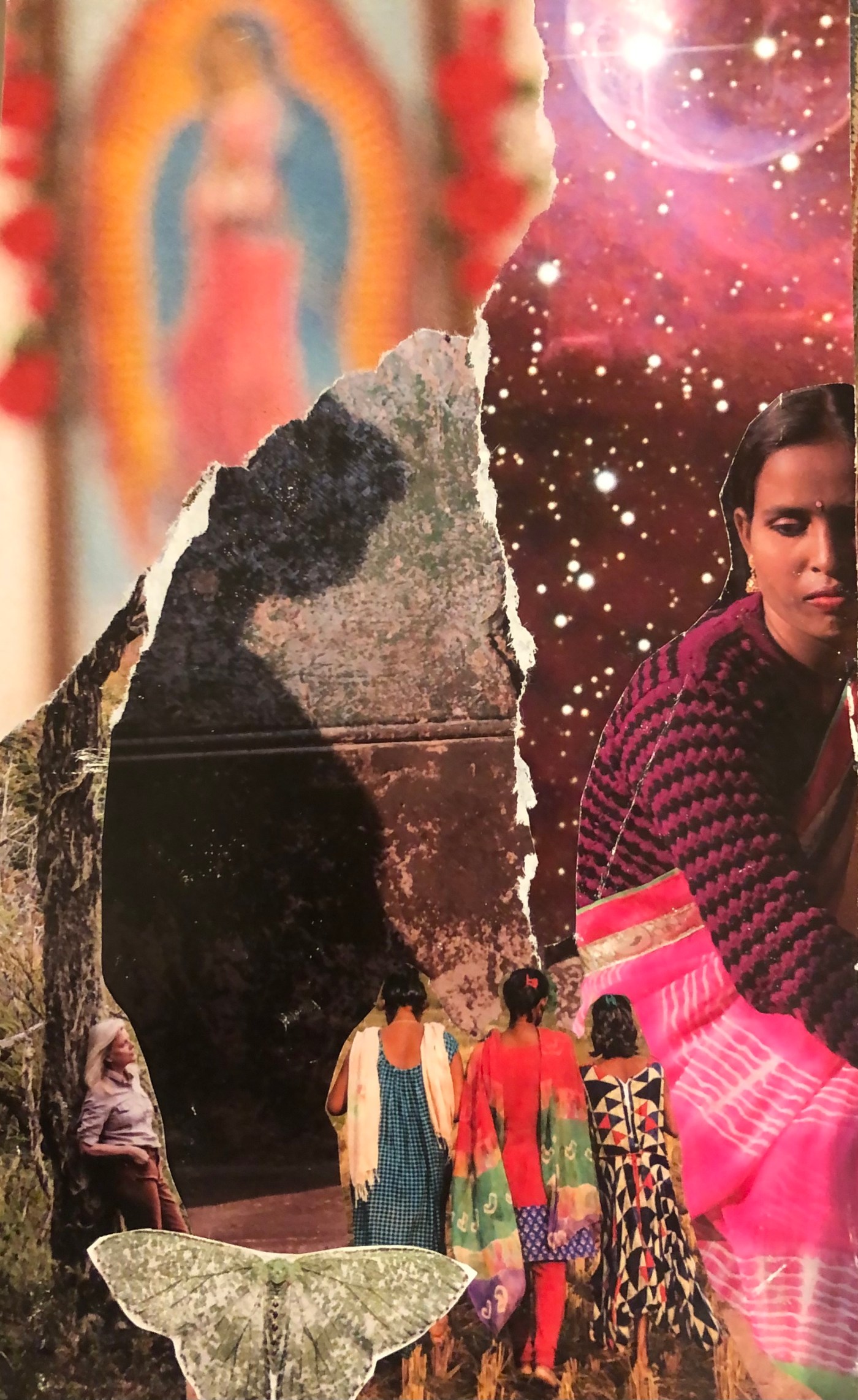
One of the Mary cards I created during a Full Moon retreat with anam caras, women friends on the spiritual journey, features Our Lady of Guadalupe and her role in the life of all women, particularly those who are marginalized and suffering. In the upper left corner is an image of Our Lady of Guadalupe, framed by roses that bloomed out of season. Our Lady watches over us—Mother of the Universe, outside time and space. Whether you call her Tonantzin, “Sacred Mother” in Nahuatl, the language of Juan Diego, or Holy Mother, Mother Mary, the Mother of God, or the Virgin Mary, she offers a divine motherly love and protection available to all. Mary empowers women to give that same love and compassion to others.
“Do not grumble or think ill of others.” (Rule of St. Benedict Ch. 4:39)
What is the key to practicing gratitude rather than grumbling? How can we live a grateful life in the midst of pain and suffering, our own, that of others, and that of the world around us? Is it possible to be thankful for challenging experiences?
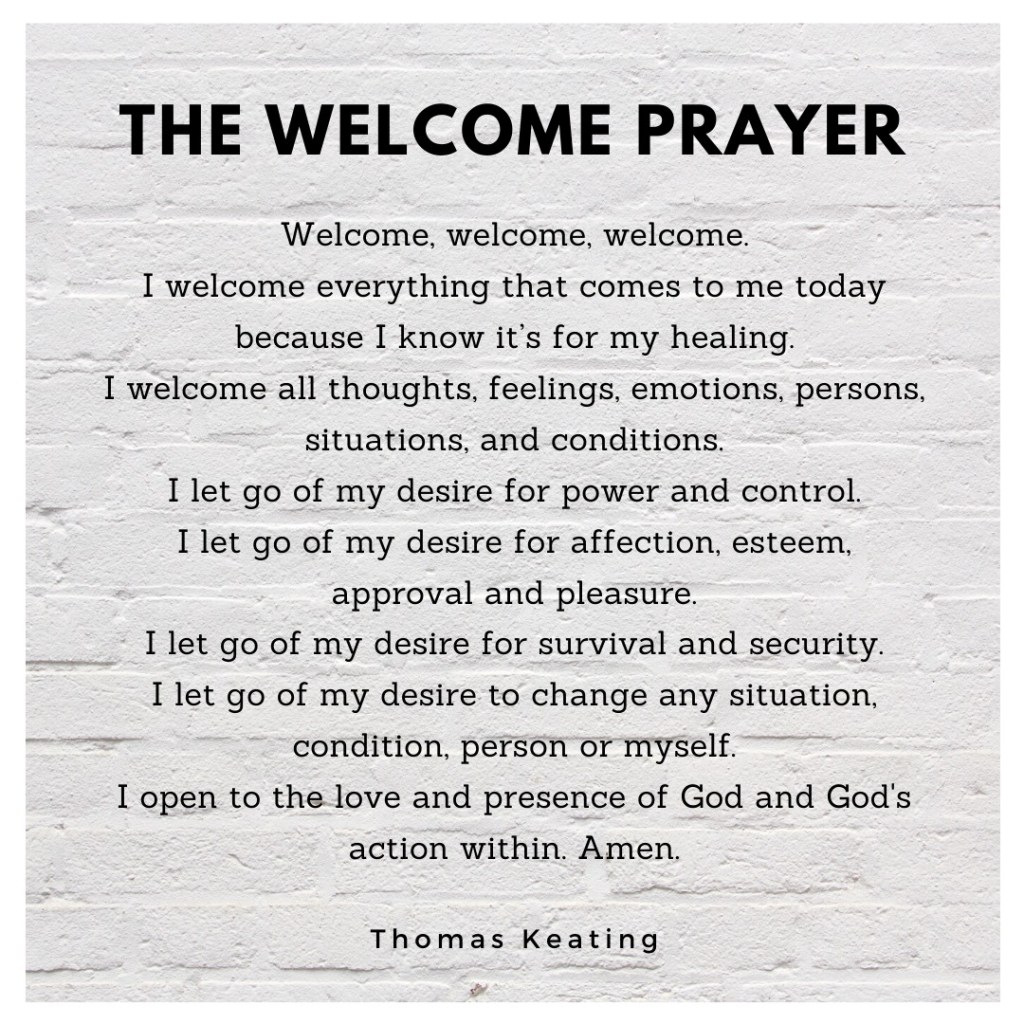
We use the Rule of St. Benedict and Scripture to address these questions at our November oblate meeting. We opened our meeting with the Welcome Prayer written by Fr. Thomas Keating).
If we truly practice this prayer to welcome all of the above, we find that the benefit of grumbling is minimal. In fact, grumbling is self-sabotage. The benefit of welcoming everything is that through the moments of distress, unease, discomfort, or suffering, we learn that another way could be a blessing. What can be difficult about the Welcome Prayer is the “letting go” of our control—and oh my, how much we prefer when things go our way.
St. Benedict has a few things to say about grumbling, a form of letting go of our own gripes, opinions, and negativity for the greater good of the community and ultimately our own selves. He encourages his monks to cultivate humility, patience, and a joyful acceptance of their station in life. It requires a surrender of pride to be content even when it is challenging to be.
We read the following excerpts and practice Lectio Divina as a group, sharing the insights we gained.
“In a delightful letter on the contemplative life called The Ladder of Monks, Guigo II (a 12th-century Carthusian monk) divides the experience of Lectio into four phases or degrees: reading, meditation, prayer, contemplation. Reading, he says, puts food whole into the mouth. Meditation chews it, digs for treasure. Prayer extracts the flavor and helps us to get to know the treasure. Contemplation embraces and welcomes the thirsty soul.” (A Tree Full of Angels: Seeing the Holy in the Ordinary, Macrina Weiderkehr)
Lectio Divina: Matthew 9:1-13; 35-36
He entered a boat, made the crossing, and came into his own town. And there people brought to him a paralytic lying on a stretcher. When Jesus saw their faith, he said to the paralytic, “Courage, child, your sins are forgiven.” At that, some of the scribes said to themselves, “This man is blaspheming.” Jesus knew what they were thinking, and said, “Why do you harbor evil thoughts? Which is easier, to say, ‘Your sins are forgiven,’ or to say, ‘Rise and walk’? But that you may know that the Son of Man has authority on earth to forgive sins”—he then said to the paralytic, “Rise, pick up your stretcher, and go home.” He rose and went home. When the crowds saw this they were struck with awe and glorified God who had given such authority to human beings.
As Jesus passed on from there, he saw a man named Matthew sitting at the customs post. He said to him, “Follow me.” And he got up and followed him. While he was at table in his house, many tax collectors and sinners came and sat with Jesus and his disciples. The Pharisees saw this and said to his disciples, “Why does your teacher eat with tax collectors and sinners?”
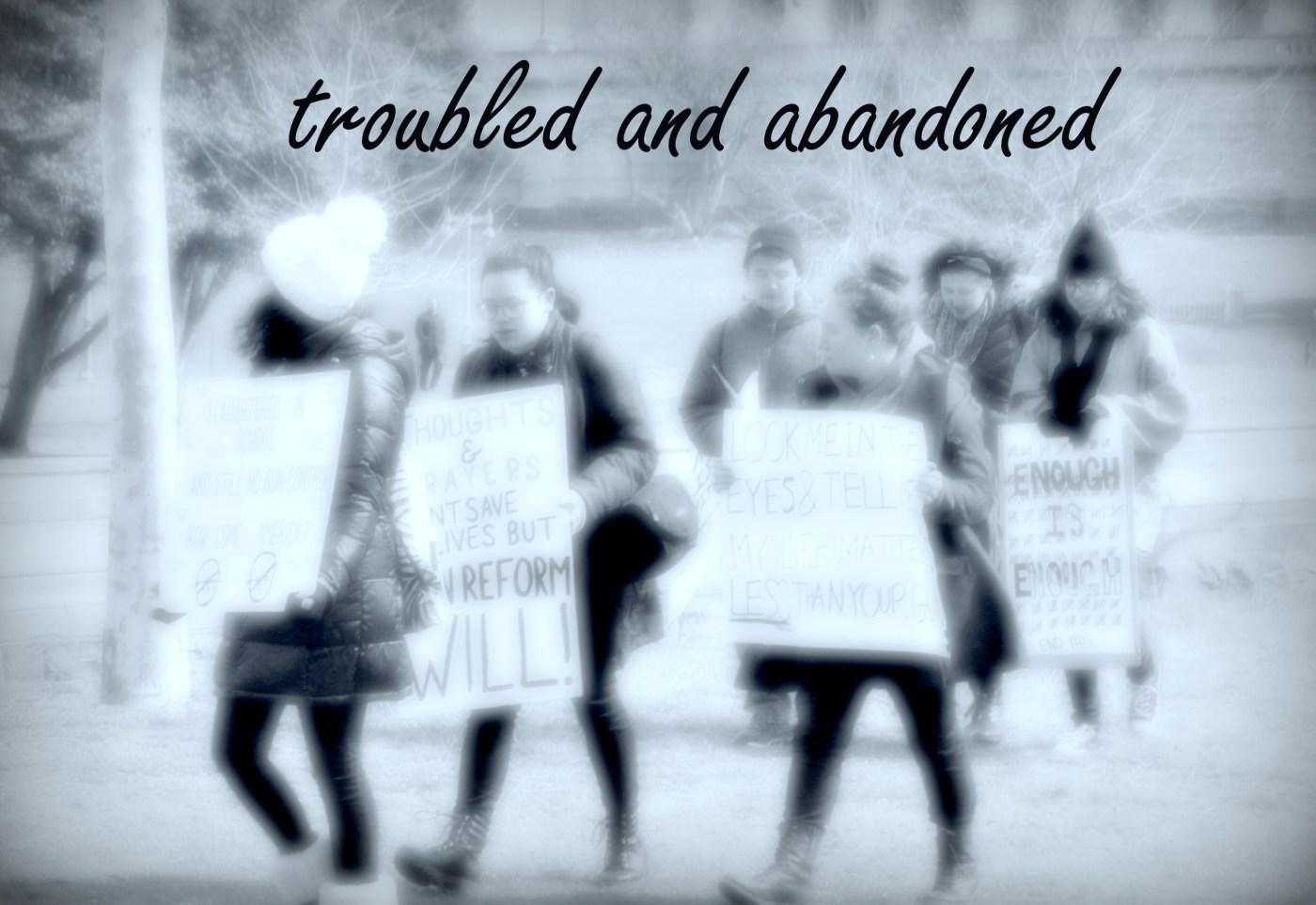
He heard this and said, “Those who are well do not need a physician, but the sick do. Go and learn the meaning of the words, ‘I desire mercy, not sacrifice.’ I did not come to call the righteous but sinners.” Jesus went around to all the towns and villages, teaching in their synagogues, proclaiming the gospel of the kingdom, and curing every disease and illness. At the sight of the crowds, his heart was moved with pity for them because they were troubled and abandoned, like sheep without a shepherd.
In our oblate group, we read, reflect, respond, and rest in sacred scripture. There is a synergy that results from sharing a word or phrase that resonates within, as well as the wisdom or insight each has received. I leave with a greater understanding of other perspectives and of how I am called to follow Christ.
Some reflections from our reading:
Courage, child, your sins are forgiven…Rise, pick up your stretcher, and go home. Jesus’ first instruction is to have courage and to know that sins are forgiven. Many aspects in our life require our courage—difficult conversations, facing our own limitations, expressing love, making or adapting to changes, dealing with physical or emotional suffering, feeling despair, and understanding our next steps in each season of life, to name a few. Life requires courage. Some questions we might consider in taking Jesus’ advice: What is our stretcher or our crutch? Where might we be trapped or paralyzed? We are not to harbor evil thoughts about others or ourselves, knowing that nothing can separate anyone from the love of God. Jesus asks us to rise—right where we are, no matter who we are, and go home. Our home is much more than a brick-and-mortar dwelling. Home is a place of peace, where we can be seen and heard, loved and believed, held and yet free. Home accepts all the parts of our self, our truest self.
Home is where you belong. It is your shelter and place of rest, the place where you can be yourself. –John O’ Donohue, Eternal Echoes: Celtic Reflections on Our Yearning to Belong
They were struck with awe and glorified God whohad given such authority to human beings. We are to become like Christ. We can rise up, go home, follow, listen, have our hearts moved, give mercy, have courage, doubt, choose, forgive and be forgiven, be filled with awe, mix and mingle with the “tax collectors and sinners” of our day (the poor, oppressed, and marginalized), and be compassionate. In a very short story, Jesus asks much and gives much. He is an example of who we can be to others. The crowds were struck with awe by what Jesus did. We, too, can stand in awe of the kindness of others, a spectacular sunrise, or a day of feeling healthy. In each day, there are countless ways to choose awe and gratitude, glorifying God in all.
I did not come to call the righteous but sinners. Accepting both the righteous and the sinner within ourselves is a sort of homecoming. Accepting with humility that we are not one or the other—saint or sinner—is the way to integration and accepting others. Jesus tells the crowd that he desires mercy. We can be merciful, too, slow to judge ourselves and others.
His heart was moved. This line resonated with me the most. Jesus, in his humanity, felt pity for the “troubled and abandoned.” Beyond our bodies, Jesus sees our inner wounds, our fears and anxieties, our feelings. He sees beyond the physical to our spiritual and emotional needs. This, too, we must ask—who might the troubled and abandoned be today? We can only know who they are by deep listening, extending hospitality, and having compassion as Jesus did. And then we must ask, how are we responding to them? With judgment or with a moved heart?






 Being Benedictine