“Vision stories, both empower and heal the soul. The right story told at the right time helps a soul knit together life‘s broken pieces. Stories work in the unconscious mind slowly through time, healing our spirits as we absorb their truths. Soul stories evoke a more powerful response than doctrine or precept. They transmit real life-changing power,” writes Rev. John Sumwalt, a retired United Methodist pastor whom I met on a Celtic Christianity pilgrimage to Ireland and Scotland.
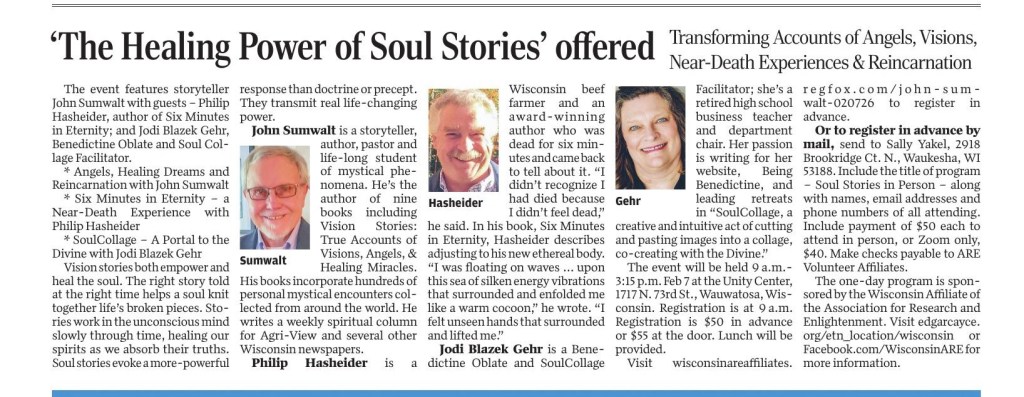
John and I have stayed in touch since then, sharing our interests, writing, and travels. I am honored that he asked me to collaborate on a retreat day called “The Healing Power of Soul Stories” at the Unity Center in Wauwatosa, Wisconsin, on Saturday, February 7. The one-day program sponsored by the Wisconsin Affiliate of the Association for Research and Enlightenment includes presentations and sharing sessions led by John Sumwalt , Philip Hasheider, and myself (see article for bios.)
Article in Agri-View, a Madison, Wisconsin newspaper, written by John Sumwalt.
We come into this world as carriers of stories. We carry generational stories, universal stories, and our own personal stories–stories that tell us something about ourselves and our God. Our SoulCollage® cards tell our soul story, reflecting parts of our inner self and archetypes, or larger energies, that have chosen to work in us. “Stories give us hope, a little guidance, and a lot of bravery,” writes Sue Monk Kidd. It is through our stories that we come to know the Divine. Frederick Buechner goes a step further–“to lose track of our stories is to be profoundly impoverished not only humanly but also spiritually.” SoulCollage® has been an essential prayer practice of listening to the stories of my life. I look forward to sharing!
For more information and a registration form, go HERE.
I realized this most profoundly when I was the one who felt unheard. Perhaps you, too, have had a moment like this when you felt no one was listening—a meaningful, traumatic, challenging, or gratifying experience that needed to be shared fell on deaf ears.
I have written about the Benedictine promises of obedience and the importance of listening to God and others as part of one’s spiritual growth. “Listening requires us to pause, to have silence, and to be open to seeing in a new way. Listening can lead to a shift in perspective, a flash of insight, a new understanding. When you listen closely to another, it is an expression of love,” I shared in a recent reflection.
It is just as crucial to examine the impact it has on others when we are forgetful about listening—understandably, we get busy, or miss clues that others need our ear. Indeed, there are times when others may not realize how important it is (these slights may be easily forgiven), but there may be other times when you or another is summarily dismissed. The message is loud and clear—either you or what you have to say is not valued. It feels hurtful, as if you don’t matter, as if you are insignificant. Being intentionally rejected for your thoughts, ideas, feelings, and experiences leaves a wound, a hole in one’s heart, a sense of being rejected or abandoned.
For me, the experience of not being heard came during a traumatic time for women who had been sexually harassed, abused, or assaulted. I felt my trauma, but also the suffering of so many beyond me. It was a profound compassion, sharing the wound. It came to me then, weeping, that this is what it might feel like for those who have spent their entire lives not feeling listened to, of all those who have been unheard throughout our history, from the enslaved, defeated, oppressed, and marginalized—those who have no one to listen to or validate their pain. They had a story in their heart that needed to be heard, then and now.
“Compassion asks us to go where it hurts, to enter places of pain, to share in brokenness, fear, confusion, and anguish. Compassion challenges us to cry out with those in misery, to mourn with those who are lonely, to weep with those in tears… Compassion means full immersion in the condition of being human.” –Donald McNeill, Douglas Morrison, and Henri Nouwen (quoted in Boundless Compassion by Joyce Rupp)
My heart felt broken—not just for me, but for the lack of compassion I may have shown others. Simultaneously wounded and regretful, a part of me died while something else was taking root—a desire to listen to those who feel unheard, to offer acceptance where there might not be, to advocate for those marginalized. I felt pierced entirely with compassion. Tears flow often now for the suffering that, perhaps, I had not noticed before, the pain that I may have caused others, and the pain that continues to go unnoticed or even flatly denied.
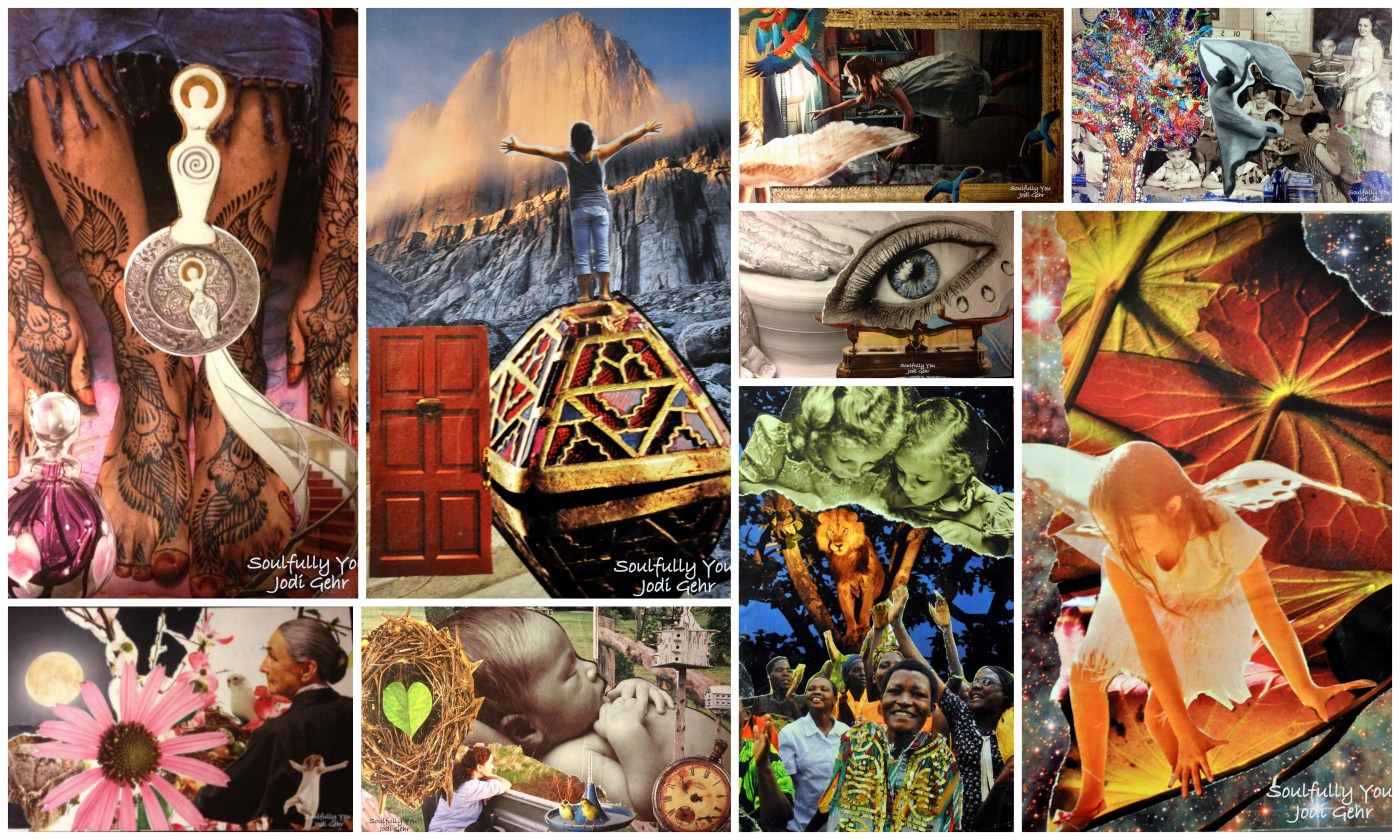
I created a SoulCollage® card shortly after this eye-opening, traumatic experience. Consider the image and the following questions.
“The eyes of the Lord are toward the righteous and his ears toward their cry”. -Psalm 34:15
Questions for reflection:
Do you have a story you would like to share with someone? Have you been able to share it with another or write about it? If so, how did it make you feel to be heard? Does it inspire you to listen to the pain and suffering of the world?
Can there be some healing for your wound by expressing it to God if there is no one to share it with? Are you available for others to share their story with you? What is the consequence for a loved one if their story isn’t shared? Is there a person or marginalized group of people that you may listen to more closely than you have?
May our prayers be heard for all those suffering, and for those who have shared their stories but not been heard. May we listen with “the ear of our hearts,” as Benedict instructs. May we be moved to tears. Amen.
But now faith, hope, and love remain, these three; but the greatest of these is love. –1 Corinthians 13:13
This scripture verse is one of the most frequently read at wedding ceremonies, but it is meant for more than those getting married. We are created to love and be loved—all of us, no matter who we are or our chosen paths in life, whether monk or married.
Our deepest longing is to be loved. Love is the thread that runs through all the world’s religions. In Christianity, the Great Commandment is to “love the Lord your God with all your heart, and with all your soul, and with all your mind” and to “love your neighbor as yourself.”
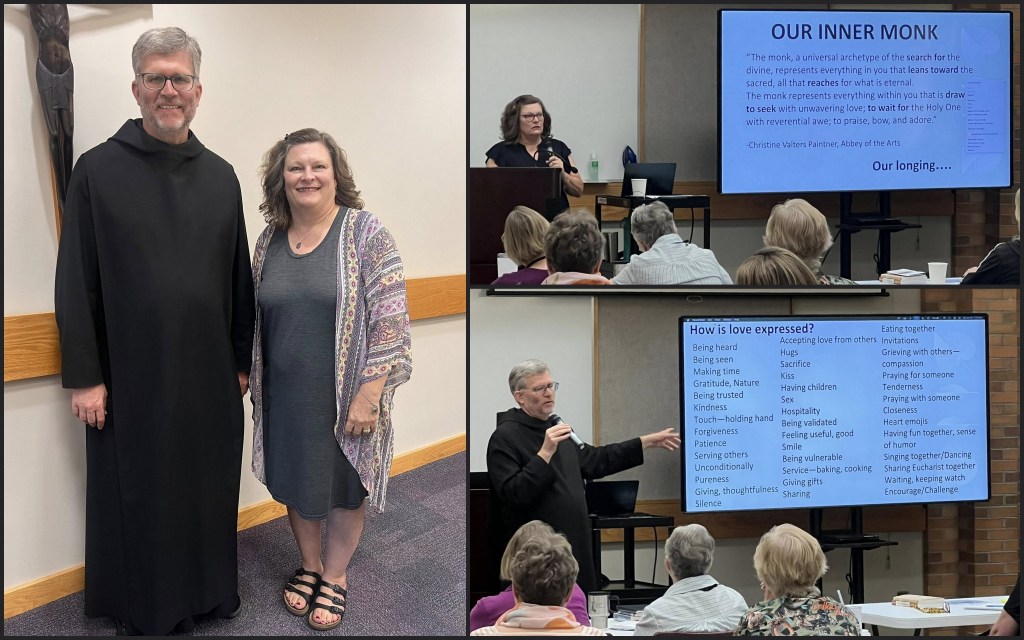
Several years ago, during spiritual direction with Benedictine monk, Fr. Mauritius Wilde, we discussed, despite our different vocations, how much we have in common. We each have a holy longing—to love God, to have a healthy love for ourselves, and to give and receive love. Practically speaking, we are the same age, we are both teachers and retreat leaders, have one brother, have the same middle name (Marie—seriously, what are the odds on that?), we share similar Enneagram personality traits, and each of us professed our marriage or monastic vows 40 years ago, a day apart. I was married on August 17, 1985, and Fr. Mauritius entered the monastery as a novice on August 18, 1985.
After one of many conversations where one of us would say, “That is exactly how it is for me!” or “Me, too!”, I half-seriously, half-jokingly suggested that we write a book about how, setting the whole monk vs. being married thing aside, we experience our love of God and others in many of the same ways. Nearly forgotten, this idea resurfaced a year or so ago, and we decided that leading a retreat together would be a good beginning. Our theme would be love, specifically how the Rule of St. Benedict can help us grow in love and to discover our “inner monk.”
“The monk, a universal archetype of the search for the divine, represents everything in you that leans toward the sacred, all that reaches for what is eternal. The monk represents everything within you that is drawn to seek with unwavering love; to wait for the Holy One with reverential awe; to praise, bow, and adore.” -Christine Valters Paintner
The Rule of St. Benedict shows us the path of love, of nurturing the monk within while living in community. During our retreat, held in July 2025, we shared how the monk’s promises—stability, obedience, and conversion of life—are the foundation for learning and growing in the “school for God’s service.” (RB Prologue 45) For the monk, this place of learning is the monastery. For me, it begins in my family as wife and mother. But each of us is more than our role as a monk or a married person. Each can be transformed by practicing love in our friendships, workplaces, community, and environment.
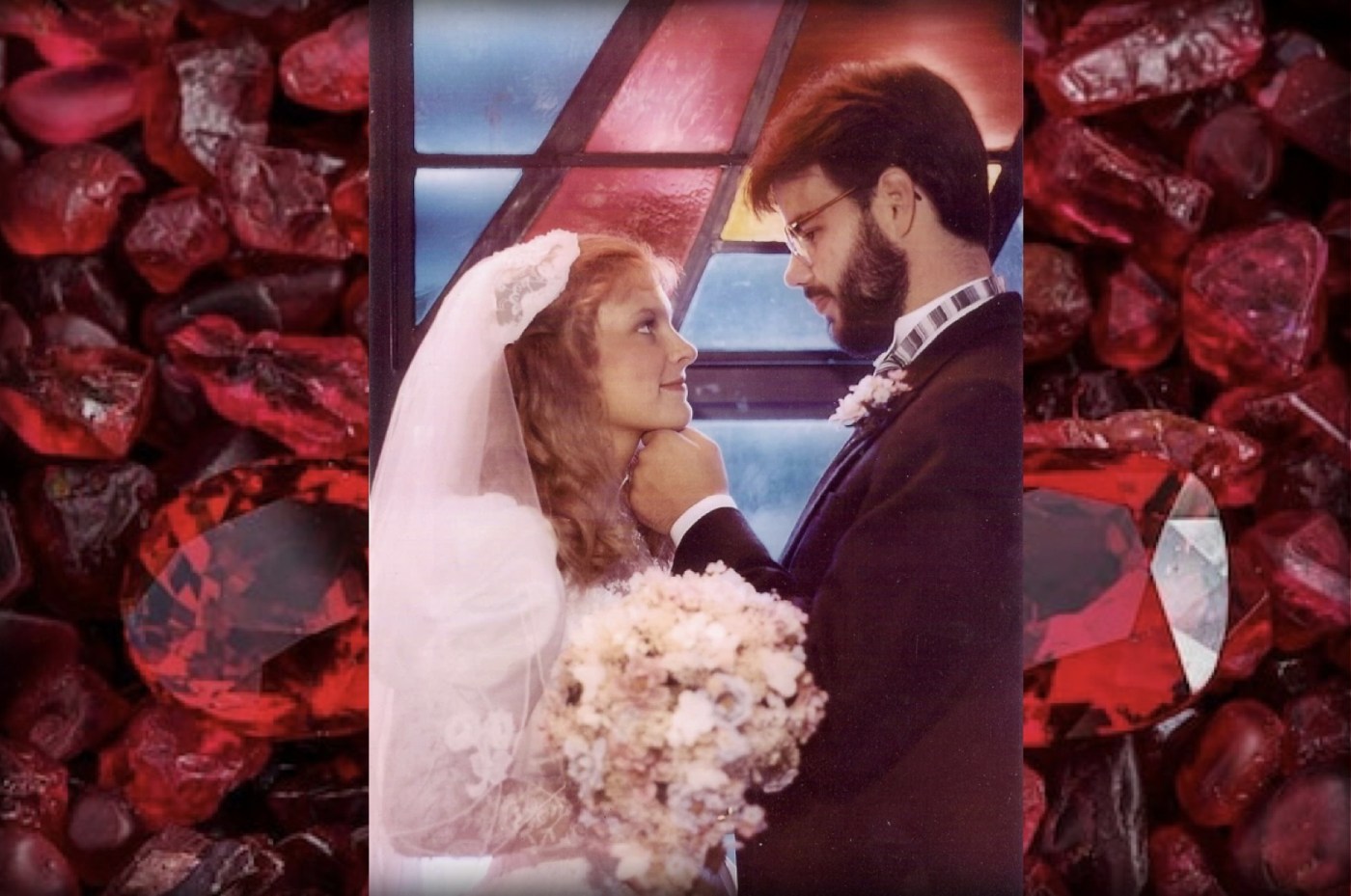
“I promise to be true to you in good times and in bad, in sickness and in health. I will love you and honor you all the days of my life.”
Forty year ago, my husband, Joe, and I made our marriage vows on August 17, 1985. As a 19-year-old bride, I had little understanding of what those words meant or would require. I imagine it is the same for many. We have hopes and expectations, albeit idealistic or romanticized. We may also have a good idea of what we hope our marriage will NOT be like. Surely, it’s a good place to start, but it is then that the real work of love begins.
Stability, a Benedictine value, is what is promised in marriage when we vow, “all the days of my life.” We promise to stay, to not run away from challenges or difficulties; instead, we remain present to the relationship, to see what we discover about each other. After writing seventy-two chapters in The Rule, Benedict titles his last chapter, “This rule only a beginning of perfection.” In other words, marriage, or any commitment we make, requires practice—making mistakes, forgiveness, and always beginning again.
To love is a decision. A marriage is not made, once and for all, when the I-dos are exchanged. A marriage is constantly being recreated; it is always in the process of becoming.A marriage is made of moments. Moments we would like to forget, moments we must forgive, and moments that help us become more fully who we are. There are moments of joy, adventure, contentment, and the making of beautiful memories. When you string them all together, you get a picture of a life built together.
I love that the ruby, a precious gem, second only to the diamond in toughness and durability, is the traditional symbol for a 40th wedding anniversary. Throughout history, many cultures and religions have associated the ruby with mystical or spiritual qualities, representing love, passion, protection, vitality, and wealth. (Ruby Symbolism and Legends)
The word “ruby” comes from the Latin word “ruber,” meaning red. The red heart of Valentine’s Day reminds us of a desire for passion and romantic love. One also thinks of the redness of blood, which carries oxygen to all parts of the body, giving life.
Joe and I have experienced this “ruby” nature, not all in one day, month, or year, but over time and as a way of life. The ruby’s “inner glow” led to beliefs that it contained an inner fire or “an inextinguishable flame”. This inner glow, with a playful spirit and sense of humor, has fueled our commitment to protect our marriage, to be resilient, to learn, grow and change. We are wealthy in countless ways—a beautiful daughter and son-in-law, great friends and family connections, opportunities for travel, hobbies, personal interests, and, now, more time for together.
Our new season of retirement. After lengthy careers in law enforcement and education, both Joe and I have retired—letting go of our careers, but not what was at the heart of our vocation. We continue to work in other ways: I lead SoulFully You retreats and workshops on creativity and the spiritual life, write essays for Being Benedictine, and belong to a variety of book/study groups, including oblates. Joe drives senior citizens to recreational activities and appointments, enjoys travel with his siblings, meeting with friends, and cultivating his bourbon collection. We have time to slow down, take a nap when we want, read, and binge-watch TV shows, travel more, and enjoy spontaneous trips to be with our daughter Jessica and her husband, John.
“We have God and we have each other. We have our island community, fragile, and yet a fortress.”
–Parable of the Sower, Octavia Butler
The past few months have presented some hard times in my circle of friends and family. Each week presents a new situation—diagnosis, dying, death—all of it; not to mention the growing instability in our country and world. It seems impossible not to feel sadness, loss, fear, even despair.
Over a recent campfire conversation with friends, my husband shared a sympathy card he received after his brother, Steve, passed away. Overcome with tears, he could not get through the words, so I finished reading it for him. I, too, was in tears by the time I reached the end. And that’s when it hit me–this is how we must walk through any darkness we face: KINDNESS.
My husband’s former co-worker was so thoughtful! His words are an example of how we can extend kindness to others. We are grateful for all the acts of kindness from so many during the last few weeks and throughout our lives. Kindness matters.Continue reading “Kindness Matters”→
Steven Gehr, my husband’s oldest brother at 66 years old, passed away in the early morning hours of Sunday, January 26, 2025. After a tragic accident, Steve was placed on a ventilator to assist his breathing, and within hours it was breathing for him. It was clear that letting Steve go was the best decision; he would be physically unable to live the joyful, carefree life he knew. The oldest child of seven children born to Marvin and Mary Gehr, Steve was born with intellectual disabilities. Steve was the center of the family, bringing everyone together in the spirit of joy with his huge grin and infectious laugh. His joy was everyone’s joy.
The Gehr Family, circa 1966. Steve stands between his mom and dad. Baby Kathy and I are the same age. In order, left to right–David, Karen, Diane, Mary/Kathy, Steve, Marvin, Alan and my husband, Joe…looking a little grumpy. Edit: Joe and his brother David look so much alike NOW that I mixed them up in the above photo. Joe, my husband, is on the left (isn’t he adorable?) and Dave is on the right. Their sisters said they had pre-arranged to look grumpy. LOL
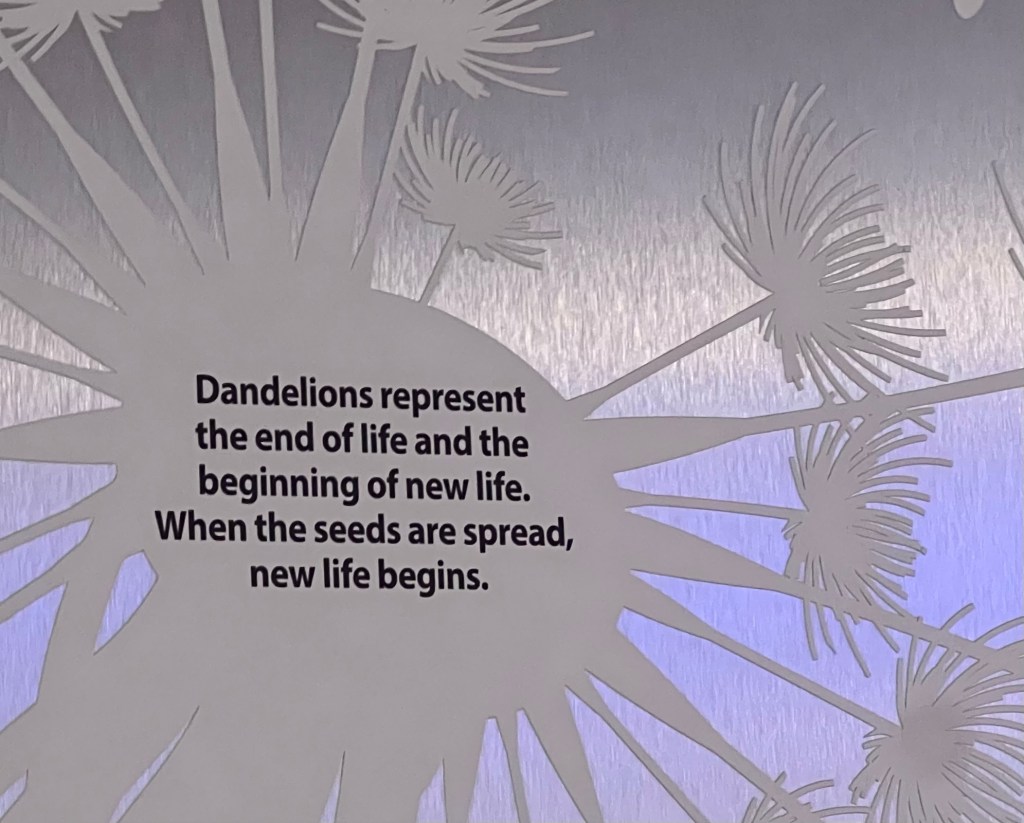
Steve’s life became the seed for new life when he was approved to be an organ donor. The decision to pursue the organ donation process was influenced by our family experience of loss just two years ago. Alan, Steve’s brother, lost his life partner Greg when he passed waiting for a liver transplant. It was a difficult few days waiting for organ recipient arrangements, but knowing others will receive Steve’s liver and kidneys brings peace.
There is so much we love about Steve.
Steve got excited about things that were special to him—visits to the Goodwill to look for records, family gatherings, trips to McDonald’s (cheeseburger, French fries, Diet Coke), opening Christmas presents, having a Diet Coke or red coffee (the Folgers label that has caffeine.) The simplest things brought him so much joy, and his joy lit up the room.
Steve loved family get-togethers. When he returned to Glenwood, where he lived in a group home, he would already be talking about his next visit. In the fall, he envisioned Thanksgiving dinner, reciting the line-up of menu items, ticking off the list by counting on his hand—turkey, mashed potatoes, salad, white dressing (Ranch, which he could eat by the spoonful), pumpkin pie, and so on.
Lectio Divina—Rule of St. Benedict, Chapter 72, The Good Zeal of Monks
In the 1500-year-old Rule of St. Benedict, monks who live in a monastic community are presented with a choice to guide their relationships—to embrace good zeal which monks should foster with fervent love rather than the zeal of bitterness. This choice is a call to holiness and contributes to an atmosphere of separation or togetherness in the community.
Benedict is clear—if monks choose to respond to their brothers with bitterness, they cultivate an environment of separateness. They become distant from God and the community. But if monks choose to foster enthusiasm for loving their brother, Benedict writes that it will “bring us all together to everlasting life.”
Love is the antidote to separation and bitterness. Benedict encourages enthusiasm and eagerness when expressing our fervent love to God, one’s abbot (or leader), and one’s brothers. He also provides an action plan to demonstrate love.
Chapter 72 begins and ends in love—what is hoped for (” a good zeal which separates from evil and leads to God and everlasting life) and what is the promised outcome ( to “bring us all together in everlasting life.”) The specific instructions to demonstrate “fervent love” are to show respect to others; be patient with other’s weaknesses; practice active listening; and to consider the best interest of others, not just our own.
God’s work and desire is to “bring us all together” through our acts of love. We must consciously choose between holding onto bitterness, which separates us from God and from others. We must be committed to this goal to keep a community, family, organization, or friendship from growing apart through conflict, misunderstandings, and the bitterness that might result. This can be hard, there is no denying it.
We demonstrate our preference for “nothing whatever but Christ” when we see and treat others as Christ. Christ dwells within us, defining who we are. Christ, then, is active in creating togetherness in the community.
In a community, each one matters. We cannot become holy without the other; we are responsible for co-creating and honoring connections with others. We live in context with everyone as a member of the body of Christ. God works in us as we work together. The whole thing falls apart when we do not consider the bigger picture.
The Rule is relevant today for Benedictine oblates, lay associates of a monastery, and those who find wisdom in the spiritual insights of St. Benedict to learn how to live in connectedness with family, friends, coworkers, team members, and in all our relationships. We have much to learn.
February 2021 Lectio Divina and Oblate Reflections
Sources: Colossians 3:12-17; Always We Begin Again: The Benedictine Way of Living by John McQuiston II (pages 17-22)
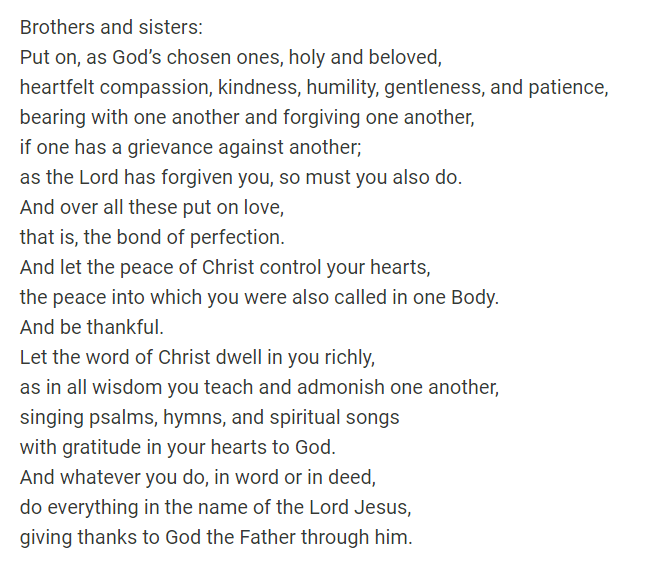
For our Lectio Divina practice, we read more deeply Colossians 3:12-17
We share aloud, some of the words and phrases that resonate with us:
God’s chosen ones, holy and beloved. Put on…heartfelt compassion, kindness, humility, gentleness, and patience.
Bearing with one another. Forgiving one another. Put on love….that is the bond of perfection.
Let the peace of Christ control your hearts. Be thankful.
Let the word of Christ dwell in your richly. Gratitude in your hearts.
Compassion: We think of compassion as feeling sorry for someone, but it is to feel with someone, to enter into the sufferings and joys of another person. Jesus had compassion for us, entering fully into our lives. He is one with us. We are called to emulate this kind of compassion with others. Sometimes there may not be much we can say to another, but we can give our presence, a physical touch. Wordless gestures are just as compassionate, perhaps even more so.
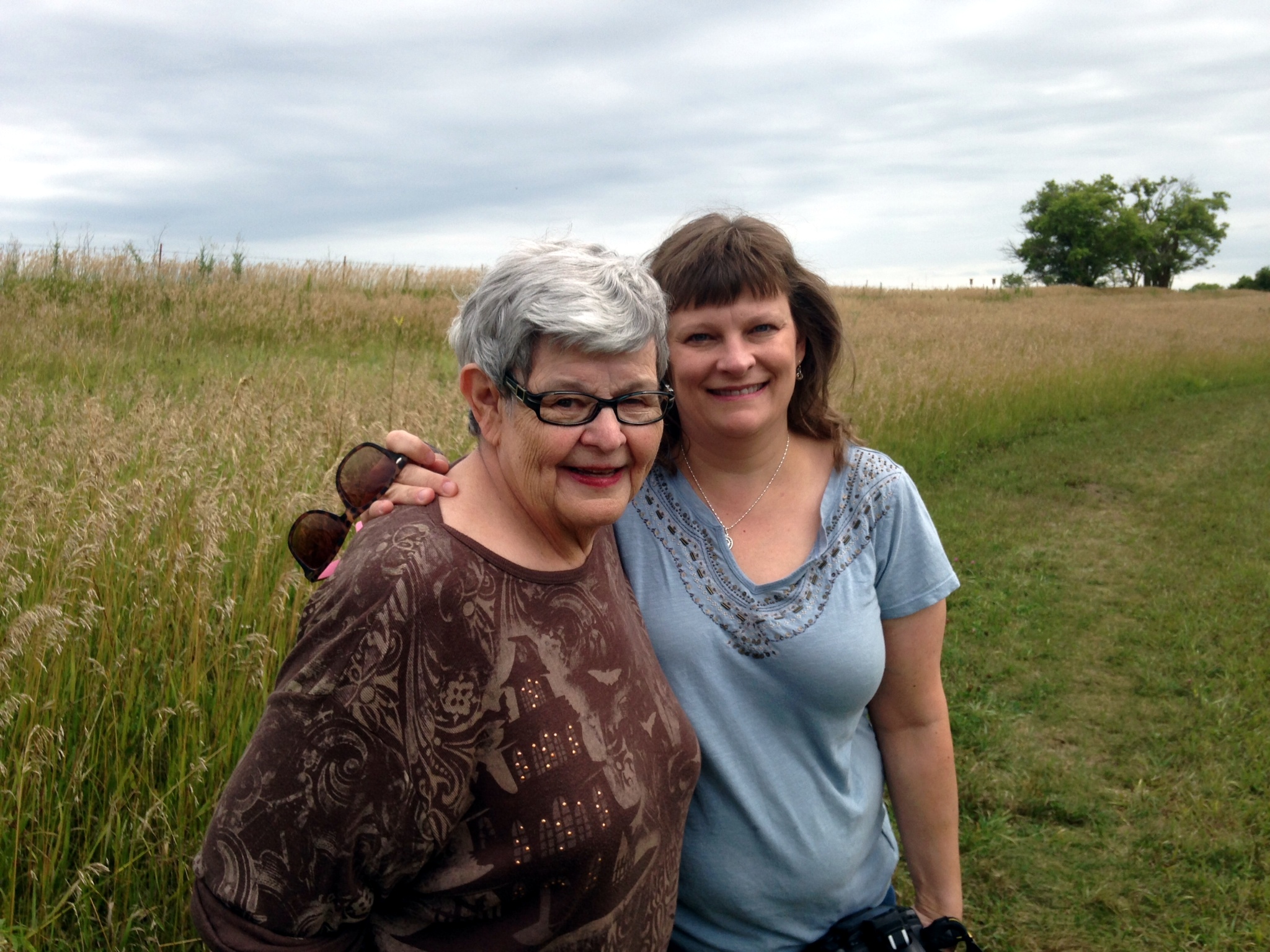
Four years ago we lost Mary Gehr, lover and giver of life. I was blessed to have her as a mother-in-law. My husband, Joe, said in her eulogy, “We were taught the meaning of selflessness, caring, patience and compassion for humankind. We were taught to see people for who they were, not for who the world tells us they are.
My mother’s arms were always open and welcoming to anyone, it didn’t matter who you were, where you came from or what you wanted, for my mom, it was about what she could do to help…Whenever you saw Mary, you would see a big smile on her face. It never mattered what kind of mood she was in; she was always happy to see you. If you didn’t want a hug, you were going to get one anyway.
Sometimes I think she should have gone into politics. I think if she was the Secretary of State, a lot of countries would end their conflicts and hug each other instead. If you only met Mary for a few minutes, she would make an impression on you that would last a lifetime. Couldn’t our country use a few more Mary Gehrs right now?”Continue reading “Ode to Mary: Lover and Giver of Life”→












 Being Benedictine