Search

Being Benedictine

Living SoulFully as an Oblate of St. Benedict

Tag

present moment

Naming the Darkness Within: An Advent Reflection

December 2025 Oblate Reflections

Presentation Leader: Fr. Jim Secora – Advent “He is Coming”

“The people who walked in darkness have seen a great light.” (Isaiah 9:2)

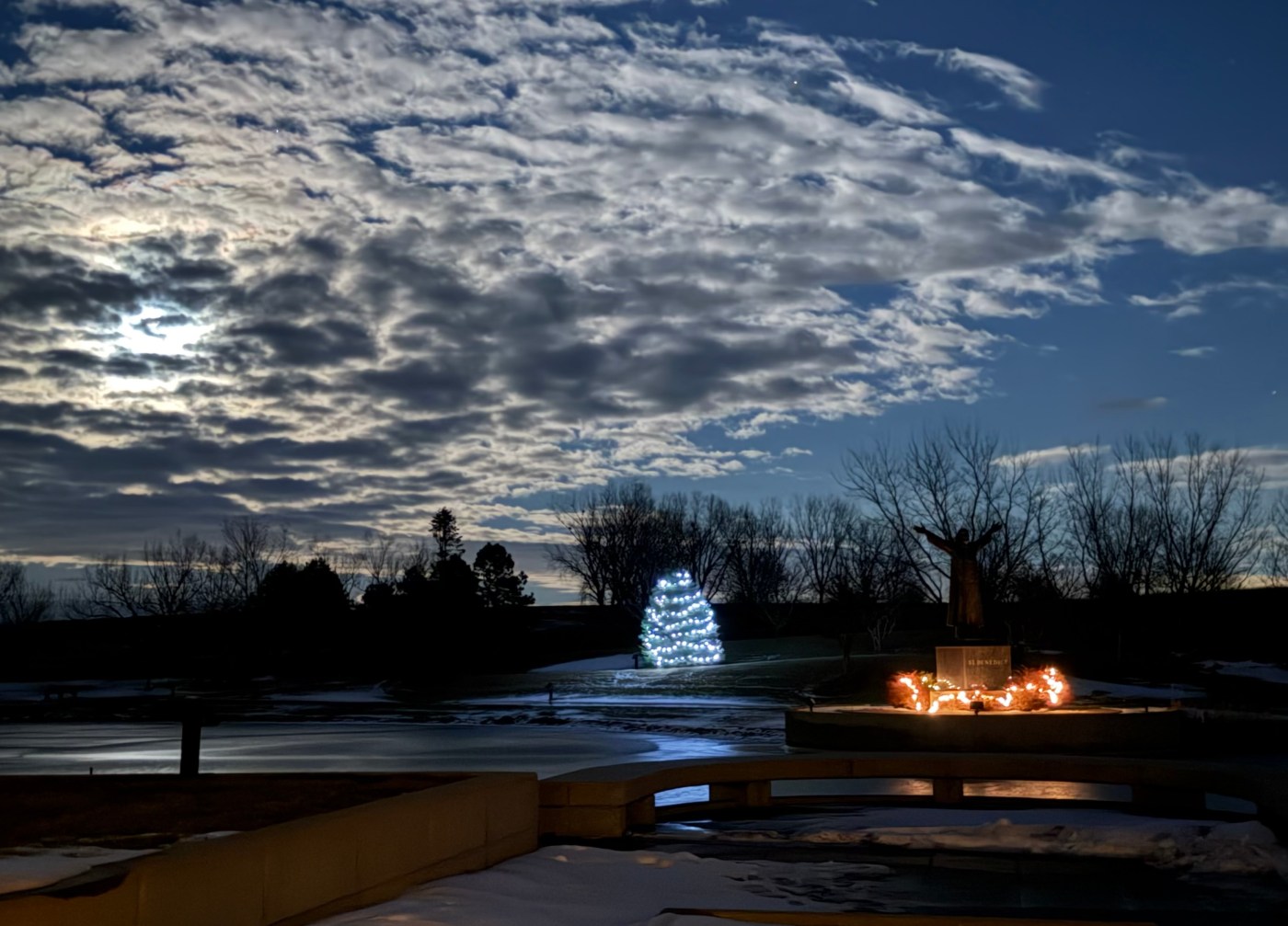
We seek the light. In total darkness, our eyes can see a single point of light up to 5 miles away. This is the lesson of Advent, shared by Fr. Jim Secora, a retired priest and Benedictine oblate. We must accept the darkness, become comfortable with it, and not run from it. We must confront the darkness in the world and from within.

We live in a generation of darkness, as many generations before us have. There is much suffering—with refugees, immigrants, those lacking good health care, those who cannot afford necessities, who are sick, or have personal suffering. Advent calls us to confront the darkness. We cannot appreciate the light around us until we do.

Gaudete Sunday, the third Sunday of Advent, is a reminder of the joy we have and of the joy to come. The light of Christ is here and is coming—both are true. Miracles happen every day when we pay attention.

The fear of uncertainty, the unknown, leads to personal darkness. Even Jesus felt it. And he faced it head-on. We must practice trusting, letting go, and sitting in discomfort. If we don’t have an opportunity to see the need for light in our lives, why do we need Christmas? Fr. Jim suggests.

In small groups, we shared our personal experiences in response to the following questions—

1. Name the experiences of darkness that you find in the world, the church, the lives of people, and if only if you are comfortable, any area of darkness that you have or are experiencing. Where or when have you experienced light piercing the darkness?

2. The people of Israel sought out John because he offered them a vision of salvation. Where in the life of the world do you see the need for a savior? Where in my life, do I need to experience a rebirth of Jesus and his gift of salvation?

3. What is the star you are following now? And where is that star in its present radiance in your life leading you?

Much of our personal darkness comes from a feeling of helplessness. We want our discomfort relieved, our problems fixed. We live in a cloud of doubt and uncertainty, where we can’t “fix it” and no one else can “fix it” for us either. We forget that often the fear of the unknown may be worse than the reality that may be to come. But this presents the question: What do we trust in?

During my greatest fear, waiting for a life-changing health diagnosis, I experienced this desperation. And the only answer, the only peace is to trust in the breath of the Divine. Taking one deep breath at a time, I was more aware of the connection to the greater Source of peace. The breath prayer is the start of a surrendering practice, a continual turning it over to God, a reminder that we cannot assume to know how things will turn out or that we know what is best. This spiritual practice is impossible without humility.

“We have made ourselves the love of our lives and found little to adore at the altar of our egos. We have made ourselves our own gods and have forgotten God in the process…Joy, the deep-down awareness of what it means to live well, to live productively, to live righteously, is made out of self-giving, simplicity, and other-centeredness…Joy is not about what happens to us, the manger indicates. It is the meaning we give to what we do that determines the nature, the quality of the lives we live.”

-Joan Chittister, The Liturgical Year

It takes humility to surrender our “me” to “we.” We need a redemption of me. The stars we can follow are trust, acceptance, joy, and peace. Practicing gratitude for the present moment, finding peace, joy, and strength in whatever situation we are in, not wishing that we were somewhere else. Our star is directly above our present moment.

More reflections on Advent.

The Light Shines in the Darkness

Holy Darkness: An Advent Meditation

You Are A Sanctuary for the Divine ~ Sprigs of Rosemary Online Advent Retreat

An Advent Call of Humility: Mary and Zechariah
Flood the World with Love: An Antidote to Darkness

© Jodi Blazek Gehr, Being Benedictine Blogger

10 Reasons Benedictines Love Silence

I carefully consider everything that I write and share here, especially the more personal or contentious reflections. I rarely write and post on the same day. Not so with my speech. I find myself saying often enough, “Did I just say that out loud?” Words fly out of my mouth much faster than they flow from my pen or keyboard.

 Perhaps this is why I enjoy journaling and writing so much. It slows my mind down. In silence, I can be more deliberate, careful, and organized in what I share. A healthy respect for silence could save me some angst in times when my mouth works faster than my mind.

At our annual oblate retreat, with the theme “Building Community Through Our Oblate Promises,” the importance of silence was the topic of the opening session led by Fr. Thomas Leitner, the administrator of St. Benedict Center and a monk who lives at the monastery across the road. Throughout the weekend, we would learn about and practice silence.

Why is silence so fundamental to Benedictine spirituality?

Silence is the way to self-knowledge. A discipline of silence confronts us with ourselves. “Silence is a way for us to put up with ourselves the way we are. Not everything that comes to mind at times of silence is pleasant. Repressed needs and wishes may come up, repressed anger, and perhaps missed opportunities,” Fr. Thomas shared. Silence gives our wounds space to surface, allowing us time to wrestle with and soothe our pain in healthy ways. Silence allows us to see ourselves unfiltered without the influence of others.

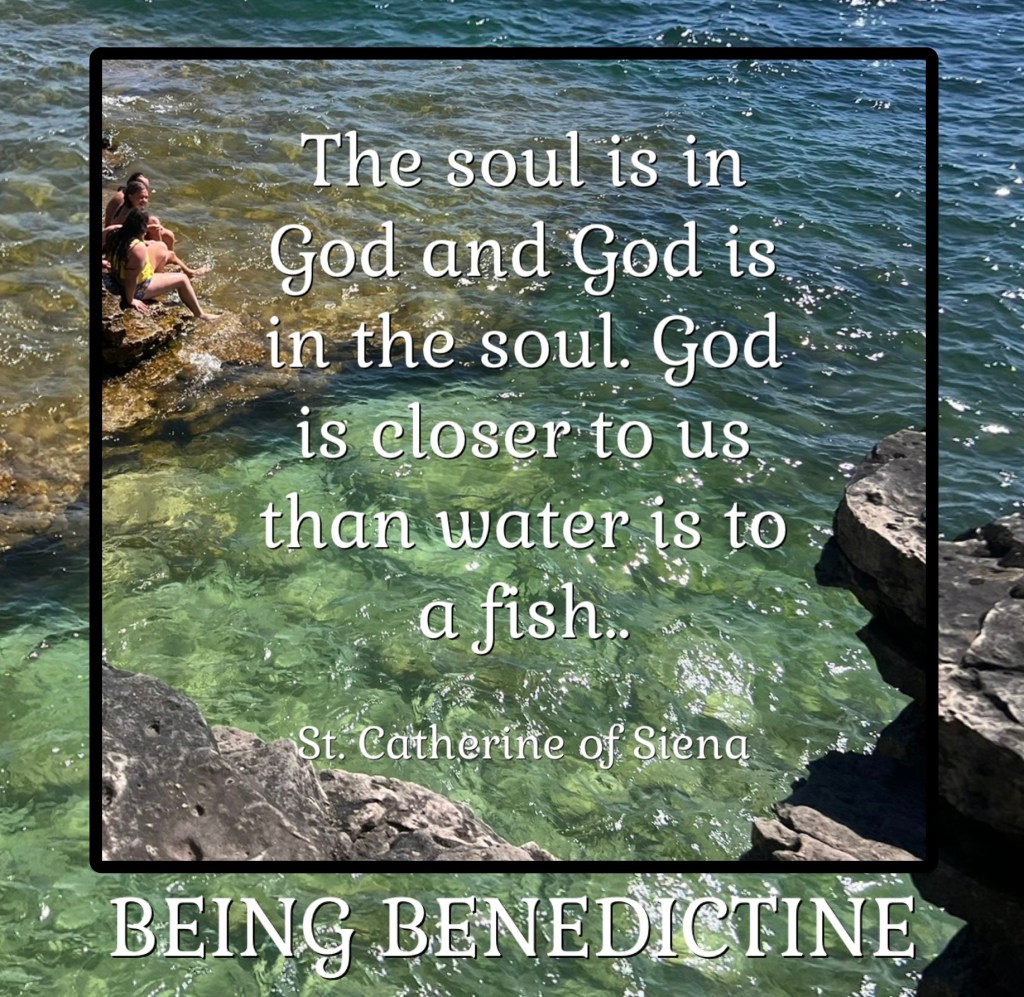
In The Interior Castle, St. Teresa of Avila uses imagery of a castle for our soul, emphasizing “how necessary this room (of self-knowledge) is…we shall never completely know ourselves if we don’t strive to know God.” She writes that God dwells within us, and to know God, we must first know ourselves. Hard, but necessary, work to “know thyself,” as the ancient Greek maxim suggests.

Silence connects us to the Divine. Seventh-century bishop and theologian, St. Isaac of Syria, writes:

We enter this “treasure house,” our very soul, through the practice of prayer. Some of us may be conditioned to think of prayer as a transactional bubble-gum-machine approach to asking God for what we want. We put in a coin; God supplies the big gumball. Our prayers are “answered.” Yet this is not the kind of prayer that leads to self-knowledge or to a connection with God. Consider a poem by the 19th-century Danish theologian Søren Kierkegaard that points to a different kind of prayer.

Silence builds confidence and leads to self-respect.

“As my prayer became more and more devout and interior,” I come to know myself with greater depth. This knowing builds my confidence: I have been created just as I am, in the image of God. I forgive myself for weaknesses and celebrate my gifts. I seek less approval from others. I have “less and less” to say to justify, convince, or plead my case of worthiness to myself or others.

Teacher, writer, and friend, Parker Palmer, writes,One of our most debilitating illusions (is) that the answer to our problems is always ‘out there’ somewhere, never ‘in here.’ It’s an illusion that’s constantly reinforced by educational and religious institutions that make us dependent on “experts” and “authorities.” We need not look for knowledge in others; we can trust our own interiority, the Divine Expert Within. I can grow in self-respect, knowing God is within me, intimately speaking to me when I am silent long enough.

Continue reading “10 Reasons Benedictines Love Silence”

Put on a Heart of Compassion

February 2021 Lectio Divina and Oblate Reflections

Sources: Colossians 3:12-17; Always We Begin Again: The Benedictine Way of Living by John McQuiston II (pages 17-22)

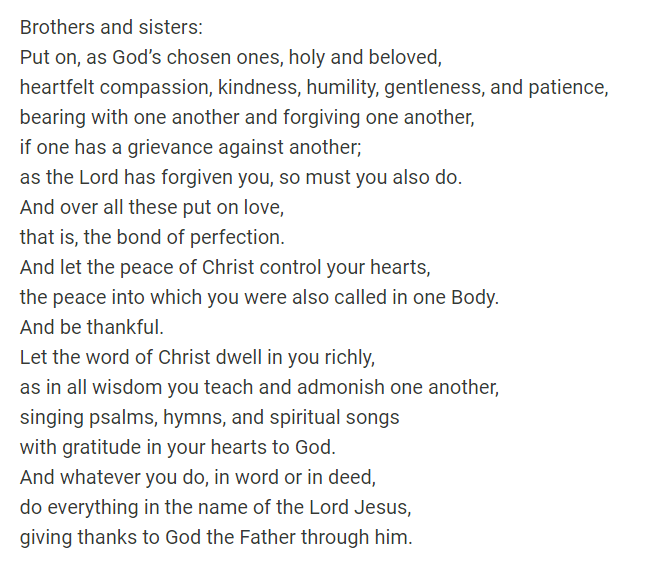
For our Lectio Divina practice, we read more deeply Colossians 3:12-17

We share aloud, some of the words and phrases that resonate with us:

God’s chosen ones, holy and beloved. Put on…heartfelt compassion, kindness, humility, gentleness, and patience.

Bearing with one another. Forgiving one another. Put on love….that is the bond of perfection.

Let the peace of Christ control your hearts. Be thankful.

Let the word of Christ dwell in your richly. Gratitude in your hearts. 

Compassion: We think of compassion as feeling sorry for someone, but it is to feel with someone, to enter into the sufferings and joys of another person. Jesus had compassion for us, entering fully into our lives. He is one with us. We are called to emulate this kind of compassion with others. Sometimes there may not be much we can say to another, but we can give our presence, a physical touch. Wordless gestures are just as compassionate, perhaps even more so.

Continue reading “Put on a Heart of Compassion”

Blog at WordPress.com.

Up ↑