Search

Being Benedictine

Living SoulFully as an Oblate of St. Benedict

Tag

silence

10 Reasons Benedictines Love Silence

I carefully consider everything that I write and share here, especially the more personal or contentious reflections. I rarely write and post on the same day. Not so with my speech. I find myself saying often enough, “Did I just say that out loud?” Words fly out of my mouth much faster than they flow from my pen or keyboard.

 Perhaps this is why I enjoy journaling and writing so much. It slows my mind down. In silence, I can be more deliberate, careful, and organized in what I share. A healthy respect for silence could save me some angst in times when my mouth works faster than my mind.

At our annual oblate retreat, with the theme “Building Community Through Our Oblate Promises,” the importance of silence was the topic of the opening session led by Fr. Thomas Leitner, the administrator of St. Benedict Center and a monk who lives at the monastery across the road. Throughout the weekend, we would learn about and practice silence.

Why is silence so fundamental to Benedictine spirituality?

Silence is the way to self-knowledge. A discipline of silence confronts us with ourselves. “Silence is a way for us to put up with ourselves the way we are. Not everything that comes to mind at times of silence is pleasant. Repressed needs and wishes may come up, repressed anger, and perhaps missed opportunities,” Fr. Thomas shared. Silence gives our wounds space to surface, allowing us time to wrestle with and soothe our pain in healthy ways. Silence allows us to see ourselves unfiltered without the influence of others.

In The Interior Castle, St. Teresa of Avila uses imagery of a castle for our soul, emphasizing “how necessary this room (of self-knowledge) is…we shall never completely know ourselves if we don’t strive to know God.” She writes that God dwells within us, and to know God, we must first know ourselves. Hard, but necessary, work to “know thyself,” as the ancient Greek maxim suggests.

Silence connects us to the Divine. Seventh-century bishop and theologian, St. Isaac of Syria, writes:

We enter this “treasure house,” our very soul, through the practice of prayer. Some of us may be conditioned to think of prayer as a transactional bubble-gum-machine approach to asking God for what we want. We put in a coin; God supplies the big gumball. Our prayers are “answered.” Yet this is not the kind of prayer that leads to self-knowledge or to a connection with God. Consider a poem by the 19th-century Danish theologian Søren Kierkegaard that points to a different kind of prayer.

Silence builds confidence and leads to self-respect.

“As my prayer became more and more devout and interior,” I come to know myself with greater depth. This knowing builds my confidence: I have been created just as I am, in the image of God. I forgive myself for weaknesses and celebrate my gifts. I seek less approval from others. I have “less and less” to say to justify, convince, or plead my case of worthiness to myself or others.

Teacher, writer, and friend, Parker Palmer, writes,One of our most debilitating illusions (is) that the answer to our problems is always ‘out there’ somewhere, never ‘in here.’ It’s an illusion that’s constantly reinforced by educational and religious institutions that make us dependent on “experts” and “authorities.” We need not look for knowledge in others; we can trust our own interiority, the Divine Expert Within. I can grow in self-respect, knowing God is within me, intimately speaking to me when I am silent long enough.

Continue reading “10 Reasons Benedictines Love Silence”
The Sound of Silence

December 2023 Oblate Reflections

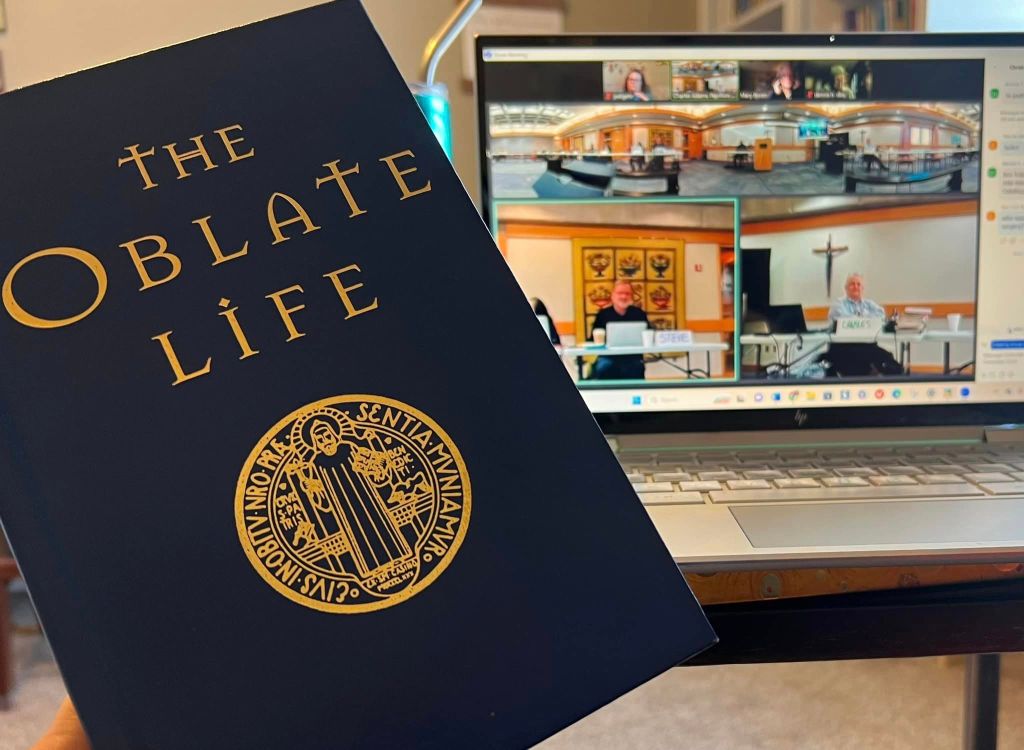
Source: The Oblate Life, edited by Gervase Holdaway, OSB, 2008

Men and women who have made monastic vows, called monks, practice stability by committing to a specific monastery. “The monk is an archetype, whether we live in a monastery or not, we have a sense of what it means to be a monk. We long to be together with God in solitude.” (Fr. Mauritius Wilde, OSB)

Being Benedictine as an oblate is making a commitment to a monastery, living the core values of obedience, conversion of life, and stability while following the Rule of St. Benedict as monks “in the world,” meeting monthly to practice Lectio Divina and discussing a spiritual reading. In the age of Zoom meetings (in which I, gratefully, participated this month), it is a good reminder that it is the monastery that I am drawn to—to the sacred rhythm of prayer and respect for silence, the theme of our discussion (December 2023.)

Grateful for the option of Zooming in to Oblate meetings, but it’s never quite the same. I love to go to our monastery and retreat center.

“If we are to learn about silence and cultivate its art form, the monastery is the first place to visit, for it is within the ancient tradition of monasticism, that we can begin to understand the relevance and the need for silence as a discipline, and a way of life. It is highly relevant that the very first word of the rule of Saint Benedict is listen.”—Susie Hayward, Silence, The Oblate Life

In silence, we can be transformed. “We will begin to see the ‘world’ differently, our breathing will become more rhythmical, surrounding color will intensify and brighten and our eyes will see more clearly and with greater perception.” (Hayward) We become more attentive. We notice the details around us, and we notice what is happening within us.

I had this experience during a contemplative prayer retreat over 20 years ago, my first visit to the monastery and retreat center that has become such an important part of my life. Even during our meals, we sat in silence, which contributed to a heightening of my senses—the quiet and stillness provided a backdrop through which I appreciated the color and tastes of ordinary foods—lettuce, tomatoes, bread, pasta, butter, milk.  It was pure ecstasy to look, touch, and taste—to interact with my food.  This sentiment—the sensitivity to physical, tangible cues—carried over into watching fish swim in the pond, grasshoppers jump from one station of the cross to the next, a candle flickering.  All things seemed to be created for me.  Every movement, color, taste, and sensation seemed special, whereas just days before it was ordinary.

Silence magnifies an experience. The practice of silence helps cultivate attentiveness to others and to how God is working in our lives. Thomas Merton writes, “By learning to listen… we can find ourself engulfed in such happiness that it cannot be explained: the happiness of being at one with everything in that hidden ground of Love for which there can be no explanations.” This type of interior silence must be cultivated. Visiting a monastery where there is silence can help, but one can create physical spaces in our own homes to remind us that times of silence are needed.

Hayward writes that “without silence, God has no voice.” No doubt silencing the noise of our daily lives can help us be more aware of the divine—in creation, in others, in words we read, in the thoughts that run through our mind, and in the story we tell ourselves. Indeed, silence allows us to experience the sacred, but many of us have felt God working, “God’s voice,” through the written or spoken words of others. In discussion, we wonder—do we really need absolute silence to hear God?

Perhaps Hayward means that we need to silence ourselves—to shut our mouths, to let go of thoughts and stories, and to be truly present wherever we find ourselves. If we are in conversation with another, there is sound, not silence, but we can practice interior silence by deeply listening to the other and standing witness to another’s story. It is important to remember that the first word in the Rule of St. Benedict is “Listen.” We must practice silence, both in words and thoughts, in the presence of the divine, including others.

Hayward writes about “the experience of feeling the total ‘presence’ of another person, in such a profound way that ‘in that moment’ we will have felt absolutely heard, totally cared for and completely understood.” What a gift to be heard and to hear others without the noise in our heads! She continues, “Listening reflectively in this attentive and empathic way allows each person to respond to the other fruitfully.”

God is working in this ‘total presence,’ the compassionate listening to another’s story. May we practice silence, to listen, see, and fully experience the humility of unknowing all that we think we know, to experience a oneness with our Creator, with creation, and with all those whom we share both.  

© Jodi Blazek Gehr, Being Benedictine Blogger

Praying with Collage: Seek Peace and Pursue It

School starts this week. It has been five months since I have been in a real-life classroom with my students. After spring break, we immediately went to online learning for the remainder of the school year.

What it means to be a teacher, captured in a SoulCollage® card. More blogs about teaching HERE

I have been so encouraged by those who have asked me how things are going, promising their prayers. I was encouraged by my friend, Sara, to create a SoulCollage® card that I could keep at school as a reminder to pray when I am feeling overwhelmed or anxious. My prayer is that I can find some peace despite the fear of the unknown. My prayer is to remember to seek peace and pursue it, as St. Benedict instructs (RB Prologue 17), and to include time in my day for silence and meditation. Continue reading “Praying with Collage: Seek Peace and Pursue It”

Silence as Sanctuary ~ Sprigs of Rosemary Online Advent Retreat (Session 3)

Welcome to Session 3—Silence as Sanctuary

build a cell

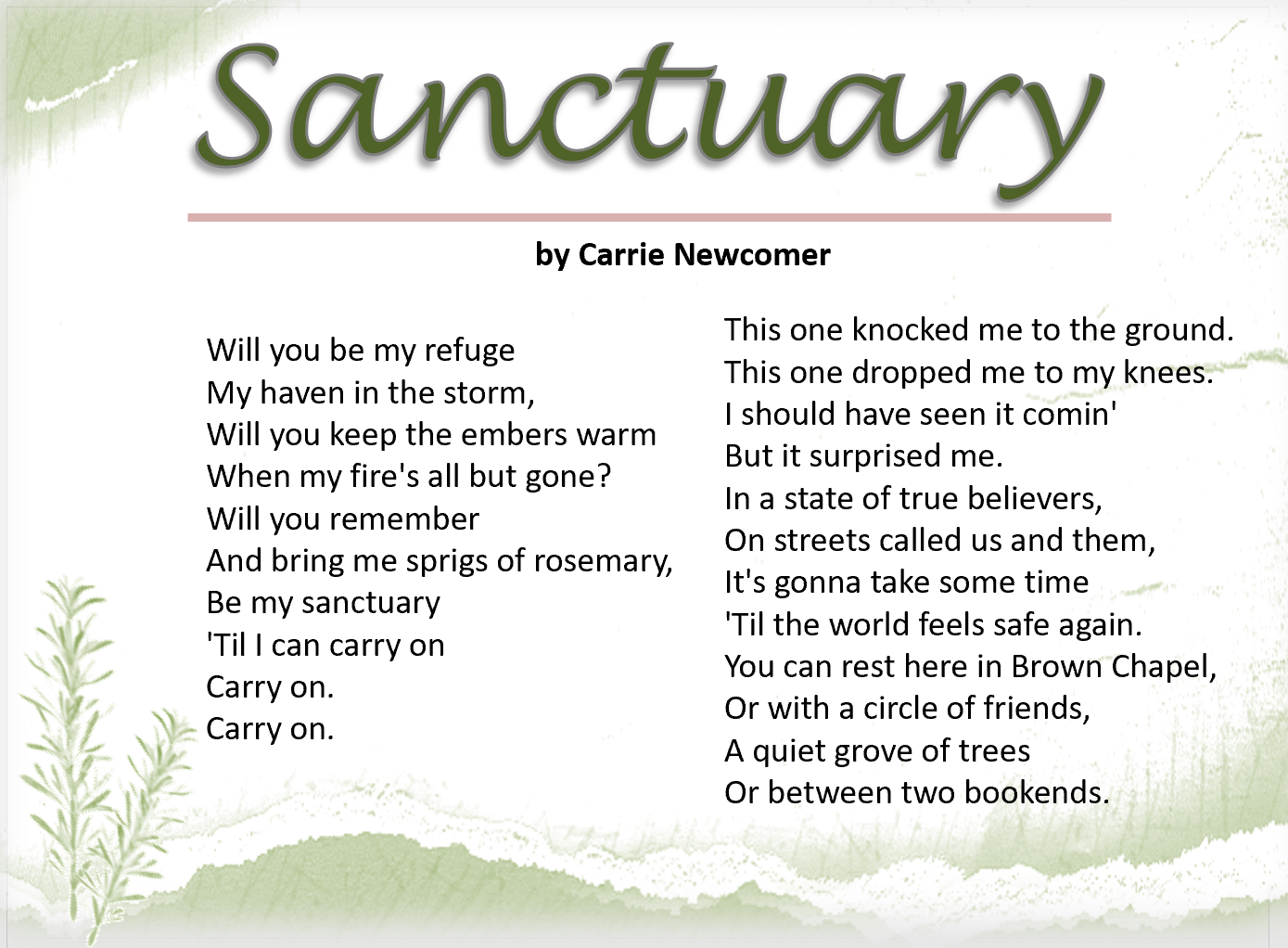
There are many ways to find refuge in our daily lives if we choose to remember. Too often, we can get sucked into the vortex of expectations and things to do accompanied by a flurry of activities and thoughts, that we forget to ask for help when we need it. Refuge, sanctuary, will not come looking for us.  Consider the first lines of Sanctuary.

Will you be my refuge
My haven in the storm,
Will you keep the embers warm
When my fire’s all but gone?

The lyrics are posed as a question. To ask for help requires self-awareness and humility. We must remember to ask for sanctuary.

You can rest here in Brown Chapel,
Or with a circle of friends,
A quiet grove of trees
Or between two bookends.

Carrie Newcomer, Sanctuary

sanctuary lyrics

There is no one right way to seek or find sanctuary. Sometimes sanctuary is a place. Sometimes we need to be with loved ones, our circle of friends. Sometimes spending time in nature or reading a good book. Sometimes we find sanctuary through an act of creativity, like collage or journaling or in an activity where one loses all sense of time. And sometimes we just need silence.

We need silence to hear our own thoughts. It is in silence that we recognize thin places.

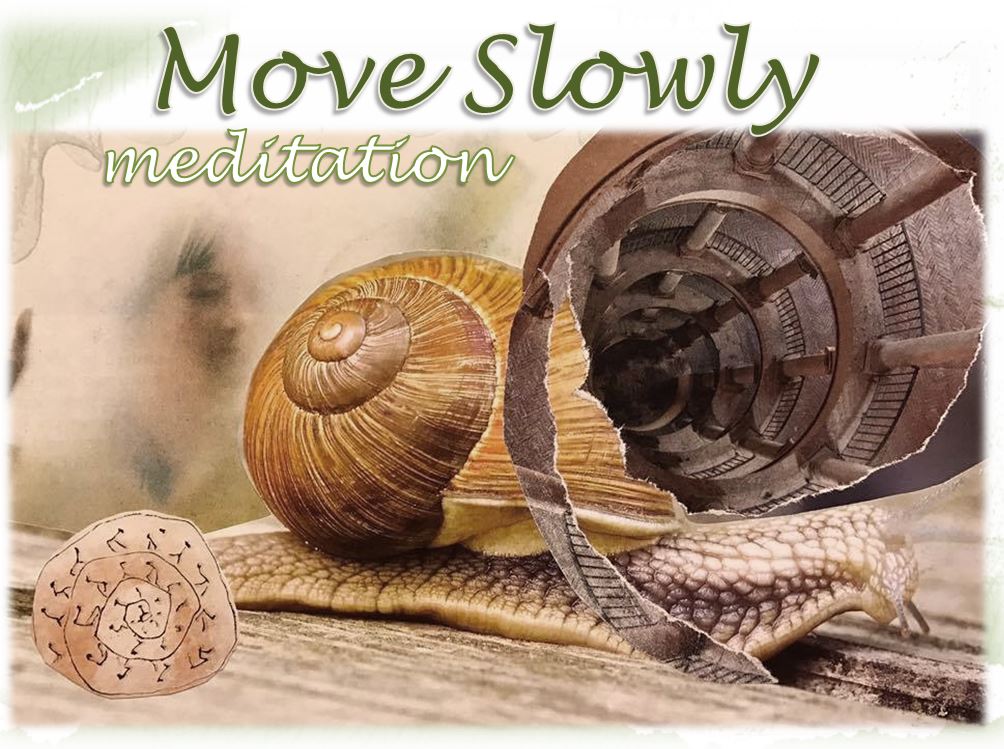
move slowly

To enter into silence for this session, listen to “Move Slowly”, a meditation narrated by James Finley, set to the music of Alana Levandoski from the album “Sanctuary: Exploring the Healing Path.” Follow the link below for “Move Slowly” (it may be on the right side under Top Tracks), or you can download it at Alana’s website. Follow along with lyrics below. Continue reading “Silence as Sanctuary ~ Sprigs of Rosemary Online Advent Retreat (Session 3)”

In Praise of Words and Less Words

Sometimes I just don’t know when to shut up. Words, words, and more words.

I love words—to write them and to read them. I have been considering how I use words after reading The Power of Words by Joe Kay at Living Gracefully. It ­shined a light on the word wars often waged in my head, in conversation, in writing—either on social media or my personal journaling.

In some ways, I give words too much power. I think if I keep talking I might find just the right words to communicate my point better. Maybe my words weren’t effective, or they weren’t heard the way I intended, or my words were rejected—so I try again with more words, thinking “this time” I will be understood or be able to help another understand. Maybe “this time” we will come to an agreement or reach a hoped-for reconciliation.

But words do have power, Kay writes “Martin Luther King, Jr., understood the power of words. He spoke so beautifully and prophetically about his dream of a world in which everyone is treated as an equally beloved child of God.

mlk

Words have the power to inspire us, touch us, and transform us for better or worse, depending upon which words we choose to allow inside of us. They can bring us more peace, love and justice, or they can increase our levels of division, fear and hatred. In the last few months, we’ve been reminded how easy it is to get sucked into the pool of hateful words. Continue reading “In Praise of Words and Less Words”

Blog at WordPress.com.

Up ↑