Search

Being Benedictine

Living SoulFully as an Oblate of St. Benedict

Tag

St. Benedict

125 Years: A Big Day for Benedictines!

Celebrating the 125th Jubilee of the Benedictine Confederation, Pope Francis addressed Abbot Primate Gregory Polan, Fr. Prior Mauritius Wilde and other Benedictines, expressing his gratitude “for the important contribution that the Benedictines have made to the life of the Church, in every part of the world, for almost fifteen hundred years.”

frm2

Sant’ Anselmo, the seat of the Benedictine Confederation, is the home of the Abbot Primate and eighty monks from over thirty countries around the world. It was a thrill for me to visit Fr. Mauritius Wilde, Prior of Sant’ Anselmo, for a tour of the academic center, prayers with the monks, and a formal address for the Fourth International Oblate Congress. It was Pope Leo XIII, Fr. Mauritius shared, who said, “You Benedictines need a place in Rome. He saw two things: he certainly saw it was difficult for him to control us Benedictines, so he wanted to have a representative in Rome and he created the office of the Abbott Primate, the highest representative of all Benedictines.”

jubilee

On April 18, 1893, the first stone of Sant’Anselmo was laid on the Aventine Hill.  “In this celebration of the Jubilee of the Benedictine Confederation we wish to recall the commitment of Pope Leo XIII, who in 1893 wanted to unite all the Benedictines by founding a common house of study and prayer, here in Rome”, Pope Francis said. On July 12, 1893, Pope Leo XIII officially established the Benedictine Confederation. Continue reading “125 Years: A Big Day for Benedictines!”

O God, Who Are Moved By Acts of Humility

February 2017 Oblate Lectio Divina and Discussion

Topic: Lent and Humility

humility

“O God, who are moved by acts of humility and respond with forgiveness to works of penance, lend your merciful ear to our prayers.” These lines in the Catholic Prayer for Blessing and Distribution of Ashes resonated with me during Ash Wednesday Mass, especially after a recent oblate discussion.

This prayer suggests our Creator is moved by what we do, by our acts of humility. The Latin word for “are moved” is flectaris, meaning to bend down. God bends down to us, moves to us, is moved by us. In our humility, we become vulnerable and open ourselves for a deeper connection with God. Continue reading “O God, Who Are Moved By Acts of Humility”

Guns and Schools, Prayer and Work

These past few days our social media feeds have been filled with messages of thoughts and prayers for the victims of yet another school shooting. And there are just as many posts that reject what may seem like Pollyanna, feel-good greetings:

thoughts and prayers 2thoughts and prayers

I understand both perspectives. I want to “LIKE” the thoughts and prayers posts and the posts that say prayers are not enough.

I send my thoughts and prayers to all the families who have lost loved ones because I believe in prayer. My heart goes out to the parents who have lost their beloved children, bursting with potential; for the teachers, inspired to share a passion for life-long learning; for the students who survived, the students who saw their friends die, and the students who will have nightmares for weeks, months and years to come from this trauma. Continue reading “Guns and Schools, Prayer and Work”

The Feast of St. Scholastica, Twin of St. Benedict

In celebration of St. Scholastica’s Feast Day, February 10, I share a previous post about St. Scholastica, St. Benedict and the value of spiritual friendships.

I received the gift of the Holy Spirit when I was nine years old. It took many months of catechism class to prepare to receive the sacrament of Holy Confirmation in the Catholic Church. There were dozens of questions about doctrine and faith to study, like:

What is a sacrament?  A sacrament is an outward sign made by Christ to give grace.
What is grace? Grace is any gift from God.
How many persons are there in God? There are three Persons in God. Continue reading “The Feast of St. Scholastica, Twin of St. Benedict”

Rome ~ Layers Like Lasagna

There are layers of history in Rome—“layers like lasagna”—one tour guide suggested. Literally, layers were built on top of layers, buildings that had been destroyed by war and natural disaster were covered with dirt and new buildings were erected over ruins. Symbolically, many Christian churches were built over ancient pagan sites.

The architecture, art, and religious history communicate something spiritual, a deeper story with layers of meaning, like lasagna. I’ll share some of my favorite places, and the journey, from my trip to Rome to attend the World Congress of Benedictine Oblates:

St. Peter’s Basilica and the Scavi tour Continue reading “Rome ~ Layers Like Lasagna”

St. Henry II: Patron Saint of Benedictine Oblates, July 13

Happy Feast of St. Henry, patron saint of Benedictine Oblates!

Saint Henry II was born in 973 in the village of Hildesheim, Bavaria, German. (Note: Hildesheim is the same hometown as Fr. Mauritius Wilde, Prior of Sant’ Anselmo formerly of Christ the King Priory. They also attended the same school!) Henry served as the Duke of Bavaria (995) and as the Holy Roman Emperor (972-1024), crowned by Pope Benedict VIII. As emperor, Henry, who had considered the priesthood, was devoutly religious. He shared his faith by rebuilding the many churches that had been destroyed,  building monasteries, and supporting them with both money and land.

According to the Life of Saint Benedict, as told by Saint Gregory the Great, Oblates were received by Saint Benedict in Subiaco even before the monastery at Monte Cassino was founded. A monk during the 11th century wrote:

“There are a great many of the faithful, both poor and rich, who request confraternity with us. We give unto all of them participation in whatever good is done in our monastery, be it by prayer or almsgiving. Let us make special prayer for them, both while they live and after their death.”

According to historians, many people committed themselves to God and to follow the Rule of St. Benedict by uniting themselves to famous monasteries such as Cluny, Hirschau, Saint Blase, and others. St. Henry II was one such individual. Tradition states that Henry wanted to be a Benedictine and lived as an Oblate. Once when he was suffering from a severe illness in the monastery of Monte Cassino, St. Benedict cured him by a wonderful miracle. Continue reading “St. Henry II: Patron Saint of Benedictine Oblates, July 13”

A Big Day for Benedictines: July 11, Feast Day of St. Benedict

Learn more about St. Benedict on July 11 in an original EWTN docu-drama presenting the life and spirituality of Saint Benedict of Nursia.  Fr. Prior Mauritius Wilde and Abbot Primate Gregory Polan contribute to this one-hour program taped at Sant’ Anselmo, the Benedictine monastery in Rome.  The program airs Tuesday, July 11 at  8:00 am and Wednesday, July 12 at 12:00 AM Central Time.  See EWTN schedule for your time zone.

Listen to The Life of St. Benedict –The Holy Rule of St. Benedict with Fr. Mauritius Wilde O.S.B.  Podcasts #28-33 reflect on the life of St. Benedict by using the biography penned by St. Gregory the Great. The first episode looks at the pivotal discernment he made as a young man to pursue the religious life. The aspect of detachment from our earthly family in favor of our Heavenly Father is explored by Fr. Mauritius. There are six reflections on the life of St. Benedict in this Discerning Heart series.

Read Benedict-inspired blog posts from Fr. Mauritius Wilde, OSB at WildeMonk.net

Learn more about living Benedictine spirituality as a monk or oblate at Christ the King Monastery’s website.  

And finally, St. Benedict is pretty special to me too.

“My parents gave me an illustrated book of the “Lives of the Saints” to commemorate the occasion and as any nine-year-old would do, the first thing I did was look up my birthday. I was immediately disappointed. The illustration seemed so dark –a man with a hood, a scary looking bird and a funny name that I had only associated with Benedict Arnold, a famous American traitor.  After gaining such a beautiful name like Christine, what kind of luck did I have to get a guy named Benedict on my birthday?!  July 11, St. Benedict, Abbot, it said.  I read the pages about St. Benedict often, thinking that I should have some connection with this man as my patron saint, but then I forgot about him until…

Read more of St. Benedict, St. Scholastica and Spiritual Friendship at SoulFully You.

Happy Feast Day of St. Benedict!

Praying the Psalms ~ Psalm 22

April 2017 Oblate Reflections and Lectio Divina

Topic: Praying the Psalms

We can read the Psalms with three layers in mind: what the Psalm meant the first time it was prayed in history; how the Psalm hints at the life of Christ in the New Testament and how Jesus would have prayed it; and, finally, how it applies to our own lives and  how we can pray the Psalms now. We pray Psalms 22: 1-32.

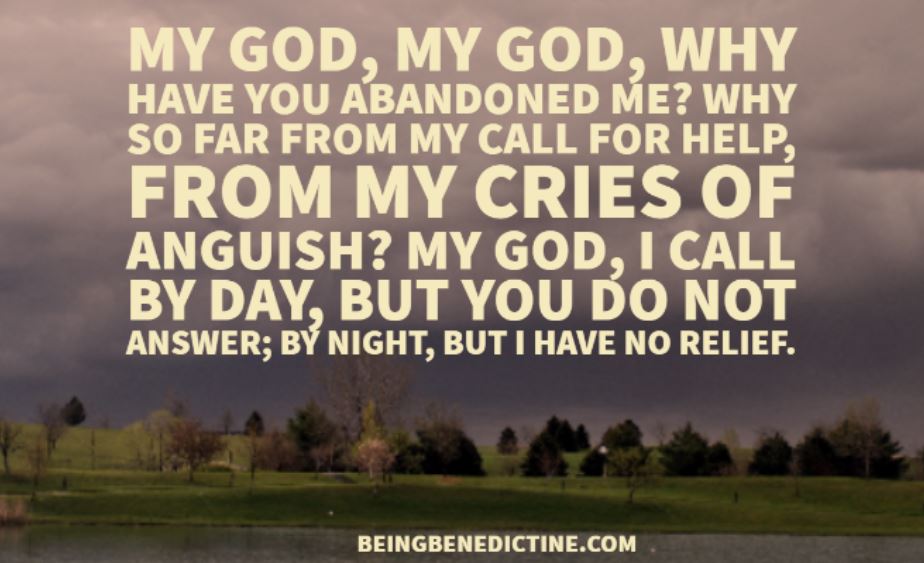
my god why have you forsaken me

In practicing Lectio Divina, after reading the Scripture out loud, we contemplate, consider and reflect on what we have heard. The Scripture is read again. After some time of silence, we are welcomed to share a word or phrase that speaks to us.

All night long I call and cannot rest, my soul will live for you.      They never trusted you in vain.     Do not stand aside trouble is near.       They trusted and you rescued them.     If God is your friend let God rescue you.        Rescue my soul from the sword.           More worm than human.        My heart is like wax melting inside me.  

One participant said the images of wild beasts in the desert environment was overwhelming—she had no words.  We rest in silence, some speak, a few sniffles, a sigh. The verses and words in this Psalm touch each of us in a unique way.

What resonates with you from reading Psalms 22?  This is what resonated with us:

So many feelings are expressed in this Psalm—complaint, fear, desperation, anguish, hopelessness. We tend to think that we should feel in a certain way, that trust is the superior action or emotion, but it is human to feel all of the desperate feelings mentioned. We can accept all of our emotions because God lets us feel all of those things and desires that we express them. Continue reading “Praying the Psalms ~ Psalm 22”

Begin Everything in Prayer

February 2017 Oblate Reflections and Lectio Divina

Topic—Prayer; Rule of St. Benedict, Chapters 8-20, 52.

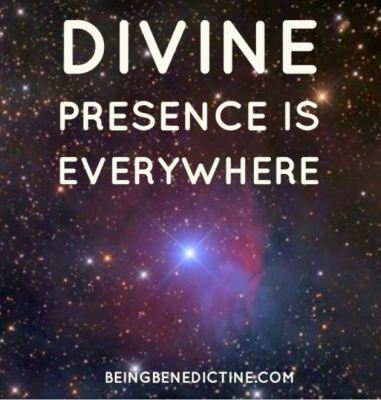
The Divine Presence is Everywhere, RB 19:1 We believe that the divine presence is divine-presence
everywhere
and that in every place the eyes of the Lord are watching the good and the wicked. (Prov 15:3). 2. But beyond the least doubt we should believe this to be especially true when we celebrate the divine office.

“It is also held that even work can be prayer. Any occupation undertaken through obedience, offered to God and accompanied with short invocations frequently renewed would in itself be prayer. Thus, only by sanctifying one’s daily actions can one pray without ceasing.” – Maria-Thomas Beil

Lectio and Discussion

Scripture for Lectio Divina: Matthew 6:1-6, 16-18

After reading the Scripture out loud, we contemplate, consider and reflect on what we have heard. The Scripture is read again. After some time of silence, we are welcomed to share a word or phrase that speaks to us. What I love most about practicing lectio divina with a group is what resonates with each of us is so different. We bring to the table a variety of ways to understand what we’ve read; we learn from each other.

Inner room.      Deliver.     Do not babble.    So that others may see them.    Received they reward.      Sees in secret.          Thy will.         Us.          Forgive.           Your Father knows what you need. 

 What resonates with you from this reading?  This is what resonated with us:

prayer-fr-volker

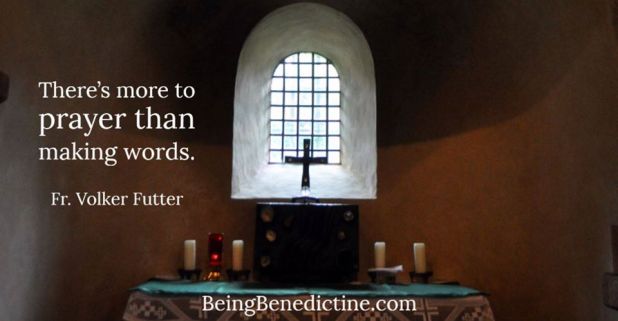
There’s more to prayer than making words. Continue reading “Begin Everything in Prayer”

Blog at WordPress.com.

Up ↑