Search

Being Benedictine

Living SoulFully as an Oblate of St. Benedict

Tag

Stability

To Love and Be Loved: The Monk and The Marriage

But now faith, hope, and love remain, these three; but the greatest of these is love. –1 Corinthians 13:13

This scripture verse is one of the most frequently read at wedding ceremonies, but it is meant for more than those getting married. We are created to love and be loved—all of us, no matter who we are or our chosen paths in life, whether monk or married.

Our deepest longing is to be loved. Love is the thread that runs through all the world’s religions. In Christianity, the Great Commandment is to “love the Lord your God with all your heart, and with all your soul, and with all your mind” and to “love your neighbor as yourself.” 

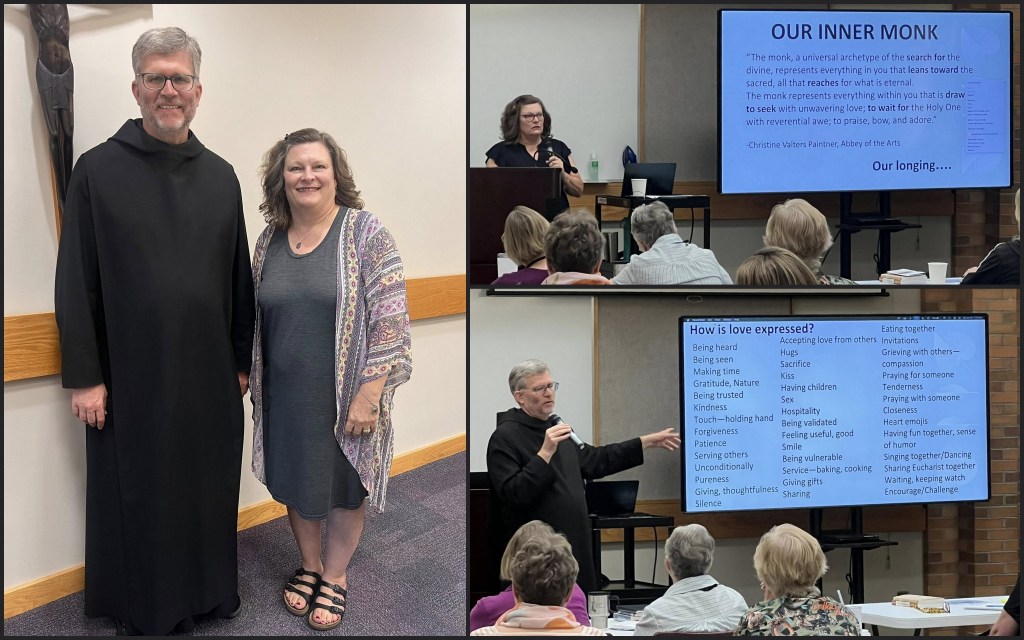
Several years ago, during spiritual direction with Benedictine monk, Fr. Mauritius Wilde, we discussed, despite our different vocations, how much we have in common. We each have a holy longing—to love God, to have a healthy love for ourselves, and to give and receive love. Practically speaking, we are the same age, we are both teachers and retreat leaders, have one brother, have the same middle name (Marie—seriously, what are the odds on that?), we share similar Enneagram personality traits, and each of us professed our marriage or monastic vows 40 years ago, a day apart. I was married on August 17, 1985, and Fr. Mauritius entered the monastery as a novice on August 18, 1985.

After one of many conversations where one of us would say, “That is exactly how it is for me!” or “Me, too!”, I half-seriously, half-jokingly suggested that we write a book about how, setting the whole monk vs. being married thing aside, we experience our love of God and others in many of the same ways. Nearly forgotten, this idea resurfaced a year or so ago, and we decided that leading a retreat together would be a good beginning. Our theme would be love, specifically how the Rule of St. Benedict can help us grow in love and to discover our “inner monk.”

“The monk, a universal archetype of the search for the divine, represents everything in you that leans toward the sacred, all that reaches for what is eternal. The monk represents everything within you that is drawn to seek with unwavering love; to wait for the Holy One with reverential awe; to praise, bow, and adore.” -Christine Valters Paintner

The Rule of St. Benedict shows us the path of love, of nurturing the monk within while living in community. During our retreat, held in July 2025, we shared how the monk’s promises—stability, obedience, and conversion of life—are the foundation for learning and growing in the “school for God’s service.” (RB Prologue 45) For the monk, this place of learning is the monastery. For me, it begins in my family as wife and mother. But each of us is more than our role as a monk or a married person. Each can be transformed by practicing love in our friendships, workplaces, community, and environment.

Continue reading “To Love and Be Loved: The Monk and The Marriage”

Our Ruby Anniversary: 40 Years of Marriage

“I promise to be true to you in good times and in bad, in sickness and in health. I will love you and honor you all the days of my life.”

Forty year ago, my husband, Joe, and I made our marriage vows on August 17, 1985. As a 19-year-old bride, I had little understanding of what those words meant or would require. I imagine it is the same for many. We have hopes and expectations, albeit idealistic or romanticized. We may also have a good idea of what we hope our marriage will NOT be like. Surely, it’s a good place to start, but it is then that the real work of love begins.

Stability, a Benedictine value, is what is promised in marriage when we vow, “all the days of my life.”  We promise to stay, to not run away from challenges or difficulties; instead, we remain present to the relationship, to see what we discover about each other. After writing seventy-two chapters in The Rule, Benedict titles his last chapter,This rule only a beginning of perfection.” In other words, marriage, or any commitment we make, requires practice—making mistakes, forgiveness, and always beginning again.

To love is a decision. A marriage is not made, once and for all, when the I-dos are exchanged. A marriage is constantly being recreated; it is always in the process of becoming. A marriage is made of moments. Moments we would like to forget, moments we must forgive, and moments that help us become more fully who we are. There are moments of joy, adventure, contentment, and the making of beautiful memories. When you string them all together, you get a picture of a life built together.

I love that the ruby, a precious gem, second only to the diamond in toughness and durability, is the traditional symbol for a 40th wedding anniversary. Throughout history, many cultures and religions have associated the ruby with mystical or spiritual qualities, representing love, passion, protection, vitality, and wealth. (Ruby Symbolism and Legends)

The word “ruby” comes from the Latin word “ruber,” meaning red. The red heart of Valentine’s Day reminds us of a desire for passion and romantic love. One also thinks of the redness of blood, which carries oxygen to all parts of the body, giving life.

Joe and I have experienced this “ruby” nature, not all in one day, month, or year, but over time and as a way of life. The ruby’s “inner glow” led to beliefs that it contained an inner fire or “an inextinguishable flame”. This inner glow, with a playful spirit and sense of humor, has fueled our commitment to protect our marriage, to be resilient, to learn, grow and change. We are wealthy in countless ways—a beautiful daughter and son-in-law, great friends and family connections, opportunities for travel, hobbies, personal interests, and, now, more time for together.

Our new season of retirement. After lengthy careers in law enforcement and education, both Joe and I have retired—letting go of our careers, but not what was at the heart of our vocation. We continue to work in other ways: I lead SoulFully You retreats and workshops on creativity and the spiritual life, write essays for Being Benedictine, and belong to a variety of book/study groups, including oblates. Joe drives senior citizens to recreational activities and appointments, enjoys travel with his siblings, meeting with friends, and cultivating his bourbon collection. We have time to slow down, take a nap when we want, read, and binge-watch TV shows, travel more, and enjoy spontaneous trips to be with our daughter Jessica and her husband, John.

Continue reading “Our Ruby Anniversary: 40 Years of Marriage”

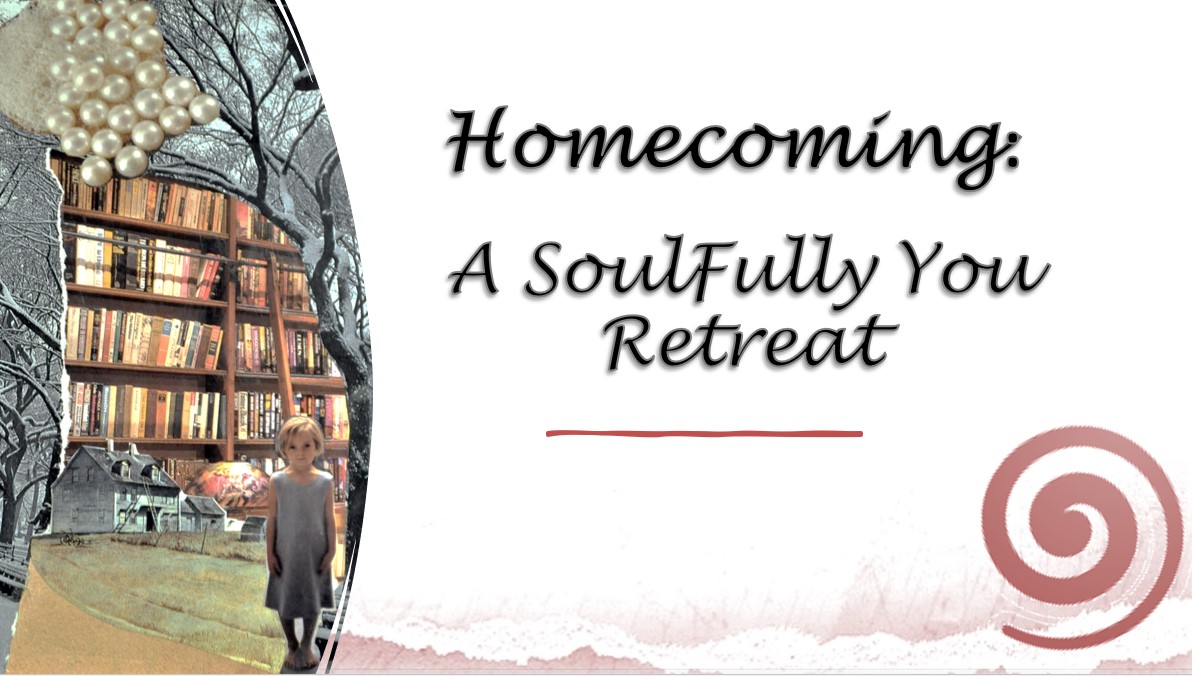
Homecoming: A SoulFully You Retreat

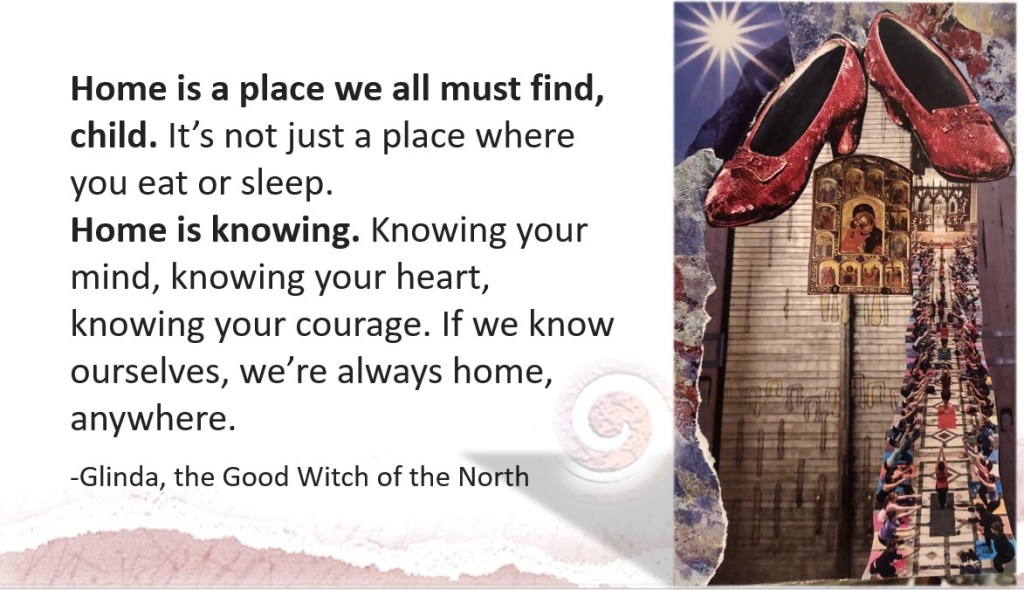
We long for the acceptance of home, a place of peace where we can be truly ourselves–seen and heard, loved and believed, held and yet free. Our longing is the existential homesickness that THIS isn’t all there is and that when we get a taste of unconditional acceptance and love, we want more. Our longings are good and holy—it is our Divine inheritance to experience all that it means to feel at home.

Inspired by the lyrics of Homesick, a song by friend Jana West, my annual Advent retreat was titled Homecoming: A SoulFully You Retreat. We explored how the Divine accompanies us, making a home within, and what it means to feel homesick or “at home” with ourselves and others. I offer some of our reflections so you, too, can take part:

“Love is home. Home is both an external dwelling and an internal abode. Home is the place where we belong, our place of acceptance and welcome. There, in this shame and judgment-free embryonic cocoon of love, we practice unconditional acceptance; we learn to relate to ourselves and the world around us.

And home is a soft place for the body to land, a safe place for the soul to fully disrobe. Home is the place where our failures don’t kill, our sins can’t crush, and even when we are at our worst, we’re safe. Home is a place where we are free to take our deepest, fullest, least encumbered breath.

At home, there’s no need to guess whether we’re in or out, welcomed or not. Home always prepares a place with us in mind.” (Center for Action and Contemplation, Home, 5/10/2024, Felicia Murrel)


What words or phrases resonate with you? Indeed, our personal experiences of home can bring a spectrum of feelings, from warm and fuzzy to sadness or terror, when we consider what being “at home” means. The ideal is what we seek and long for, both within ourselves and with others.

Continue reading “Homecoming: A SoulFully You Retreat”

Abbey of the Arts: Monk in the World Guest Post

I have been so inspired by the writing and work of Christine Valters Painter, a Benedictine oblate, author, and online abbess of Abbey of the Arts. The Abbey is a virtual global online monastery offering pilgrimages, online classes & retreats, reflections, and resources which integrate contemplative spiritual practice and creative expression with monastic spirituality. They provide support and resources in becoming a monk in the world and an artist in everyday life.

Learning from members of the community in the Monk in the World Guest Post series has been a source of affirmation that, indeed, one can live according to the Rule of St. Benedict not only in the monastery but in the life one chooses to lead.

I am so honored to have my blog post shared on Abbey of the Arts on the Feast of St. Benedict! The full text is below or at Abbey of the Arts.

“I am delighted to share another beautiful submission to the Monk in the World guest post series. Read on for Jodi Blazek Gehr’s reflection on being a Benedictine oblate.

St. Benedict is special to me for a few reasons. First, we share a birthday. I admit I was disappointed when I first discovered this. My parents had given me an illustrated book of the “Lives of the Saints” to commemorate my Confirmation. As any nine-year-old would do, I immediately looked to see who the saint was for July 11, my birthday. Perhaps Elizabeth, Mary, or Theresa would be my special saint.

Instead, I see an illustration of a man with a dark hood, a scary-looking bird, a crooked cane, and an unusual name I had only associated with Benedict Arnold. July 11, St. Benedict, Abbot, it said. I had never heard of him and surely did not know what an Abbot was. Through the years, I returned to this image of St. Benedict, thinking that I should have some connection with my patron saint.

Fast forward 26 years. With a full and busy life—married with a young daughter, a career as a high school teacher and club sponsor—I felt a deep longing for times of silence. I answered the call of my heart and responded to an advertisement for a silent contemplative prayer retreat. I discovered an oasis of peace just a few hours from home in the cornfields of Nebraska…called St. Benedict Center.

Continue reading “Abbey of the Arts: Monk in the World Guest Post”

Walk With Me: A Wedding Promise of Stability

Last summer (July 17, 2021) we enjoyed celebrating the wedding of my daughter, Jessica, to John Holland with a beautiful ceremony officiated by my dear friend, Joyce.

This summer (June 25, 2022) I was so honored to be the officiant for the wedding of Travis and Sam, one of Jessica’s college friends. It was such a joy to walk with them in creating their ceremony and so humbling to be a part of their special day with family and dear friends.

It was a spiritual experience for me to consider again, after 37 years of marriage, what it means to make a marriage commitment—to promise “to have and to hold from this day forward, for better, for worse, for richer, for poorer, in sickness and in health, until death does us part” (Sam and Travis’ vows to each other) and to walk together on life’s journey.

Antoine de Saint-Exupéry, the famous French author of The Little Prince, wrote in Wind, Sand and Stars:

“Love is not just looking at each other, it’s looking in the same direction.”

I shared these words during the wedding ceremony:

“Walking together, in the same direction, is what your marriage commitment will require. The primary reason we commit to relationships, to promise stability, is to be there for the other. In a consumer-driven society, we are encouraged to buy new, better, more but the ancient monastic practice of stability encourages us to stay put. Nathan Oates writes, “Stability doesn’t mean you’re not trying to improve or that you don’t work on the problems. Just the opposite. It means you’re going to work hard, and you expect problems. This isn’t a fairy tale. This is learning how to love.”

Promising to stay, to walk together in all of life’s joys and challenges, is the vow of stability. One’s relationship can grow deep roots, in great love, by understanding that the other will always be there for you.

Selfies with the bride and groom!
Continue reading “Walk With Me: A Wedding Promise of Stability”

July 11: A Big Day for Being Benedictine

St. Benedict is special to me for a few reasons. First, we share a birthday. I admit I was disappointed when I first discovered this. My parents had given me an illustrated book of the “Lives of the Saints” to commemorate my Confirmation. As any nine-year-old would do, I immediately looked to see who the saint was for July 11, my birthday. Perhaps Elizabeth, Mary, or Theresa would be my special saint.

Instead, I see an illustration of a man with a dark hood, a scary-looking bird, a crooked cane, and an unusual name I had only associated with Benedict Arnold. July 11, St. Benedict, Abbot, it said. I had never heard of him and surely did not know what an Abbot was. Through the years, I returned to this image of St. Benedict, thinking that I should have some connection with my patron saint.

Fast forward 26 years. With a full and busy life—married with a young daughter, a career as a high school teacher and club sponsor—I felt a deep longing for times of silence. I answered the call of my heart and responded to an advertisement for a silent contemplative prayer retreat. I discovered an oasis of peace just a few hours from home in the cornfields of Nebraska…called St. Benedict Center.

Continue reading “July 11: A Big Day for Being Benedictine”

The Sower Sows

May 2022 Lectio Divina and Oblate Reflections

Sources

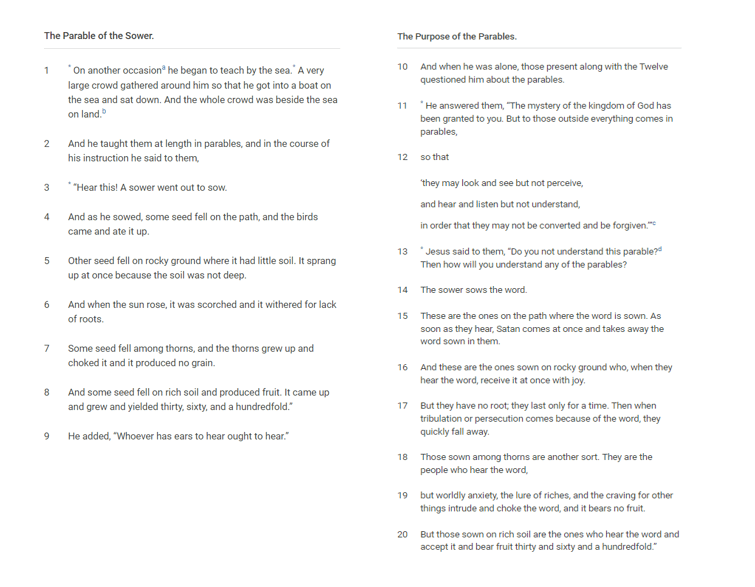
Lectio Divina—Parable of the Sower, Mark 4: 1-20

Book Discussion—Stability: How an ancient monastic practice can restore our relationships, churches, and communities by Nathan Oates. (Introduction)

Lectio Divina

Mark 4:1-20 A sower went out to sow

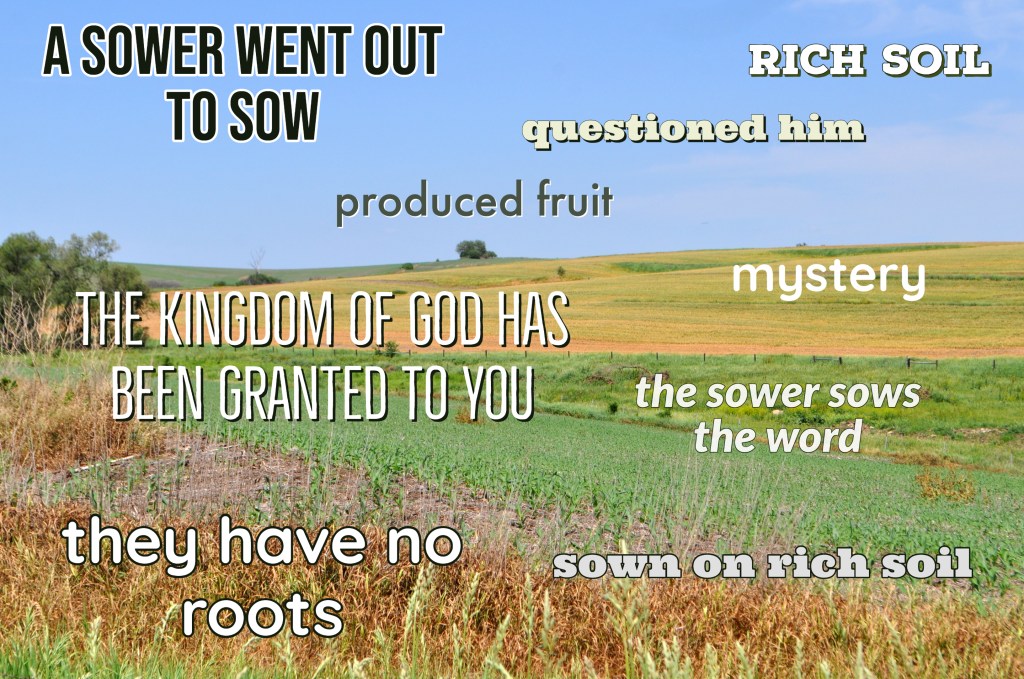
We consider the question: How does the Parable of the Sower apply to the Benedictine value of stability? Words and phrases that resonate give us a rich perspective of the sower, the seed, the soil, and the fruit.

The sower sows regardless of thorns, rocky ground, little soil, or rich soil. The sower sows—a committed action to continue to sow.

Continue reading “The Sower Sows”

Stay With Me

April 2022 Lectio Divina and Oblate Reflections

Sources

Lectio Divina, Matthew 26: 20-50, The Cross of Christ

Book Discussion, Stability: How an ancient monastic practice can restore our relationships, churches, and communities by Nathan Oates

Of Gods and Men, 2010 French film directed by Xavier Beauvois

Additional Resources: Paraclete Press Lenten Series on Stability with reflections from Nathan Oates, Kathleen Norris & Michael Patrick O’Brien, Jonathon Wilson Hartgrove, and Ronald Rohlheiser. Links below.

Lectio Divina

Matthew 26: 20-50, The Cross of Christ

Discussion

Stability “is the commitment to a purpose, a place, and a people…At its root, stability is the blend of two biblical concepts: patient endurance and standing firm.” (Stability, Nathan Oates) After reflecting on Matthew 26: 20-50, we consider:

How is the virtue of stability present in the gospel story? Are there similarities between what happened to Jesus in Gethsemane and what is happening in Ukraine?

Many people of Ukraine will not flee their country. “This is my home,” they say. Despite the many risks, they stay. They are rooted in their homeplace, their land. Jesus also stayed; despite knowing he was to be betrayed, despite the possibilities the next day would bring. Everything that can go wrong, does go wrong for Jesus. Everyone betrays him, even the best of friends. It would have been much easier to give up when left alone.

“My soul is very sorrowful even to death.” We all struggle with the virtue of stability, but Jesus stayed IN HIS sorrow; he could have fled. Despite our difficulties, we need to die before we die as Jesus did. Jesus’ steadfastness, his stability, was rooted in doing the will of God. “Your will be done” is an exclamation of surrender that gave Jesus the courage to stay. He died before his own death; he surrendered his will. He was able to face his suffering because he had consented to let God work out what would happen next. As St. Benedict said, “keep death daily before our eyes.”

Continue reading “Stay With Me”

Happy Birthday to me…and St. Benedict!

St. Benedict is pretty special to me for a few reasons.

First, we share a birthday. I have to admit that I was pretty disappointed when I first discovered this. My parents had given me an illustrated book of the “Lives of the Saints” to commemorate my Confirmation. As any nine-year-old would do, I immediately looked to see who the saint was for July 11, my birthday. Perhaps Elizabeth or Mary, Theresa or Christine (my confirmation name) would be my special saint. A lovely woman saint with a beautiful name—I had hoped.

confirmation

Instead, I beheld an illustration of a man with a dark hood, a scary-looking bird, some sort of walking cane, and an unusual name that I had only associated with Benedict Arnold, a famous American traitor.

July 11, St. Benedict, Abbot, it said. Continue reading “Happy Birthday to me…and St. Benedict!”

Blog at WordPress.com.

Up ↑