Search

Being Benedictine

Living SoulFully as an Oblate of St. Benedict

Author

Jodi Blazek Gehr

SoulCollage® Facilitator, Benedictine Oblate of Christ the King Priory, Retreat Leader at St. Benedict Center, Blogger at Being Benedictine and SoulFully You, Teacher, Mother, Wife, Friend, Lover of learning, reading, creativity and spirituality.

Sacred Mother: Our Lady of Guadalupe

Mother Mary finds her way into many of my collage creations, but it is the story and image of Our Lady of Guadalupe that I am especially drawn to. On December 12, the feast day of our Lady of Guadalupe is celebrated.

“Am I not here, I, who am your Mother? Are you not under my shadow and protection? Am I not the source of your joy? Are you not in the hollow of my mantle, in the crossing of my arms? Do you need anything more? Let nothing else worry you, disturb you.”

Our Lady of Guadalupe to St. Juan Diego on Mount Tepayac, 1531

On the site of an ancient shrine to the Aztec mother goddess, near Mexico City on Tepeyac Hill, a young Christian Indian named Juan Diego had a vision of a young Indian woman. Speaking in his native tongue, she directed him to tell the bishop to construct a church on the hill. The bishop dismissed the story, but the young maiden appeared yet again to Diego identifying herself as the Mother of God. She instructed him to gather roses that grew at her feet, during the winter no less, and take them to the bishop. When Diego opened his coat, a colorful impression of Our Lady, with dark skin, was imprinted on the fabric.

Our Lady of Guadalupe - Wikipedia

This story has been told for five hundred years, standing as an “image of divine compassion for a demoralized people. Speaking to Juan Diego in his own language, she presented herself in terms of compassion and solidarity, not power and domination.” (Blessed Among Us, December 12, 2020) The image of Our Lady attracts millions of pilgrims each year at the basilica in Mexico City, one of the world’s most visited sacred sights.

Recently I gathered with some friends for a much-needed retreat, a “pause between labor contractions”—a metaphor that resonated with us. In such troubling times, we came together to be creative, soulful, compassionate listeners—to take, literally and prayerfully, a breath from the labor of a divisive political environment and necessary pandemic adjustments. Jana, Deb, Patsy, Sara, Julie, and I brought open hearts to celebrate a weekend filled with blessings—a full moon, the beauty of the woods, the insightful practice of SoulCollage® and the celebration of All Saints Day.

Continue reading “Sacred Mother: Our Lady of Guadalupe”

Our (Piano Teacher) Family Tree Includes Beethoven!

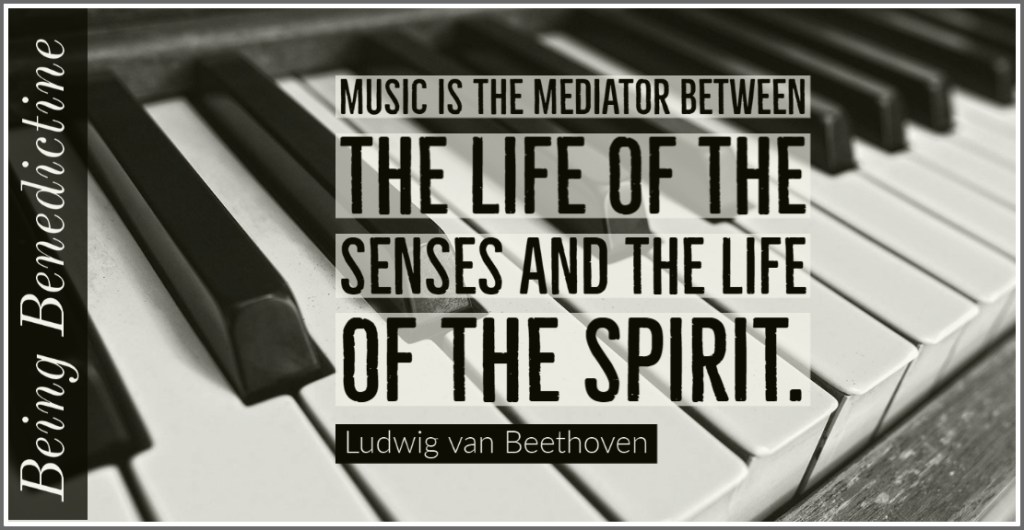
Ludwig van Beethoven was born in Bonn, Germany in December 1770—250 years ago. A long-awaited celebration for music aficionados, over 300 concerts and other projects had been planned in Germany, and many others around the world, to celebrate one of the most performed of all classical music composers. Unfortunately, the pandemic resulted in events being postponed or adapted for a virtual audience.

This significant date, 250th birthday of Beethoven, was the nudge I needed to write the story of the family tree that includes my daughter, Jessica, as a direct descendent of Beethoven—as a piano player.

Jessica played piano from her Kindergarten year until she entered high school under the tutelage of Ceil Brown, 1953- 2010. Ceil learned to play piano from Marie Ducey, who she spoke of so highly. Marie Ducey took piano lessons from James Madison Tracy, 1837-1928.  Tracy and his wife established the Liszt School of Music in Denver in 1910, named in honor of his piano teacher, Franz Liszt.

Franz Liszt, 1811-1886, one of the greatest pianists of all time, a Franciscan lay associate, was known to have never charged his students for piano lessons. Liszt learned from Carl Czerny, 1791-1857, an Austrian composer, teacher, and pianist of Czech origin whose vast musical production amounted to over a thousand works. His study books are still widely used in piano teaching. And….drumroll, please….Czerny was trained by Ludwig van Beethoven.

Our family is proud to be in this distinguished family tree of musicians and lovers of music.

Jessica describes Ceil, her piano teacher, as patient, gracious and calm. Ceil was an extraordinary teacher who appreciated individual student strengths and abilities. I delighted in hearing the conversations between her and Jessica. Ceil treated her as person, not like a kid as so many adults can do. When Jessica did not like a piece of music Ceil had selected for her to learn, Jessica was not afraid to say it. Ceil would go to her bookcase and look for another piece. I remember one occasion when Ceil looked three or four times for music that would suit Jessica’s style and interest (in a 45-minute lesson!)

Continue reading “Our (Piano Teacher) Family Tree Includes Beethoven!”

St. Cecilia, Patron of Music—November 22 Saint of the Day

“The aim and final reason of all music should be nothing else but the glory of God and the refreshment of the spirit.”

Johann Sebastian Bach

St. Cecilia—November 22, Saint of the Day

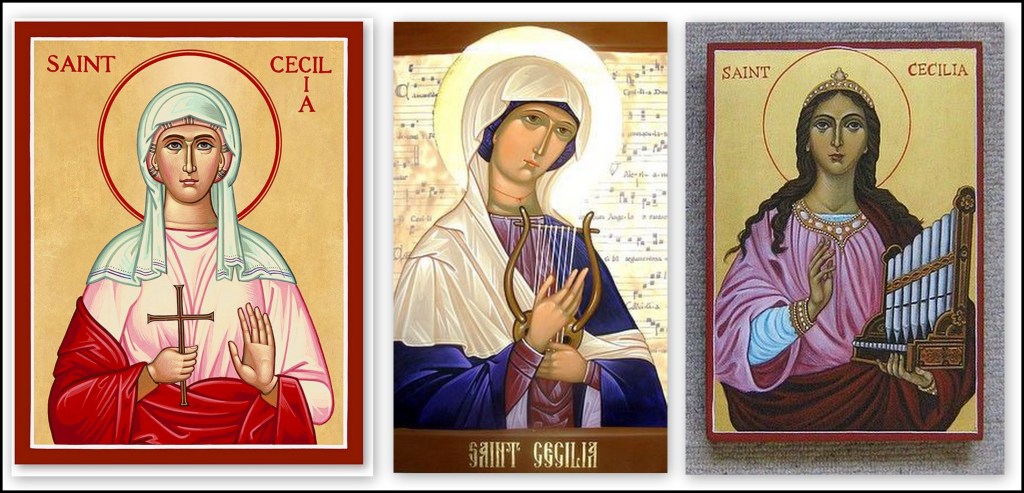
St. Cecilia is a Roman martyr and the patron of music and musicians. It is written that Cecilia dedicated herself to virginity, but instead was forced by her parents into marriage. As musicians played at her wedding, Cecilia “sang in her heart to the Lord”. Memorializing St. Cecilia is remembering that music is a pathway to connect to the Divine, a way to seek comfort, to praise and to pray.

“Singing is soulful. It is prayerful and it is powerful. I love to sing (in the privacy of my own car). I love to listen to others sing, from the liturgical chant of Benedictine monks to contemporary Christian artists. Whether it is the melody or insightful lyrics that I find a connection with, music can create a mood, help recognize or express a feeling, or bring me to a place of prayerful listening.

journey is my own
SoulCollage Card–This Journey Is My Own (blog post link below.)

When monks sing, they believe they are singing with the angels, and we are just to join in. The beauty of singing familiar songs and hymns is allowing our mind and heart to beat as one. Songs that capture what we could have not so artfully written, become our prayer. To sing, or sing with another, is to elevate the soul, to connect with the Divine.” (from a previous blog post, Music as Prayer ♫ This Journey Is My Own)

St. Cecilia was memorialized in the church of Santa Cecilia in Trastevere, founded in the 3rd century after Cecilia was martyred. The church is believed to be on the site of the house where she lived and died. Since 1527, a community of Benedictine nuns has lived in the monastery next door. In 1599, Cecilia’s body was found in incorrupt with deep cuts in her neck just as she had died. A sculpture by Stefano Maderno of Cecilia’s body lies in front of the choir.

When I visited Rome during the World Oblate Congress, we made an unscheduled stop at St. Cecilia’s in the Trastevere region. It was a profound experience, one that I cannot quite capture in words. Instead, I share some photos of my visit.

Continue reading “St. Cecilia, Patron of Music—November 22 Saint of the Day”

Circle of Friends: Make new friends, but keep the old. One is silver, the other is gold.

And let there be no purpose in friendship save the deepening of the spirit.

Kahlil Gibran, The Prophet

I’ve been thinking a lot about friendships lately–both old and new, those friends who are near and far, and those who have passed away.

In 2015, our Circle lost a dear sister. Judy passed away only a year or so after being diagnosed with a rare, incurable, fast-growing cancer. For the last several weeks of her life, Judy was unable to leave her bed and wanted few visitors, but it was important for our Circle to continue sending our love and prayers. Even if we weren’t physically present, we wanted her to feel that we held her in our heart. Each of us committed to a day of the week that we would send Judy some kind of card, note or greeting. In this time of pandemic, just as we did with Judy, we can stay connected with our loved ones.

Judy, Laura, Ruth, Joyce, me and Katie–some of our Circle who came to my first SoulCollage® retreat at St. Benedict Center.

Judy was a lover of SoulCollage®—she came to my first retreat at St. Benedict Center and fell in love with the process. She started meeting weekly to cut, paste and create with our friend, Beth. The practice became a form of expression and prayer for her and she even shared it with her daughters and grandchildren on one of their last vacations together on Captiva Island. Making and sending a SoulCollage® card to honor Judy and our Circle was a form of creative prayer for me.

I was drawn to images that represented the strong, hard-working, loving women that had met together monthly for several years. I hoped the card would make Judy smile, bring her a little joy and remind her of the bond we all shared. It also gave me the chance to put images and words to how I feel about our Circle.

Continue reading “Circle of Friends: Make new friends, but keep the old. One is silver, the other is gold.”

Friends are friends forever

Cleaning out some old papers, I stumbled upon a script from which I read a farewell greeting to my spiritual director and monk friend, Fr. Mauritius Wilde when he moved from Schuyler, Nebraska to Rome four years ago.

My message was one of gratitude for our shared experiences, but also sadness that we would not see each other regularly…since Rome is a bit more than a car drive away. I knew that we would continue to be in touch, and as luck would have it I was able to visit Rome one year later for the Benedictine World Congress and he has also visited Nebraska a few times to lead retreats. So, it was not a good-bye, but a see-ya-later.

Farewell party for Fr. Mauritius. October, 2016

As I read through what I had written four years ago, I realized this feeling of being separated, yet remaining deeply connected speaks to our current situation of pandemic. I feel this same nostalgic see-ya-later-sort-of-way as we hunker down, cancel trips, stay at home and physically distance to keep ourselves and our loved ones safe. It is bittersweet—but it is what we must do. We will survive this liminal space where we are together in spirit, but not in person.

I experience this distance, and yet connectedness, with my daughter, who also moved from home—first to Washington DC four years ago (yikes, that 2016 was a doozy of a year) and then to Madison, Wisconsin. She is my child, so of course, we see each other as often as possible, but without the spontaneity of a quick lunch date or evening walk. I am grateful that we talk or text each other nearly every day and have been able to exchange visits nearly every other month.

But still, it is challenging to have your loved ones far away. As much as I love reading about the pioneer days, I was not cut out to be one. I cannot imagine what it would have been like to send your grown child off with her family in a covered wagon, perhaps never to be seen again.

Continue reading “Friends are friends forever”

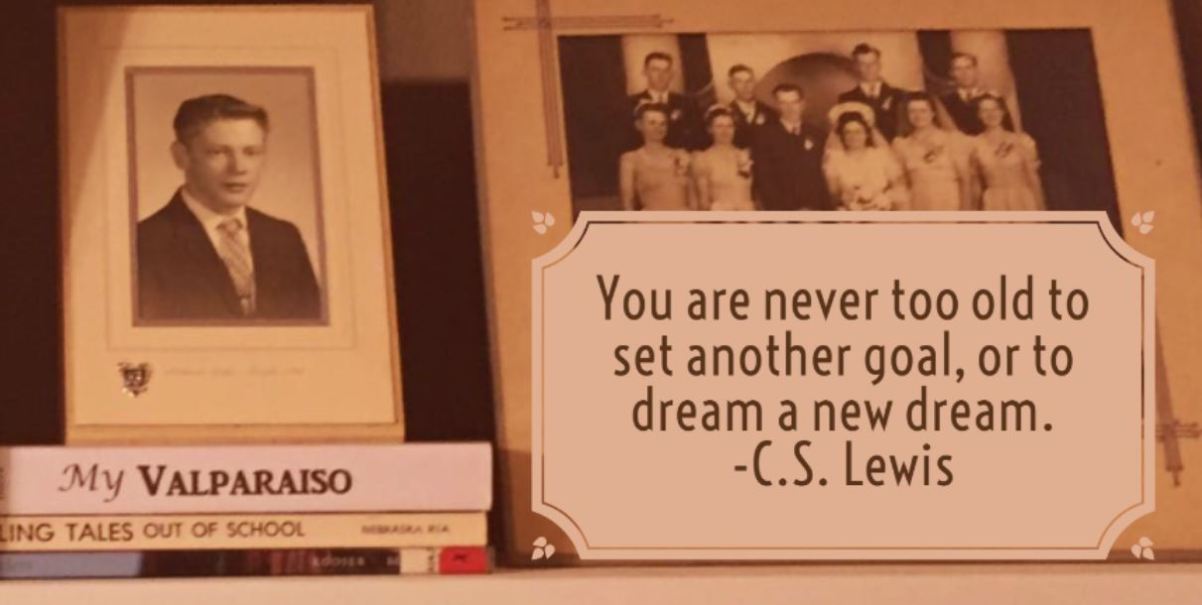
You are never too old to set another goal, or to dream a new dream.

Stories are as important for those who hear them as the one doing the telling. Being listened to validates our experiences; we matter when we are heard. The first word in the Rule of St. Benedict is “Listen.”

When we were kids, my brother and I would beg for stories about our dad’s growing up shenanigans, a window into his life before we were in it. His stories helped us see what life was like for him and helped connect us to the generations before us. But these stories are lost if not written down.

My dad, Tom Blazek, had a dream to write a book about his hometown, Valparaiso, Nebraska—to create a timeline of its history and to share stories of growing up in a small town. Writing this book was part fact-finding and part storytelling, both his own and others. Passionate about history, he would devour a book on a topic he loved—about World War II, the Civil War, the history of Lincoln or Nebraska. He could find bits and pieces about Valparaiso from different sources, but he had a dream of gathering it all into one book, from the birth of the small village up to the present. His love of reading about history turned into a passion for sharing with others.

For some, his ambition to write a book came as quite a surprise. My dad wasn’t a particularly motivated student, he is the first to admit.  One classmate said he was the least likely of their class to ever write a book.  As a teenager, any reason was a legitimate one for skipping school. One afternoon, hanging out at the town gas station with his friends, my grandma (God-rest-her-soul-for-raising-five-boys) discovered his truancy, went to the gas station, and strongly encouraged him to get back to school. Mrs. Jean Ang, my dad’s 7th and 8th-grade teacher, commented, “the Blazek boys, they had a lot of life.” God love his teachers and parents for tolerating his alternative form of education. As a teacher, it’s important for me to remember that everyone learns differently. Regardless of what he did or didn’t learn in school, he always worked hard. 

grandma and pa blazek w boys
Grandma and Grandpa Blazek with the five boys that “had a lot of life”  

Pray and Work

The Benedictine motto Ora et Labora, Pray and Work, is a way of life for my dad.

I’ve observed a work ethic in my dad that is unmatched. From delivering newspapers, farming and working at a gas station as a teenager; being a manager at Safeway grocery stores, working in dispatch, sales and management in the transportation industry; and, finally, in production and office management, my dad has ALWAYS worked hard, whether he liked his job or not.  And for many years he supplemented his full-time job with hauling jobs—cleaning out attics and basements, taking trash to the landfill, and helping people move their belongings. Continue reading “You are never too old to set another goal, or to dream a new dream.”

Waters of Peace: Psalm 23

November 2020 Lectio Divina and Oblate Reflections

Topic: The Psalms

Sources: Psalm 23; Study Guide for The Rule of St. Benedict, pages 90-97, Maria-Thomas Beil, OSB

St. Benedict used the Psalms extensively in writing his Rule and suggested that we ought to pray all 150 Psalms at least once a week. This is a tall order for the average person, but perhaps we pray a psalm every day, contemplating its meaning in our hearts as a start. Psalm 23 is one of the most loved and most known of the Psalms, a comforting Psalm for our challenging times.

 For our Lectio Divina, we used the following translation of Psalm 23.

Our November 2020 Oblate meeting had participants both in person and via Zoom. This is the version of Psalm 23 with which we practiced Lectio Divina .

There were many words and phrases that resonated with us:

Phrases from Psalm 23 that resonated with us.
Continue reading “Waters of Peace: Psalm 23”

Work is the Friend of the Soul: #TeacherStrong and Grateful

I have just completed four weeks of teaching students in the middle of a pandemic. Not a boatload of people throughout history can make that claim. It is not normal. While it is much harder than I could have imagined, it also feels safer than I had feared. It feels good to be back to school…and it feels so good that it feels good, especially after so much anxiety about going back. It feels like a perfect fitting glove to be back in my role as teacher. It is where I belong. I feel #TeacherStrong and am filled with gratitude.

“We experience that work is not only a necessity and hard labor…but our work brings us likewise joy and fulfillment, a sense of accomplishment. We grow and develop ourselves in our work. It becomes part of who we are. However, we are more than our work. Any serious effort that enhances and enriches our own and other people’s life can fill us with joy and gratitude.”

Maria-Thomas Beil, OSB, Study Guide for the Rule of St. Benedict

Twenty percent of our students have chosen to participate in remote learning—they Zoom in from home to their classes every day. I have seen their faces (for some of the time) but have not gotten to know them very well yet. Eighty percent of our students, who I have come to recognize from their eyes up only, are doing a hybrid version of in school and remote learning—attending classes 2-3 days a week in person and the other days Zooming with the fully remote students. The fancy word for this is “synchronous learning.” It means I am teaching students at home and online simultaneously while students are adapting to new ways of learning.

It is taking a lot of resilience, creativity, and hard work for all of us to adapt to this new way of teaching and learning. I have gathered so much strength and peace from the Benedictine motto—ora et labora, pray and work. Before school started, I spent time with soulful friends and in solitude creatively praying with SoulCollage®. I felt a seismic shift within that allowed me to detach from my fears, to separate myself from the circumstances of going back to school and to focus on the needs of my students. It truly has been a “Seek Peace and Pursue It” experience. The peace has remained for four weeks—I am grateful.

Continue reading “Work is the Friend of the Soul: #TeacherStrong and Grateful”

Every. Good. Work.

Every. Good. Work.

St. Benedict instructs that “every time you begin a good work, you must pray to him most earnestly to bring it to perfection.” (RB: Prologue vs. 4)

Embedded in the guidance from St. Benedict in his Rule is that we must both pray and work, ora et labora. The prayers offered by religious at the Democratic National Convention embody the longing for peace and justice that, as Americans, we hope for and work towards. The prayers offered must not be declared only once but be the prayer of our hearts and in our every breath.

ora et labora

My Benedictine Oblate friend, Gloria, invited me to pray with her each day the prayers that Sr. Simone Campbell and Fr. James Martin, SJ shared at the DNC. Her suggestion gave me the idea to invite all who desire peace in the United States of America to also join us in daily prayer.

I share below the text and video of the prayers offered by Sister Simone Campbell, Executive Director of NETWORK and leader of Nuns on the Bus; Fr. James Martin, S.J., editor at large at America Media; Rabbi Lauren Berkun of Shalom Hartman Institute of North America; and Imam Al-Hajj Talib ‘Abdur-Rashid from The Mosque of Islamic Brotherhood.

Sister Simone Campbell

“The very first paragraph of the Scripture that informs the three Abrahamic traditions tells us: The Divine Spirit breathed over the waters of chaos and brought forth a new creation. Encouraged by this promise that a new creation can come from chaos, let us pray:

O Divine Spirit!

During the weeks and months ahead, stir our hearts and minds that we might fight for a vision that is worthy of you and your call to honor the dignity of all of your creation.

A vision of who we are as a people, grounded in community and care for all, especially the most marginalized.

A vision that cares for our earth and heals the planet.

A vision that ends structural racism, bigotry and sexism so rife now in our nation and in our history.

A vision that ensures hungry people are fed, children are nourished, immigrants are welcomed.

O Spirit, breathe in us and our leaders a new resolve…that committed to this new American promise, we will work together to build a national community grounded in healing, fearlessly based on truth, and living out of a sense of shared responsibility.

In the name of all that is holy, O Spirit, bring out of this time of global and national chaos a new creation, a new community that can, with your help, realize this new promise that we affirm tonight.

With profound hope, let we the people say: Amen!

Father James Martin, S.J. Continue reading “Every. Good. Work.”

Blog at WordPress.com.

Up ↑