Search

Being Benedictine

Living SoulFully as an Oblate of St. Benedict

Author

Jodi Blazek Gehr

SoulCollage® Facilitator, Benedictine Oblate of Christ the King Priory, Retreat Leader at St. Benedict Center, Blogger at Being Benedictine and SoulFully You, Teacher, Mother, Wife, Friend, Lover of learning, reading, creativity and spirituality.

The Gospels: The Story of Jesus

God does so much and asks so little

god does so much

The past several days I have read all four Gospels of the New Testament—Matthew, Mark, Luke, AND John. And not just the miracles or the well-known parables, but from beginning to end; every chapter, every verse. And for each of the Gospels, I’ve also read a chapter in my textbook, The New Testament by Stephen L. Harris, for a class I’m taking at Creighton University. Each chapter comments on key topics, themes, author, date and place of composition, various sources used, the intended audience and interpretations.

I don’t have the words yet for all that I’ve learned, but that’s also why I’m procrastinating. I need to find some words (very soon) to write an 1800 word paper, due in 48 hours, responding to this prompt: Explain the story of the life of Jesus as portrayed in the Gospel of John, and compare it to either Matthew or Luke and how this might relate to ministry today.

I trust the words will come, but this first. Here goes….

Surprisingly (to me) each of the four Gospels share a unique portrayal of Jesus, his life, death, resurrection, and ultimate purpose of all of the above. Ninety percent of the content in the Gospel of John is not in the other three synoptic Gospels. Who knew?

Luke vs. John: An 1800ish word paper

the wordA few of you asked to read the paper…and now that it is graded (94%), I feel confident enough to share the-just-shy-of-1800-words that I wrote.  I would love to hear what you think, whether you have ever read all four Gospels in their entirety, and what resonates most with your spirituality.

Jodi Gehr
Word Count: 1794

Each of the Gospels contributes to an understanding of who Jesus is. The Gospel of Luke shares Jesus as bringing a universal faith under the direction of the Spirit; John focuses on the power and divinity of Jesus to confer salvation and immortality (Harris 110, 189). The themes, characters, teachings and post-resurrection interpretations for each of the gospels support these unique aspects of Jesus. The relationship between John and Luke could be stated: the Johannine Jesus shows who God is while Luke shows people how to be God-like in their lives.

The Gospel of John, written between 90-100 CE, is a cosmic and theological, rather than historical, representation of Jesus (Harris 249-250). John portrays Jesus as the incarnation of divine Wisdom, born to overcome darkness, evil and chaos, bring light into the world and offer salvation (Brubacher, Jesus; Harris 250, 259). Exclusive to John, Jesus is revealed as the Word, or Logos translated in Greek, “When all things began, the Word already was. The Word dwelt with God, and what God was, the Word was. (John 1:1)” Jesus pre-existed, “In the beginning God created heaven and earth (Gen 1:1, Harris 259).” The Wisdom tradition united with Greek philosophy places Jesus existing, in cosmic order, at the beginning of the universe, cooperating with Yahweh before his incarnation (Harris 249, 259).

Greek and Jewish Wisdom literature, the hypothetical Signs Gospel, and oral teachings of the “Beloved Disciple” were sources that “John”, likely anonymous, used to reach a broad audience. Because of tension between Torah loyalists and Jesus followers, Christians were excluded from synagogues; for Christianity to be a sustainable religion, casting a wider evangelical net was imperative (Harris 250, 253). John also confronted the disappointment of Jesus’ original followers when an imminently predicted second-coming was not realized and to provide encouragement for believers who hoped a Messiah would save them from hardships (Brubacher, Jesus; Harris 250).

Ninety percent of John’s content is not in other gospels (Harris 113). Divided into two sections—the Book of Signs, seven miracles of Jesus; the Book of Glory, Jesus’ death as glorious, fulfillment of divine will, its Christology states Jesus and the Holy Spirit are one; after Jesus’ death and resurrection, the Holy Spirit takes his place (14:26). Jesus proclaims, “I am the bread of life (6:35), the good shepherd (10:11), the resurrection and the life (11:25), the way, the truth and the life (14:6, Harris 260-262).”  Jesus, with authority and “equality with God” gives a new commandment to love one another (13:34-3). Jesus’ dying on the cross demonstrates the ultimate act of love.

The Synoptic Gospels, narratives of the life, death, and resurrection of Jesus, focus on Torah reinterpretation (Harris 249). The Gospel of Luke, specifically, was written around 85-90 CE (Harris 192). Luke, “the beloved physician”, did not know Jesus and is likely anonymous.  Luke’s goal was to write a well-researched gospel, “going over the whole course of these events in detail (1:1-4).” Luke was written to convince Jews and Gentiles to believe in Jesus as universal savior, a familiar role appropriated to gods and human rulers (Harris 190-191).  Luke’s message is intended to guide all—men, women, rich, poor, and especially those disadvantaged—to salvation (Brubacher, Jesus).  Luke’s gospel, most inclusive to women,  gives prominent “roles” to Jesus’ mother, Mary, who proclaimed the Magnificat (1:46-55) and was with Jesus at his death (Harris 196, 270). In the story of Mary and Martha, Mary was encouraged to equally participate with men listening to Jesus’ teaching (Harris 206). And Mary Magdalene alone discovers the empty tomb upon Jesus’ resurrection (Harris 270). The Lukan Jesus is concerned with social and economic justice, for the poor, social outcasts and women (Harris 193).

Luke provides a “connected narrative” of events in Jesus’ life, fulfilling prophecies in Hebrew scripture, securing a role in salvation history for Israelites, and revealing a new covenant to Gentiles (Harris 190, 201). Jesus as Son of Man is Messiah for Jews and Savior for all (9:22), forgives sins (5:24), must suffer (19:20), die and be judge of all (Harris 198, 201).  Luke uses the Hebrew Bible, Lukan sources, Mark, and Q, a document portraying Jesus as wisdom teacher and prophet (Harris 157). Luke goes a step further than John with a commandment to love not just one’s friends, but enemies as well (6:27).

From Jesus’ conception through the resurrection, each of the gospels concentrates on aspects that reinforce its impression of Jesus. Luke shares Mary receiving news from the angel Gabriel to announce she is expecting and the visitation between Mary and her cousin, Elizabeth, where unborn John leaps in anticipation of Mary’s child, Jesus (Harris 200). Unlike other gospels, Luke traces Jesus’ genealogy back to Adam rather than Abraham, symbolizing Jesus as savior for all (Harris 190). In John there is no birth story; the pre-existence of Jesus establishes his divinity and makes irrelevant Jesus’ conception (Harris 253). Also only in Luke: the boyhood story of Jesus lost in the temple (Harris 201); the depiction of John the Baptist’s parents, likened to Hebrew’s Abraham and Sarah; and John as the returned Elijah, messenger of a new covenant, “Until John, it was the Law and the prophets (16:16; Harris 191).” In John, there is no baptism of Jesus and the role of the Baptist is only to introduce Jesus as the Lamb of God and to foreshadow the importance of who Jesus is (1:6-9, 19-36). The Lukan Jesus is historical, Johannine Jesus is divine from the start.

In Luke, Jesus teaches using parables; in John, lengthy speeches (Harris 254). In Luke, Jesus is empowered by the same inspiration as Israel’s prophets—portrayed as a gentle, serving Jesus, concerned for the poor, outcast, and powerless, showing compassion, offering comfort and forgiveness (22: 24-27; Harris 193, 204). Jesus practices his commandment to “love one’s enemies” by visiting Samaritans, typically hated by Jews (9:52-56; Harris 205). In the Sermon on the Plain, the Lukan Jesus, concerned with social justice, makes real the importance of the poor and hungry; not metaphorical Beatitudes as in Matthew (Harris 202). In the story of the Good Samaritan, Jesus commands his followers “love their neighbor”. When questioned about what the Torah means by one’s neighbor, Jesus notes that one who is different from us racially or religiously, may be capable of human kindness and is our neighbor (Harris 205). One must leave all wealth and power behind to follow Luke’s Jesus (6:24). Only in Luke are the stories of the prodigal son, the lost coin, the Good Samaritan, Lazarus and the rich man shared focusing on unexpected reversals and forgiveness of wrongdoers (Harris 207). Luke focuses on Jesus’ humanity, even tempted by Satan, as a role model for others. It is with the transfiguration when his divinity is revealed (Harris 112, 212).

In Luke, Jesus embodies the compassion, mercy and unconditional forgiveness of God, so it is no surprise when Pope Francis declared 2016 the Jubilee Year of Mercy, he quotes Luke 6:36 in which Jesus tells his disciples, “Be merciful as your Father is merciful.” Pope Francis states, “we are all called to give consolation to every man and every woman of our time (Harris, Pope).

John focuses Jesus’ ministry around seven signs, or miracles. For example, one significant sign is the dialogue with Nicodemus on spiritual rebirth illuminating Jesus’ purpose as seen by John, to save the world (3:16).  Additionally, the raising of Lazarus, the most spectacular miracle, demonstrates Jesus’ power over life and death, “I am the resurrection and I am life. If a man has faith in me, even though he die, he shall come to life; and no one who is alive and has faith shall ever die” (11:25) and also foreshadows his own death and resurrection (Harris 266-67).

A distinct difference between Luke and John is the Last Supper. In Luke, a more traditional version of the Eucharist, Jesus does not refer to wine as his blood; he is never considered a sacrificial atonement for sins as other Synoptic gospels (Harris 213). In John, Jesus was already referred to as “heavenly bread”; he comes as servant instead by washing the feet of his disciples (13:3-17; Harris 268).

In Luke, Pilate testifies to Jesus’ innocence; still, he is sentenced to death. Only in Luke is Jesus the model of forgiveness, breaking the cycle of hatred and retaliation that brings evil in the world, “Father forgive them; they do not know what they are doing (Harris 214).” Confident already as eschatological judge, Jesus confirms the felon next to him will also be in paradise (Harris 271). Jesus relinquishes his spirit, “Father into your hands I commit my spirit (23:34).”

In John the crucifixion is not humiliating, Jesus alone makes the decision to give up his life (10:17-18) accepting a glorified return to heaven and the descent of the Holy Spirit. In John there are no prophecies of a second coming, rather the risen Christ is eternally present with the Holy Spirit, a “realized eschatology” where eternal life is fully available now demonstrated by Jesus’ last words, “It is accomplished”. (14:1-3, 25-26; Harris 250, 255, 275). Luke suggests Jesus is present in Christian practices after the resurrection, but John goes farther—the Paraclete as substitute for Jesus, equal with God (8:58), provides the framework for the later Trinity doctrine (Harris 276). In Luke, as Jesus triumphs over death, Mosaic law is fulfilled and a new evangelization is called for (24:36-53). The Holy Spirit, referred to fourteen times in Luke, far more than other gospels, is the initiator in Jesus’ life from conception to baptism, in the wilderness to his ministry in Galilee. The Spirit is present in prayer and at his death (Harris 193). Luke briefly mentions a second coming of Jesus, but it is considered to be unexpected and unpredictable, instead focusing on growing the community of believers (Harris 211).

Using various gospels in ministry allows a focus on the characteristics of Jesus that apply to personal situations. Not one gospel is able to fully understand who the Jesus of humanity or divinity is—language is limited, understanding is incomplete. Having four gospels written at different times, towards unique audiences, with various purposes and themes allows us to see Jesus in every new and changing ways, applicable to being Christian in daily life.

Works Cited

Brubacher, G. (2017).  Jesus of Nazareth: Selected Teaching. Unpublished manuscript, Department of Theology, Creighton University, Omaha, Nebraska.

Brubacher, G. (2017). Meta-narrative of the New Testament: The Jesus Movement Era. Unpublished manuscript, Department of Theology, Creighton University, Omaha, Nebraska.

Harris, Elise.  Pope Francis declares Holy Year for Mercy. Catholic News Agency. Rome, Italy. March 13, 2015.

Harris, Stephen L. The New Testament: A Student’s Introduction. 7th ed. New York: McGraw Hill, 2012. Print

Happy 20th Anniversary, St. Benedict Center!! 

Happy 20th Anniversary, St. Benedict Center!! Tens of thousands of people have enjoyed the many gifts of St. Benedict Center since 1997. At our celebration and blessing of our new labyrinth on Sunday, July 16, I shared the following words:

IMG_4788Some things change the trajectory of your life forever—getting married, having a baby, getting a new job, for some becoming a monk or a sister. For me, I add to the list coming to St. Benedict Center for the first time in June 2002. It was the beginning of a relationship that has changed my life in many ways.
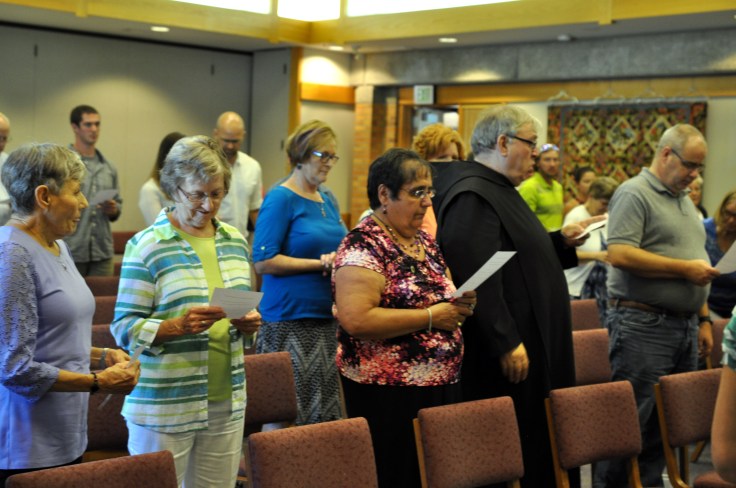
First, the retreats that I’ve attended at the Center have nurtured my love of learning. The first retreat I went to was a Contemplative Prayer retreat, a 4-day silent retreat. I wasn’t sure if I would come back for a silent retreat again (it was hard!) but I knew I would be coming back to this sacred getaway soon. It started out that I came two or three times a year….and it gradually increased over time to be once or twice a month. There was one summer that I came every week and it was suggested that I build a little cabin out back. I’ve particularly enjoyed attending retreats given by the monks of Christ the King and by authors like Macrina Weiderkehr, Anselm Gruen, Helen Prejean, and Michael Casey. I have even come back for more silent retreats too, and I eagerly look forward to them now.

DSC_0532a.JPG

Second, I am grateful for the relationships I have made at St. Benedict Center. I have met some of my best friends here—the monks and oblates, people I have met on retreat and those that have come to retreats that I lead. It has become a spiritual home for me, and now it can be difficult to find silent time because I run into so many friends and interesting people that I want to connect with.  If I have a friend that I didn’t meet here, you can be sure I have invited them to come with me. Which brings me to the next gift that the Center has given me.

I have a passion for sharing what I love.  If you know me, you know that when I feel passionate about something I have a hard time keeping my mouth shut. If I read a good book, I want to tell everyone about it and start a book discussion. If I take a photograph that moves me, I feel compelled to share it with others. Fr. Thomas has given me the opportunity to put purpose and passion together by helping with the St. Benedict Center Facebook page and other social media marketing. It’s something I love to do and it’s helped me think more like a monk too; with everything I post I say, “What would a monk do?” Continue reading “Happy 20th Anniversary, St. Benedict Center!! “

St. Henry II: Patron Saint of Benedictine Oblates, July 13

Happy Feast of St. Henry, patron saint of Benedictine Oblates!

Saint Henry II was born in 973 in the village of Hildesheim, Bavaria, German. (Note: Hildesheim is the same hometown as Fr. Mauritius Wilde, Prior of Sant’ Anselmo formerly of Christ the King Priory. They also attended the same school!) Henry served as the Duke of Bavaria (995) and as the Holy Roman Emperor (972-1024), crowned by Pope Benedict VIII. As emperor, Henry, who had considered the priesthood, was devoutly religious. He shared his faith by rebuilding the many churches that had been destroyed,  building monasteries, and supporting them with both money and land.

According to the Life of Saint Benedict, as told by Saint Gregory the Great, Oblates were received by Saint Benedict in Subiaco even before the monastery at Monte Cassino was founded. A monk during the 11th century wrote:

“There are a great many of the faithful, both poor and rich, who request confraternity with us. We give unto all of them participation in whatever good is done in our monastery, be it by prayer or almsgiving. Let us make special prayer for them, both while they live and after their death.”

According to historians, many people committed themselves to God and to follow the Rule of St. Benedict by uniting themselves to famous monasteries such as Cluny, Hirschau, Saint Blase, and others. St. Henry II was one such individual. Tradition states that Henry wanted to be a Benedictine and lived as an Oblate. Once when he was suffering from a severe illness in the monastery of Monte Cassino, St. Benedict cured him by a wonderful miracle. Continue reading “St. Henry II: Patron Saint of Benedictine Oblates, July 13”

A Big Day for Benedictines: July 11, Feast Day of St. Benedict

Learn more about St. Benedict on July 11 in an original EWTN docu-drama presenting the life and spirituality of Saint Benedict of Nursia.  Fr. Prior Mauritius Wilde and Abbot Primate Gregory Polan contribute to this one-hour program taped at Sant’ Anselmo, the Benedictine monastery in Rome.  The program airs Tuesday, July 11 at  8:00 am and Wednesday, July 12 at 12:00 AM Central Time.  See EWTN schedule for your time zone.

Listen to The Life of St. Benedict –The Holy Rule of St. Benedict with Fr. Mauritius Wilde O.S.B.  Podcasts #28-33 reflect on the life of St. Benedict by using the biography penned by St. Gregory the Great. The first episode looks at the pivotal discernment he made as a young man to pursue the religious life. The aspect of detachment from our earthly family in favor of our Heavenly Father is explored by Fr. Mauritius. There are six reflections on the life of St. Benedict in this Discerning Heart series.

Read Benedict-inspired blog posts from Fr. Mauritius Wilde, OSB at WildeMonk.net

Learn more about living Benedictine spirituality as a monk or oblate at Christ the King Monastery’s website.  

And finally, St. Benedict is pretty special to me too.

“My parents gave me an illustrated book of the “Lives of the Saints” to commemorate the occasion and as any nine-year-old would do, the first thing I did was look up my birthday. I was immediately disappointed. The illustration seemed so dark –a man with a hood, a scary looking bird and a funny name that I had only associated with Benedict Arnold, a famous American traitor.  After gaining such a beautiful name like Christine, what kind of luck did I have to get a guy named Benedict on my birthday?!  July 11, St. Benedict, Abbot, it said.  I read the pages about St. Benedict often, thinking that I should have some connection with this man as my patron saint, but then I forgot about him until…

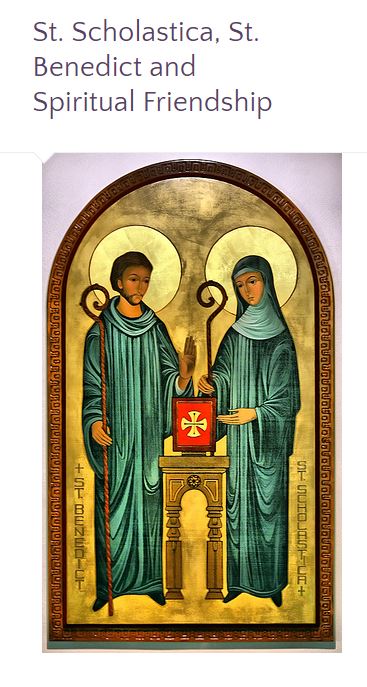
Read more of St. Benedict, St. Scholastica and Spiritual Friendship at SoulFully You.

Happy Feast Day of St. Benedict!

Many Ways to Pray: Walking a Labyrinth

“There are hundreds of ways to kneel and kiss the ground.” –Rumi

There are many ways to pray—in song, spoken or written words, silence, creativity, nature and movement, just to mention a few. Paul recommends to “pray without ceasing” (1 Thessalonians 5:17), which is only possible if we are able to connect with our Creator in a variety of ways. We are meant to engage our senses, our whole bodies, in prayer.

I’ve come to appreciate this about the Catholic Mass, even if visitors might think there is a lot of up and down. We genuflect, sit, stand, kneel and bow. These gestures, postures or movement help to bring our whole being into prayerful expression—raising our hands when saying the “Our Father”, making the sign of the cross or receiving the Eucharist allows us to use our bodies in prayer.

lab signIn addition, walking the stations of the cross or a labyrinth, taking a nature hike, or practicing yoga or tai chi are prayerful forms of movement that engage our bodies while quieting our mind. Going away on retreat is an opportunity to explore and practice various forms of prayer.

St. Benedict Center is building a labyrinth modeled after the famous labyrinth in the Cathedral of Chartres, France.  “When the Holy Land was closed to pilgrims in the Middle Ages, labyrinths abounded in the churches of Europe.  They were used to symbolically represent the pilgrimage to the Holy Land.  Our life is a pilgrimage, a journey to our eternal home with God in heaven.” –Father Thomas Leitner The labyrinth will be completed in late summer or fall. 

DSC_0925a

This summer I had the opportunity to pray in many ways while attending an eight-day Ignatian retreat at the Creighton University Retreat Center. Each day, for about an hour, I met with a spiritual director to receive guidance and to share my faith journey; the remainder of the day was spent reflecting on these discussions and praying. One of the ways that I prayed was by walking a labyrinth.

“A labyrinth is not a maze. A maze is a symbol of life without meaning, it is an agent of confusion, deception with dead ends that lead you nowhere. But a labyrinth is a symbol of a life of deeper meaning, an on-going sacred journey leading us inward, outward and to greater wholeness.” –Carrie Newcomer Continue reading “Many Ways to Pray: Walking a Labyrinth”

The Lord is Our Shepherd: New Meaning, Ancient Words

May 2017 Oblate Reflections and Lectio Divina

Topic:  Psalm 23, God is Our Shepherd and Guide

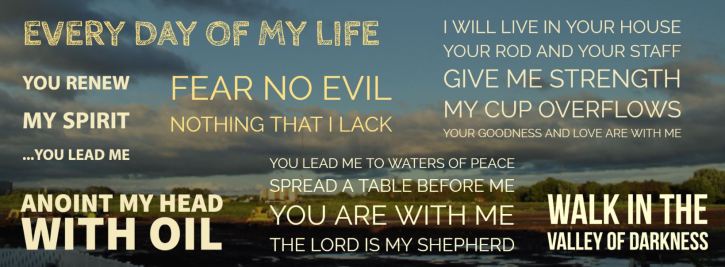
Psalm 23 is the most commonly known Psalm—simple, familiar and full of richness. In lectio divina we ask, “What does this Psalm mean for me?”  We dwell in the words to make personal the promises of God to the people of Israel–promises of renewal, healing, peace, protection, encouragement, and guidance.

The Lord is my shepherd,
I shall not want.
He makes me lie down in green pastures;
He leads me beside quiet waters.
He restores my soul;
He guides me in the paths of righteousness
For His name’s sake.
Even though I walk through the valley of the shadow of death,
I fear no evil, for You are with me;
Your rod and Your staff, they comfort me.
You prepare a table before me in the presence of my enemies;
You have anointed my head with oil;
My cup overflows.
Surely goodness and lovingkindness will follow me all the days of my life,
And I will dwell in the house of the Lord forever.

After reading through the text together and then quietly, we share the words and phrases that come to mind. These words should ultimately lead to personal prayer.

Psalm 23 lectio

Oblates share the words that have settled on their hearts, continuing to listen deeply to what God is saying.

“I remind myself every morning that no matter what the day may bring, I gather strength from God. If I forget this, then other thoughts come into my mind and the day doesn’t go very well.”

“I realize that I lack nothing.  When I pray the “Our Father”, I am praying for my daily bread, not for yesterday or for tomorrow or when I retire, but for my daily bread.  When I realize I lack for nothing in this present moment, my cup overflows. Even when it’s cold, rainy, dreary, or my coworkers are a pain, my cup still overflows. I need to remember the gifts rather than the stuff going on around me.”

psalm 23b

“It can be comforting to substitute the name of a loved one who has died when reading Psalm 23. The Lord is John’s shepherd, He shall not want. He makes John lie down in green pastures; he leads him beside still waters; he restores his soul.

“In grief and hard times, we can believe that our happiness will return soon and our spirit will be renewed. If you substitute happiness for spirit, the Psalm can read as prayer and affirmation. Lord, renew my spirit.” Continue reading “The Lord is Our Shepherd: New Meaning, Ancient Words”

The Presence of the Saints

The Presence of the Saints

Capture

Saint Benedict, founder of the Benedictine Order, writes in his Rule:

When the novice is to be received, he comes before the whole community in the oratory and promises stability, fidelity to monastic life, and obedience. This is done in the presence of God and his saints … He states his promise in a document drawn up in the name of the saints whose relics are there, and of the abbot, who is present. (RB 58:17-19).

At the important moment of their vows, the monks are reminded of the presence of the Saints. The Church believes for some people with certainty that they are with God. They have risen to a life eternal, which means they are with God in unending light, joy, and community. In the Catholic Church we have the custom to invoke the Saints on certain occasions. For some this seems to be superstition. However, when you try to do it, you might be surprised that it “works”. St. Anthony has helped me a lot. He is the Saint you call when you have lost things. I often lose things. When I call him, I calm down. I trust that I will find what I have lost, and he has never disappointed me. One may argue this is self-suggestion – and if so, why not? There are other Saints you can call. Saint Christopher helps the travelers. Recently I heard about St. Leonard who helps to find a parking space. Yes, it made me smile. It is a playful way in which we recall the presence of the Saints. Who are your favorite Saints?  (Read more at WildeMonk)


Learn more about St. Benedict and his sister, St. Scholastica.  Capture

Praying the Psalms ~ Psalm 22

April 2017 Oblate Reflections and Lectio Divina

Topic: Praying the Psalms

We can read the Psalms with three layers in mind: what the Psalm meant the first time it was prayed in history; how the Psalm hints at the life of Christ in the New Testament and how Jesus would have prayed it; and, finally, how it applies to our own lives and  how we can pray the Psalms now. We pray Psalms 22: 1-32.

my god why have you forsaken me

In practicing Lectio Divina, after reading the Scripture out loud, we contemplate, consider and reflect on what we have heard. The Scripture is read again. After some time of silence, we are welcomed to share a word or phrase that speaks to us.

All night long I call and cannot rest, my soul will live for you.      They never trusted you in vain.     Do not stand aside trouble is near.       They trusted and you rescued them.     If God is your friend let God rescue you.        Rescue my soul from the sword.           More worm than human.        My heart is like wax melting inside me.  

One participant said the images of wild beasts in the desert environment was overwhelming—she had no words.  We rest in silence, some speak, a few sniffles, a sigh. The verses and words in this Psalm touch each of us in a unique way.

What resonates with you from reading Psalms 22?  This is what resonated with us:

So many feelings are expressed in this Psalm—complaint, fear, desperation, anguish, hopelessness. We tend to think that we should feel in a certain way, that trust is the superior action or emotion, but it is human to feel all of the desperate feelings mentioned. We can accept all of our emotions because God lets us feel all of those things and desires that we express them. Continue reading “Praying the Psalms ~ Psalm 22”

Earthquake and Easter go together

Homily for the Easter Vigil 2017 at Christ the King Priory/St. Benedict Center, Prior Fr. Joel Macul OSB

Vigil readings: Gn 1:–2:2 • Gn 22:1–18 • Ex 14:15–15:1 • Is 54:5–14 • Is 55:1–11 • Bar 3:9–15 • Ez 36:16–28 • Rom 6:3–11 • Mt 28:1–10

Earthquake! Earthquake and Easter go together today. Most of us could probably use a little earthquake right now to wake us up and get our attention. We have been sitting and listening for a long time. ….God is so full of surprises. Dawn comes, a new day and Fr. Joel Macul, O.S.B.what do we feel? An earthquake. Everything is splitting open, the old is collapsing, and the new is stepping out. The sound of the earthquake and stones rolling away, that is the announcement of Easter this year. But it is a new day, a new creation, the old has passed. After the earthquake, we cannot go back. Life is not the same, for Jesus, for the women, for disciples. Dare I say, for us also?

The readings we have just heard are like photos in a family or community album. Each year on this night we gather to sit down and look at these pictures. We gather here to listen to the stories and poems about God’s ways in our faith community’s story. We sit and listen to the stories and words of the prophets and apostles. Every time we look at a family or community photo album, the pictures remind someone of another story, of another member of the family and community. Sometimes the stories are the same, sometimes they are not. A new memory is added. It is like that with the words and rituals of this Easter Vigil. Each year the same words are read but each year they sound new and different. Something in them is heard for the first time. Why? Because each year we have grown and experienced another piece of life since the hearing last Easter. This year a particular word hits us; it makes sense, more sense than ever before. God is penetrating into our hearts ever more deeply. Each year we hear these words and each year we become these words more and more. Or so we hope.

Continue reading “Earthquake and Easter go together”

Blog at WordPress.com.

Up ↑