What do a threshold, a cow, fire, and water have in common?
St. Brigid of Kildare!
Recently I was introduced to St. Brigid while preparing for a Celtic Christianity pilgrimage and she could not have arrived at a more apt time for me. Admittedly, I’ve fallen down the rabbit hole (or holy well?) of the legends and stories of St. Brigid, a 5th-century abbess and founder of monasteries. St. Brigid is known by many names —Bhride, Bride, Brighid, Brigid, Bridget—and many titles including Muire na nGael (Mary of the Irish) Brigid of the Mantle, Brigid of the Fire, and Mary of the Gael. Brigid is recognized as the patron of midwives including new beginnings, birth, thresholds, and transformation. She has also been linked to fire, blacksmiths, wells, healing waters, springs, and poets. This year, 2024, is the 1500th anniversary of the death of St. Brigid with many celebrations and for the first year has been declared a national holiday in Ireland.
The Threshold
Legend holds that Brigid was born in the doorway of a barn at dawn, at the threshold between light and dark, inside and outside, winter and spring. She is celebrated on February 1, the anniversary of her death, and the same day as the Celtic Feast of Imbolc. Imbolc, a celebration of the Celtic sun goddess Brigid is the halfway point between the Winter Solstice and Spring Equinox in the Northern Hemisphere. Imbolc, which literally means “in the belly”, celebrates the change of seasons, a threshold time of welcoming more sunlight in the day. What is hidden in the earth’s dark belly is beginning to stir—darkness gives way to light and spring is coming!
Choosing a word to focus on each year has become a nourishing, soulful ritual. I savor the word, that more so chooses me, throughout the year—it brings great joy when in perfect synchronicity, it appears over and again in what I read, hear, and see. I trust that the word, as it settles in my heart, will be a guiding light for months to come—challenging, inspiring, and transforming me.
My 2024 word of the year, FULLY, is a throwback to ten years ago when I birthed and named my first website and creative venture, SoulFully You. I participated in training to become a certified SoulCollage® facilitator, to lead retreats on creativity and spirituality. As a Marketing teacher, creating a brand name felt like the best first step. With my daughter Jessica and her friend Claire (both students of my high school classes) we brainstormed a variety of words, phrases, and combinations, and then it clicked, that “aha moment” of knowing I have come to trust—SoulFully You. I loved what it meant, and still do. The image at the top of this page, a SoulCollage® card to represent SoulFully You, came later.
Being SoulFully You is living with purpose, on purpose; being attentive to the present moment; practicing gratitude; making good choices and having no regrets; living with death daily before your eyes, as St. Benedict writes; and leaving something beautiful from a life well-lived. It is living life to the fullest, using the gifts and talents you have while being open and responsive to opportunities and surprises that come your way.
A tree gives glory to God by being a tree.
Thomas Merton
Being SoulFully You is discovering and becoming all that God has created you to be. Thomas Merton writes, “For me to be a saint means to be myself.” The call to be holy is the call to be more fully myself, just as a tree gives glory to God by being a tree.
Since the beginning of time, peoples of all cultures and religions have beheld the beauty of the earth, endeavoring to understand the universe and their place in it. We long for this sacred knowing. Just a century ago, we could not have conceived of the technology and space exploration that would produce photographs and telescopic images, inspiring such awe and wonder, my word for 2023. We are imbued with the grandeur of God.
Hildegard of Bingen, the 12th Century Benedictine Abbess and founder of German scientific natural history, captures this wonder:
“Glance at the sun. See the moon and the stars. Gaze at the beauty of earth’s greenings. Now, think. What delight God gives to humankind with all these things. All nature is at the disposal of humankind. We are to work with it. For without we cannot survive.”
Hildegard of Bingen
Since 1990, the Hubbel Telescope has captured the wonder of our universe’s distant past, more than 13.4 billion light-years away, capturing images of black holes, galaxies, and the birth and death of stars, changing how we look at our cosmos.
The James Webb Telescope launched on Christmas Day, 2021, has even greater potential, using infrared capabilities to see through dusty regions of space viewing objects that are too old, faint, or distant for the Hubble Space Telescope.
It is astounding to behold the images of what is beyond us, but, perhaps, even more profound are the images captured on Christmas Eve, 1968, of Earth. The three astronauts of Apollo 8 completed the first manned orbit around the moon, becoming the first humans to see, and photograph, the Earth from space.
The first color photograph taken beyond Earth’s orbit was later titled Earthrise. The film “Earthrise” tells the story of this image captured by the Apollo 8 astronauts—Bill Anders, Frank Borman, and Jim Lovell—and recounts their experiences, exploring the beauty, awe, and grandeur of the Earth against the blackness of space.
The vast loneliness is awe-inspiring and it makes you realize just what you have back on Earth. The Earth from here is a grand oasis in the big vastness of space.”
Astronaut Jim Lovell, Apollo 8
Looking beyond, looking upon, looking around, and within—all are filled with wonder.
“…take a look around you. Ponder how the solid-seeming ground beneath your feet is quietly shaking with the force of billions of years of cosmic collisions. Go outside…watch the wind blow through the trees … The endless comings and goings of galaxies, stars, and planets create a melding of songs that you are part of too. It’s a reminder that the world always has been, and always will be, worthy of wonder.”–Adam Frank, The Constant Fire
In awesome wonder, may your Christmas be filled with reminders of the beautiful mystery that surrounds you.May your prayer begin with “How Great Thou Art.”
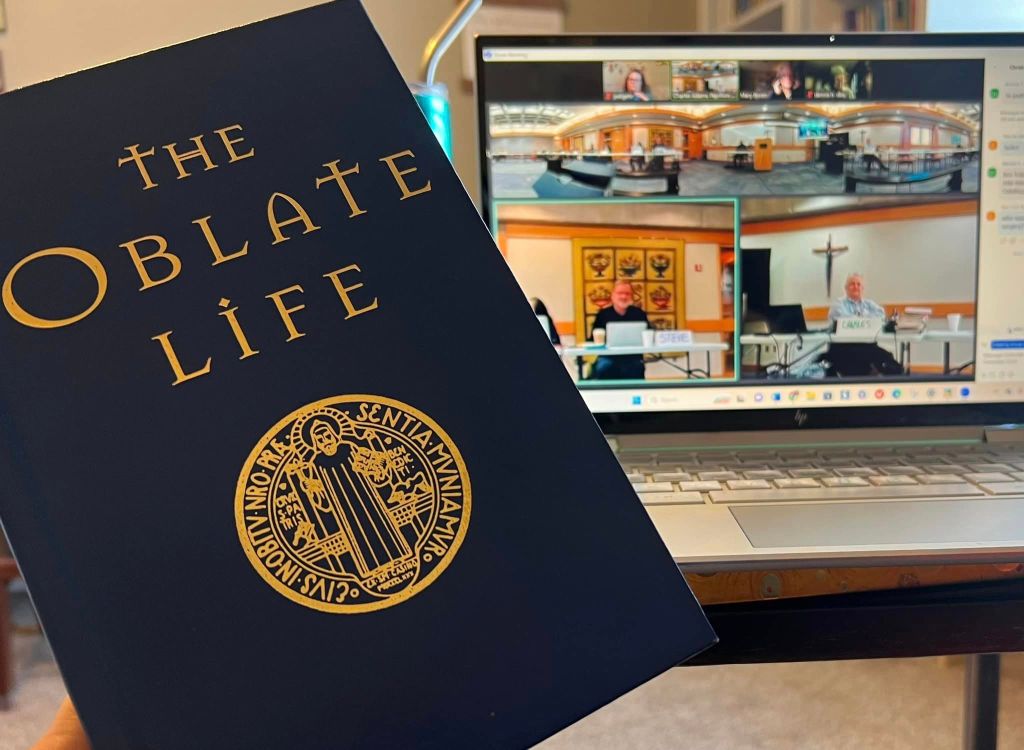
Source: The Oblate Life, edited by Gervase Holdaway, OSB, 2008
Men and women who have made monastic vows, called monks, practice stability by committing to a specific monastery. “The monk is an archetype, whether we live in a monastery or not, we have a sense of what it means to be a monk. We long to be together with God in solitude.” (Fr. Mauritius Wilde, OSB)
Being Benedictine as an oblate is making a commitment to a monastery, living the core values of obedience, conversion of life, and stability while following the Rule of St. Benedict as monks “in the world,” meeting monthly to practice Lectio Divina and discussing a spiritual reading. In the age of Zoom meetings (in which I, gratefully, participated this month), it is a good reminder that it is the monastery that I am drawn to—to the sacred rhythm of prayer and respect for silence, the theme of our discussion (December 2023.)
Grateful for the option of Zooming in to Oblate meetings, but it’s never quite the same. I love to go to our monastery and retreat center.
“If we are to learn about silence and cultivate its art form, the monastery is the first place to visit, for it is within the ancient tradition of monasticism, that we can begin to understand the relevance and the need for silence as a discipline, and a way of life. It is highly relevant that the very first word of the rule of Saint Benedict is listen.”—Susie Hayward, Silence, The Oblate Life
In silence, we can be transformed. “We will begin to see the ‘world’ differently, our breathing will become more rhythmical, surrounding color will intensify and brighten and our eyes will see more clearly and with greater perception.” (Hayward) We become more attentive. We notice the details around us, and we notice what is happening within us.
I had this experience during a contemplative prayer retreat over 20 years ago, my first visit to the monastery and retreat center that has become such an important part of my life. Even during our meals, we sat in silence, which contributed to a heightening of my senses—the quiet and stillness provided a backdrop through which I appreciated the color and tastes of ordinary foods—lettuce, tomatoes, bread, pasta, butter, milk. It was pure ecstasy to look, touch, and taste—to interact with my food. This sentiment—the sensitivity to physical, tangible cues—carried over into watching fish swim in the pond, grasshoppers jump from one station of the cross to the next, a candle flickering. All things seemed to be created for me. Every movement, color, taste, and sensation seemed special, whereas just days before it was ordinary.
Silence magnifies an experience. The practice of silence helps cultivate attentiveness to others and to how God is working in our lives. Thomas Merton writes, “By learning to listen… we can find ourself engulfed in such happiness that it cannot be explained: the happiness of being at one with everything in that hidden ground of Love for which there can be no explanations.” This type of interior silence must be cultivated. Visiting a monastery where there is silence can help, but one can create physical spaces in our own homes to remind us that times of silence are needed.
Hayward writes that “without silence, God has no voice.” No doubt silencing the noise of our daily lives can help us be more aware of the divine—in creation, in others, in words we read, in the thoughts that run through our mind, and in the story we tell ourselves. Indeed, silence allows us to experience the sacred, but many of us have felt God working, “God’s voice,” through the written or spoken words of others. In discussion, we wonder—do we really need absolute silence to hear God?
Perhaps Hayward means that we need to silence ourselves—to shut our mouths, to let go of thoughts and stories, and to be truly present wherever we find ourselves. If we are in conversation with another, there is sound, not silence, but we can practice interior silence by deeply listening to the other and standing witness to another’s story. It is important to remember that the first word in the Rule of St. Benedict is “Listen.” We must practice silence, both in words and thoughts, in the presence of the divine, including others.
Hayward writes about “the experience of feeling the total ‘presence’ of another person, in such a profound way that ‘in that moment’ we will have felt absolutely heard, totally cared for and completely understood.” What a gift to be heard and to hear others without the noise in our heads! She continues, “Listening reflectively in this attentive and empathic way allows each person to respond to the other fruitfully.”
God is working in this ‘total presence,’ the compassionate listening to another’s story. May we practice silence, to listen, see, and fully experience the humility of unknowing all that we think we know, to experience a oneness with our Creator, with creation, and with all those whom we share both.
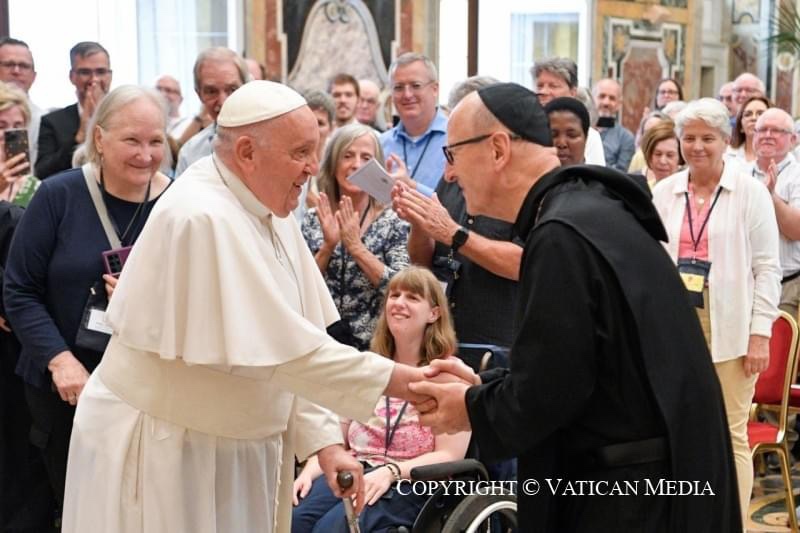
Meeting the Pope is a big deal. Recently I wrote about the 5th World Congress of Benedictine Oblates and the private audience that Oblates had with Pope Francis. Jaime Williams, an Oblate of Christ the King Priory, was in the private audience and was profoundly impacted. I asked him to share his experience and he graciously accepted.
A “Being Benedictine” Reflection by Jaime Williams:
Two plus weeks after the most extraordinary handshake in my life, I still struggle to comprehend how my journey from an inauspicious upbringing in small-town Iowa led to meeting Pope Francis and visiting the two most important holy sites associated with our beloved St. Benedict and St. Scholastica in Italy – nearly 30 years after graduating high school and leaving home. After spending a significant portion of my career traveling extensively through parts of the developing world, I don’t consider my childhood to be been one rooted in poverty, but certainly, my parents had to work hard to make ends meet and there was no shortage of stress present throughout my childhood. I generally consider the Christian formation I received while growing up to be relatively poor, and our participation in church of any kind was sporadic and inconsistent: we were members of Presbyterian, Nazarene, and Methodist congregations at various times during my youth, and moved constantly between northeast Iowa, and east and west coast towns in Florida, before finally settling in southern Iowa where I spent most of my high school years. It is no surprise to me that of our Oblate promises Stability is what I cherish most from my family and Oblate community!
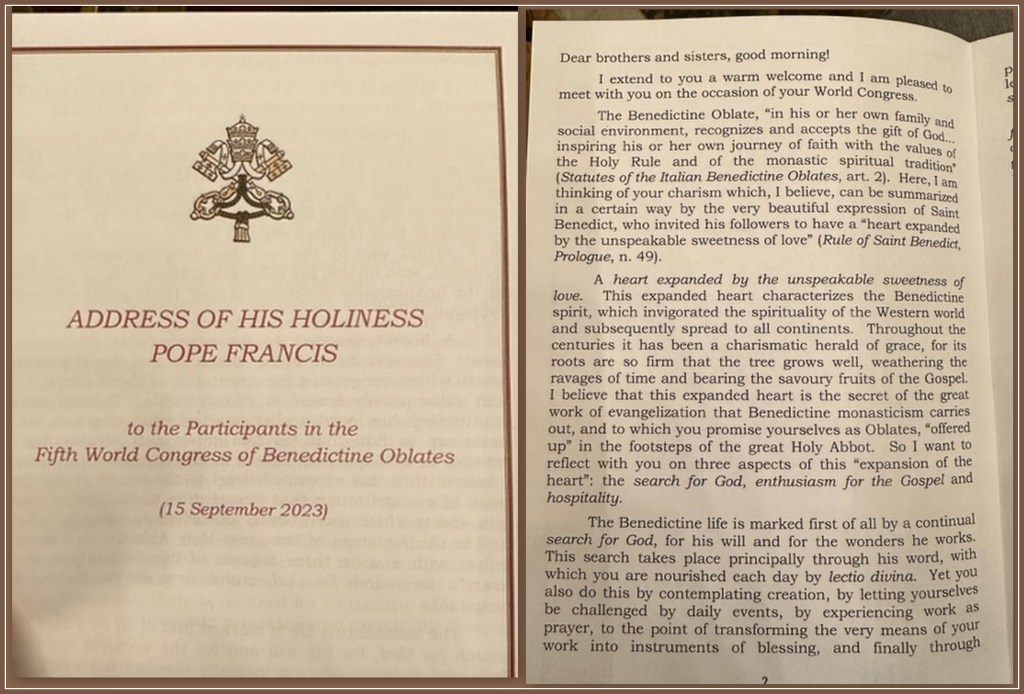
The Benedictine spirit is characterized by “a heart expanded by the unspeakable sweetness of love.” Pope Francis addressed the 5th World Congress of Benedictine Oblates in a private audience on September 15, 2023, as reported by Vatican News. The Congress theme, “Moving forward: Living the Wisdom of the Rule,” is an opportunity for Oblates, lay associates of a Benedictine monastery, to learn about their calling as monks in the world.
I participated in the 2017 Congress in Rome, attending the General Audience of Pope Francis at St. Peter’s Square. I reflected, “We were delighted to be seated on the platform, very near where the Holy Father was also seated. His message on the Eucharist was followed with a welcome for visiting groups with a special mention of Benedictine Oblates. For many oblates, this was one of the most magical moments of the week.” Indeed, it was very special.
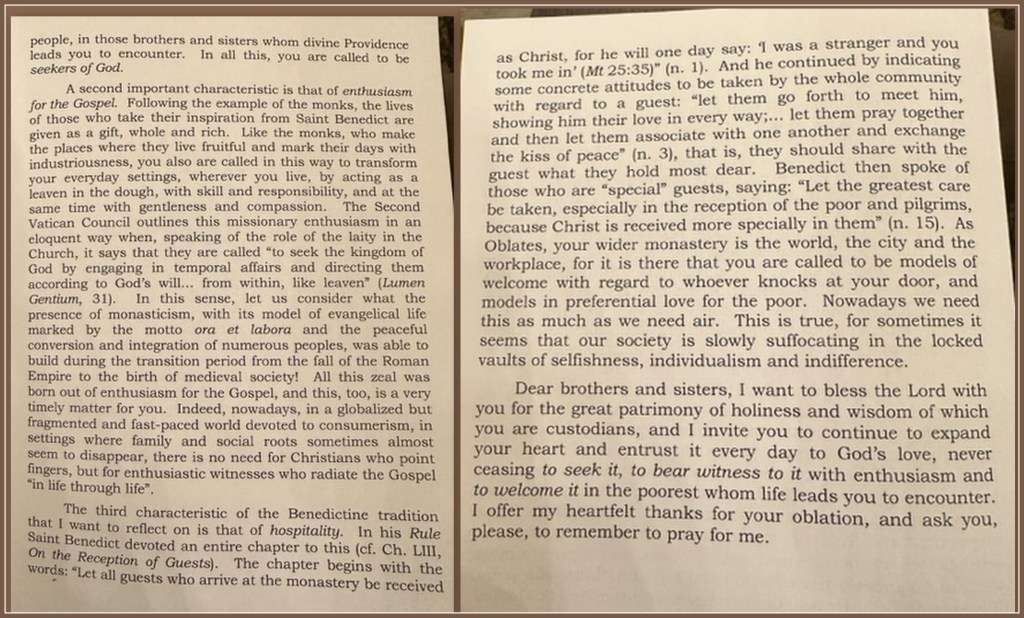
But I can only imagine that a private audience with Pope Francis has left oblates still pinching themselves. Jaime Williams, Oblate from Christ the King Priory where I also belong, shared he cannot find the words to describe the experience (although he has promised a guest post when the words begin to flow.) Jaime shared photos of the program with the words of Pope Francis’ message, of which I will comment.
Jaime Williams, Oblate of Christ the King Priory, Schuyler NE, in the background (blue shirt) as Pope Francis greets Abbot Primate Gregory Polan.
The Holy Father spoke to three aspects of this “expansion of heart”: the search for God, enthusiasm for the Gospel, and hospitality. “The Benedictine life is marked first of all by a continual search for God, for His will and for the wonders He works,” the Pope said. He emphasized the importance of practicing contemplation with the practice of Lectio Divina, as well as contemplation of creation, the challenges of daily life, the experience of work as prayer, and especially through other people.
Like the monks,” he said, “who make the places where they live fruitful and mark their days with industriousness, you also are called in this way to transform your everyday settings, wherever you live, by acting as a leaven in the dough, with skill and responsibility, and at the same time with gentleness and compassion.”
Finally, Pope Francis reflected on the characteristic of “hospitality,” noting that Benedict instructed monks to receive guests at the monastery as they would receive Jesus Himself. As Oblates our “wider monastery is the world, the city, and the workplace, for it is there that you are called to be models of welcome with regard to whoever knocks at your door, and models in preferential love for the poor.”
Pope Francis captures what being Benedictine means to me. It is not about interpreting the literal words in the gospel, but how I take its timeless message into my daily life—in my work, family, relationships, community, environment, and more. The words of Franciscan monk, Richard Rohr, resonate with me, “I’m convinced that one of the only reasons Roman Catholicism has lasted is because we have these satellites of freedom on the edge of the inside—religious communities of Benedictines, Jesuits, Dominicans, Franciscans, Sisters of Charity, Sisters of Mercy, and many more.” It is the connection with my favorite monks, our monastery, and Benedictine spirituality, a 1600-year-old tradition, that has sustained my search for God, my desire to learn from the ancient texts and rituals, and to practice hospitality as a monk in the world.
September 2023 Lectio Divina and Oblate Reflections
Lectio Divina—Chapters 19 and 20, Rule of St. Benedict
Book Discussion—The Oblate Life, edited by Gervase Holdaway, OSB, 2008
Being Benedictine is to believe that the Divine Presence is everywhere, as the opening of Chapter 19 in the Rule of St. Benedict states.
“We believe that the divine presence is everywhere and “that in every place the eyes of the Lord are watching the good and the wicked” (Proverbs 15:3). But beyond the least doubt we should believe this to be especially true when we celebrate the divine office.”
Chapter 19, The Rule of St. Benedict
What is the Divine Office?
The Divine Office, also known as the Liturgy of the Hours or Opus Dei, the “Work of God”, is a daily prayer of psalms, readings, hymns, and prayers. Traditionally during a week, with prayers seven times a day, all 150 Psalms are recited by monks. The Psalms are prayers that Jesus and his disciples recited as part of the Jewish liturgy expressing the depth of human experience and emotion from joy, anger, thanks, praise, suffering, sorrow, contrition, petition, and more.
This Labor Day, a day of rest after starting my 27th year of teaching, is an opportunity to reflect on the first four weeks of the 2023-2024 school year. Our first week back to school, sans students, is solely intended for teacher professional development, meetings, reconnecting with coworkers, and planning for new classes.
At our LSE Staff Back to School Day, teachers were asked to consider what Knight Pride means, and what makes Lincoln Southeast High School uniquely LSE. My response, in a word, is tradition. Celebrating and learning from our history helps shape who we are. Carrying a strong tradition into each new year, adapting to new challenges, and balancing empathy with high expectations capture our essence. We have cultivated close relationships in each of our departments creating a smaller community, a school family, within the larger community of Lincoln. This is #knightpride!
*The Knight is our mascot. Pride is an acronym we use to encourage positive behaviors and values in the classroom. PRIDE stands for Personal Responsibility, Respect, Integrity, Determination, and Excellence.
Why are we here?
Remembering our purpose can be helpful when teaching day-to-day gets challenging. The purpose of my work, believing that learning is the greatest gift of being human, is what makes me come alive. Fostering curiosity, wonder, and the love of learning with co-teachers and students is my motivator.
How do we show our passion and purpose?
In The Monastic Way, September 2023 issue, Joan Chittister writes, “Good work is work that develops us as we develop it.” Modeling curiosity and wonder by committing to my own learning shows students that learning is a purposeful, lifelong endeavor. Each year, I commit to creating lessons that inspire curiosity while also communicating the connections between what we are learning and the value to my students’ lives. Students must understand their why.
What outcomes do we desire?
Relationships with former students are the greatest reward from my years of teaching. Seeing these young adults share their Knight Pride as LSE alumni at school events and as contributing members of their community is a great joy. I wish for all my students—that their life is better because of what they learn; that they have aha moments now and, in their future; that they build career and life skills; and that they become lifelong learners. Joan Chittister shares, “Work is the gift we give to the world. That’s why it’s so important that what we do for a living has value, not simply for ourselves but for the world at-large.”
Barbie is a big deal. The smash-hit movie “Barbie” has reached the coveted billion-dollar mark at the global box office and its director, Greta Gerwig, had the highest-grossing opening weekend ever for a film directed by a woman. Millions of women—from 20 something to 70 something—have donned pink attire with their besties or their daughters—and headed to the theatres for pre-movie selfies and a trip down memory lane.
Barbie is a big deal. And, yes, even some guys have gone to the movie and enjoyed it! Every major newspaper, magazine, and news organization has weighed in on a variety of Barbie themes from feminism, patriarchy and consumerism to mother-daughter relationships, authenticity, and existentialism. Since I saw Barbie with one of my besties, Katie, a few weeks ago, I have read dozens of commentaries on the film. One’s reaction to the movie, or, for that matter, any cultural, social, or political phenomenon, cannot be separated from our own interests, values, biases, and experiences.
My experience includes fond memories of playing with my Barbie dolls–selecting special clothes my parents told me Mrs. Clause had personally tailored, organizing my wardrobe suitcase and setting up camp with a Barbie drive-camper. My daughter celebrated a Barbie-themed birthday, loved her Pepto-Bismol pink bedroom with Barbie comforter and curtains, and had all the Barbie things, even a lunchbox. Barbie captured the imaginations of little girls, and when they became mothers, their little girls enjoyed them as well.
“We mothers stand still so our daughters can look back to see how far they have come,” the spirit of Handler, the inventor of Barbie, said to Barbie, played by Margot Robbie, in the film.
I absolutely loved the movie--from the set and costume design (I mean, a life-sized Barbie house!), the special effects, the song selections and dancing, the clever comedy/satire, the Birkenstocks and the many feminist themes that elevated the movie to one for serious discussion. Katie, and I shared laughs and tears, many de-briefing conversations, and a commitment to see the movie again. My one wish–that I can also see it with my daughter someday.
But, this is what I have been considering: Is Barbie being Benedictine? Yes! I see a few themes in the Barbie movie that provide a glimpse of what it means to be Benedictine.
Barbie considers her death.
Early in the movie, Barbie asks her friends, “Do you guys ever think about dying?” This existential question is the impetus for Barbie’s (s)hero’s journey, one of curiosity, self-discovery, and transformation, depicted in religious literature, myths, and poetry since the beginning of storytelling. When Barbie’s perfect plastic curves are met with the disappointment of flat feet, cellulite, and clumsy accidents, she attempts to restore the status quo. She experiences a “dark night of the soul,” desperate only for life to go back to the way it was (as she lies face down, in humility, pining for untroubled times.)
When faced with our own mortality, we come face-to-face with the certain uncertainty of our lives. When Barbie adventures into the Real World, where events are not contrived, she is faced with the purpose and meaning of her life, eyes opened to embracing both joy and suffering, aging and death.
St. Benedict advises in his Rule, to “Keep death daily before your eyes.” These thoughts of death make Barbie more human, real, authentic—once she realizes her own mortality, she cannot unsee it. Her old life has gone, and a new way must be birthed. Barbie is becoming.
Barbie listens.
In one of the most poignant scenes in the film, Barbie is overwhelmed with the stimuli of the Real World. She pauses to sit down on a bench to consider her next steps. This act of pausing to contemplate is the epitome of being Benedictine.








 Being Benedictine