Search

Being Benedictine

Living SoulFully as an Oblate of St. Benedict

Category

Spiritual Journey

The Soul of a Pilgrim: A Benedictine Pilgrimage, Part 1

“A pilgrimage is an intentional journey into the experience of unknowing and discomfort for the sake of stripping away preconceived expectations. We grow closer to God beyond our own imagination and ideas.” The Soul of a Pilgrim: Eight Practices for the Journey Within, Christine Valters Paintner

Recently my Spirit Circle chose to read Christine Valters Paintner’s “The Soul of a Pilgrim”, a book that explores pilgrimage as both an inner and outer journey. Several of us were preparing for “Footsteps of St. Benedict and St. Scholastica,” a Benedictine pilgrimage to Germany, Austria, and Switzerland sponsored by the Benedictine Oblates of Christ the King Priory.

9781933495873_p0_v1_s550x406

By definition, a pilgrimage is a sacred journey or holy expedition, but we do not need to travel a great distance to go on pilgrimage. It is more about choosing to be “attentive to the divine at work in our lives through deep listening, patience, opening ourselves to the gifts that arise in the midst of discomfort, and going out to our own inner wild edges to explore new frontiers.”

The purpose of going on a journey “is always to return home carrying the new insight back to everyday life,Paintner writes. “When we take inward and outward journeys, we can be pilgrims as long as we stay open to new experiences.”  A week of hard work, becoming a new parent, losing a loved one, resolving a relationship conflict, or going on a spiritual retreat can all be a pilgrimage if one seeks to learn, reflect and be transformed from the experience.

These insights from the first few chapters and the book “The Soul of a Pilgrim” travel with me on my two-part pilgrimage. First, I visit cousins in Germany and then I join thirty-six other pilgrims to learn more about St. Benedict and to visit sacred sites including churches, monasteries, abbeys, castles, small villages, and large cities.

Three weeks, three days I will be gone. As I journey from Nebraska to Europe, I reflect on both my outer and inner experiences—the people, places, feelings and insights that I encounter on the journey. Continue reading “The Soul of a Pilgrim: A Benedictine Pilgrimage, Part 1”

You Are Free: 2019 Word(s) of the Year

I’ve written before about choosing a “Word of the Year.” This year, I chose a phrase to serve as my spiritual mantra—three life-changing words that came as a gift of grace when I felt torn between two possibilities and needed to make a difficult decision.

For me, the process of discernment, especially when I have strong feelings or attachments, often begins with compulsive mental role-playing. I replay conversations—what was said, what was meant, what could have been said, and now what? Once I am able to slow down my thoughts, create some space, and breathe, I can face a decision more calmly and with a spiritual perspective. I write out my thoughts and feelings, ask questions of myself and God, and listen to what might be beneath the words. I write as prayer, knowing that, so often, an answer is revealed.

The decision I needed to make felt particularly heartbreaking. Feeling desperate, I reached out to a spiritual companion and asked for prayers.

Asking for prayers was admitting I needed help.
Asking for prayers was an act of vulnerability, humility, and surrender for me.
Asking for prayers helped me to be even more prayerful about my situation. I surrendered to God for the answer that my obsessive thinking would not bring.
Asking for prayers opened me for the words that came. Continue reading “You Are Free: 2019 Word(s) of the Year”

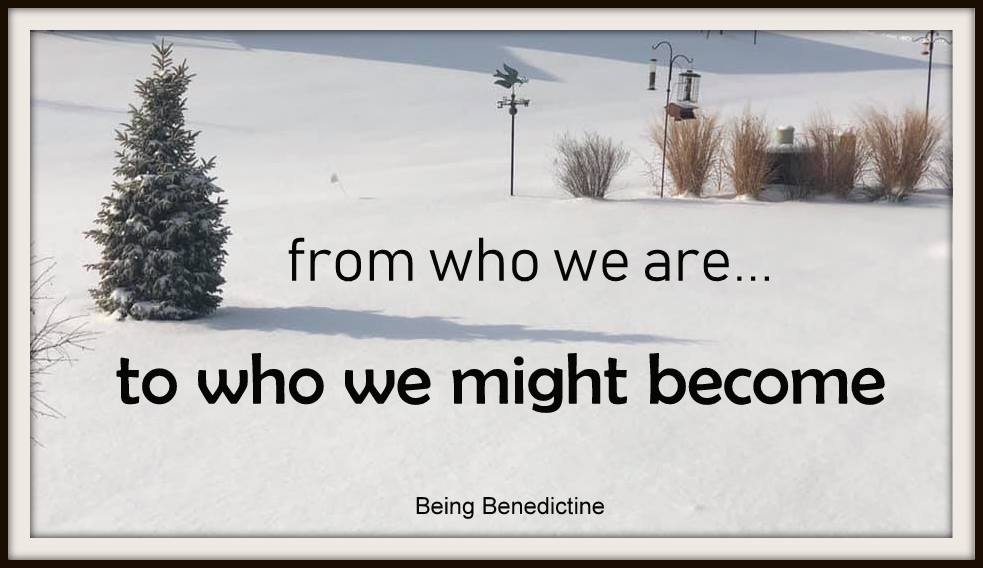
From who we are to who we might become

February 2019 Oblate Lectio Divina and Discussion

Topic: Conversion

Luke 5:27-32Jesus saw a tax collector named Levi sitting at the customs post. He said to him, “Follow me.” And leaving everything behind, he got up and followed him. Then Levi gave a great banquet for him in his house, and a large crowd of tax collectors and others were at table with them. The Pharisees and their scribes complained to his disciples, saying, “Why do you eat and drink with tax collectors and sinners?” Jesus said to them in reply, “Those who are healthy do not need a physician, but the sick do. I have not come to call the righteous to repentance but sinners.”

Jesus saw something in Levi—that he was both a tax collector and open to an invitation to follow him. Levi worked with the oppressive Roman Empire, likely judged as greedy and affluent at the expense of others, but Jesus saw his potential.

So often we see people or situations as either/or, not both/and. We see the tax collector, or a politician, or social media as either good or bad, quickly making blanket statements or judgments to categorize into one or the other. But Jesus does not see Levi as one or the other, he sees Levi, and us, as both/and—as who we are and who we might become. Continue reading “From who we are to who we might become”

In a Pair of Red Shoes

“And if God sees fit to hold me
Anyone that’s ever known me
Know I’d walk the gold streets only
In a pair of red shoes.”

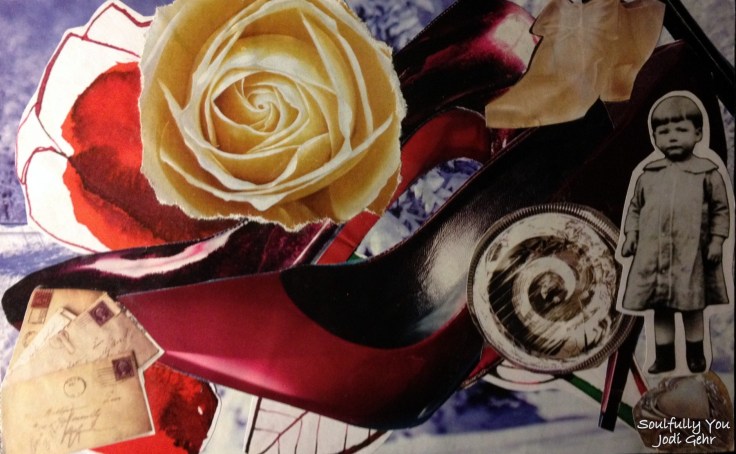
My friend, Colleen, loved red shoes. But I didn’t know this about her until her Aunt Bea shared a story at her funeral.

Colleen 1
SoulCollage® card remembering Colleen.

What a silly thing to say at a funeral, but for “some reason” I told Bea that I loved the beautiful red shoes she had on. Sometimes things fly out of my mouth without any consideration to how they might sound—and today was no exception.  But, of course, there was a reason.

Aunt Bea immediately connected the shoes to Colleen.  Just a few months earlier, Colleen had borrowed those red shoes on an evening when she and her sisters were going out dancing, something they loved to do together.  Aunt Bea commented how much Colleen loved to dance; telling us that Colleen believed when you dance you have to wear high-heeled shoes.  It was a nice story of when Colleen was joyful and doing what she loved most—dancing.  There is comfort in storytelling and remembering. Continue reading “In a Pair of Red Shoes”

A Wild and Precious Life: Mary Oliver

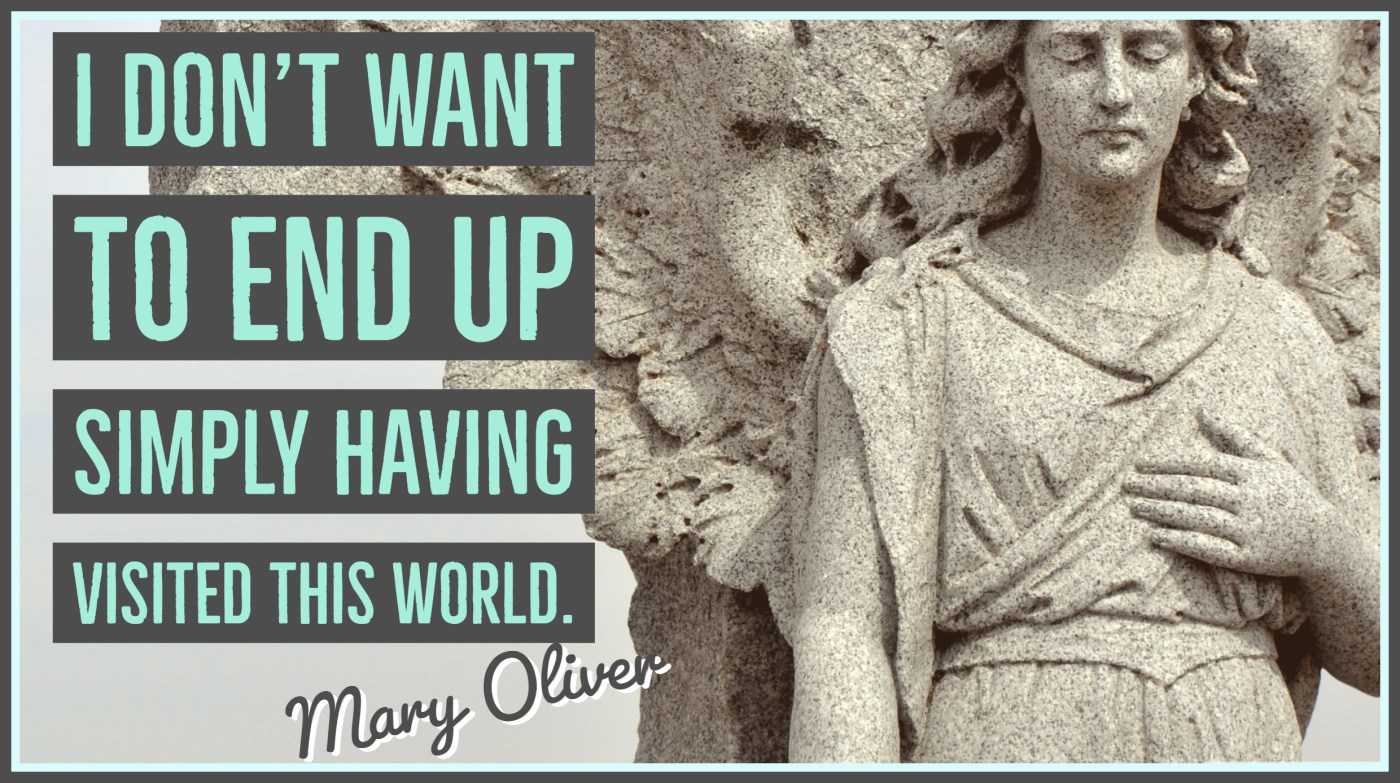
 Mary Oliver. She must have loved life.  She deeply reflected upon it and wrote about it so eloquently. She suffered and enjoyed and made peace. And she wrote about it all. 

living in this world.jpg

She encouraged us to slow down and enjoy each moment. 

“For how many years did I wander slowly through the forest. What wonder and glory I would have missed had I ever been in a hurry!”  Leaves and Blossoms Along the Way: A Poem

She encouraged us to see the holy that is wholly visible.

“God, or the gods, are invisible, quite understandable. But holiness is visible, entirely.” Leaves and Blossoms Along the Way: A Poem Continue reading “A Wild and Precious Life: Mary Oliver”

No GPS, Just Follow the Star

Just over three years ago, we built a new house on what was the edge of town. We could see the city limits boundary from our backyard. There were empty lots behind us, next to us and across the street. Our address was not listed on Google Maps or detectable by other forms of GPS.

For the first four weeks at our new address, the local cable company claimed they couldn’t connect us to internet and television services (much to the disappointment of my sports-loving husband.) When people came to visit us, we needed to provide directions, not just our street address.

No Google maps or Siri would find us; just good, old-fashioned directions. “Head south on ___street.  Go three more blocks until you reach ___street. Turn right. Go to ____ street, and turn left.” We had a few late arrivals and phone calls from lost friends for several months, but we actually enjoyed being out in the boonies.

DSC_0699a.jpg
Old barn less than 1/4 mile away from our house

GPS, although so helpful, has become a crutch. I love young people (I teach them; I have one…a daughter), but often it is younger people that just don’t know their directions very well, having relied on technology their entire lives. Continue reading “No GPS, Just Follow the Star”

Begin Again: New and Improved!

The most used words in marketing campaigns and on product packaging are new and improved. This expression taps into our deepest desires to improve our lives and our circumstances. Marketers know this—that most of us want better and that we want to BE better, to be more of this or less of that—and so come the advertisements for weight loss, exercise facilities, home improvement, travel and more. Of course, the superficial and material never satisfy and leave us still wanting more, or less.

The essence of making New Year’s resolutions—everything from setting financial, career and relationship goals to considering new ways of being and doing—is that we desperately seek the chance to “do over.” It might sound elementary, and even impossible, but we long for it anyway.

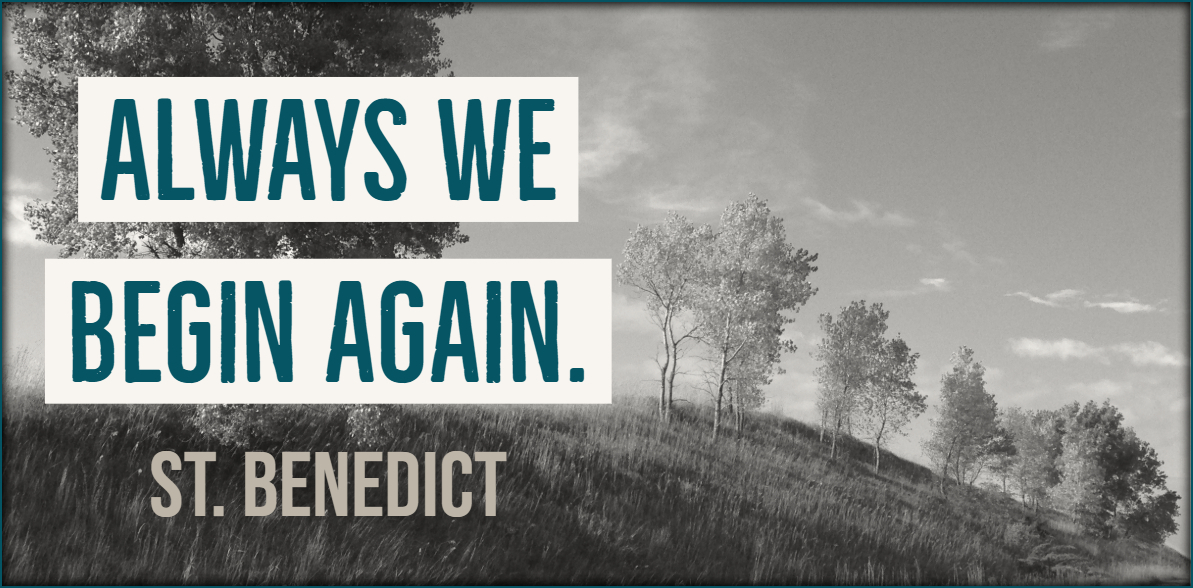
Celebrating the beginning of a new year is a reminder of our opportunity to “always begin again”—the embodiment of Being Benedictine. It’s not as simple as a “do over” but January 1, merely just one day that follows December 31, gives us a definitive time and space to honor our deepest longing to begin again.

always begin again

I’ve long since quit making resolutions. Well, not really—I make them and break them so quickly and consistently, that I’ve chosen to look at them more gently, as beginning again. Each year I select a word that will help guide me in the New Year. Continue reading “Begin Again: New and Improved!”

Sobriety: The Nature of our Need

Fr. Mauritius Wilde, Prior of Sant’ Anselmo in Rome, has a new podcast series on the Benedictine understanding of sobriety.

Can you get caught up in the swirl and chaos of fear, violence, and anger assaulting our world today? Practicing soberness means being detached from emotions, both overly negative or positive feelings. It is not good to be “drunk” on either extreme.

Soberness is taking just what we need. What do I take with me? What do I take in? What do I consume? How much wine, money, noise, whatever? Is it too much? The journey of soberness is to become more aware of whether there was too much.

But soberness is more than an absence of something—there is its own positive quality. The absence of the noise of tv is more than just turning off the tv. We begin to discover how beautiful silence is. Once you taste it, you want to have more of it.

Capture


Thanksgiving: A Ritual of Gratitude

Preparing for the Thanksgiving holiday can be a sacred ritual. Weeks in advance several family members begin planning the menu for our Thanksgiving dinner. Of course, there is little variation from year to year—turkey, dressing, dumplings, sweet potatoes, green bean casserole, pies, dinner rolls, and so on—but an afternoon of list-making, guest-counting, and recipe-searching ensues. Some years, even a second planning session is required—to count plates and chairs, to create a map of the food line, or to scour advertisements for butter sales. The planning sessions have become part of the practice of Thanksgiving.

The Thanksgiving planning sessions and meals that immediately followed the passing of each of Joe’s parents was bittersweet. We missed their presence. But the ritual itself, while grounding us in the present, was a reminder to be grateful even in our sadness and grief. Continue reading “Thanksgiving: A Ritual of Gratitude”

Blog at WordPress.com.

Up ↑