I carefully consider everything that I write and share here, especially the more personal or contentious reflections. I rarely write and post on the same day. Not so with my speech. I find myself saying often enough, “Did I just say that out loud?” Words fly out of my mouth much faster than they flow from my pen or keyboard.
Perhaps this is why I enjoy journaling and writing so much. It slows my mind down. In silence, I can be more deliberate, careful, and organized in what I share. A healthy respect for silence could save me some angst in times when my mouth works faster than my mind.
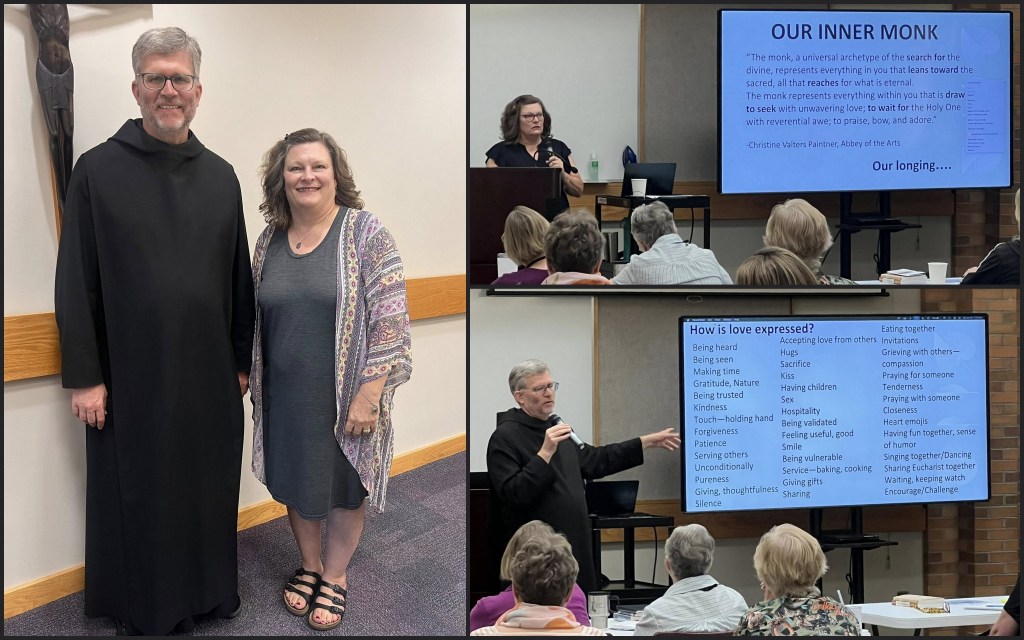
At our annual oblate retreat, with the theme “Building Community Through Our Oblate Promises,” the importance of silence was the topic of the opening session led by Fr. Thomas Leitner, the administrator of St. Benedict Center and a monk who lives at the monastery across the road. Throughout the weekend, we would learn about and practice silence.
Why is silence so fundamental to Benedictine spirituality?
Silence is the way to self-knowledge. A discipline of silence confronts us with ourselves. “Silence is a way for us to put up with ourselves the way we are. Not everything that comes to mind at times of silence is pleasant. Repressed needs and wishes may come up, repressed anger, and perhaps missed opportunities,” Fr. Thomas shared. Silence gives our wounds space to surface, allowing us time to wrestle with and soothe our pain in healthy ways. Silence allows us to see ourselves unfiltered without the influence of others.
In The Interior Castle, St. Teresa of Avila uses imagery of a castle for our soul, emphasizing “how necessary this room (of self-knowledge) is…we shall never completely know ourselves if we don’t strive to know God.” She writes that God dwells within us, and to know God, we must first know ourselves. Hard, but necessary, work to “know thyself,” as the ancient Greek maxim suggests.
Silence connects us to the Divine. Seventh-century bishop and theologian, St. Isaac of Syria, writes:
Try to enter into your treasure house and you will see the treasure of heaven. For both the one and the other are the same, and the one and the same entrance reveals them both. The ladder leading to the kingdom is within you, that is, in your soul.
We enter this “treasure house,” our very soul, through the practice of prayer. Some of us may be conditioned to think of prayer as a transactional bubble-gum-machine approach to asking God for what we want. We put in a coin; God supplies the big gumball. Our prayers are “answered.” Yet this is not the kind of prayer that leads to self-knowledge or to a connection with God. Consider a poem by the 19th-century Danish theologian Søren Kierkegaard that points to a different kind of prayer.
As my prayer became more and more devout and interior, there was less and less I had to say. Finally I became completely still.
I became— this is perhaps an even greater contrast to talking— I became a listener.
First I thought praying is talking. I learned, however, that praying is not only silence, but listening.
That’s the way it is: Praying does not mean hearing oneself speak, praying means becoming still and being still and waiting until I hear God.
-Søren Kierkegaard
Silence builds confidence and leads to self-respect.
“As my prayer became more and more devout and interior,” I come to know myself with greater depth. This knowing builds my confidence: I have been created just as I am, in the image of God. I forgive myself for weaknesses and celebrate my gifts. I seek less approval from others. I have “less and less” to say to justify, convince, or plead my case of worthiness to myself or others.
Teacher, writer, and friend, Parker Palmer, writes, “One of our most debilitating illusions (is) that the answer to our problems is always ‘out there’ somewhere, never ‘in here.’ It’s an illusion that’s constantly reinforced by educational and religious institutions that make us dependent on “experts” and “authorities.” We need not look for knowledge in others; we can trust our own interiority, the Divine Expert Within. I can grow in self-respect, knowing God is within me, intimately speaking to me when I am silent long enough.
But now faith, hope, and love remain, these three; but the greatest of these is love. –1 Corinthians 13:13
This scripture verse is one of the most frequently read at wedding ceremonies, but it is meant for more than those getting married. We are created to love and be loved—all of us, no matter who we are or our chosen paths in life, whether monk or married.
Our deepest longing is to be loved. Love is the thread that runs through all the world’s religions. In Christianity, the Great Commandment is to “love the Lord your God with all your heart, and with all your soul, and with all your mind” and to “love your neighbor as yourself.”
Several years ago, during spiritual direction with Benedictine monk, Fr. Mauritius Wilde, we discussed, despite our different vocations, how much we have in common. We each have a holy longing—to love God, to have a healthy love for ourselves, and to give and receive love. Practically speaking, we are the same age, we are both teachers and retreat leaders, have one brother, have the same middle name (Marie—seriously, what are the odds on that?), we share similar Enneagram personality traits, and each of us professed our marriage or monastic vows 40 years ago, a day apart. I was married on August 17, 1985, and Fr. Mauritius entered the monastery as a novice on August 18, 1985.
After one of many conversations where one of us would say, “That is exactly how it is for me!” or “Me, too!”, I half-seriously, half-jokingly suggested that we write a book about how, setting the whole monk vs. being married thing aside, we experience our love of God and others in many of the same ways. Nearly forgotten, this idea resurfaced a year or so ago, and we decided that leading a retreat together would be a good beginning. Our theme would be love, specifically how the Rule of St. Benedict can help us grow in love and to discover our “inner monk.”
“The monk, a universal archetype of the search for the divine, represents everything in you that leans toward the sacred, all that reaches for what is eternal. The monk represents everything within you that is drawn to seek with unwavering love; to wait for the Holy One with reverential awe; to praise, bow, and adore.” -Christine Valters Paintner
The Rule of St. Benedict shows us the path of love, of nurturing the monk within while living in community. During our retreat, held in July 2025, we shared how the monk’s promises—stability, obedience, and conversion of life—are the foundation for learning and growing in the “school for God’s service.” (RB Prologue 45) For the monk, this place of learning is the monastery. For me, it begins in my family as wife and mother. But each of us is more than our role as a monk or a married person. Each can be transformed by practicing love in our friendships, workplaces, community, and environment.
“We have God and we have each other. We have our island community, fragile, and yet a fortress.”
–Parable of the Sower, Octavia Butler
The past few months have presented some hard times in my circle of friends and family. Each week presents a new situation—diagnosis, dying, death—all of it; not to mention the growing instability in our country and world. It seems impossible not to feel sadness, loss, fear, even despair.
Over a recent campfire conversation with friends, my husband shared a sympathy card he received after his brother, Steve, passed away. Overcome with tears, he could not get through the words, so I finished reading it for him. I, too, was in tears by the time I reached the end. And that’s when it hit me–this is how we must walk through any darkness we face: KINDNESS.
My husband’s former co-worker was so thoughtful! His words are an example of how we can extend kindness to others. We are grateful for all the acts of kindness from so many during the last few weeks and throughout our lives. Kindness matters.Continue reading “Kindness Matters”→
Just for a moment, at 10:06 pm tonight, March 19, 2024, darkness and light will be held in perfect balance. Equinox, meaning “equal night” in Latin, is when the sun is directly over the Earth’s equator, causing day and night to be equal moments. In the northern hemisphere, where I live, we will begin to have longer days with more sunshine and hours of light. As the earth continues moving around the sun, the position of the sunrise and sunset will change quickly, and the balance between night and day will not last long.
Indeed, an apt metaphor for the balance we seek in our daily lives. It is good to remember that even in the cosmos there is either more dark or more light. This is life.
During pre-Christian Europe, the pagan goddess, Ostara, was celebrated during the spring equinox. She was honored for renewal, rebirth, fertility, balance, and the coming of spring. In Western Christian churches, Easter is celebrated on the first Sunday after the first full moon following the spring equinox. The cosmic connection between spring equinox and Easter, the crucifixion, death, and resurrection of Jesus, cannot be missed–they follow the rhythm of nature and point to more light, either literally or through Christ.
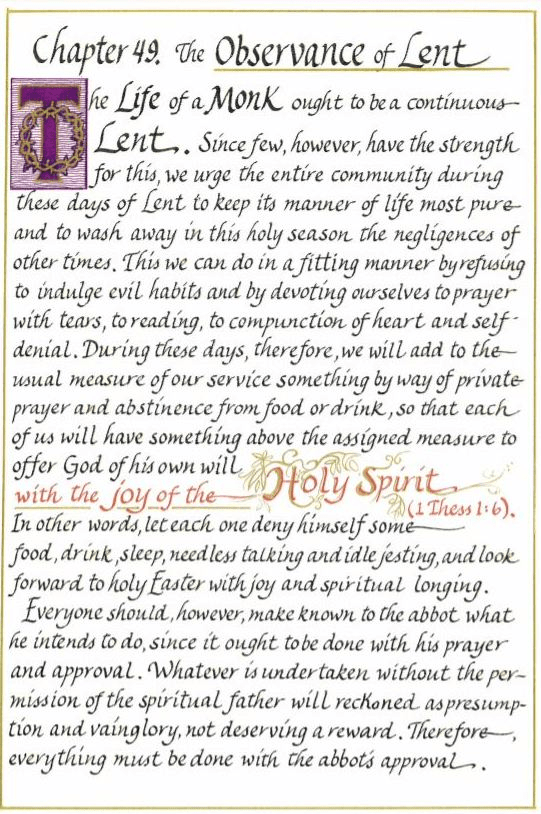
I have been feeling some guilt this Lent season. St. Benedict devotes an entire chapter to observing Lent with advice for monks. He writes, “Let each one deny himself some food, drink, sleep, needless talking and idle jesting, and look forward to holy Easter with joy and spiritual longing (RB 49: 7).” I have not made any grand gestures of sacrifice, quite the opposite. During my spring break from school, which occurs during Lent, we tend to travel out of state to see our daughter and son-in-law, we wine and dine, gather with friends and family, and generally celebrate time on vacation. Return from spring break marks the beginning of the last quarter, or nine weeks, of school when teachers begin to see the light at the end of the tunnel.
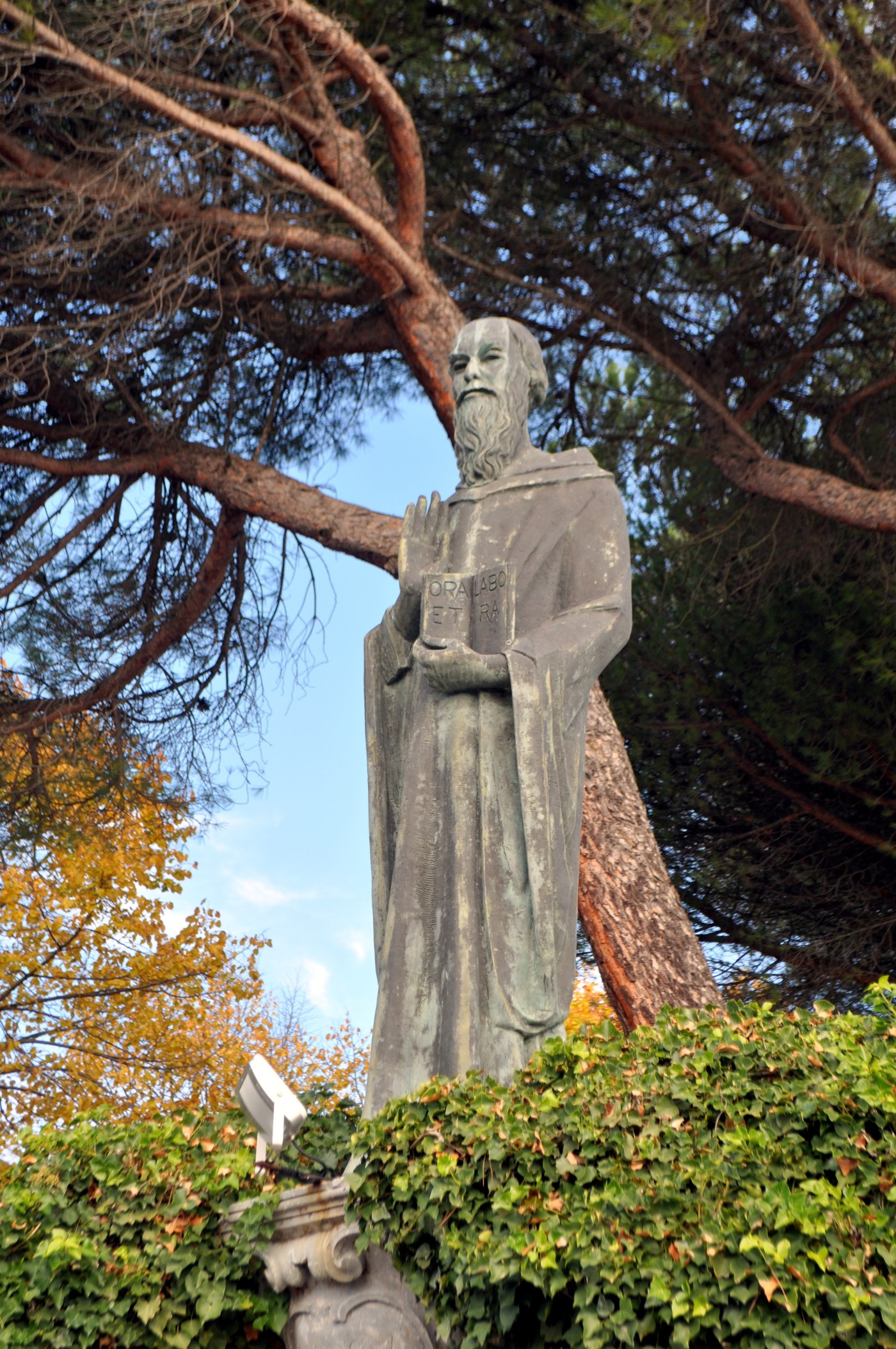
My Lent intention is to “hold it all”– to live as prayerfully, joyfully, playfully, gratefully, mindfully, and soulfully as possible while balancing my school and home life. Striking a perfect balance in one’s life is more of an ideal than a reality. The celebrations of the liturgical and astronomical calendar are reminders that our spiritual longings can be met by following the rhythms of nature. Each season we have another opportunity to set new intentions and to honor them in sacred ritual. The Benedictine idea of balance comes from the monk’s life, moving between prayer and work, ora et labora. So, too, do those who live as “monks in the world” seek this balance–sometimes there is more work, less prayer–but both are seen as necessary, sacred, and part of the whole.
“Blessed are you, spring, season of resurrection, sacrament of promise. Like Jesus you rise up out of the darkness, leaving around you a wake of new life. Blessed are you, spring, season of hope and renewal. Wordless poem about all within us that can die. Each year you amaze us with the miracle of returning life.” -Excerpt from A Spring Blessing in The Circle of Life: The Heart’s Journey Through the Seasons by Joyce Rupp & Macrina Wiederkehr
I have been so inspired by the writing and work of Christine Valters Painter, a Benedictine oblate, author, and online abbess of Abbey of the Arts. The Abbey is a virtual global online monastery offering pilgrimages, online classes & retreats, reflections, and resources which integrate contemplative spiritual practice and creative expression with monastic spirituality. They provide support and resources in becoming a monk in the world and an artist in everyday life.
Learning from members of the community in the Monk in the World Guest Post series has been a source of affirmation that, indeed, one can live according to the Rule of St. Benedict not only in the monastery but in the life one chooses to lead.
I am so honored to have my blog post shared on Abbey of the Arts on the Feast of St. Benedict! The full text is below or at Abbey of the Arts.
“I am delighted to share another beautiful submission to the Monk in the World guest post series. Read on for Jodi Blazek Gehr’s reflection on being a Benedictine oblate.
St. Benedict is special to me for a few reasons. First, we share a birthday. I admit I was disappointed when I first discovered this. My parents had given me an illustrated book of the “Lives of the Saints” to commemorate my Confirmation. As any nine-year-old would do, I immediately looked to see who the saint was for July 11, my birthday. Perhaps Elizabeth, Mary, or Theresa would be my special saint.
Instead, I see an illustration of a man with a dark hood, a scary-looking bird, a crooked cane, and an unusual name I had only associated with Benedict Arnold. July 11, St. Benedict, Abbot, it said. I had never heard of him and surely did not know what an Abbot was. Through the years, I returned to this image of St. Benedict, thinking that I should have some connection with my patron saint.
Fast forward 26 years. With a full and busy life—married with a young daughter, a career as a high school teacher and club sponsor—I felt a deep longing for times of silence.I answered the call of my heart and responded to an advertisement for a silent contemplative prayer retreat. I discovered an oasis of peace just a few hours from home in the cornfields of Nebraska…called St. Benedict Center.
St. Benedict is special to me for a few reasons. First, we share a birthday. I admit I was disappointed when I first discovered this. My parents had given me an illustrated book of the “Lives of the Saints” to commemorate my Confirmation. As any nine-year-old would do, I immediately looked to see who the saint was for July 11, my birthday. Perhaps Elizabeth, Mary, or Theresa would be my special saint.
Instead, I see an illustration of a man with a dark hood, a scary-looking bird, a crooked cane, and an unusual name I had only associated with Benedict Arnold. July 11, St. Benedict, Abbot, it said. I had never heard of him and surely did not know what an Abbot was. Through the years, I returned to this image of St. Benedict, thinking that I should have some connection with my patron saint.
Fast forward 26 years. With a full and busy life—married with a young daughter, a career as a high school teacher and club sponsor—I felt a deep longing for times of silence. I answered the call of my heart and responded to an advertisement for a silent contemplative prayer retreat. I discovered an oasis of peace just a few hours from home in the cornfields of Nebraska…called St. Benedict Center.
Lectio Divina, Matthew 26: 20-50, The Cross of Christ
Book Discussion, Stability: How an ancient monastic practice can restore our relationships, churches, and communities by Nathan Oates
Of Gods and Men, 2010 French film directed by Xavier Beauvois
Additional Resources:Paraclete Press Lenten Series on Stability with reflections from Nathan Oates, Kathleen Norris & Michael Patrick O’Brien, Jonathon Wilson Hartgrove, and Ronald Rohlheiser. Links below.
Lectio Divina
Matthew 26: 20-50, The Cross of Christ
Discussion
Stability “is the commitment to a purpose, a place, and a people…At its root, stability is the blend of two biblical concepts: patient endurance and standing firm.” (Stability, Nathan Oates) After reflecting on Matthew 26: 20-50, we consider:
How is the virtue of stability present in the gospel story? Are there similarities between what happened to Jesus in Gethsemane and what is happening in Ukraine?
Many people of Ukraine will not flee their country. “This is my home,” they say. Despite the many risks, they stay. They are rooted in their homeplace, their land. Jesus also stayed; despite knowing he was to be betrayed, despite the possibilities the next day would bring. Everything that can go wrong, does go wrong for Jesus. Everyone betrays him, even the best of friends. It would have been much easier to give up when left alone.
“My soul is very sorrowful even to death.” We all struggle with the virtue of stability, but Jesus stayed IN HIS sorrow; he could have fled. Despite our difficulties, we need to die before we die as Jesus did. Jesus’ steadfastness, his stability, was rooted in doing the will of God. “Your will be done” is an exclamation of surrender that gave Jesus the courage to stay. He died before his own death; he surrendered his will. He was able to face his suffering because he had consented to let God work out what would happen next. As St. Benedict said, “keep death daily before our eyes.”
“Friendship binds past and present and makes bearable the uncertainty of the future. Friendship is…always and everywhere eternal mystery, eternal desire. It is a grasp at the ultimate, the quest for human understanding.”
Joan Chittister, The Friendship of Women
Friendships, both old and new, are a treasure, a gift of hospitality, a welcoming of another into your life. Friendships create space for coming home to oneself, an opportunity to be fully seen as who we are and who we want to become. Friendships are an opportunity to accept the hospitality of another as well, to see ourselves through the eyes of our special friends. Friendships with women are all-at-once sistering, mothering, armchair counseling, and spiritual direction.
Friendship is sacramental, an “outward, visible sign of an inward, invisible grace,” as defined by St. Augustine. Friendship is an invisible grace, a soul connection, that lives on even when friends are not together, when time or distance separate, and even after a dear friend passes. It is a sacred gift to have an old friend, one who has seen you through decades of life. Beth and Judy, friends from “Circle” had that kind of friendship for fifty years.
A short “Circle” story (the longer version HERE) that inspired a new card and brought new insights about hospitality, humility, and friendship:
I met Beth through Katie and then Judy through Beth. Colleen shared her friend, Joyce, with me and she eventually introduced me to SoulCollage. I shared my love of SoulCollage® with Beth, Judy and our Circle through several retreats and social gatherings. Judy and Beth loved to create cardstogether—finding images, cutting them out, and when the time was right, pasting them into collages. They looked forward to weekly conversations and new insights. In 2016, their weekly ritual came to an end when Judy passed away. Recently Beth gifted me a bin of SoulCollage® supplies with folders of carefully trimmed images. SoulCollage® was an intimate memory she treasured with Judy, and not something she wanted to continue. Those images came with me on my last retreat.
Now I Become Myself
Sorting through Beth’s images, I came across a photo of Judy and Beth from some 50 years ago. I placed the photo on my table as inspiration, the younger Judy and Beth standing witness to our weekend creativity and to the conversations and insights of the ten women attending.
Judy (left) and Beth (middle), accepting an award on behalf of the Lincoln Mayor’s Committee for International Friendship in Washington DC.
Several of the images I gathered came together in a special way to make a card titled “Another Kind of Hospitality.” I felt the essence of Beth and Judy that weekend and as I work with the meaning of my card. They were not at the retreat, but there were definitely present.
Another Kind of Hospitality–card made from images that Beth had collected.
Reflection: Another Kind of Hospitality
Take off your shoes. Stay awhile.
Join me at the table, there is always an extra place. Break bread with me.
Or sit on the floor. Let’s play, watch, listen, create.
I see you, the One and the Many. I see you in all your many selves—your playfulness, your fear, your loneliness, your becoming. I see that you see me, too.
Welcoming you, I meet a part of myself that perhaps I didn’t see before.
Being with you teaches me about who I am, more of who I am becoming.
I take time to stand still, to be here, to look within. I see me and I see you.
“We have gathered today to celebrate the union of Jessica Gehr and John Holland. Marriage is a sacred blessing and this morning we celebrate the love shared between two special individuals.”
–Joyce Schmeeckle, wedding officiant and dear friend
We gathered—John and Jessica’s community, their friends and family—to support and bless their marriage. A wedding day conjures images of hearts and flowers, vows and wedding rings, first kisses and champagne toasts. Marriage is a sacred commitment where two people commit to journey through life together, so it is appropriate that the focus of the day is on the bride and groom. It is their BIG DAY!!
My daughter, Jessica, had her fairytale, storybook, dream-come-true wedding on July 17, 2021, and yes, indeed, she married her Prince Charming—we absolutely love our new son-in-law, John, and are so grateful that he adores our daughter. I remember when my husband and I got married, there was very little choice in what the day would look like. Tradition said this, the parents said that, the Catholic Church said this…but what I loved about John and Jessica’s wedding is that they created their own ceremony and carefully planned what their first day as husband and wife would look like.
The wedding guests, John and Jessica’s community, were an integral part of their wedding day—from who the officiant was, to parts of the ceremony, to the events planned to celebrate after the wedding. As a Benedictine oblate, it reminds me that for St. Benedict, everything that is written in his Rule takes place within the context of community; whether giving instruction about prayer, relationships, or work, the monk is reminded he or she is a part of a community. It is through community, not just as monks or oblates but within families and our community of friends, that we grow in understanding of self and God and learn to love one another more deeply.
“Benedict’s genius was in recognizing the power of journeying together. There is power and empowerment, healing and strength in living together and recognizing our mutual interdependence.”
Judith Valente writes, “My friend Sister Thomasita Homan of Mount St. Scholastica once described a monastic community as ‘a place where people agree to link arms, support one another, and help each other grow’ (How to Live: What the Rule of St. Benedict Teaches Us About Happiness, Meaning and Community).” The guests of John and Jessica’s wedding are linking arms with them, will support them, and as community does, will challenge them and help them grow.
When creating their wedding ceremony, John and Jessica carefully chose who would be part of the ceremony and the words that would be spoken. When they talked about who they wanted to marry them, they knew they wanted someone who shared their own spirituality and values and would deliver a message filled with insight and wisdom. They asked my own “anam cara,” soul friend, Joyce, who also hired Jessica for her first job in high school, quickly becoming a spiritual mentor to Jess as well. This is a newer phenomenon, to choose your own officiant, but my heart is full that they chose so wisely. (See script throughout this post.)
The ceremony also included a family blessing shared by each mother. I was deeply touched to be able to contribute some words about what I hoped John and Jessica’s marriage might hold for them. I shared the following blessing:
Blessing for John and Jessica Holland Wedding
When Jessica was just a toddler, I created a bedtime prayer that I blessed her with each night. Some nights, in a hurry, it was shortened to “God bless Jessica’s mind, body and spirit. Amen.” But the lengthier version has remained my prayer for Jessica as she has grown up.
This special prayer I say now includes BOTH Jessica and John as they join their life together in marriage.
God bless Jessica, and John’s minds, so that they make good decisions and choices.
God bless Jessica and John’s bodies so that they grow strong and healthy and safe.
God bless Jessica and John’s spirit so that they know the love of God and others. Amen.
It is said that the only thing that prepares you for marriage, is marriage. It will not always be easy, but more often it will be better than you could have imagined. Every day you will make choices about what kind of person you want to be and the kind of relationship you will continue to build with God and each other.
A marriage is made of moments. When you string them all together, you get a picture of a life built together. A marriage is not made, once and for all, when the I-dos are exchanged. A marriage is constantly being recreated; it is always in the process of becoming.
In your becoming, take time for solitude—pursuing your individual passions knowing you are always supported by the other. Listen with the ear of the heart, as St. Benedict writes, listening to each other’s words but also to what lies between the words, seeking to understand the silence too.
May you be patient with each other, keeping a sense of humor, apologizing, and forgetting quickly.
May you be a joyful giver and treat each hour as the rarest gift with gratitude for each other. May you build traditions and rituals that are uniquely yours as a couple.
May you have a marriage that embraces all seasons.
God Bless Jessica’s mind, body, and spirit.
God Bless John’s mind, body, and spirit.
God Bless the marriage of John and Jessica. Amen
Family was an important part of the wedding ceremony and weekend. Both dads and John’s brother shared toasts and the mothers shared a blessing.
A reading from Romans 12: 9-18, instruction for sharing love and hospitality both in marriage and in community, was followed by a message from Joyce. Friends and family were asked to participate in a community vow, agreeing to love and support John and Jessica in their marriage, offering them love and friendship.
This community vow mirrors the importance of The Rule of St. Benedict, written 1500 years ago as a guide for those who desired a spiritual life of prayer and work, learning to love others as Christ. It was not a guide for individual pursuits, but for living in community. It is a given that the community is important, an integral part of growing in holiness and happiness. John and Jessica see clearly that they have the support of friends and family, that they are part of a community that they will also share their gifts and hospitality with. This was followed by a moment of silent prayer for their marriage.
“The words community and communicate share the same Latin root. They are related by root to another word, compassion, which means to “suffer with”, or more loosely, to “walk beside.”
Judith Valente, How to Live: What the Rule of St. Benedict Teaches Us About Happiness, Meaning and Community.
John and Jessica have created a community that will walk beside them, people they have known all their life as well as those who they have met along the way. As a couple, they will continue to gather new friends as well. My husband gave a nod during his toast to all those in John and Jessica’s community who have helped them become who they are:
When you raise your kid, you hope to instill your hopes, dreams, and values in them and that when they go out into the world, they make all the right choices and remember the way they were raised. Lots of people have told Jodi and I what a great job we did in raising our daughter. That is partially true, but I think we learn and form who we are from those around us. Jessica and John have had many positive role models in their lives. They have taken a little bit of each one of those people to become who they are today. So, when people tell me, you did a great job in raising your daughter, it has as much to do with all the relationships she had with others. I want to thank everyone for helping me raise my daughter. Everyone here can take credit for the beautiful person she is today. Many can take credit for John being a kind, loving and caring person. They are who they are today because of all the people in their life.
“The Benedictine spirituality of community is based on life with other persons in the spirit of Christ: to support them, to empower them, and to learn from them.”
Joan Chittister, Wisdom Distilled from the Daily: Living the Rule of St. Benedict Today
John and Jessica vow to journey through life together—to support and empower each other and to continue to learn and grow in their relationship. They are community to each other, first and foremost. I am so proud of and happy for them!
As part of their wedding gift, I created a SoulCollage® card called “John and Jessica Becoming.” A wedding photo will be added to the card soon.
We are grateful that Jessica’s friend, Tarah, videotaped the wedding ceremony! You can watch the video HERE.