Search

Being Benedictine

Living SoulFully as an Oblate of St. Benedict

Tag

awe

His Heart Was Moved

September 2025 Oblate Reflections

“In a delightful letter on the contemplative life called The Ladder of Monks, Guigo II (a 12th-century Carthusian monk) divides the experience of Lectio into four phases or degrees: reading, meditation, prayer, contemplation. Reading, he says, puts food whole into the mouth. Meditation chews it, digs for treasure. Prayer extracts the flavor and helps us to get to know the treasure. Contemplation embraces and welcomes the thirsty soul.” (A Tree Full of Angels: Seeing the Holy in the Ordinary, Macrina Weiderkehr)

Lectio Divina: Matthew 9:1-13; 35-36

He entered a boat, made the crossing, and came into his own town. And there people brought to him a paralytic lying on a stretcher. When Jesus saw their faith, he said to the paralytic, “Courage, child, your sins are forgiven.” At that, some of the scribes said to themselves, “This  man is blaspheming.” Jesus knew what they were thinking, and said, “Why do you harbor evil thoughts? Which is easier, to say, ‘Your sins are forgiven,’ or to say, ‘Rise and walk’? But that you may know that the Son of Man has authority on earth to forgive sins”—he then said to the paralytic, “Rise, pick up your stretcher, and go home.” He rose and went home. When the crowds saw this they were struck with awe and glorified God who had given such authority to human beings.

As Jesus passed on from there, he saw a man named Matthew sitting at the customs post. He said to him, “Follow me.” And he got up and followed him. While he was at table in his house, many tax collectors and sinners came and sat with Jesus and his disciples. The Pharisees saw this and said to his disciples, “Why does your teacher eat with tax collectors and sinners?”

He heard this and said, “Those who are well do not need a physician, but the sick do. Go and learn the meaning of the words, ‘I desire mercy, not sacrifice.’ I did not come to call the righteous but sinners.” Jesus went around to all the towns and villages, teaching in their synagogues, proclaiming the gospel of the kingdom, and curing every disease and illness. At the sight of the crowds, his heart was moved with pity for them because they were troubled and abandoned, like sheep without a shepherd.

In our oblate group, we read, reflect, respond, and rest in sacred scripture. There is a synergy that results from sharing a word or phrase that resonates within, as well as the wisdom or insight each has received. I leave with a greater understanding of other perspectives and of how I am called to follow Christ.

Some reflections from our reading:

Courage, child, your sins are forgiven…Rise, pick up your stretcher, and go home. Jesus’ first instruction is to have courage and to know that sins are forgiven. Many aspects in our life require our courage—difficult conversations, facing our own limitations, expressing love, making or adapting to changes, dealing with physical or emotional suffering, feeling despair, and understanding our next steps in each season of life, to name a few. Life requires courage. Some questions we might consider in taking Jesus’ advice: What is our stretcher or our crutch? Where might we be trapped or paralyzed? We are not to harbor evil thoughts about others or ourselves, knowing that nothing can separate anyone from the love of God. Jesus asks us to rise—right where we are, no matter who we are, and go home. Our home is much more than a brick-and-mortar dwelling. Home is a place of peace, where we can be seen and heard, loved and believed, held and yet free. Home accepts all the parts of our self, our truest self.

Home is where you belong. It is your shelter and place of rest, the place where you can be yourself.  –John O’ Donohue, Eternal Echoes: Celtic Reflections on Our Yearning to Belong

They were struck with awe and glorified God who had given such authority to human beings. We are to become like Christ. We can rise up, go home, follow, listen, have our hearts moved, give mercy, have courage, doubt, choose, forgive and be forgiven, be filled with awe, mix and mingle with the “tax collectors and sinners” of our day (the poor, oppressed, and marginalized), and be compassionate. In a very short story, Jesus asks much and gives much. He is an example of who we can be to others. The crowds were struck with awe by what Jesus did. We, too, can stand in awe of the kindness of others, a spectacular sunrise, or a day of feeling healthy. In each day, there are countless ways to choose awe and gratitude, glorifying God in all.

I did not come to call the righteous but sinners. Accepting both the righteous and the sinner within ourselves is a sort of homecoming. Accepting with humility that we are not one or the other—saint or sinner—is the way to integration and accepting others. Jesus tells the crowd that he desires mercy. We can be merciful, too, slow to judge ourselves and others.

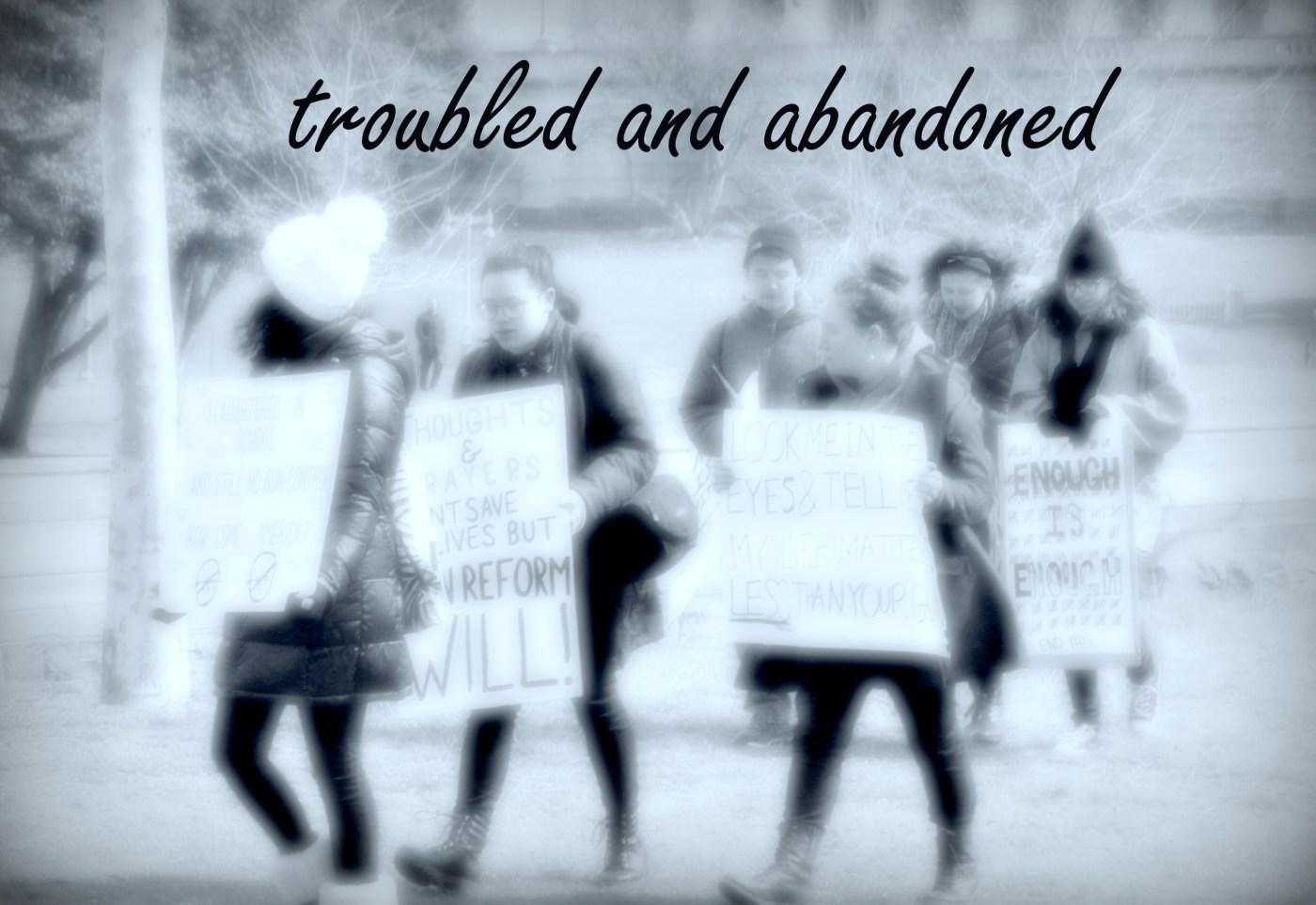
His heart was moved. This line resonated with me the most. Jesus, in his humanity, felt pity for the “troubled and abandoned.” Beyond our bodies, Jesus sees our inner wounds, our fears and anxieties, our feelings. He sees beyond the physical to our spiritual and emotional needs. This, too, we must ask—who might the troubled and abandoned be today?  We can only know who they are by deep listening, extending hospitality, and having compassion as Jesus did. And then we must ask, how are we responding to them? With judgment or with a moved heart?

More on compassion here.

© Jodi Blazek Gehr, Being Benedictine Blogger

The Grandeur of God: Care for Creation and for the Vulnerable

I have been enchanted by the poem The Grandeur of God, by Gerard Manley Hopkins, for years. I practiced Lectio Divina, a sacred reading practice, with this poem and wrote about it in God’s Grandeur: Praying with Poetry.

I cannot confess to understanding every word of this Victorian-era sonnet, published nearly 30 years after Hopkins’ death in 1889, but I feel the same passion for the beauty and sacredness of creation “that gathers to a greatness like the ooze of oil / Crushed” with which he writes. Hopkins writes with celebratory confidence,

“And for all this, nature is never spent;
There lives the dearest freshness deep down things”

But we know as global temperatures rise, more droughts, storms, rising sea levels, melting glaciers and warming oceans are impacting both human and animal life. Nature has been used and abused in so many ways. Is it true that “nature is never spent?” Can this earth withstand the heavy burden of “man’s smudge…and smell?” Indeed, we seek comfort in the notion that the sun will always rise as “the brown brink eastward, springs” and always sets as “last lights off the black West went.”

We hope for the future of our planet, but we must be caretakers, not just takers. We must be co-creators with the Divine to ensure the “grandeur of God,” our planet, is full of wonder and awe for future generations.

“Glance at the sun. See the moon and the stars. Gaze at the beauty of earth’s greenings. Now, think. What delight God gives to humankind with all these things. All nature is at the disposal of humankind. We are to work with it. For without we cannot survive.”

-Hildegard of Bingen
Continue reading “The Grandeur of God: Care for Creation and for the Vulnerable”

Wonder Begins in the Present Moment

Our being is often crowded out by our doing. Each day we are summoned to be creators of the present moment. Artists know the value of white space. Sometimes what isn’t there enables us to see what is.

Macrina Weiderkehr

In art and design, white space, also called negative space, is the area of a page without images or text. It is the space between lines, margins, graphics, and other design elements. Without white space a reader would be terribly distracted, having difficulty understanding the message or determining what is most important to see.

So, too, with our lives. Our moments can be filled with distractions, both in our thinking and in the many daily responsibilities we have. Macrina Wiederkehr, Benedictine sister, suggests that we are the creators of our present moment. We must, as the artists of our life, create our own white space—perhaps in simply being rather than doing, taking moments of silence to pause between activities, or practicing creativity or contemplation. It is when we create white space in our lives that we see differently, appreciating the wonder of an ordinary day.  

Recently I guided a retreat called “The Grandeur of God: Living Life with Wonder and Awe.” Taking a retreat, time away from ordinary life, can be the “white space” that one needs to relax, rejuvenate, and refocus. When we look at our life as a means to an end, something to endure until things get better, we steal opportunities to live a life with wonder and awe.

It is not always possible to leave our homes, families, or places of employment, but science and religion unequivocally agree on the importance of creating white space in our daily life to experience wonder and awe. Experiences of awe, what C.S. Lewis calls “golden moments,” can reduce stress, loneliness, and physical distress, and bring one a sense of expanded time, perspective, and connection.

Continue reading “Wonder Begins in the Present Moment”

The Awe of Moral Beauty: The Story of Regina & Achim

Life is difficult. The first three words in M. Scott Peck’s classic The Road Less Traveled, which I read in my early twenties, left me feeling both comforted and troubled. Oh, thank God, I’m not the only one going through hard things; this is normal…but oh my God, is life really this hard? As I “grew up”, I learned that despite the challenges of life there are plenty of opportunities to practice gratitude and seek joy and wonder.

I am inspired, and filled with awe, by those who meet challenges and overcome obstacles with resilience, courage, kindness, and positivity. In Awe: The New Science of Everyday Wonder and How It Can Transform Your Life, author Dacher Keltner outlines eight wonders of life that bring us a sense of awe and wonder. Music, nature, spiritual practices, and more influence us, but “we are most likely to feel awe when moved by moral beauty…in fact, it was other people’s courage, kindness, strength, or overcoming” that inspire us most.

This leads me to the story of Regina and Achim—I am inspired by them both. Regina met the challenge of a life-threatening illness with humor, positivity, faith, and courage. Achim showed selfless kindness and generosity by becoming Regina’s lifeline.

Continue reading “The Awe of Moral Beauty: The Story of Regina & Achim”

A Winter WONDERland

“A snow day literally and figuratively falls from the sky, unbidden, and seems like a thing of wonder.”

-Susan Orlean

For students and teachers alike, there is nothing quite like getting a “snow day,” no matter if it is actually snowy or whether it is sleet, ice, or high winds— especially if we learn of our impending day off BEFORE we go to bed. I usually stay up a little later, sleep in a little later, binge-watch some TV, catch up on some reading or writing, and gaze out the window (or if it isn’t too awful out, take photos in my yard.) It is a gift of time, a free day.

This week we had one of those snow days. We were forecasted to get 8 to 12 inches of snow. We didn’t—but we did get a lot of sleet and ice. It was a challenge to get little Bailey, my 14-year-old dachshund poodle to go potty. Her little paws stuck to the stiff, sticky, icy grass, so it was one of those snow days to enjoy from the inside.

“They say that every snowflake is different. If that were true, how could the world go on? How could we ever get up off our knees? How could we ever recover from the wonder of it?

Jeanette Winterson

Only one snow day, so I was off to school the next day. The morning drive took a bit longer (no time for gazing in the morning; every minute matters when you’re not a morning person), but the intentionally-circuitous drive home from school was an opportunity to gaze at icicles, glistening like crystals, full of the drop-to-your-knees kind of wonder. (I was driving, so I saved my knees). I am so grateful that the temperature stayed chilly enough to preserve the false-alarm-blizzard-sleet-and-ice storm icicles.

Continue reading “A Winter WONDERland”

2023 Word of the Year: Wonder

I love the practice of asking for a word, allowing a word or phrase to bubble up to ponder for the new year. Words that have chosen me in the last few years include Mercy (2017), Cushion (2018), You Are Free (I needed more words that year) (2019), Carry On (2020), Truth (2021), and Consent (2022).

My 2023 Word of the Year is WONDER.

This tradition (for desert mothers and fathers) of asking for a word was a way of seeking something on which to ponder for many days, weeks, months, sometimes a whole lifetime.  The “word” was often a short phrase to nourish and challenge the receiver.  A word was meant to be wrestled with and slowly grown into.

Christine Valters Painter

WONDER opens our eyes to synchronicity.

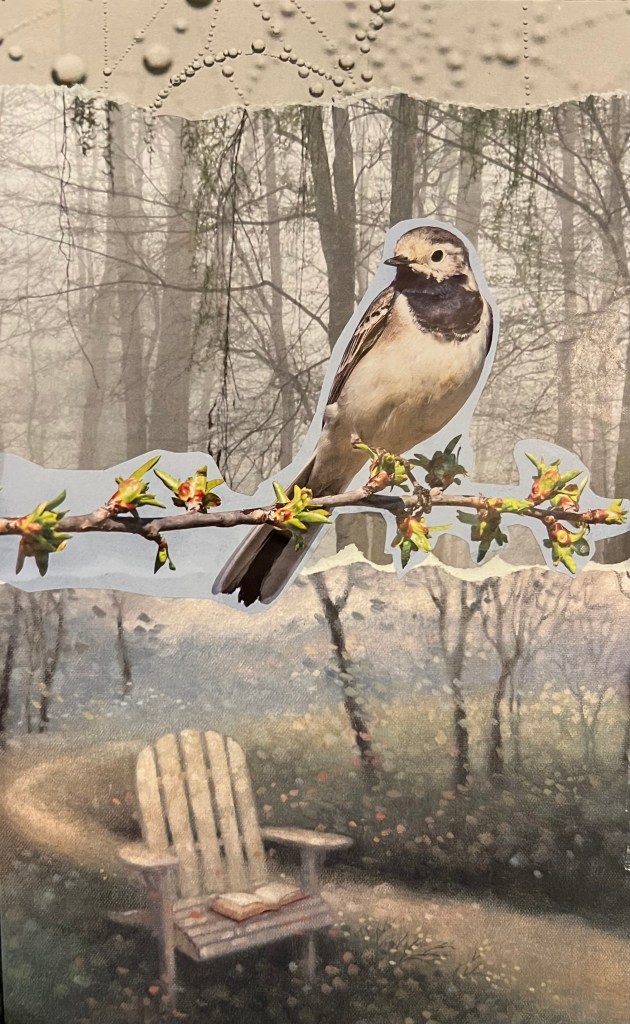
The images in a recent SoulCollage card brought forth the word WONDER, and it settled comfortably in my soul.  The title of my card, Sit A Spell, is an encouragement to be open and receptive to the wonders of the universe revealing themselves right where we are—comfortable on our perch, walking through the seasons of life, or, even, in our thoughts and imagination.

It is only with eyes open to wonder, holy surprises, and synchronicity that we experience the humbling and awesome fall to our knees. There we are uplifted by invisible forces and surrounded by angels seen and unseen. (Synchronicity and Holy Surprise)

A card I created using images gathered on retreat and from a greeting card that screamed synchronicity!

WONDER makes us fall to our knees.

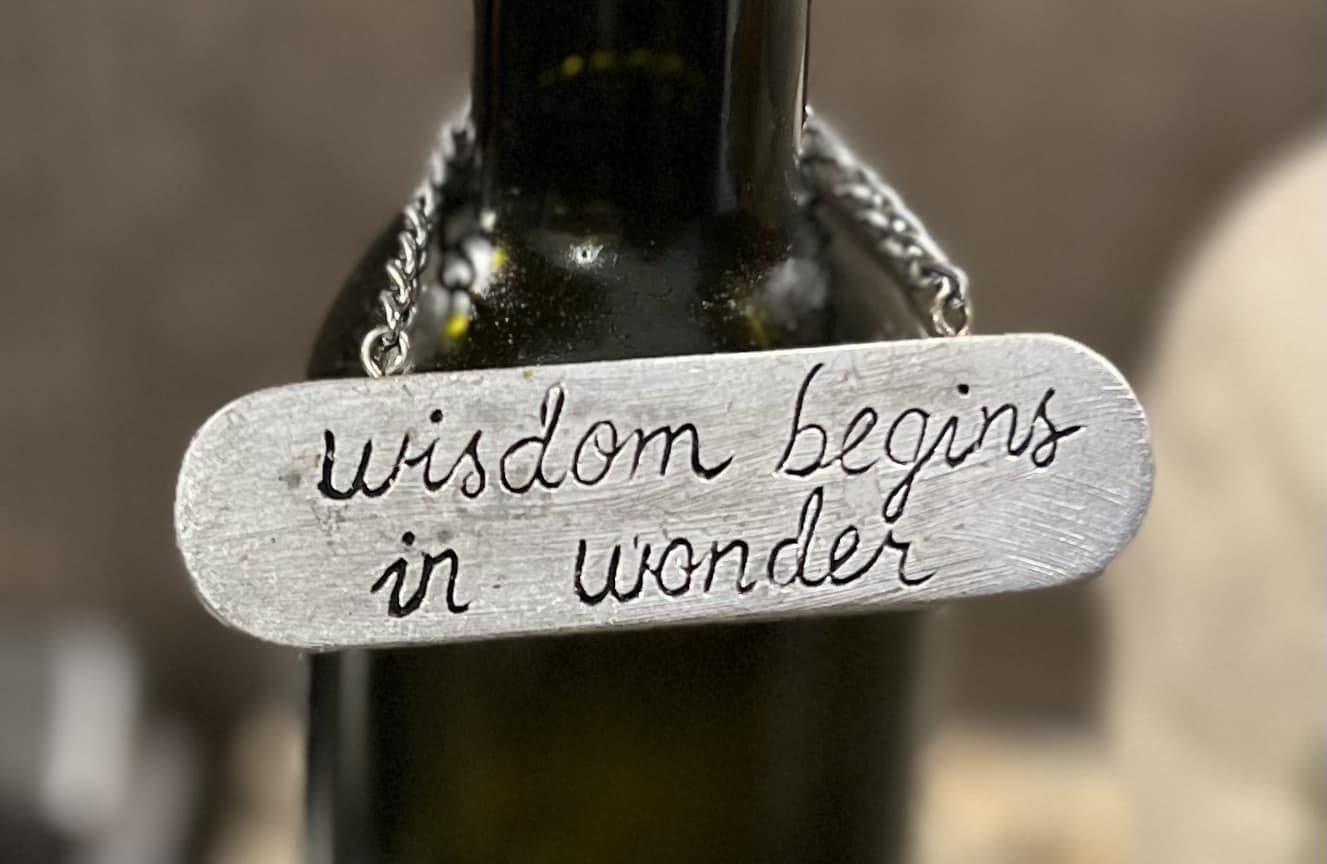
After the word WONDER rested in my awareness, it was providential how many words of wisdom, poems, and quotes I came across in my reading. The wisdom begins in wonder decoration (pictured above) hangs around an olive oil bottle in my kitchen. I pass by it many times every day, but I realize I wasn’t really SEEING it. Waking up to meaningful coincidences, C.J. Jung said, “could shift our thinking so we recognize a greater wholeness in all of creation…It could precipitate a spiritual awakening.”

“Concepts create idols; only wonder comprehends anything. People kill one another over idols. Wonder makes us fall to our knees.”

Gregory of Nyssa
Continue reading “2023 Word of the Year: Wonder”

A Wild and Precious Life: Mary Oliver

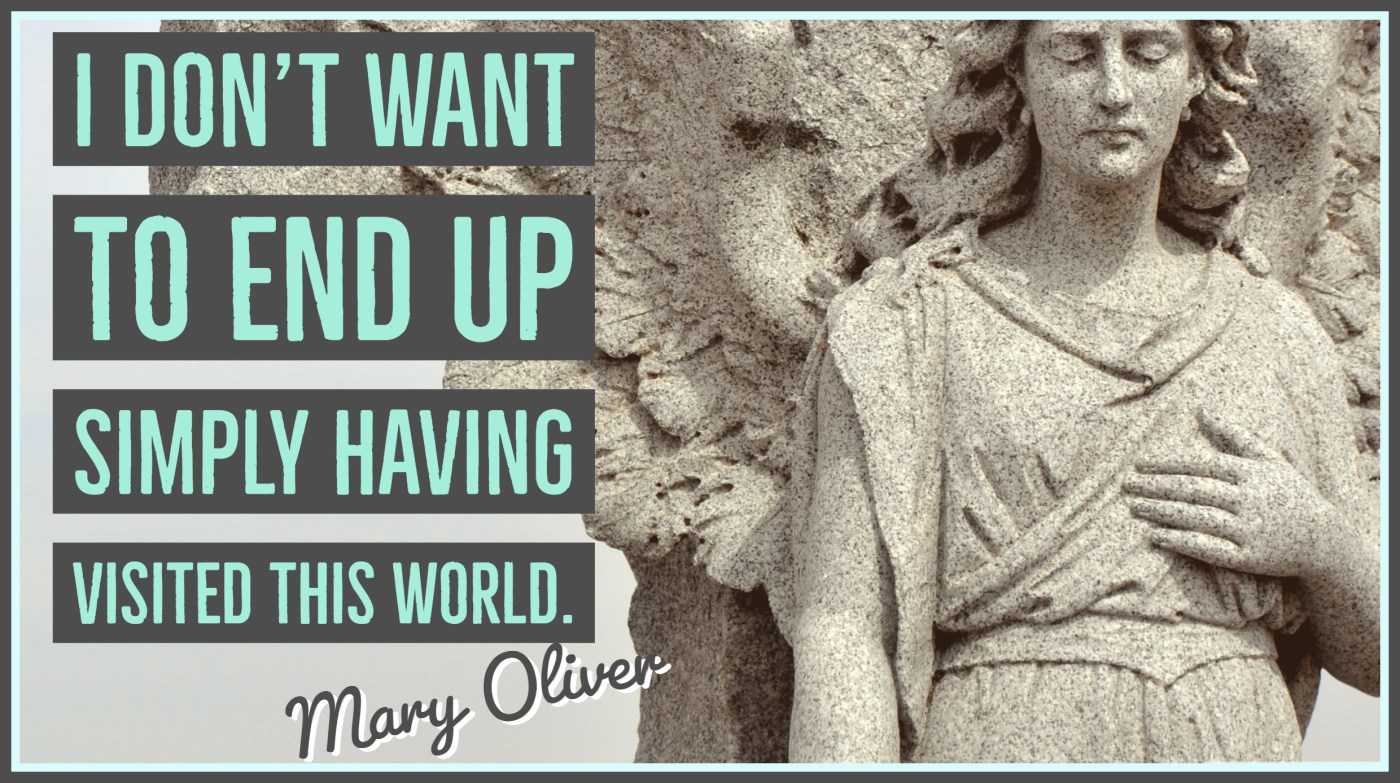
 Mary Oliver. She must have loved life.  She deeply reflected upon it and wrote about it so eloquently. She suffered and enjoyed and made peace. And she wrote about it all. 

living in this world.jpg

She encouraged us to slow down and enjoy each moment. 

“For how many years did I wander slowly through the forest. What wonder and glory I would have missed had I ever been in a hurry!”  Leaves and Blossoms Along the Way: A Poem

She encouraged us to see the holy that is wholly visible.

“God, or the gods, are invisible, quite understandable. But holiness is visible, entirely.” Leaves and Blossoms Along the Way: A Poem Continue reading “A Wild and Precious Life: Mary Oliver”

Blog at WordPress.com.

Up ↑