Search

Being Benedictine

Living SoulFully as an Oblate of St. Benedict

Tag

benedictine

O Antiphons: O Come, O Come, Emmanuel!

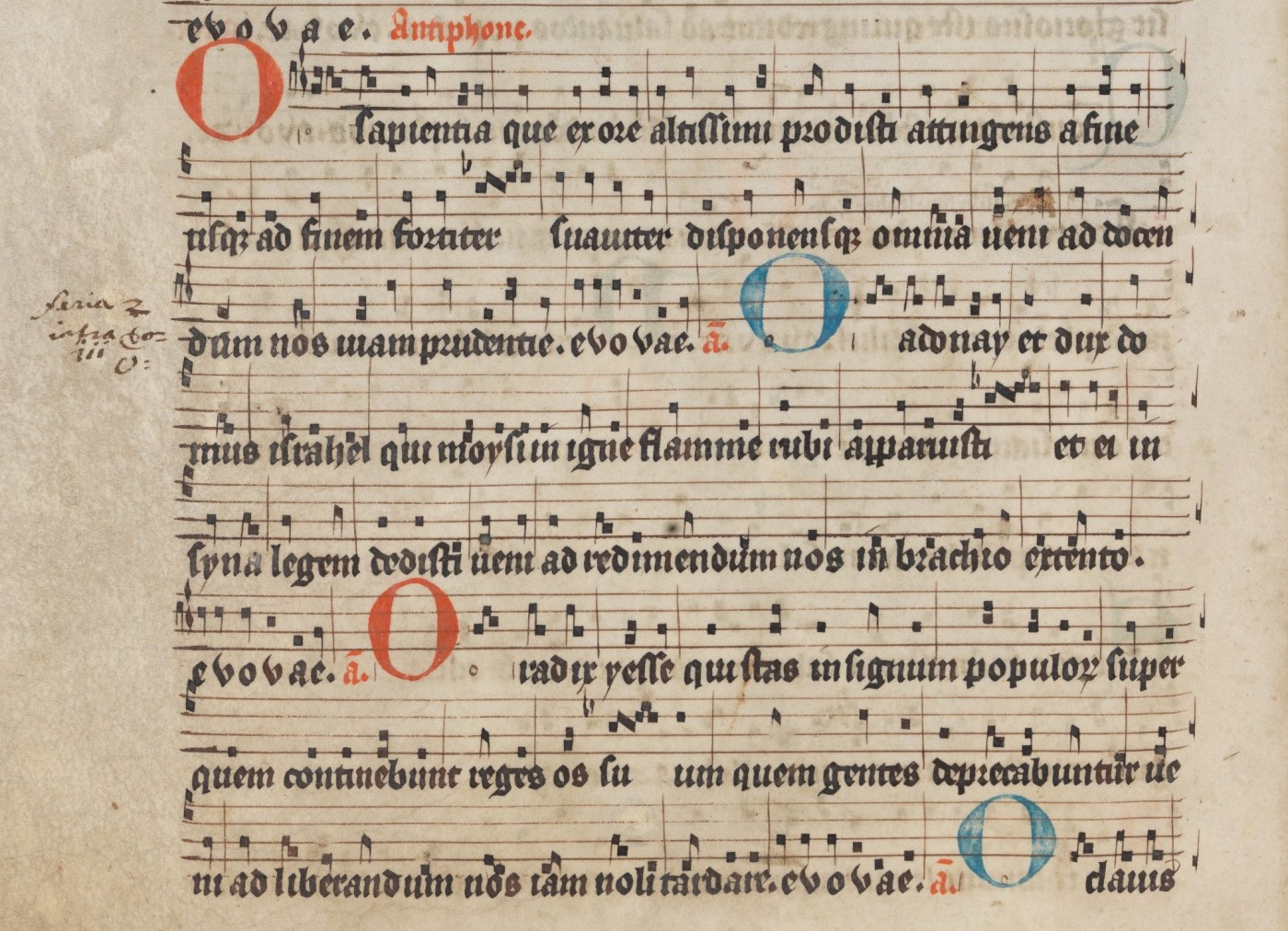
The traditional Advent hymn “O Come, O Come, Emmanuel,” which many are familiar with, is a paraphrase of the lesser-known O Antiphons written by Benedictine monks in the Middle Ages. One of the oldest liturgical rituals in the Church, the O Antiphons have been sung since at least the 8th century. These short prayers, starting with O followed by a title given to the Messiah from Old Testament prophecies, are sung before the Magnificat during Evening Prayer from December 17–23, the last seven days before Christmas. Each antiphon describes God in terms of Old Testament traits and images.

Images and symbols that appear in dreams, art, literature, or scripture carry both personal and universal meaning. Serving as a bridge between the unconscious and the conscious, images can nourish our spirit. “Images open windows through which we can see realities formerly hidden from us. Images want to infuse themselves into us and to change us from the inside out, ” writes Anselm Grün.

Images are an essential part of rituals, prayer, self-reflection, and creativity. When practicing SoulCollage®, one of my favorite spiritual practices, images can guide us to a new level of awareness and reveal a deeper understanding of thought and feeling. Perhaps this is what attracts me to the tradition of praying the O Antiphons.


“Reflecting on the words and images prepares us to let Christ himself enter into us…We are all an image, an icon, of God. It is our task to become ever more like this unique image of God.”

Anselm Grün, A Time of Fulfillment: Spiritual Reflections for Advent and Christmas

The O Antiphons use images to help us envision the Christ we long for, and to draw us into a more profound connection to the God of history. “In the O-Antiphons the art of interpreting Old Testament text as images for the coming of Jesus Christ into the world becomes apparent.” (Anselm Grün) The repeated word “Come!” expresses our deepest longing for Christ. When we accept that we are not God, we yearn for fulfillment, for all that a Messiah can bring, not just in the hereafter but in the here and now. We long for wisdom, freedom, hope, peace, belonging, light, healing, salvation, dignity, protection, love, and accompaniment. Each of these longings is addressed in the O Antiphons.

For an extensive examination of our longings and the use of images in praying the O Antiphons, I highly recommend A Time of Fulfillment by Anselm Grün, a Benedictine monk from Münsterschwarzach Abbey, the motherhouse of the monastery of which I am an oblate.

Feel free to download and share any of the images in this reflection, or follow Being Benedictine on Facebook to share daily posts. Join the monks of St. John’s Abbey for each of the O Antiphons as Benedictine monks have done for 1300 years.

St. John’s Abbey sings O Antiphons: Holy Wisdom—

December 17th – O Sapientia (O Wisdom)
December 18th – O Adonai (O Lord)
Continue reading “O Antiphons: O Come, O Come, Emmanuel!”

Curiosity is good for the soul, and for democracy too!

Cultivating curiosity is Being Benedictine.

As an educator and lover of learning, I appreciate the reference to schools in the Rule of St. Benedict. In the Prologue of The Rule, Benedict writes that the monastery is “a school for God’s service.” Whether in the monastery, home, or work—we are learning to live and love in community. Our life is a school of becoming—a continual learning.

Learning does not happen in solitude.

“A school is a community of learners: a group that comes together to learn with and from each other…education should expand our consciousness, capabilities, sensitivities, and cultural understanding. It should enlarge our worldview.”  –What Is Education For? by Sir Ken Robinson and Kate Robinson, Edutopia, March 2, 2022.

As a teacher, whether it was my high school students or those who attend retreats I lead, I appreciate a curious learner—someone who is open to new ideas, willing to listen, to question, to consider diverse perspectives, and, with humility, understand that there is always something new to learn.

Curiosity is a good first step toward living SoulFully and being Benedictine.

Being Benedictine, in my experience, is a genuine attempt to meet others in love and compassion, listening with the intent to understand, encouraging inclusiveness, and respecting diversity.  It is a blessing to share our feelings, faith, or perspectives and to have someone truly listen, especially those who might believe differently. Listening is the doorway to learning from others and growing in compassion; curiosity is the key.

“The spiritual life takes discipline,” Joan Chittister writes in The Rule of St. Benedict, A Spirituality for the 21st Century. “It is something learned, to be internalized. It’s not a set of daily exercises; it’s a way of life, an attitude of mind, an orientation of soul. And it is gotten by being schooled until no rules are necessary.”

Curiosity is good for the soul.

In Women Who Runs with the Wolves, Clarissa Pinkola Estes, defines the wild woman archetype as one who listens deeply, is intuitive, creative, playful, courageous, curious, loyal, and passionate. There is some wildness of divinity in us all, calling us to live fully, to reach beyond ourselves and, to discover something new. “When you limit your life to the one frame of thinking, you close out the mystery,” writes John O’ Donohue in Eternal Echoes: Celtic Reflections on Our Yearning to Belong.

Curiosity is good for community. Wonder is good for the world.

Wonder, my 2023 word of the year, is an attitude of curiosity, a willingness to withhold judgment, and to be open to what happens. Dacher Keltner in Awe: The New Science of Everyday Wonder and How It Can Transform Your Life writes, “People who find more everyday awe show evidence of living with wonder. They are more open to new ideas. To what is unknown. To what language can’t describe…to the strengths and virtues of other people.”  

Is it possible to behold our neighbor with wonder, in the spirit of hospitality? Could we hold a curious heart even when we passionately disagree with one another? Rather than defaulting to the shoulds and should-nots of orthodoxy, or a deeply held conviction, could we practice curiosity instead? Rather than seeking to change another’s opinion or defend our own, could we simply stand in awe of this great universe that holds such diversity of thought? Is it possible to let a disagreement stand to the side, while the desire to learn about the other steps forward?

Curiosity leads to wonder. Wonder leaves room for the unexpected, for learning something new.

This is how Lectio Divina, the Benedictine practice of sacred reading, can work in community. We hear different perspectives, drawing on the experiences and insights of those in our community. We can release the need for the one right way to interpret what we read and be curious about what others bring to the table. I share reflections from the richness of our oblate community discussions on this website but with a disclaimer,

“I cannot claim to have captured all the wisdom shared in our monthly oblate discussions or that I represent all oblates in attendance. The group discussion is a starting point for this reflection, but it is my interpretation of what I heard and what resonated with me. There could easily be as many different blog posts or reflections as oblates. Each of us comes to Lectio from our personal experience of God at that moment and we receive what we need in that moment as well. The beauty of Lectio Divina is that the reading, insights, and discussion may fall differently on each of our hearts. How blessed we are that there are “many dwelling places” (John 14:2)” and we are all invited to “listen with the ear of the heart.” (RB Prologue)”

Curiosity is good for democracy.

In Healing the Heart of Democracy: The Courage to Create a Politics Worthy of the Human Spirit, Parker Palmer encourages us to consider “What do I have in common with people who, for example, regard their religious or political convictions as so authoritative that they feel no need to listen to anyone who sees things differently—especially that small subgroup of extremists who would use violence to advance their views?”

This can be difficult. I get it. I know too well how disagreements can escalate, and how estrangements result. I have appreciated discussions where curiosity is a motivation to more deeply understand, but I also know the heartbreak of rejection when another is not interested in my story, feelings, or perspective. The door is slammed shut for exploring possibilities, another proclaims they know what they know and there is no need to share ideas or learn something new. But I believe for many situations curiosity, wonder, listening, and a little respect could be the remedy. It may not change minds or beliefs, but it can change hearts. I believe, as Palmer does, that I can find even “the smallest patch of common ground” with others whose views are different than mine. I can disagree with another while also being Benedictine.

Continue reading “Curiosity is good for the soul, and for democracy too!”

Is Barbie Being Benedictine?

Barbie is a big deal. The smash-hit movie “Barbie” has reached the coveted billion-dollar mark at the global box office and its director, Greta Gerwig, had the highest-grossing opening weekend ever for a film directed by a woman. Millions of women—from 20 something to 70 something—have donned pink attire with their besties or their daughters—and headed to the theatres for pre-movie selfies and a trip down memory lane.

Barbie is a big deal. And, yes, even some guys have gone to the movie and enjoyed it! Every major newspaper, magazine, and news organization has weighed in on a variety of Barbie themes from feminism, patriarchy and consumerism to mother-daughter relationships, authenticity, and existentialism. Since I saw Barbie with one of my besties, Katie, a few weeks ago, I have read dozens of commentaries on the film. One’s reaction to the movie, or, for that matter, any cultural, social, or political phenomenon, cannot be separated from our own interests, values, biases, and experiences.

My experience includes fond memories of playing with my Barbie dolls–selecting special clothes my parents told me Mrs. Clause had personally tailored, organizing my wardrobe suitcase and setting up camp with a Barbie drive-camper. My daughter celebrated a Barbie-themed birthday, loved her Pepto-Bismol pink bedroom with Barbie comforter and curtains, and had all the Barbie things, even a lunchbox. Barbie captured the imaginations of little girls, and when they became mothers, their little girls enjoyed them as well.

“We mothers stand still so our daughters can look back to see how far they have come,” the spirit of Handler, the inventor of Barbie, said to Barbie, played by Margot Robbie, in the film.

I absolutely loved the movie--from the set and costume design (I mean, a life-sized Barbie house!), the special effects, the song selections and dancing, the clever comedy/satire, the Birkenstocks and the many feminist themes that elevated the movie to one for serious discussion. Katie, and I shared laughs and tears, many de-briefing conversations, and a commitment to see the movie again. My one wish–that I can also see it with my daughter someday.

Oh, you know I created more than one! lol….for both myself and my daughter Jessica. You can create your own selfie here. https://www.barbieselfie.ai/step/1-upload/

But, this is what I have been considering: Is Barbie being Benedictine? Yes! I see a few themes in the Barbie movie that provide a glimpse of what it means to be Benedictine.

Barbie considers her death.

Early in the movie, Barbie asks her friends, “Do you guys ever think about dying?” This existential question is the impetus for Barbie’s (s)hero’s journey, one of curiosity, self-discovery, and transformation, depicted in religious literature, myths, and poetry since the beginning of storytelling. When Barbie’s perfect plastic curves are met with the disappointment of flat feet, cellulite, and clumsy accidents, she attempts to restore the status quo. She experiences a “dark night of the soul,” desperate only for life to go back to the way it was (as she lies face down, in humility, pining for untroubled times.)

When faced with our own mortality, we come face-to-face with the certain uncertainty of our lives. When Barbie adventures into the Real World, where events are not contrived, she is faced with the purpose and meaning of her life, eyes opened to embracing both joy and suffering, aging and death.

St. Benedict advises in his Rule, to Keep death daily before your eyes.” These thoughts of death make Barbie more human, real, authentic—once she realizes her own mortality, she cannot unsee it. Her old life has gone, and a new way must be birthed. Barbie is becoming.

Barbie listens.

In one of the most poignant scenes in the film, Barbie is overwhelmed with the stimuli of the Real World. She pauses to sit down on a bench to consider her next steps. This act of pausing to contemplate is the epitome of being Benedictine.

Continue reading “Is Barbie Being Benedictine?”

From Dumpsite to Daffodils

One of my favorite places to visit is a former dump site. 

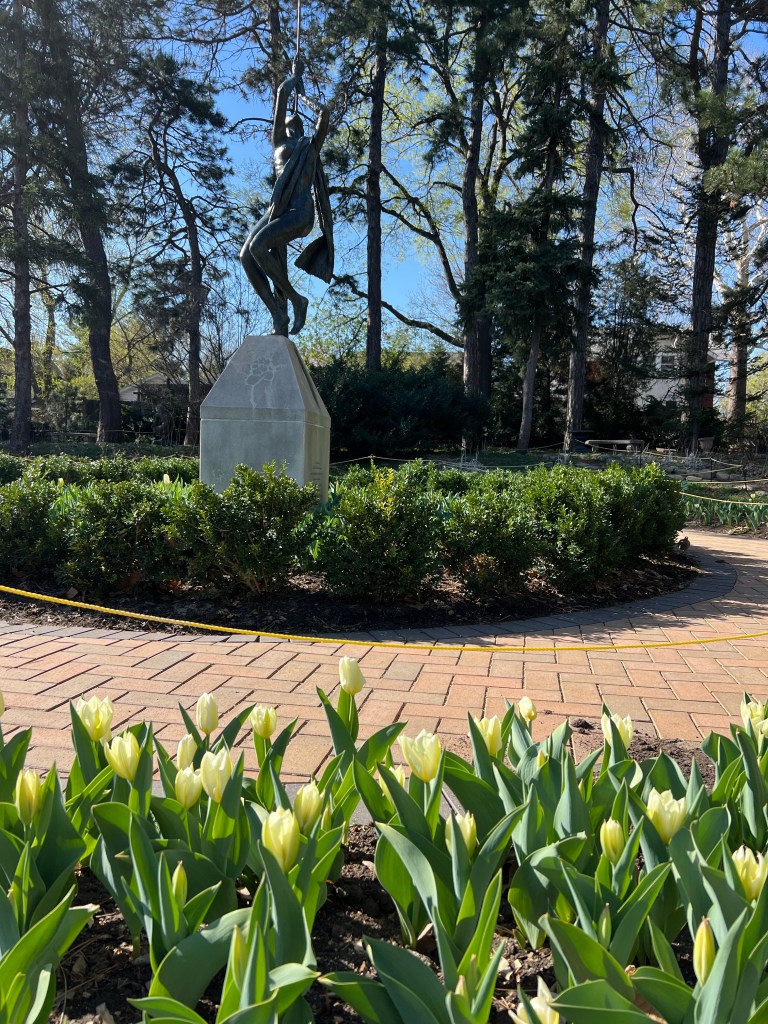
Despite its location on the corner of a very busy intersection in Lincoln, a former landfill is now a sanctuary with thousands of flowers planted on its one-and-a-half acres. The iconic Sunken Gardens, perfect for wandering, contemplation, and enjoying the beauty of nature, has a healing garden, stunning sculptures, a cascading fountain, and open lawn spaces. Through the years, the gardens have been a special venue for weddings (although brides and grooms must be prepared for cars honking as they drive by), art shows, family picnics, contemplative walks, a quiet place to read, photography, or friendly conversations.

On one of our many sightseeing or historical tours of Lincoln as a child, my dad shared that the gardens had originally been a dump. Amazed, I couldn’t imagine how that kind of transformation could take place. In 1930, as part of a depression-era city program to help unemployed men earn a little cash, the idea of Sunken Gardens was birthed. Crew members worked eight-hour shifts, two days a week for a total of $6.40 per week. Through the years, the gardens have been improved and renovated, most recently in 2005 with a $1.7 million fundraising campaign. I am so grateful for that vision and the continued effort of volunteers to create something of such beauty from trash. 

Sunken Gardens is often a specific destination for me but if I happen to be driving nearby, I might make a spontaneous visit. Recently, I had a few minutes after an appointment, and knowing the tulips and other bulb flowers wouldn’t last much longer, I drove a little out of my way to visit. It was a soulful, wonder-full fifteen minutes of enjoying the fleeting blooms. Finding wonder in nature is a path to practicing contemplation and observing silence. 

St. Benedict invites us to “listen with the ear of the heart” (Rule of St. Benedict, Prologue:1).

“This calls for a contemplative stance, an ability to experience wonder and joy in nature. It can also prompt me to ask: when was the last time I really saw the swift flight of a bird, the delicate beauty of rose petals?? Rather than trying to fill every moment with sound and distraction, the Benedictine way of life is characterized by peace and silence. Benedict instructs his followers to “diligently cultivate silence” (Rule of St. Benedict, 42:1)

Common threads: Francis’ encyclical and Benedict’s rule, By Mary McDonald SGS

I considered this dump-turned-garden as the ultimate metaphor for transformation. Truly, all things can be transformed, and have the potential to be created anew, in our planet, in ourselves, and in relationships.

God did not create creation light years ago, he continually maintains it in existence. God is constantly in the very act of creating. He fills us with his Spirit of creativity so that we can transform the world according to his creative will. Anselm Grün OSB, Benedict and Creation

To be Benedictine is to be open to conversion within ourselves, with people we might disagree with, or in protecting our environment. We allow for the possibility of reconciliation, and restoration of how things could be at their fullest potential. Just as creation is constantly creating and evolving, so must we. We must adapt and change to the environment we are living in by not taking too much or giving too little. Enjoying nature, being in the present moment, and nurturing silence that brings creative thought is the call of Being Benedictine.

© Jodi Blazek Gehr, Being Benedictine Blogger

The Wonder of a Broken Arm

WONDER sees the everyday as sacred.

Living with a sense of wonder, my word for 2023, is my intention. Being open to surprises, having a sense of curiosity, and having the desire to learn is important to my spiritual practice of “being Benedictine.” Wonder sees the sacred in the ordinary and is a doorway to gratitude, but seeing with eyes of wonder is a much easier proposition when our daily life is comfortable. My sense of comfort was recently challenged.

On a cold, windy February morning, my little dog Bailey did not want to do her business outside. Fourteen degrees in Nebraska, who can blame her? Worried about potentially icy roads and getting myself to school in time, I hurriedly picked up my little dog and headed out to accompany her on a potty trip. After stepping down onto our (apparently icy) landing, my feet slipped out from underneath me. It happened so fast yet every second my body met the icy ground, pain pierced through me–first on my bottom, then as I slid to my left side hitting my elbow sharply. I felt several crunches on my arm as I continued sliding on the pavement finally stopping several feet away. 

I knew immediately I had broken my arm, and later it was confirmed–a fractured ulna and a chipped elbow. The entire event was captured on our doorbell video. I watched it only one time to see if it was as I had remembered. Seeing myself fall has ruined me forever from watching America’s Funniest Home Videos again. Falls that used to crack me up (no pun intended) seem not so funny anymore. 

Wonder is the doorway to gratitude.

Making meaning out of life’s experiences and practicing gratitude is foundational to my spirituality, but much of my broken arm experience (7 weeks to date) has been spent feeling like I am not being very Benedictine. I am grateful for much, but I have also been so tired, irritable, and moody. It has been more traumatic for my body, mind, and spirit than I could have imagined. 

Despite my general crabbiness, I know my injury could have been worse–for that I am grateful. Thank God I hadn’t hit my head and been knocked unconscious. I am grateful that it was my left arm that was broken, and not my dominant right. After a week of wearing a splint, I was grateful to learn that the fractured pieces of my ulna had, amazingly, stayed in alignment. I would not need surgery and instead of needing a cast, I would wear a brace that I could easily remove to shower. A welcome reprieve from the confinement of a splint, there would be enough space to wiggle a pencil through to scratch my arm. (More things to be grateful for at the end of this post.)

Gratitude is an emotion that reflects our deep appreciation for what we value, what brings meaning to our lives, and what makes us feel connected to ourselves and others.

Atlas of the Heart, Brene Brown

I thought my attitude of gratitude would carry me through the weeks of convalescence in front of me, but I underestimated the many conflicting emotions I would have–frustration, overwhelm, disappointment, empathy, compassion, and wonder, just to mention a few. Out of 87 identified emotions (and experiences or thoughts that can lead to emotions) in Atlas of the Heart by Brene Brown, I have felt no less than 40 of them since I fell. 

Early on I had decided I would be a resilient, strong, and compliant patient. I would remain calm in the face of discomfort or pain, knowing “this too shall pass.” Spoiler alert: I have grown weary, increasingly frustrated, and borderline hysterical from the discomfort and/or pain. Betty the brace–named after my strong, steady, prayerful oblate friend, Betty–has been called many other names besides Betty (Betty, the friend, took no offense.) 

Continue reading “The Wonder of a Broken Arm”

Walk With Me: A Wedding Promise of Stability

Last summer (July 17, 2021) we enjoyed celebrating the wedding of my daughter, Jessica, to John Holland with a beautiful ceremony officiated by my dear friend, Joyce.

This summer (June 25, 2022) I was so honored to be the officiant for the wedding of Travis and Sam, one of Jessica’s college friends. It was such a joy to walk with them in creating their ceremony and so humbling to be a part of their special day with family and dear friends.

It was a spiritual experience for me to consider again, after 37 years of marriage, what it means to make a marriage commitment—to promise “to have and to hold from this day forward, for better, for worse, for richer, for poorer, in sickness and in health, until death does us part” (Sam and Travis’ vows to each other) and to walk together on life’s journey.

Antoine de Saint-Exupéry, the famous French author of The Little Prince, wrote in Wind, Sand and Stars:

“Love is not just looking at each other, it’s looking in the same direction.”

I shared these words during the wedding ceremony:

“Walking together, in the same direction, is what your marriage commitment will require. The primary reason we commit to relationships, to promise stability, is to be there for the other. In a consumer-driven society, we are encouraged to buy new, better, more but the ancient monastic practice of stability encourages us to stay put. Nathan Oates writes, “Stability doesn’t mean you’re not trying to improve or that you don’t work on the problems. Just the opposite. It means you’re going to work hard, and you expect problems. This isn’t a fairy tale. This is learning how to love.”

Promising to stay, to walk together in all of life’s joys and challenges, is the vow of stability. One’s relationship can grow deep roots, in great love, by understanding that the other will always be there for you.

Selfies with the bride and groom!
Continue reading “Walk With Me: A Wedding Promise of Stability”

Top 20 Benedictine Blogs

In 2014, I started this blog/website to share my writing and reflections on Benedictine spirituality. I recently learned that Being Benedictine has been identified as one of the Top 20 Benedictine Blogs by Feedspot. THANK YOU for following, sharing, commenting and supporting Being Benedictine for these years!

You can follow new posts and see over 100 entries in the archives HERE.

Find Being Benedictine on Facebook HERE.

You can follow Christ the King Priory, where I am an oblate, HERE.

And for more blogs on Benedictine spirituality, click HERE.

St. Benedict Center, Schuyler, NE. My first visit was in 2002. In 2013, I became a Benedictine Oblate.

A New Year Prayer: Ring Out, Wild Bells!

“Music is a higher revelation than all wisdom and philosophy. Music is the electrical soil in which the spirit lives, thinks and invents.”

― LUDWIG VAN BEETHOVEN

Listening to the sweet and soulful songs of Alana Levandoski is prayer itself. I discovered Alana through the Center for Action and Contemplation and have used her contemplative songs and chants in retreats I have led and in my own prayer practice. Whether setting music to her own words, or lyrics drawn from poetry or scripture, her singing is elevated prayer.

Ring Out, Wild Bells, a poem sung by Alana, is a heartfelt, prayerful intention to ring out the old of 2020, a year of great challenges, and to ring in the new of 2021. The poem, In Memoriam, (Ring out, wild bells) was written during a time of grief, nearly 150 years ago by Alfred Lord Tennyson (1809-1892). The lyrics ring true for both letting go and welcoming in—letting go of the false, feuding, dying, grief, pride, partisan divide, and civic slander WHILE welcoming in the new, true, noble, sweet, pure, love, truth, light, and peace.

(Image above taken at St. Jacob’s Church bell tower in Telc, Czechia)

Enjoy Alana’s new video of Ring Out, Wild Bells! And at the bottom of this post, learn more about Alana, how to find her music and some additional prayerful songs to start your new year.

Continue reading “A New Year Prayer: Ring Out, Wild Bells!”

Reichenau Island at Lake Constance: Benedictine Pilgrimage, Part 13

Wednesday, June 26—Reichenau Island, Meersburg, Constance

Today we visit the beautiful and historic monastery island of Reichenau in Lake Constance, a quick stop in Meersburg, and a chance in the evening to do some exploring in Constance where we stay again for another night.

IMG_5922IMG_6029

Reichenau Island is one of 31 important sites in Germany that are on the UNESCO World Heritage List, a testimony to the religious and cultural role of this large Benedictine monastery of the Middle Ages. The Benedictine monastery was founded in 724, by Bishop Pirmin, considered to be the first abbot of Reichenau Monastery. The Monastery served as an imperial abbey during the Carolingian Empire, with special allegiance to the king, serving as Europe’s premier educational and training center. Continue reading “Reichenau Island at Lake Constance: Benedictine Pilgrimage, Part 13”

Blog at WordPress.com.

Up ↑