Lectio Divina—Genesis 1:26-2:3, Fill the earth and subdue it.
Book Discussion—The Oblate Life: Spirituality at Work, Dermot Tredget. Edited by Gervase Holdaway, OSB, 2008
Topics: Prayer, work, rest and study together provide a foundation for a Christian spirituality of work. St. Benedict recognized that work has a transformative power and for the monk is the principal means to seeking God. Our discussion flowed from words or phrases that resonated from sources listed above.
God created man in his image, in the divine image he created them.
We are created in the image of our Creator; we are creators, too, and it is our responsibility to contribute to the act of creation. Creation is not a once and done effort. Creation requires constant movement, growing, expanding, and even resting. We must ask ourselves if our work is valuable. Does my work add value to God’s creation? “We cannot speak about a spirituality of work without talking about an ethics of work.” (Dermot Tredget)
I give you every seed-bearing plant
In the image of our Creator, our work is to plant the seeds we are given which becomes our food. This isn’t quick and easy work; we need to rest, recover and have patience. We are in relationship with the Divine as co-creators. The Divine is not out of the picture. There is an unseen aspect of work–God is working even while we rest. Even further, what we see as useless toil may show value later. All is sacred.
The image and story behind the Chipko movement inspired us to do some of our own tree-hugging! The Chipko movement of the 1970s (chipko meaning ‘to cling to or hug ‘ in Hindi) led to tree-hugging movements throughout the Himalayan regions, forcing reforms and moratoriums in the forestry industry that saved thousands of trees. The peasant women of the Garhwal Hills of India, pictured below, literally threw their arms around trees to save them (Ecologically Conscious.) Their actions were inspired by events of 1730 when soldiers were ordered to fell trees in the Bishnois villages of India to build a palace. 294 men and 69 women, belonging to a branch of Hinduism, were massacred while they desperately clung to their trees. Eventually, their action led to a royal decree that prohibited the cutting down of trees, and their forests flourish today.
Across the centuries and throughout the world, the existence of trees has been threatened in the name of progress, to pad the pockets of the greedy, or, sadly, out of sheer ignorance, yet the original tree huggers continue to influence environmentalist efforts. Those Indigenous to the land see clearly that their existence is connected to the survival of trees. We can follow in their footsteps by recognizing our connection with and responsibility to the earth, which is so in need of our aid.
We have spent a few autumn weekends through the years at our friend Joyce’s family farm in the sandhills of Nebraska, near Loup City, but this year, on the heels of reading Braiding Sweetgrass: Indigenous Wisdom, Scientific Knowlege, and the Teachings of Plants, we feel a longing to connect to the land that Joyce’s great grandparents had homesteaded, to return to the home her mother grew up in, to hear their stories, and to remember and honor the Indigenous who lived with the land, in humility, gratitude, and reciprocity.
Joyce extended the invitation to the weekend with these words: “We will walk upon the land in honor of those who have walked the land before us and in sacredness to our Mother Earth and all she has provided to us. For a weekend, we will become ‘Indigenous to place’”.
What does it mean to become Indigenous to a place? Robin Wall Kimmerer, a scientist, professor, citizen of the Potawatomi Nation, and author of Braiding Sweetgrass describes it as “living as if your children’s future mattered, to take care of the land as if our lives, both material and spiritual, depended on it…To become indigenous is to grow the circle of healing to include all of Creation.” This weighs heavily on our minds and in our spirits as we create a weekend getaway to honor our connection with each other and all of Creation.
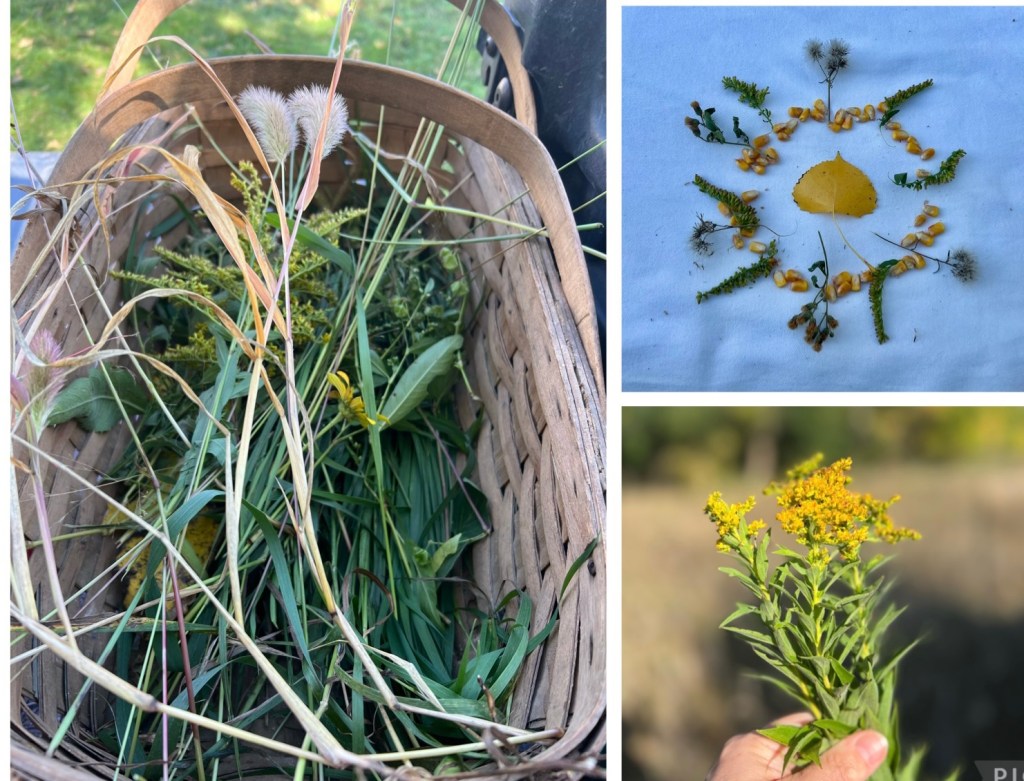
Our weekend was a medley of adventure, gratitude, creativity, good conversation, and play. We took the Gator out into the pasture and hills, enjoyed incredible vistas, laughed a lot while swinging from an old oak tree, and, afterward, thanked it with a big group hug. We searched for sweetgrass, gathered nature artifacts, created nature mandalas, and discussed Braiding Sweetgrass—reading segments of it out loud and discussing its impact on our lives and on our world.
Being silly before breakfast, we played with morning shadows, losing all sense of time. On a tractor-pulled hayrack, we rode up the hill and into the pasture to play—blowing bubbles, flying kites, and watching the sunset and the rise of the Full Harvest Moon. We danced in the moonlight to moon songs (think Fly Me to the Moon and Blue Moon), gazed at the stars, shared stories, reflected on the past, and imagined the future. How blessed we are to enjoy time in nature, on land that is loved and shared so generously.
We are here as part of creation, not as consumers of it.
-Joan Chittister
“If the universe unfolds in God, who fills it completely… there is a mystical meaning to be found in a leaf, in a mountain trail, in a dewdrop, in a poor person’s face. The world sings of an infinite Love: how can we fail to care for it?” Pope Francis addresses our responsibility to care for our common home in his newest exhortation, Laudete Deum, an urgent follow-up message to Laudato Si (Papal Encyclical, “Care for Our Common Home”, 2015).
Our weekend is filled with gratitude for the “infinite Love” displayed in the rolling hills, big oak trees, waving seas of tall grass, and the yet-to-be-harvested corn. Indeed, how can we fail to care for it? We hear the warnings of climate change and reports of how much damage has already been done, the hundreds of years needed to reverse course IF we were to make necessary changes now. Both Braiding Sweetgrass and Laudete Deum, brilliantly researched and exquisitely written, are cries for help on behalf of Mother Earth, who is speaking to us in ways we refuse to hear. I encourage you to read these powerful texts contemplatively, in the spirit of Lectio Divina, and to consider our responsibilities, what Kimmerer refers to as our “moral covenant of reciprocity.”
“The moral covenant of reciprocity calls us to honor our responsibilities for all we have been given, for all that we have taken… Whatever our gift, we are called to give it and to dance for the renewal of the world. In return for the privilege of breath.”
–Braiding Sweetgrass: Indegenous Wisdom, Scientific Knowledge and the Teachings of Plants
In Braiding Sweetgrass, Kimmerer refers to the changing roles of women as they “spiral through the phases of life, like the changing phase of the moon.” As we grow older, we have an opportunity to widen our circle of care, to “walk the Way of the Teacher, becoming models for younger women to follow…The spiral widens, farther and farther, so that the sphere of a wise woman is beyond herself, beyond her family, beyond the human community, embracing the planet, mothering the earth.”
As Pope Francis writes, “Everything is connected, and no one is saved alone.” (LD, 19) We share this earth with everyone on it, with those who came before us and those who will follow. What kind of world, and appreciation for it, do we hope to leave behind for future generations? We must remain hopeful that there will be a world to leave behind, but we must also do something to ensure it.
I have been enchanted by the poem The Grandeur of God, by Gerard Manley Hopkins, for years. I practiced Lectio Divina, a sacred reading practice, with this poem and wrote about it in God’s Grandeur: Praying with Poetry.
I cannot confess to understanding every word of this Victorian-era sonnet, published nearly 30 years after Hopkins’ death in 1889, but I feel the same passion for the beauty and sacredness of creation “that gathers to a greatnesslike the ooze of oil / Crushed” with which he writes. Hopkins writes with celebratory confidence,
“And for all this, nature is never spent; There lives the dearest freshness deep down things”
But we know as global temperatures rise, more droughts, storms, rising sea levels, melting glaciers and warming oceans are impacting both human and animal life. Nature has been used and abused in so many ways. Is it true that “nature is never spent?” Can this earth withstand the heavy burden of “man’s smudge…and smell?” Indeed, we seek comfort in the notion that the sun will always rise as “the brown brink eastward, springs” and always sets as “last lights off the black West went.”
We hope for the future of our planet, but we must be caretakers, not just takers. We must be co-creators with the Divine to ensure the “grandeur of God,” our planet, is full of wonder and awe for future generations.
“Glance at the sun. See the moon and the stars. Gaze at the beauty of earth’s greenings. Now, think. What delight God gives to humankind with all these things. All nature is at the disposal of humankind. We are to work with it. For without we cannot survive.”
Homily for the Easter Vigil 2017 at Christ the King Priory/St. Benedict Center, Prior Fr. Joel Macul OSB
Vigil readings: Gn 1:–2:2 • Gn 22:1–18 • Ex 14:15–15:1 • Is 54:5–14 • Is 55:1–11 • Bar 3:9–15 • Ez 36:16–28 • Rom 6:3–11 • Mt 28:1–10
Earthquake! Earthquake and Easter go together today. Most of us could probably use a little earthquake right now to wake us up and get our attention. We have been sitting and listening for a long time. ….God is so full of surprises. Dawn comes, a new day and what do we feel? An earthquake. Everything is splitting open, the old is collapsing, and the new is stepping out. The sound of the earthquake and stones rolling away, that is the announcement of Easter this year. But it is a new day, a new creation, the old has passed. After the earthquake, we cannot go back. Life is not the same, for Jesus, for the women, for disciples. Dare I say, for us also?
The readings we have just heard are like photos in a family or community album. Each year on this night we gather to sit down and look at these pictures. We gather here to listen to the stories and poems about God’s ways in our faith community’s story. We sit and listen to the stories and words of the prophets and apostles. Every time we look at a family or community photo album, the pictures remind someone of another story, of another member of the family and community. Sometimes the stories are the same, sometimes they are not. A new memory is added. It is like that with the words and rituals of this Easter Vigil. Each year the same words are read but each year they sound new and different. Something in them is heard for the first time. Why? Because each year we have grown and experienced another piece of life since the hearing last Easter. This year a particular word hits us; it makes sense, more sense than ever before. God is penetrating into our hearts ever more deeply. Each year we hear these words and each year we become these words more and more. Or so we hope.





 what do we feel? An earthquake. Everything is splitting open, the old is collapsing, and the new is stepping out. The sound of the earthquake and stones rolling away, that is the announcement of Easter this year. But it is a new day, a new creation, the old has passed. After the earthquake, we cannot go back. Life is not the same, for Jesus, for the women, for disciples. Dare I say, for us also?


 Being Benedictine