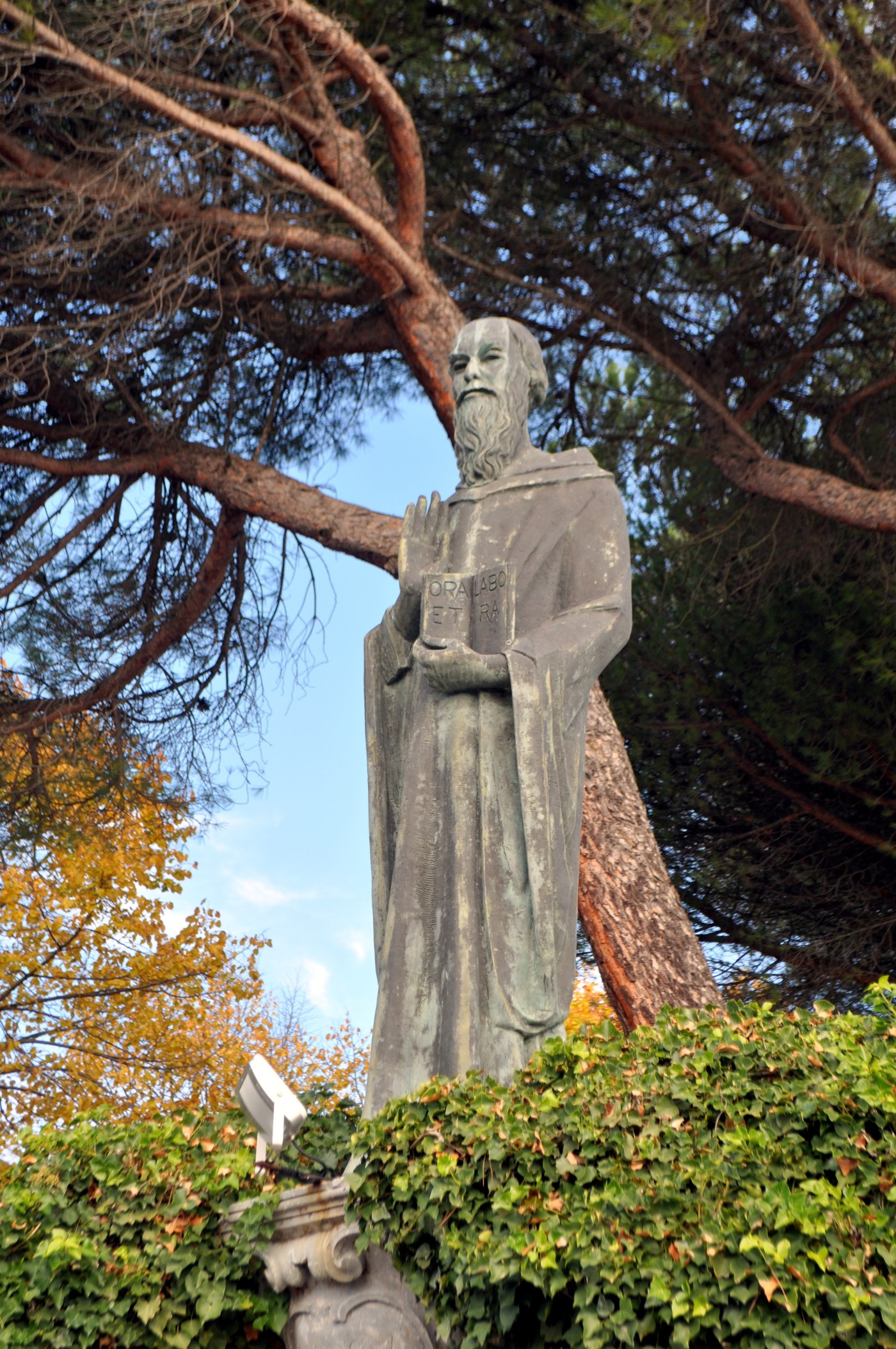
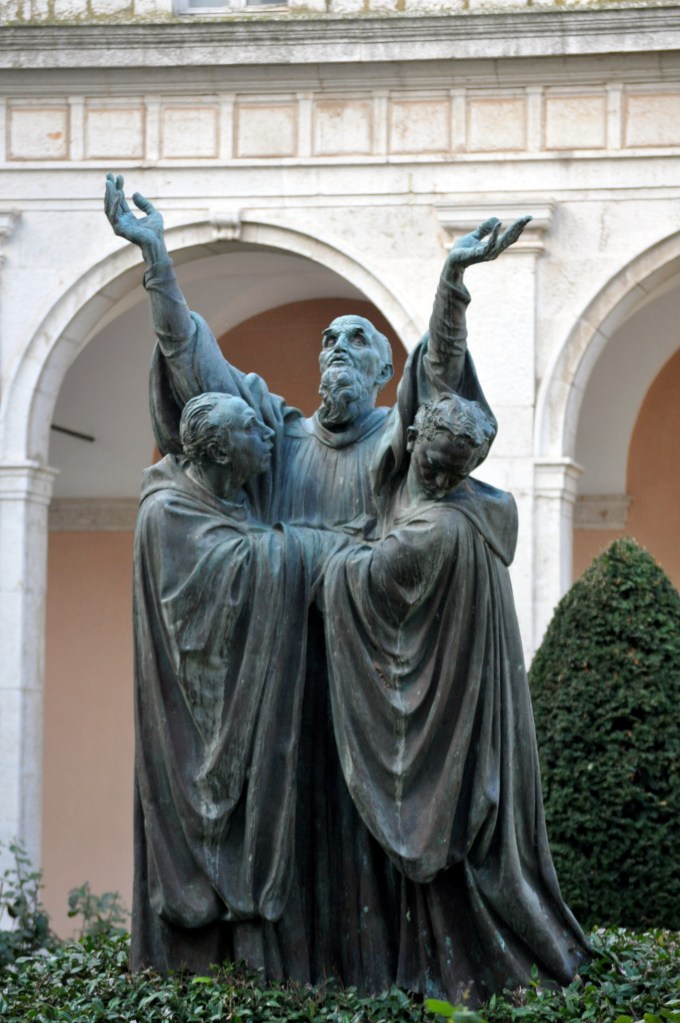
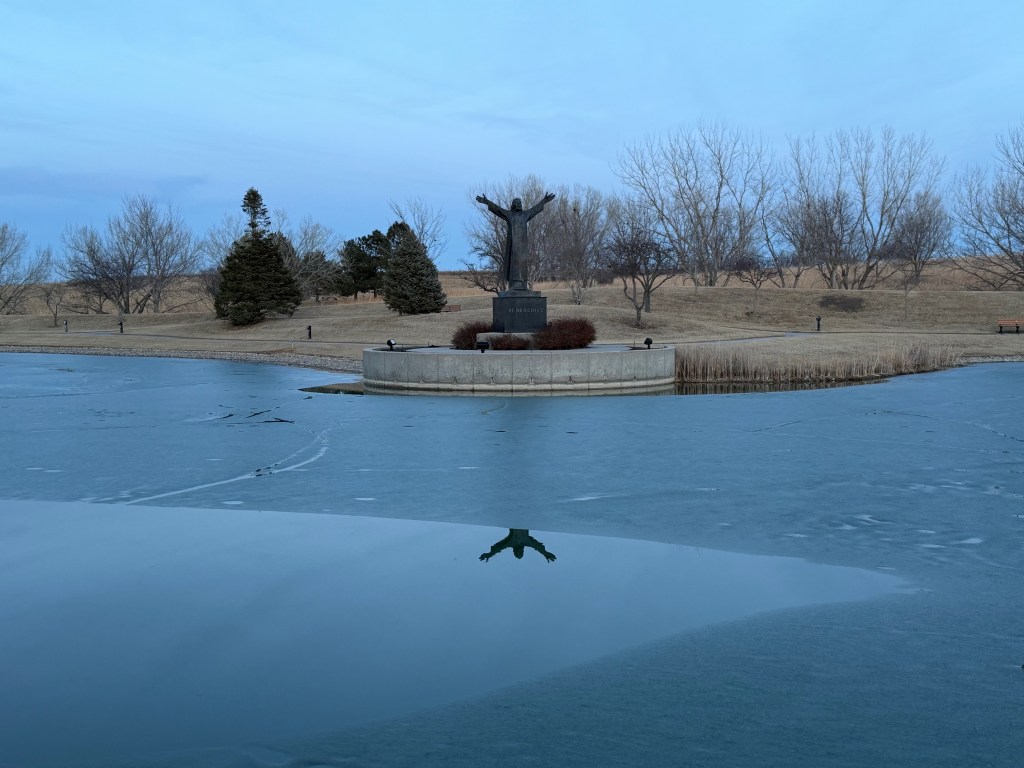
In the Rule of St. Benedict, he instructs, “Keep death daily before your eyes” as a way of life. At the Abbey of Montecassino, where St. Benedict wrote his Rule for monks, there is a statue in the courtyard depicting the moment of St. Benedict’s death.
Montecassino Abbey, the statue depicts the passing of St. Benedict. Photo by Jodi Gehr, 2017.
On March 21, Benedictines around the world celebrate the “transitus,” St. Benedict’s passing from one state to the next, from death into life. Death is not seen as final, but rather a transition into eternity with God.
St. Gregory the Great writes about St. Benedict’s last days:
“Six days before he died, he gave orders for his tomb to be opened. Almost immediately, he was seized with a violent fever that rapidly wasted his remaining energy. Each day his condition grew worse until finally, on the sixth day, he had his disciples carry him into the chapel where he received the Body and Blood of our Lord to gain strength for his approaching end. Then, supporting his weakened body on the arms of his brethren, he stood with his hands raised to heaven and, as he prayed, breathed his last.” (St. Gregory the Great, Book Two of Dialogues, chapter 37).
The advice to keep death always in our minds is the core of being Benedictine and living soulfully.Perhaps this sounds morbid, but it encourages me to live each moment with wonder and gratitude, with purpose, on purpose, and to be attentive to the present moment. Practicing gratitude, having no regrets, living with death daily before your eyes, as St. Benedict writes, and leaving something beautiful from a life well lived, help prepare us for a more peaceful transition from here to eternity. St. Benedict’s life and death are an exemplar for how we are to be Benedictine.
I do not bear discomfort well, I said, half-seriously, half-jokingly, to my son-in-law, John, the other day, as I took a little longer to get out of the car than the rest of the family. We both laughed as John noted that his wife shares this same trait at times. Like mother, like daughter.
It was a cold day in Nebraska, so we had to bundle up to go out, but once we were in the car, and the heat kicked in, I broke out into a sweat. Struggling in the back seat, off comes the coat. Two minutes later, we arrived at our destination. I wrestled my coat back on to re-enter the frigid temperatures. (An aside: Nebraska weather is a burden of extremes, from hot to cold. Our low temperature today is 12 degrees; on Saturday, 89 degrees is forecasted—how is one to cope?)
To add to my discomfort, several weeks ago, I sprained the peroneal tendons in my right foot. I will spare you the details, but it is reminiscent of the broken arm I experienced three years ago. Let’s just say—it adds to my discomfort, and I repeat, I don’t bear discomfort well. I feel a little guilty (and more discomfort) about admitting this out loud to John and writing it now. There are so many people suffering throughout the world—from war, displacement, poverty, hunger, trauma, poor health, grief, and every imaginable and unimaginable discomfort.
It is a lot for each of us to bear—our own discomfort and the wounds of the world that we also carry in our thoughts, physical bodies, emotional responses, and spirits. So much discomfort, uncertainty, ambiguity, and waiting can make us irritable and impatient—and there is so much to activate our discontent these days.
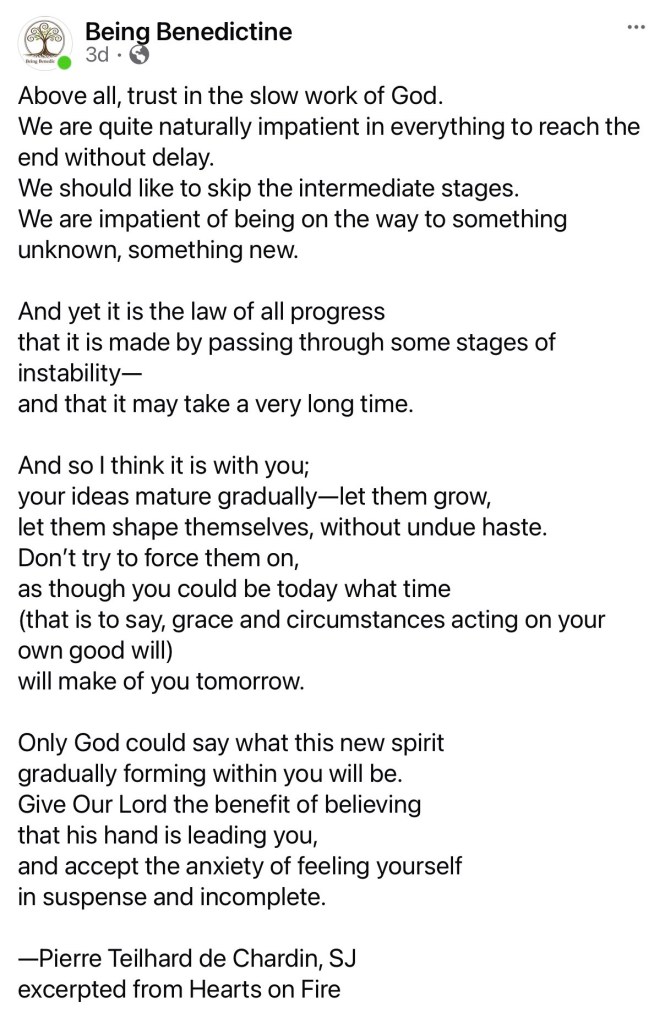
Recently, on my Being Benedictine Facebook page, I shared some wisdom from Pierre Teilhard de Chardin. Within 24 hours, the post had 130 times the average likes, comments, and views of a typical post.
This idea of waiting, and the discomfort that results, seems to resonate with many these days. It is increasingly challenging to “trust in the slow work of God,” and we need constant reminders that this is how we must cope.
February 2026 Oblate Reflections, Christ the King Priory, Schuyler, Nebraska
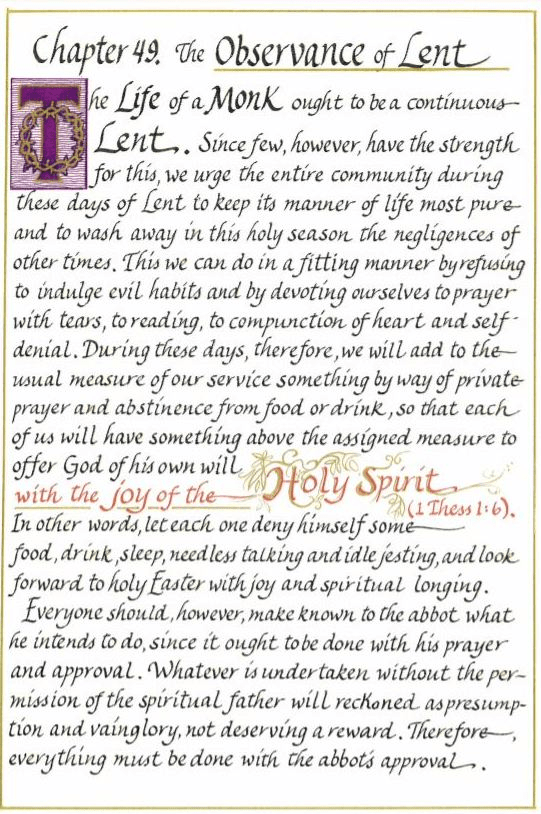
Theme: Love and Lent; Lectio Divina: Rule of St. Benedict: Chapter 49: Picturedabove: The oldest copy of the Rule of Saint Benedict, from the eighth century.
Benedictine Sisters Benevolent Association, St. Scholastica Monastery, Copyrighted 1990. Meredith Schifsky, Calligrapher; Mary Charles McGough OSB, Illuminator
What is your first thought when you consider the season of Lent? Many of us think of giving up sweets, donating to good causes, reading spiritual books or devotions, or going to Mass daily or more often. St. Benedict devotes an entire chapter of The Rule to how monks should practice Lent. He instructs that “the life of a monk should be a continuous Lent.” As an oblate, or lay member of a Benedictine monastery, seeking to live the life of a monk in the world, this can sound like a tall order. Fortunately, Benedict knows that we are only human, that everything must be done in moderation. He writes, “few…have the strength for this.”
We consider what he might mean by the ideal of a “continuous Lent” as well as other words or phrases that resonate with our oblate community during our Lectio Divina discussion.
St. Benedict Center–our monthly Oblate meetings are held in Schuyler, Nebraska More info here.
A continuous Lent. The holy season of Lent, Benedict writes, is a time “to keep its manner of life most pure and to wash away…the negligences of other times.” He offers specific ideas: avoiding evil habits, praying with tears, reading, compunction of heart, and self-denial. Unlike a New Year’s resolution, which we often resolve to add or subtract from our lives (and often lose track of what we resolved to do), a continuous Lent encourages us to keep checking in with our spiritual journey.
Our intentions are not one-and-done. We fall; we get up—again and again. Our spiritual lives can be likened to a spiral—a continuous journey in which we return to learn anew. Lent is a continuous preparation for Easter—a time of resurrection, new life, and beginning again. Even when our hearts are pierced by our own suffering and by the suffering of the world, there is a promise of something new being born, something resurrected. Joy will come again.
In the tradition of ancient monastics, each year I ask for a word to ponder, a word that I will prayerfully focus my attention on for the new year. It may be something I hope for or an attribute I want to cultivate in my life, but always for the surprise of what it might teach me, lessons I did not know needed to be learned.
The new word does not replace the old one, but enfolds, envelops, and encompasses it, another revolution on the spiral of my spiritual journey. As I reflect on the last several Words of the Year, this is still my truth: I want to hold all of life fully(2024)—the bittersweet moments and the sweet surprises, with “eyes open to wonder(2023), holy surprises, and synchronicity.” I want to see the light (2025) in the darkness. I want to be the light in the darkness.
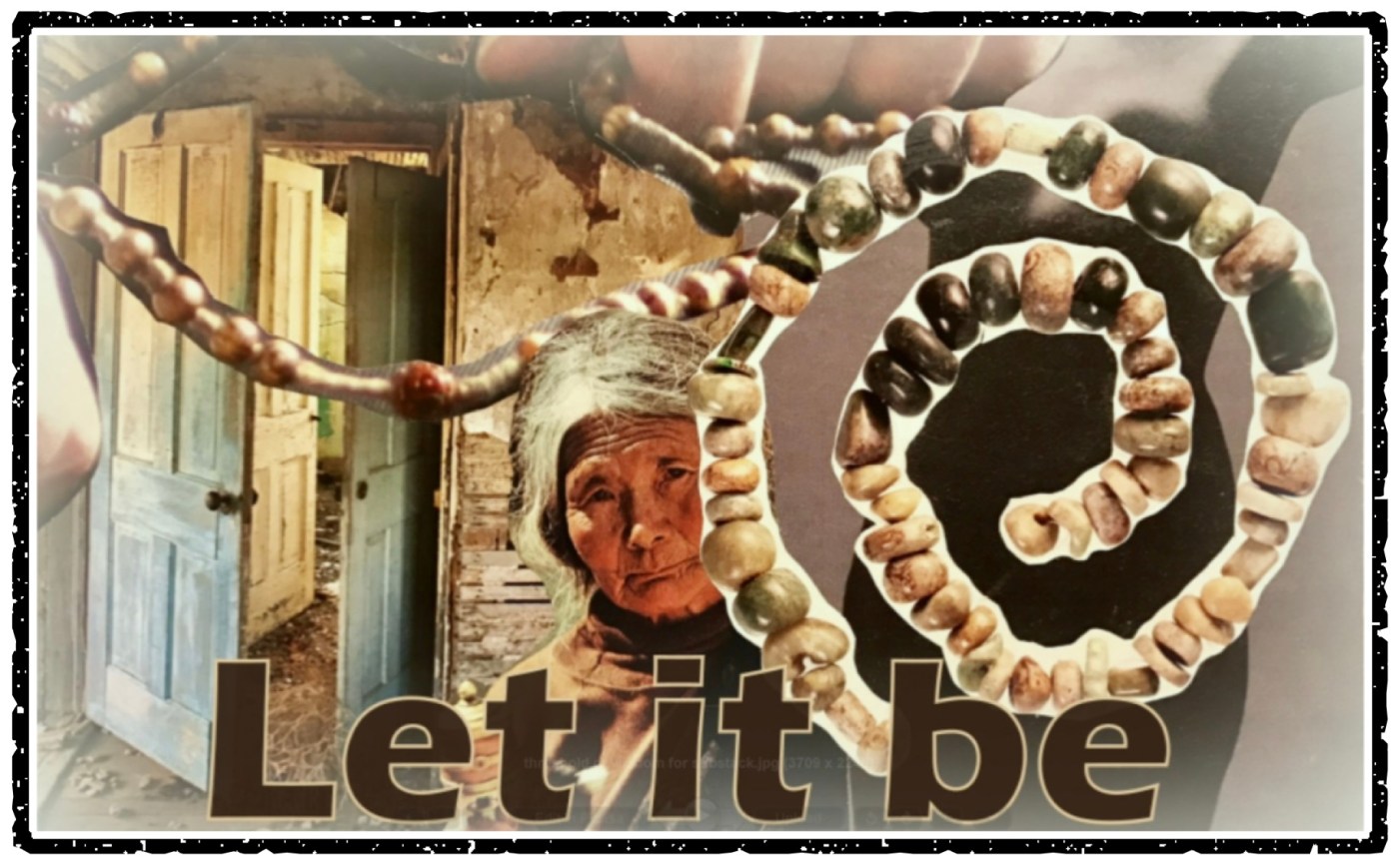
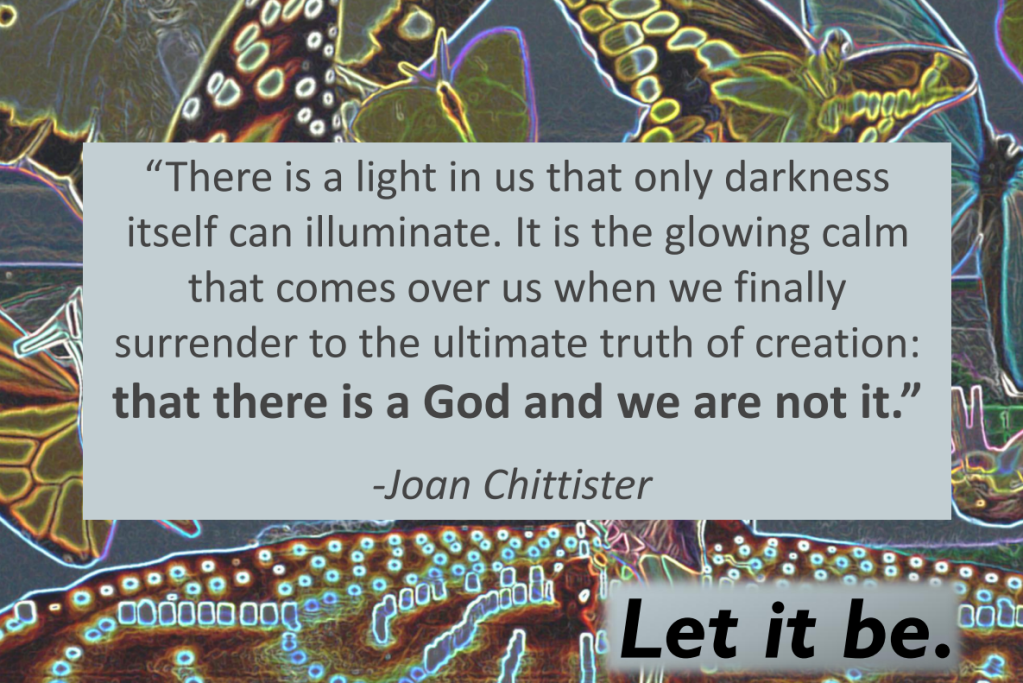
Reflecting on a very challenging year and the tragedies, trauma, and “presidential” tirades of the first few weeks of 2026, it is clear—we need a little more light, please. And so, I holdlight, my 2025 word of the year, in my heart as comfort and guide in tumultuous times, as a reminder to shine, safeguard, and trust the Divine light, and to add the mantra “Let it Be”.
On a recent SoulFully You retreat I guided, we explored how the human experience is a dance between dark and light, and that there is always a little glimpse of the other. Barbara Brown Taylor writes, “Suffering comes from our reluctance to learn to walk in the dark… Blessing the day means accepting my full quota of light and of dark, even what I cannot see what I am blessing.”
How do we carry both darkness and light in our daily lives?
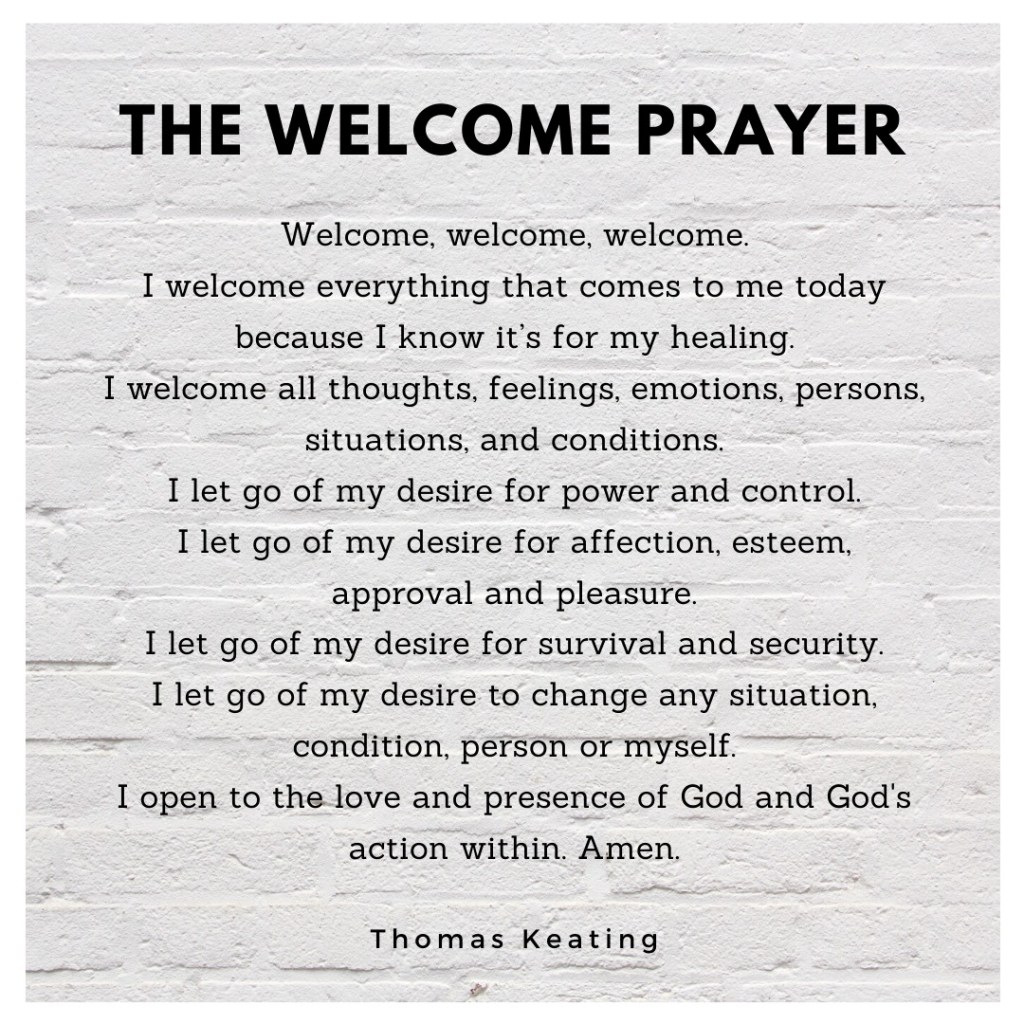
Fr. Thomas Keating, a Trappist monk, founding member of Contemplative Outreach, and an integral figure in the Christian contemplative prayer movement, suggests using the Welcoming Prayer, which has deep roots in the monasticism of the desert fathers and mothers.
Together, we practiced a Welcoming Prayer guided by David Benner, founder of Cascadia Living Wisdom. Step 1 in the process is Focus; Step 2 is Welcome; Step 3 is Let it Be—“Remember Jesus’ words in the garden of Gethsemane, ‘Not my will but thine be done’…or think of Mary, the mother of Jesus, as she responded to the annunciation. Let it be. This response is at the heart of Paul McCartney’s song called Let it Be.”
When I find myself in times of trouble, Mother Mary comes to me Speaking words of wisdom, let it be And in my hour of darkness, she is standing right in front of me Speaking words of wisdom, let it be
Let it be, let it be, let it be, let it be Whisper words of wisdom, let it be
And when the brokenhearted people living in the world agree There will be an answer, let it be For though they may be parted, there is still a chance that they will see; there will be an answer, let it be
And when the night is cloudy, there is still a light that shines on me Shinin’ until tomorrow, let it be I wake up to the sound of music, Mother Mary comes to me Speaking words of wisdom, let it be
When the spiral of negative thinking begins, let it be.“I need sanctuary from the constant rerun of conversations and/or situations that have led to hurt feelings and a sense of rejection. I need sanctuary from the relentless inner conversations that distract me from living fully and hold me a prisoner in the role of victim… Over and again, I hear that I must be silent, to listen to the breath of God within me, to still the thoughts. And then, carry on (2020).”
When I feel an urgency to get beyond the discomfort of making a decision, let it be. “I shall allow myself the cushion(2018) of time needed to make any decision. There is no need to rush, to over-commit… I shall gently bump into the ever-so-soft cushion I have gifted myself as a reminder to listen to the ear of the heart.“
It is good to remember that light and darkness cannot be separated. There is always a little glimpse of the other.
When life runs like a well-oiled machine, and things are going our way, confidence is high, and joy is palpable. It is then that we begin to feel invincible—that this good fortune is what we deserve. When the inevitable challenges, losses, or setbacks come, we feel the wind knocked out of our sails.
On the other hand, to succumb to darkness, despair, or hopelessness is to snuff out the candle of hope that we must cling to, or what is this all for? Being Benedictine means holding both/and—seeking the light while also honoring and learning from the darkness.
“When we come to understand that everything in our world, including its darker aspects, derives from God, we begin to realize that much of what we perceive as “bad” is, from the divine perspective, simply another piece of the sacred whole…that which appears as darkness to us may very well be the beacon to our redemption.” -Niles Elliot Goldstein, God at the Edge
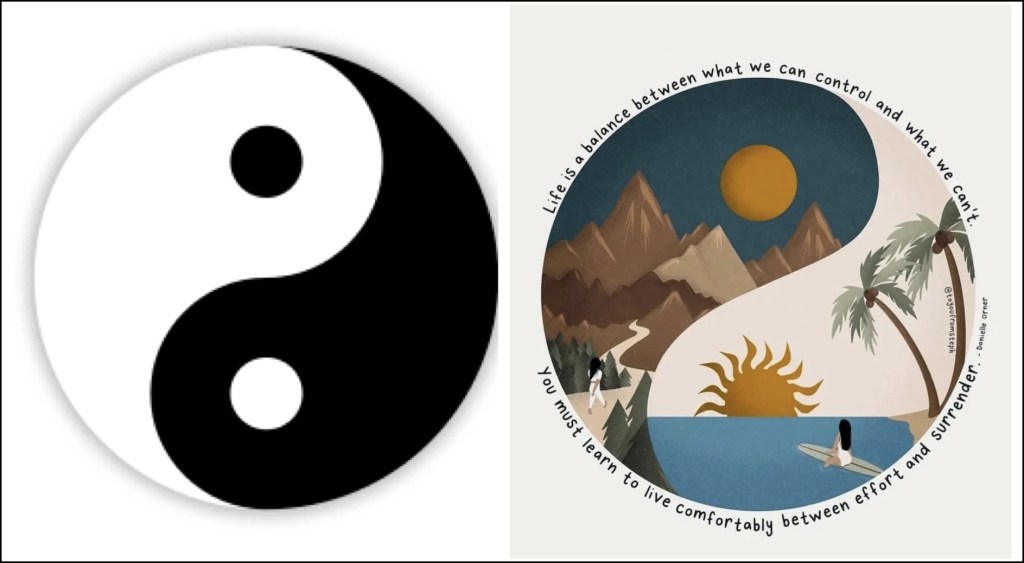
My guiding star, my 2025 Word of the Year, LIGHT, has helped me embrace this yin/yang reality in my life and the world.
“Life is a balance between what we can control and what we can’t. You must learn to live comfortably between effort and surrender.” -Danielle Orner Steph Edwards @toyoufromsteph
It is no secret that 2025 has been a tough year. We knew it wouldn’t be easy, but it has felt more…well, just more than we could have imagined. (See truth-tellers like Heather Cox Richardson, Robert Reich, Rebecca Solnit, Parker Palmer, and Pope Leo who shine their light into the darkness of a threatened democracy, giving hope to those marginalized and suffering around the world. I have shared my truth on these matters here: Be The Light: A 4th of July Message.)
Personally, we started 2025 with unexpected news, challenges, and worries about family and friends. We lost Joe’s brother, Steve, in a tragic accident, but were comforted that two successful transplant surgeries resulted from his donated organs.
I missed my teacher colleagues in my first full year of retirement, but had more time for reading and writing, coffee and lunch dates, book discussions, and binge-watching Outlander. I attended the Okoboji Writers Retreat, led two SoulFully You retreats, and collaborated on another.
“Do not grumble or think ill of others.” (Rule of St. Benedict Ch. 4:39)
What is the key to practicing gratitude rather than grumbling? How can we live a grateful life in the midst of pain and suffering, our own, that of others, and that of the world around us? Is it possible to be thankful for challenging experiences?
We use the Rule of St. Benedict and Scripture to address these questions at our November oblate meeting. We opened our meeting with the Welcome Prayer written by Fr. Thomas Keating).
If we truly practice this prayer to welcome all of the above, we find that the benefit of grumbling is minimal. In fact, grumbling is self-sabotage. The benefit of welcoming everything is that through the moments of distress, unease, discomfort, or suffering, we learn that another way could be a blessing. What can be difficult about the Welcome Prayer is the “letting go” of our control—and oh my, how much we prefer when things go our way.
St. Benedict has a few things to say about grumbling, a form of letting go of our own gripes, opinions, and negativity for the greater good of the community and ultimately our own selves. He encourages his monks to cultivate humility, patience, and a joyful acceptance of their station in life. It requires a surrender of pride to be content even when it is challenging to be.
We read the following excerpts and practice Lectio Divina as a group, sharing the insights we gained.
I carefully consider everything that I write and share here, especially the more personal or contentious reflections. I rarely write and post on the same day. Not so with my speech. I find myself saying often enough, “Did I just say that out loud?” Words fly out of my mouth much faster than they flow from my pen or keyboard.
Perhaps this is why I enjoy journaling and writing so much. It slows my mind down. In silence, I can be more deliberate, careful, and organized in what I share. A healthy respect for silence could save me some angst in times when my mouth works faster than my mind.
At our annual oblate retreat, with the theme “Building Community Through Our Oblate Promises,” the importance of silence was the topic of the opening session led by Fr. Thomas Leitner, the administrator of St. Benedict Center and a monk who lives at the monastery across the road. Throughout the weekend, we would learn about and practice silence.
Why is silence so fundamental to Benedictine spirituality?
Silence is the way to self-knowledge. A discipline of silence confronts us with ourselves. “Silence is a way for us to put up with ourselves the way we are. Not everything that comes to mind at times of silence is pleasant. Repressed needs and wishes may come up, repressed anger, and perhaps missed opportunities,” Fr. Thomas shared. Silence gives our wounds space to surface, allowing us time to wrestle with and soothe our pain in healthy ways. Silence allows us to see ourselves unfiltered without the influence of others.
In The Interior Castle, St. Teresa of Avila uses imagery of a castle for our soul, emphasizing “how necessary this room (of self-knowledge) is…we shall never completely know ourselves if we don’t strive to know God.” She writes that God dwells within us, and to know God, we must first know ourselves. Hard, but necessary, work to “know thyself,” as the ancient Greek maxim suggests.
Silence connects us to the Divine. Seventh-century bishop and theologian, St. Isaac of Syria, writes:
Try to enter into your treasure house
and you will see the treasure of heaven.
For both the one and the other are the same,
and the one and the same entrance reveals them both.
The ladder leading to the kingdom is within you,
that is, in your soul.
We enter this “treasure house,” our very soul, through the practice of prayer. Some of us may be conditioned to think of prayer as a transactional bubble-gum-machine approach to asking God for what we want. We put in a coin; God supplies the big gumball. Our prayers are “answered.” Yet this is not the kind of prayer that leads to self-knowledge or to a connection with God. Consider a poem by the 19th-century Danish theologian Søren Kierkegaard that points to a different kind of prayer.
As my prayer
became more and more devout and interior,
there was less and less I had to say.
Finally I became completely still.

I became—
this is perhaps an even greater contrast to talking—
I became a listener.

First I thought praying is talking.
I learned, however, that praying is not only silence,
but listening.

That’s the way it is:
Praying does not mean hearing oneself speak,
praying means becoming still and being still
and waiting until I hear God.

-Søren Kierkegaard
Silence builds confidence and leads to self-respect.
“As my prayer became more and more devout and interior,” I come to know myself with greater depth. This knowing builds my confidence: I have been created just as I am, in the image of God. I forgive myself for weaknesses and celebrate my gifts. I seek less approval from others. I have “less and less” to say to justify, convince, or plead my case of worthiness to myself or others.
Teacher, writer, and friend, Parker Palmer, writes, “One of our most debilitating illusions (is) that the answer to our problems is always ‘out there’ somewhere, never ‘in here.’ It’s an illusion that’s constantly reinforced by educational and religious institutions that make us dependent on “experts” and “authorities.” We need not look for knowledge in others; we can trust our own interiority, the Divine Expert Within. I can grow in self-respect, knowing God is within me, intimately speaking to me when I am silent long enough.
“In a delightful letter on the contemplative life called The Ladder of Monks, Guigo II (a 12th-century Carthusian monk) divides the experience of Lectio into four phases or degrees: reading, meditation, prayer, contemplation. Reading, he says, puts food whole into the mouth. Meditation chews it, digs for treasure. Prayer extracts the flavor and helps us to get to know the treasure. Contemplation embraces and welcomes the thirsty soul.” (A Tree Full of Angels: Seeing the Holy in the Ordinary, Macrina Weiderkehr)
Lectio Divina: Matthew 9:1-13; 35-36
He entered a boat, made the crossing, and came into his own town. And there people brought to him a paralytic lying on a stretcher. When Jesus saw their faith, he said to the paralytic, “Courage, child, your sins are forgiven.” At that, some of the scribes said to themselves, “This man is blaspheming.” Jesus knew what they were thinking, and said, “Why do you harbor evil thoughts? Which is easier, to say, ‘Your sins are forgiven,’ or to say, ‘Rise and walk’? But that you may know that the Son of Man has authority on earth to forgive sins”—he then said to the paralytic, “Rise, pick up your stretcher, and go home.” He rose and went home. When the crowds saw this they were struck with awe and glorified God who had given such authority to human beings.
As Jesus passed on from there, he saw a man named Matthew sitting at the customs post. He said to him, “Follow me.” And he got up and followed him. While he was at table in his house, many tax collectors and sinners came and sat with Jesus and his disciples. The Pharisees saw this and said to his disciples, “Why does your teacher eat with tax collectors and sinners?”
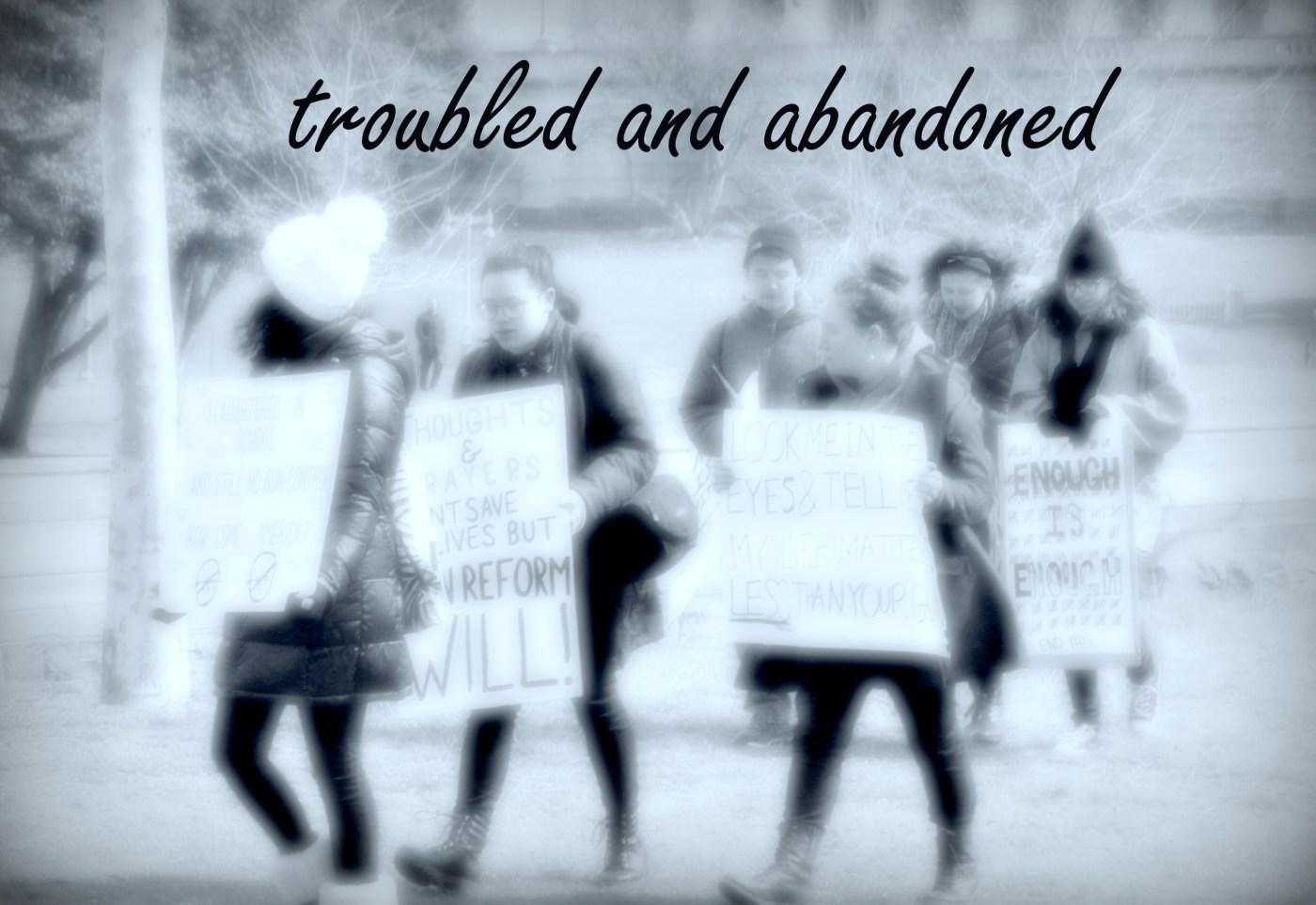
He heard this and said, “Those who are well do not need a physician, but the sick do. Go and learn the meaning of the words, ‘I desire mercy, not sacrifice.’ I did not come to call the righteous but sinners.” Jesus went around to all the towns and villages, teaching in their synagogues, proclaiming the gospel of the kingdom, and curing every disease and illness. At the sight of the crowds, his heart was moved with pity for them because they were troubled and abandoned, like sheep without a shepherd.
In our oblate group, we read, reflect, respond, and rest in sacred scripture. There is a synergy that results from sharing a word or phrase that resonates within, as well as the wisdom or insight each has received. I leave with a greater understanding of other perspectives and of how I am called to follow Christ.
Some reflections from our reading:
Courage, child, your sins are forgiven…Rise, pick up your stretcher, and go home. Jesus’ first instruction is to have courage and to know that sins are forgiven. Many aspects in our life require our courage—difficult conversations, facing our own limitations, expressing love, making or adapting to changes, dealing with physical or emotional suffering, feeling despair, and understanding our next steps in each season of life, to name a few. Life requires courage. Some questions we might consider in taking Jesus’ advice: What is our stretcher or our crutch? Where might we be trapped or paralyzed? We are not to harbor evil thoughts about others or ourselves, knowing that nothing can separate anyone from the love of God. Jesus asks us to rise—right where we are, no matter who we are, and go home. Our home is much more than a brick-and-mortar dwelling. Home is a place of peace, where we can be seen and heard, loved and believed, held and yet free. Home accepts all the parts of our self, our truest self.
Home is where you belong. It is your shelter and place of rest, the place where you can be yourself. –John O’ Donohue, Eternal Echoes: Celtic Reflections on Our Yearning to Belong
They were struck with awe and glorified God whohad given such authority to human beings. We are to become like Christ. We can rise up, go home, follow, listen, have our hearts moved, give mercy, have courage, doubt, choose, forgive and be forgiven, be filled with awe, mix and mingle with the “tax collectors and sinners” of our day (the poor, oppressed, and marginalized), and be compassionate. In a very short story, Jesus asks much and gives much. He is an example of who we can be to others. The crowds were struck with awe by what Jesus did. We, too, can stand in awe of the kindness of others, a spectacular sunrise, or a day of feeling healthy. In each day, there are countless ways to choose awe and gratitude, glorifying God in all.
I did not come to call the righteous but sinners. Accepting both the righteous and the sinner within ourselves is a sort of homecoming. Accepting with humility that we are not one or the other—saint or sinner—is the way to integration and accepting others. Jesus tells the crowd that he desires mercy. We can be merciful, too, slow to judge ourselves and others.
His heart was moved. This line resonated with me the most. Jesus, in his humanity, felt pity for the “troubled and abandoned.” Beyond our bodies, Jesus sees our inner wounds, our fears and anxieties, our feelings. He sees beyond the physical to our spiritual and emotional needs. This, too, we must ask—who might the troubled and abandoned be today? We can only know who they are by deep listening, extending hospitality, and having compassion as Jesus did. And then we must ask, how are we responding to them? With judgment or with a moved heart?
I realized this most profoundly when I was the one who felt unheard. Perhaps you, too, have had a moment like this when you felt no one was listening—a meaningful, traumatic, challenging, or gratifying experience that needed to be shared fell on deaf ears.
I have written about the Benedictine promises of obedience and the importance of listening to God and others as part of one’s spiritual growth. “Listening requires us to pause, to have silence, and to be open to seeing in a new way. Listening can lead to a shift in perspective, a flash of insight, a new understanding. When you listen closely to another, it is an expression of love,” I shared in a recent reflection.
It is just as crucial to examine the impact it has on others when we are forgetful about listening—understandably, we get busy, or miss clues that others need our ear. Indeed, there are times when others may not realize how important it is (these slights may be easily forgiven), but there may be other times when you or another is summarily dismissed. The message is loud and clear—either you or what you have to say is not valued. It feels hurtful, as if you don’t matter, as if you are insignificant. Being intentionally rejected for your thoughts, ideas, feelings, and experiences leaves a wound, a hole in one’s heart, a sense of being rejected or abandoned.
For me, the experience of not being heard came during a traumatic time for women who had been sexually harassed, abused, or assaulted. I felt my trauma, but also the suffering of so many beyond me. It was a profound compassion, sharing the wound. It came to me then, weeping, that this is what it might feel like for those who have spent their entire lives not feeling listened to, of all those who have been unheard throughout our history, from the enslaved, defeated, oppressed, and marginalized—those who have no one to listen to or validate their pain. They had a story in their heart that needed to be heard, then and now.
“Compassion asks us to go where it hurts, to enter places of pain, to share in brokenness, fear, confusion, and anguish. Compassion challenges us to cry out with those in misery, to mourn with those who are lonely, to weep with those in tears… Compassion means full immersion in the condition of being human.” –Donald McNeill, Douglas Morrison, and Henri Nouwen (quoted in Boundless Compassion by Joyce Rupp)
My heart felt broken—not just for me, but for the lack of compassion I may have shown others. Simultaneously wounded and regretful, a part of me died while something else was taking root—a desire to listen to those who feel unheard, to offer acceptance where there might not be, to advocate for those marginalized. I felt pierced entirely with compassion. Tears flow often now for the suffering that, perhaps, I had not noticed before, the pain that I may have caused others, and the pain that continues to go unnoticed or even flatly denied.
I created a SoulCollage® card shortly after this eye-opening, traumatic experience. Consider the image and the following questions.
“The eyes of the Lord are toward the righteous and his ears toward their cry”. -Psalm 34:15
Questions for reflection:
Do you have a story you would like to share with someone? Have you been able to share it with another or write about it? If so, how did it make you feel to be heard? Does it inspire you to listen to the pain and suffering of the world?
Can there be some healing for your wound by expressing it to God if there is no one to share it with? Are you available for others to share their story with you? What is the consequence for a loved one if their story isn’t shared? Is there a person or marginalized group of people that you may listen to more closely than you have?
May our prayers be heard for all those suffering, and for those who have shared their stories but not been heard. May we listen with “the ear of our hearts,” as Benedict instructs. May we be moved to tears. Amen.



 Being Benedictine