Search

Being Benedictine

Living SoulFully as an Oblate of St. Benedict

Tag

oblates

A Heart Expanded by The Unspeakable Sweetness of Love: World Oblate Congress 2023

The Benedictine spirit is characterized by “a heart expanded by the unspeakable sweetness of love.” Pope Francis addressed the 5th World Congress of Benedictine Oblates in a private audience on September 15, 2023, as reported by Vatican News. The Congress theme, “Moving forward: Living the Wisdom of the Rule,” is an opportunity for Oblates, lay associates of a Benedictine monastery, to learn about their calling as monks in the world.

I participated in the 2017 Congress in Rome, attending the General Audience of Pope Francis at St. Peter’s Square. I reflected, “We were delighted to be seated on the platform, very near where the Holy Father was also seated. His message on the Eucharist was followed with a welcome for visiting groups with a special mention of Benedictine Oblates. For many oblates, this was one of the most magical moments of the week.” Indeed, it was very special.

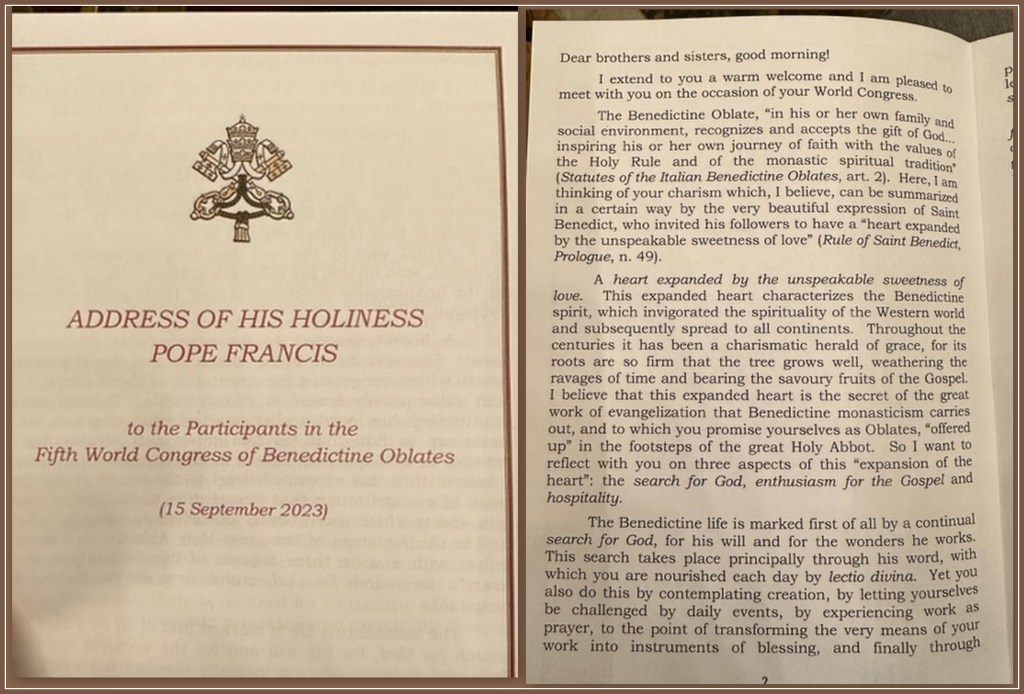
But I can only imagine that a private audience with Pope Francis has left oblates still pinching themselves. Jaime Williams, Oblate from Christ the King Priory where I also belong, shared he cannot find the words to describe the experience (although he has promised a guest post when the words begin to flow.) Jaime shared photos of the program with the words of Pope Francis’ message, of which I will comment.
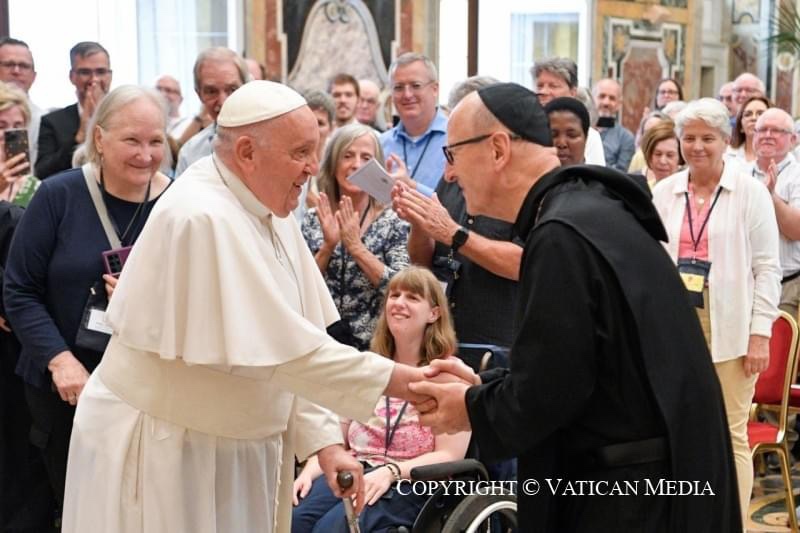
Jaime Williams, Oblate of Christ the King Priory, Schuyler NE, in the background (blue shirt) as Pope Francis greets Abbot Primate Gregory Polan.

The Holy Father spoke to three aspects of this “expansion of heart”: the search for God, enthusiasm for the Gospel, and hospitality. “The Benedictine life is marked first of all by a continual search for God, for His will and for the wonders He works,” the Pope said. He emphasized the importance of practicing contemplation with the practice of Lectio Divina, as well as contemplation of creation, the challenges of daily life, the experience of work as prayer, and especially through other people.
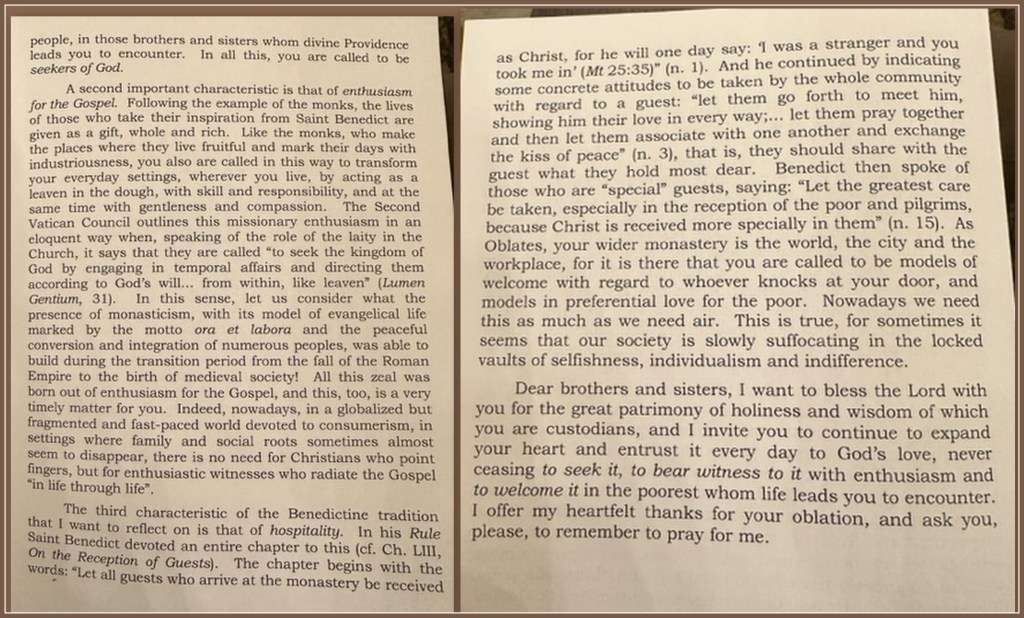
Like the monks,” he said, “who make the places where they live fruitful and mark their days with industriousness, you also are called in this way to transform your everyday settings, wherever you live, by acting as a leaven in the dough, with skill and responsibility, and at the same time with gentleness and compassion.”

Finally, Pope Francis reflected on the characteristic of “hospitality,” noting that Benedict instructed monks to receive guests at the monastery as they would receive Jesus Himself. As Oblates our “wider monastery is the world, the city, and the workplace, for it is there that you are called to be models of welcome with regard to whoever knocks at your door, and models in preferential love for the poor.”
Pope Francis captures what being Benedictine means to me. It is not about interpreting the literal words in the gospel, but how I take its timeless message into my daily life—in my work, family, relationships, community, environment, and more. The words of Franciscan monk, Richard Rohr, resonate with me, “I’m convinced that one of the only reasons Roman Catholicism has lasted is because we have these satellites of freedom on the edge of the inside—religious communities of Benedictines, Jesuits, Dominicans, Franciscans, Sisters of Charity, Sisters of Mercy, and many more.” It is the connection with my favorite monks, our monastery, and Benedictine spirituality, a 1600-year-old tradition, that has sustained my search for God, my desire to learn from the ancient texts and rituals, and to practice hospitality as a monk in the world.

Read more about the 2017 World Congress: The Future Is The Spirit’s Work
Jaime William’s 2023 World Congress reflections.

© Jodi Blazek Gehr, Being Benedictine Blogger

Praying the Psalms ~ Psalm 22

April 2017 Oblate Reflections and Lectio Divina

Topic: Praying the Psalms

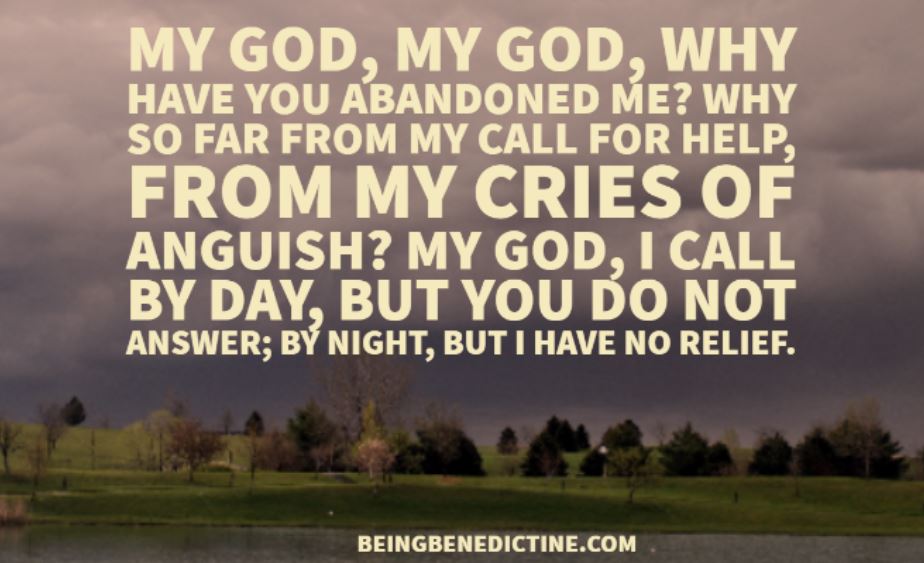
We can read the Psalms with three layers in mind: what the Psalm meant the first time it was prayed in history; how the Psalm hints at the life of Christ in the New Testament and how Jesus would have prayed it; and, finally, how it applies to our own lives and  how we can pray the Psalms now. We pray Psalms 22: 1-32.

my god why have you forsaken me

In practicing Lectio Divina, after reading the Scripture out loud, we contemplate, consider and reflect on what we have heard. The Scripture is read again. After some time of silence, we are welcomed to share a word or phrase that speaks to us.

All night long I call and cannot rest, my soul will live for you.      They never trusted you in vain.     Do not stand aside trouble is near.       They trusted and you rescued them.     If God is your friend let God rescue you.        Rescue my soul from the sword.           More worm than human.        My heart is like wax melting inside me.  

One participant said the images of wild beasts in the desert environment was overwhelming—she had no words.  We rest in silence, some speak, a few sniffles, a sigh. The verses and words in this Psalm touch each of us in a unique way.

What resonates with you from reading Psalms 22?  This is what resonated with us:

So many feelings are expressed in this Psalm—complaint, fear, desperation, anguish, hopelessness. We tend to think that we should feel in a certain way, that trust is the superior action or emotion, but it is human to feel all of the desperate feelings mentioned. We can accept all of our emotions because God lets us feel all of those things and desires that we express them. Continue reading “Praying the Psalms ~ Psalm 22”

Prayer during Lent (and other times too)

March 2017 Oblate Reflections and Lectio Divina

Topics: Lent for Benedictines; Ways to Pray

Source for discussion: Study Guide for the Rule of St. Benedict with Reflections for Oblates and All Who Seek God, Maria-Thomas Beil, OSB
Readings in the Rule of Saint Benedict: RB 48:14-15 THE DAILY MANUAL LABOR, RB 49:1-10   THE OBSERVANCE OF LENT

St. Benedict states that the life of a monk ought to be a continuous Lent  (RB:49). St. Benedict in his wisdom knew few would have the strength for this, so he has other suggestions. Fr. Volker Futter, Oblate Director, shared two important ideas:

  1. Lent is self-offering, not denial, it comes from the heart.
  2. We need to acknowledge  the presence of God then we can do sacrifice.  Sacrifice can be giving up something specific like food, TV or internet, or we can give a positive sacrifice.

Oblates shared that “giving of your time is priceless—you can’t get it back”.  So a short visit to the nursing home, or a visit to a neighbor or sending someone a long overdue card—that is your gift of time. “This may sound simple, but one of the hardest things for me to do is find that priceless gift of time for others.  It really is a sacrifice.”

A definition of compunction of heart was requested.  Compunction of heart is when we have an uneasiness or anxiety of the conscience because of something we may have done that may have caused worry, fear, etc. in someone’s heart.  When we give this up we receive more in return. Continue reading “Prayer during Lent (and other times too)”

Blog at WordPress.com.

Up ↑