Meeting the Pope is a big deal. Recently I wrote about the 5th World Congress of Benedictine Oblates and the private audience that Oblates had with Pope Francis. Jaime Williams, an Oblate of Christ the King Priory, was in the private audience and was profoundly impacted. I asked him to share his experience and he graciously accepted.
A “Being Benedictine” Reflection by Jaime Williams:
Two plus weeks after the most extraordinary handshake in my life, I still struggle to comprehend how my journey from an inauspicious upbringing in small-town Iowa led to meeting Pope Francis and visiting the two most important holy sites associated with our beloved St. Benedict and St. Scholastica in Italy – nearly 30 years after graduating high school and leaving home. After spending a significant portion of my career traveling extensively through parts of the developing world, I don’t consider my childhood to be been one rooted in poverty, but certainly, my parents had to work hard to make ends meet and there was no shortage of stress present throughout my childhood. I generally consider the Christian formation I received while growing up to be relatively poor, and our participation in church of any kind was sporadic and inconsistent: we were members of Presbyterian, Nazarene, and Methodist congregations at various times during my youth, and moved constantly between northeast Iowa, and east and west coast towns in Florida, before finally settling in southern Iowa where I spent most of my high school years. It is no surprise to me that of our Oblate promises Stability is what I cherish most from my family and Oblate community!
The image and story behind the Chipko movement inspired us to do some of our own tree-hugging! The Chipko movement of the 1970s (chipko meaning ‘to cling to or hug ‘ in Hindi) led to tree-hugging movements throughout the Himalayan regions, forcing reforms and moratoriums in the forestry industry that saved thousands of trees. The peasant women of the Garhwal Hills of India, pictured below, literally threw their arms around trees to save them (Ecologically Conscious.) Their actions were inspired by events of 1730 when soldiers were ordered to fell trees in the Bishnois villages of India to build a palace. 294 men and 69 women, belonging to a branch of Hinduism, were massacred while they desperately clung to their trees. Eventually, their action led to a royal decree that prohibited the cutting down of trees, and their forests flourish today.
Across the centuries and throughout the world, the existence of trees has been threatened in the name of progress, to pad the pockets of the greedy, or, sadly, out of sheer ignorance, yet the original tree huggers continue to influence environmentalist efforts. Those Indigenous to the land see clearly that their existence is connected to the survival of trees. We can follow in their footsteps by recognizing our connection with and responsibility to the earth, which is so in need of our aid.
We have spent a few autumn weekends through the years at our friend Joyce’s family farm in the sandhills of Nebraska, near Loup City, but this year, on the heels of reading Braiding Sweetgrass: Indigenous Wisdom, Scientific Knowlege, and the Teachings of Plants, we feel a longing to connect to the land that Joyce’s great grandparents had homesteaded, to return to the home her mother grew up in, to hear their stories, and to remember and honor the Indigenous who lived with the land, in humility, gratitude, and reciprocity.
Joyce extended the invitation to the weekend with these words: “We will walk upon the land in honor of those who have walked the land before us and in sacredness to our Mother Earth and all she has provided to us. For a weekend, we will become ‘Indigenous to place’”.
What does it mean to become Indigenous to a place? Robin Wall Kimmerer, a scientist, professor, citizen of the Potawatomi Nation, and author of Braiding Sweetgrass describes it as “living as if your children’s future mattered, to take care of the land as if our lives, both material and spiritual, depended on it…To become indigenous is to grow the circle of healing to include all of Creation.” This weighs heavily on our minds and in our spirits as we create a weekend getaway to honor our connection with each other and all of Creation.
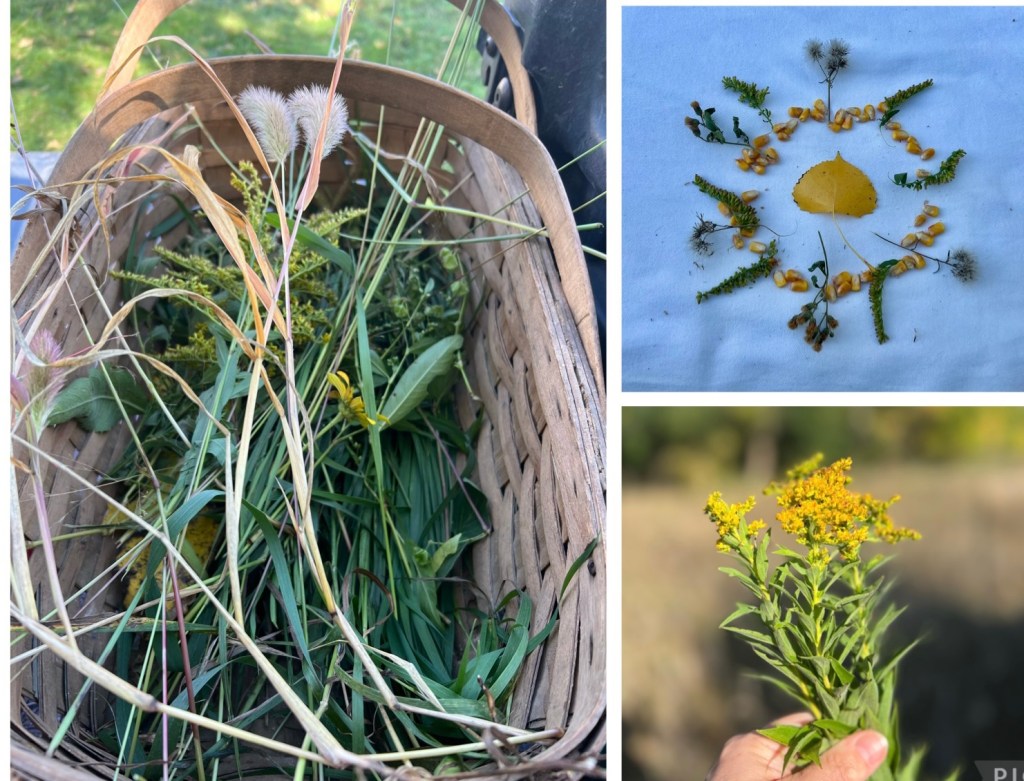
Our weekend was a medley of adventure, gratitude, creativity, good conversation, and play. We took the Gator out into the pasture and hills, enjoyed incredible vistas, laughed a lot while swinging from an old oak tree, and, afterward, thanked it with a big group hug. We searched for sweetgrass, gathered nature artifacts, created nature mandalas, and discussed Braiding Sweetgrass—reading segments of it out loud and discussing its impact on our lives and on our world.
Being silly before breakfast, we played with morning shadows, losing all sense of time. On a tractor-pulled hayrack, we rode up the hill and into the pasture to play—blowing bubbles, flying kites, and watching the sunset and the rise of the Full Harvest Moon. We danced in the moonlight to moon songs (think Fly Me to the Moon and Blue Moon), gazed at the stars, shared stories, reflected on the past, and imagined the future. How blessed we are to enjoy time in nature, on land that is loved and shared so generously.
We are here as part of creation, not as consumers of it.
-Joan Chittister
“If the universe unfolds in God, who fills it completely… there is a mystical meaning to be found in a leaf, in a mountain trail, in a dewdrop, in a poor person’s face. The world sings of an infinite Love: how can we fail to care for it?” Pope Francis addresses our responsibility to care for our common home in his newest exhortation, Laudete Deum, an urgent follow-up message to Laudato Si (Papal Encyclical, “Care for Our Common Home”, 2015).
Our weekend is filled with gratitude for the “infinite Love” displayed in the rolling hills, big oak trees, waving seas of tall grass, and the yet-to-be-harvested corn. Indeed, how can we fail to care for it? We hear the warnings of climate change and reports of how much damage has already been done, the hundreds of years needed to reverse course IF we were to make necessary changes now. Both Braiding Sweetgrass and Laudete Deum, brilliantly researched and exquisitely written, are cries for help on behalf of Mother Earth, who is speaking to us in ways we refuse to hear. I encourage you to read these powerful texts contemplatively, in the spirit of Lectio Divina, and to consider our responsibilities, what Kimmerer refers to as our “moral covenant of reciprocity.”
“The moral covenant of reciprocity calls us to honor our responsibilities for all we have been given, for all that we have taken… Whatever our gift, we are called to give it and to dance for the renewal of the world. In return for the privilege of breath.”
–Braiding Sweetgrass: Indegenous Wisdom, Scientific Knowledge and the Teachings of Plants
In Braiding Sweetgrass, Kimmerer refers to the changing roles of women as they “spiral through the phases of life, like the changing phase of the moon.” As we grow older, we have an opportunity to widen our circle of care, to “walk the Way of the Teacher, becoming models for younger women to follow…The spiral widens, farther and farther, so that the sphere of a wise woman is beyond herself, beyond her family, beyond the human community, embracing the planet, mothering the earth.”
As Pope Francis writes, “Everything is connected, and no one is saved alone.” (LD, 19) We share this earth with everyone on it, with those who came before us and those who will follow. What kind of world, and appreciation for it, do we hope to leave behind for future generations? We must remain hopeful that there will be a world to leave behind, but we must also do something to ensure it.
Pray in whatever ways and words work for you–whether you are holding space, sending positive energy, visualizing hope and peace overflowing, creating a collage, writing your own thoughts, or reciting the words of the prayer Pope Francis has intended for the consecration of Russia and Ukraine to the Immaculate Heart of Mary (shown below.)
JUST PRAY.
There are no requirements to understand every word of the prayer, to be Catholic, or to believe in Mary’s Immaculate Heart, in order to grow in compassion and unite our intentions with others who pray, hold space, and send good energy. As I read (and prayed) Pope Francis’ prayer, I created bullet-prayers (not sure if that’s a thing, but it is for me now)–one-sentence intentions that I can offer up when I think of those suffering in Ukraine.
Turn our hearts towards love and peace. 🌻 May we hold space for those suffering.
Make visible our compassion. 🌻 May we remember what causes pain for others.
May we hold in our hearts the children, the hungry, the homeless, the fleeing, the mother, the father, the child, the beloved pet, the defenders, the truth-tellers, the fighters, the comforters. 🌻
May we ravage the earth with love. 🌻 Help me to think of others.
May we be, and follow, models of love and peace. 🌻 Help us remember that darkness can be overcome.
Untie the knots of our hearts. 🌻 Help us to forgive.
Water the dryness of our hearts. 🌻 Fill our hearts with peace. 🌻 Help us to pray.
O Mary, Mother of God and our Mother, in this time of trial we turn to you. As our Mother, you love us and know us: no concern of our hearts is hidden from you. Mother of mercy, how often we have experienced your watchful care and your peaceful presence! You never cease to guide us to Jesus, the Prince of Peace.
Listen with the ear of your heart to Pope Francis’ message to the world. Practice Lectio Divina, contemplating the words and/or images that speak to your soul. Full text and video available at the end of this post.
What are you called to learn during this “unexpected, turbulent storm?” Share your insights in the comment section.
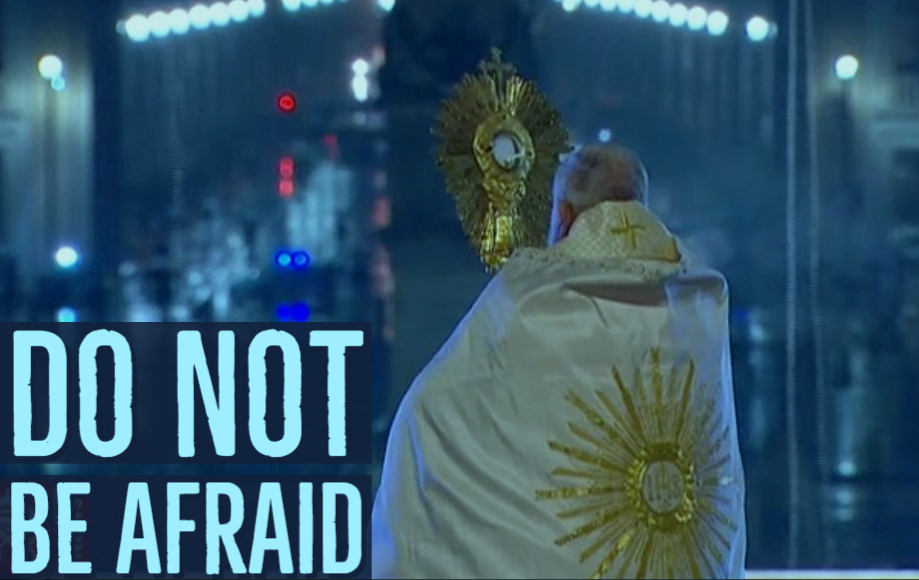
“Like the disciples in the Gospel (Mark 4: 35-41) we were caught off guard by an unexpected, turbulent storm. We have realized that we are on the same boat, all of us fragile and disoriented, but at the same time important and needed, all of us called to row together, each of us in need of comforting the other.
On this boat… are all of us. Just like those disciples, who spoke anxiously with one voice, saying “We are perishing” (v. 38), so we too have realized that we cannot go on thinking of ourselves, but only together can we do this.”
The storm exposes our vulnerability and uncovers those false and superfluous certainties around which we have constructed our daily schedules, our projects, our habits and priorities. It shows us how we have allowed to become dull and feeble the very things that nourish, sustain and strengthen our lives and our communities.
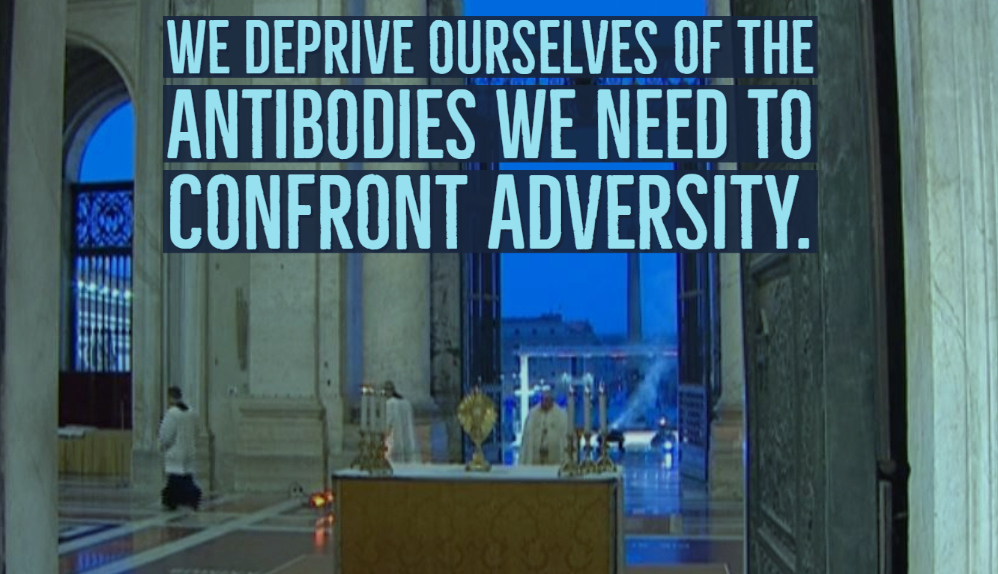
The tempest lays bare all our prepackaged ideas and forgetfulness of what nourishes our people’s souls; all those attempts that anesthetize us with ways of thinking and acting that supposedly “save” us, but instead prove incapable of putting us in touch with our roots and keeping alive the memory of those who have gone before us. We deprive ourselves of the antibodies we need to confront adversity. Continue reading “Urbi et Orbi: A Blessing for the World”→
I am one who believes in the Divine birthing of our planet and the life-force that is poured out for us by our mere existence in this dynamic, evolving, growing, breathing earth home.
I am one who exists as part of this environment, receiving the mysterious flow of energy and outpouring of nourishment with open hands. I bow my head at the splendor of shades and shapes, the rebirth of nature through the sacred spirals of the seasons, the purpose and patterns that are sometimes evident and always sought after. The waters of life flow through us—cleansing, renewing, blessing us with existence. Nature gives to us without hesitation.
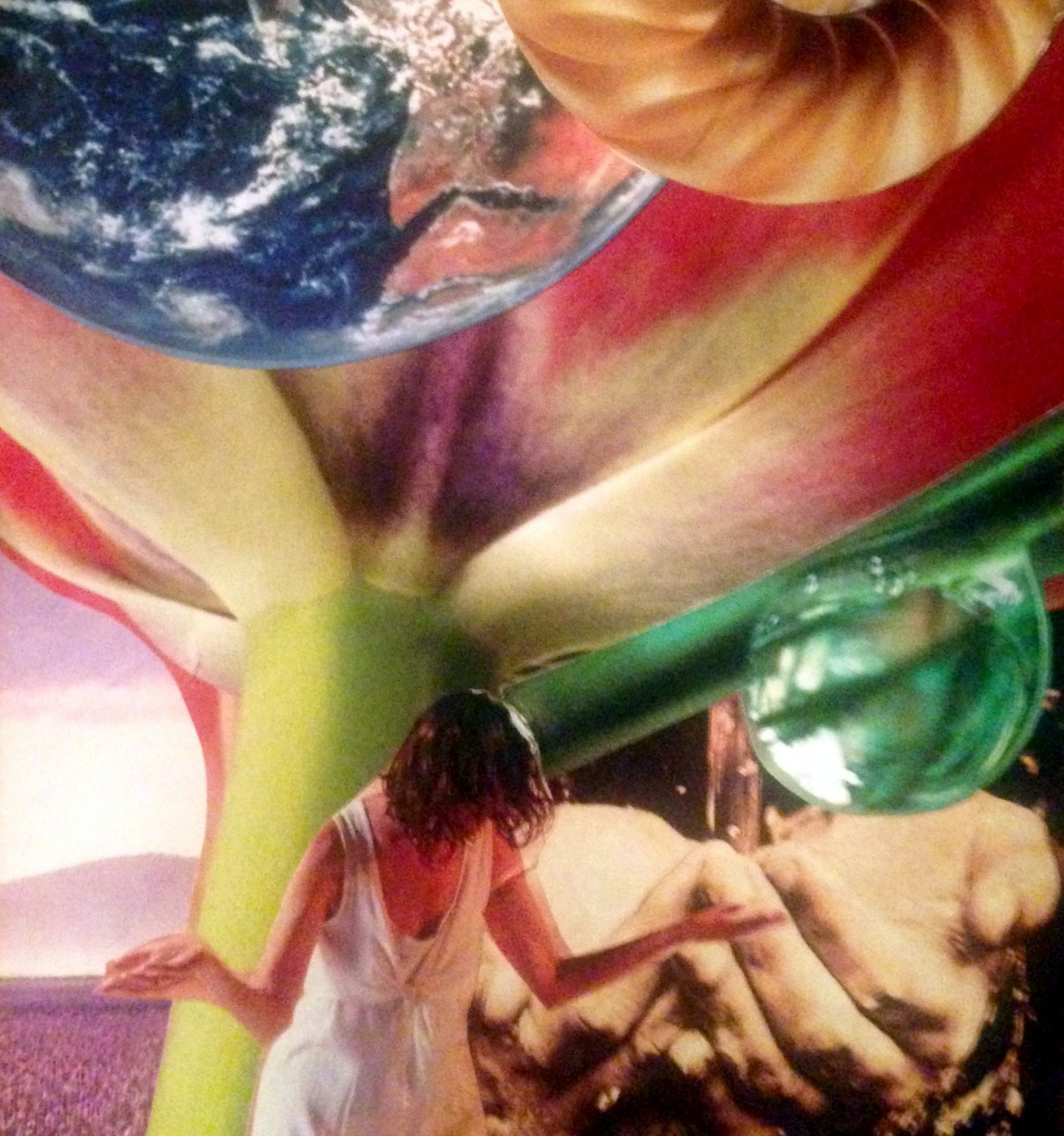
Consider creating a collage for Earth Day that represents your feelings toward our environment or your feelings about how humans interact with the environment. Be creative!! Show your love, anger, doubt, concerns, joys, gratitude—let your spirit moves you. Make it your Earth Day prayer.
Celebrating the 125th Jubilee of the Benedictine Confederation, Pope Francis addressed Abbot Primate Gregory Polan, Fr. Prior Mauritius Wilde and other Benedictines, expressing his gratitude “for the important contribution that the Benedictines have made to the life of the Church, in every part of the world, for almost fifteen hundred years.”
Sant’ Anselmo, the seat of the Benedictine Confederation, is the home of the Abbot Primate and eighty monks from over thirty countries around the world. It was a thrill for me to visit Fr. Mauritius Wilde, Prior of Sant’ Anselmo, for a tour of the academic center, prayers with the monks, and a formal address for the Fourth International Oblate Congress. It was Pope Leo XIII, Fr. Mauritius shared, who said, “You Benedictines need a place in Rome. He saw two things: he certainly saw it was difficult for him to control us Benedictines, so he wanted to have a representative in Rome and he created the office of the Abbott Primate, the highest representative of all Benedictines.”
On April 18, 1893, the first stone of Sant’Anselmo was laid on the Aventine Hill. “In this celebration of the Jubilee of the Benedictine Confederation we wish to recall the commitment of Pope Leo XIII, who in 1893 wanted to unite all the Benedictines by founding a common house of study and prayer, here in Rome”, Pope Francis said. On July 12, 1893, Pope Leo XIII officially established the Benedictine Confederation. Continue reading “125 Years: A Big Day for Benedictines!”→
Hearing from speakers, having small group discussions, sharing meals and worshipping in daily prayers and Mass were on the agenda for 5 out of the 6 days of the conference. The exception, Wednesday, November 8, was a special day for the participants of the 4th World Congress of Benedictine Oblates.
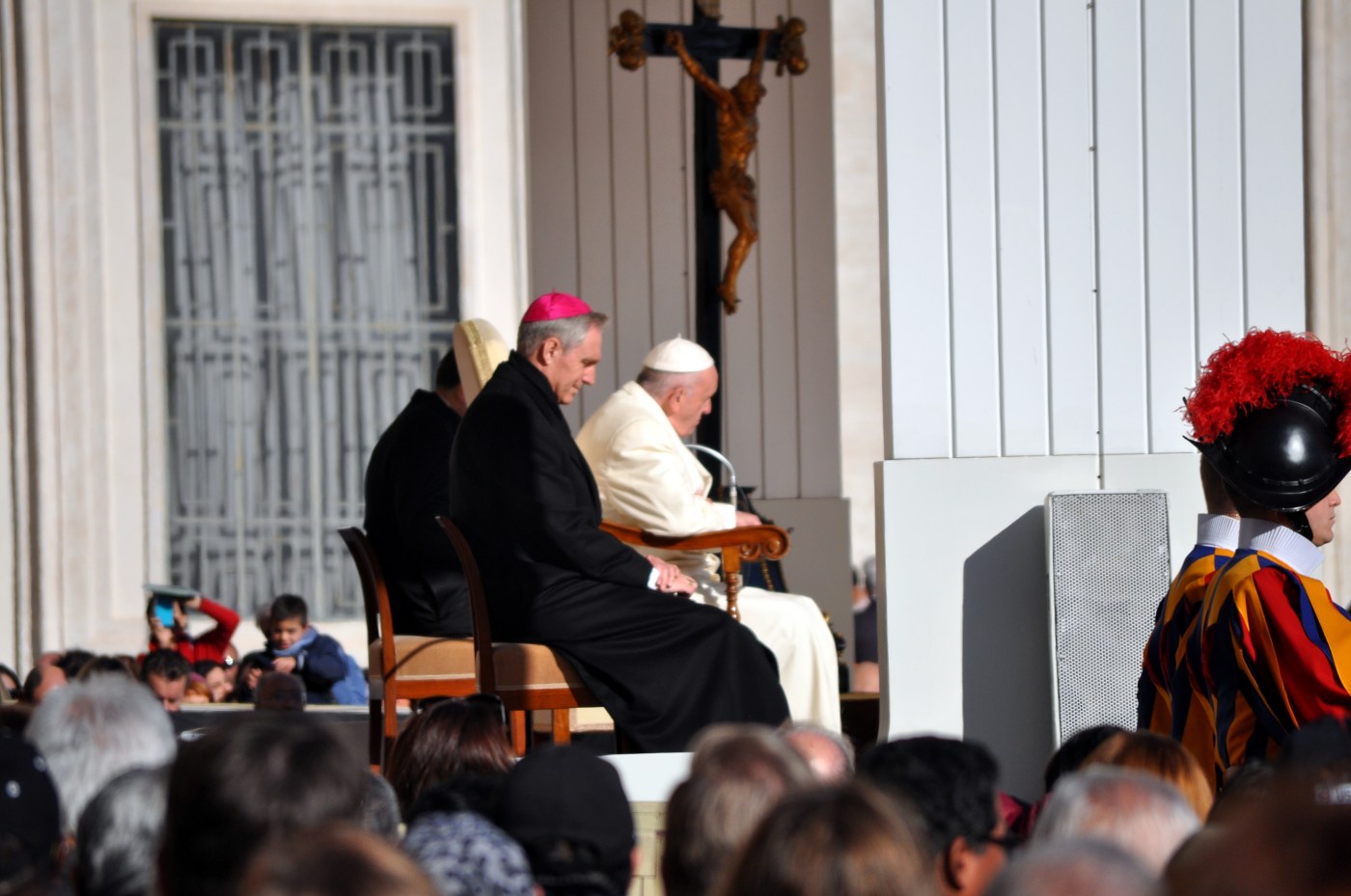
Our morning started with attending the General Audience of Pope Francis at St. Peter’s Square. We were delighted to be seated on the platform, very near where the Holy Father was also seated. His message on the Eucharist was followed with a welcome for visiting groups with a special mention of Benedictine Oblates. For many oblates, this was one of the most magical moments of the week. Continue reading “Pilgrimage Day for the World Congress of Benedictine Oblates, Part 4”→
I’ve been thinking about the decision to give (or not to give) to a beggar on the street since Pope Francis suggested that giving “is always right,” whether one thinks the other is truly in need or not. A few evenings ago, as I was leaving a movie theater, having spent a lovely evening with friends, there was a homeless man with a sign asking for donations. Engaged in conversation, I quickly walked by him. I was unsure if I had any cash on me at the time, but as I reflected on my thoughts and actions, I realized that I did not (or could not) look the man in the eye, and I wondered why. If I had money with me, would I have given it to him? Would I have looked him in the eye then? I felt a sense of shame–some for not giving him money, but more so that I hadn’t looked at him directly. Looking someone in the eye honors their dignity–it acknowledges WHO THEY ARE.
I just started my 41st semester of teaching. I love the “beginning again” that comes with the teaching profession. Two of my favorite things about teaching are discovering new ways to share the love of learning with students and the chance to start the next semester with a clean slate. Fresh ideas, new teaching strategies, another opportunity to grow, learn and improve—and hoping a little of that rubs off on my students. I want to make a difference and help students learn. Continue reading “Always, we begin again.”→





 On this boat… are all of us. Just like those disciples, who spoke anxiously with one voice, saying “We are perishing” (v. 38), so we too have realized that we cannot go on thinking of ourselves, but only together can we do this.”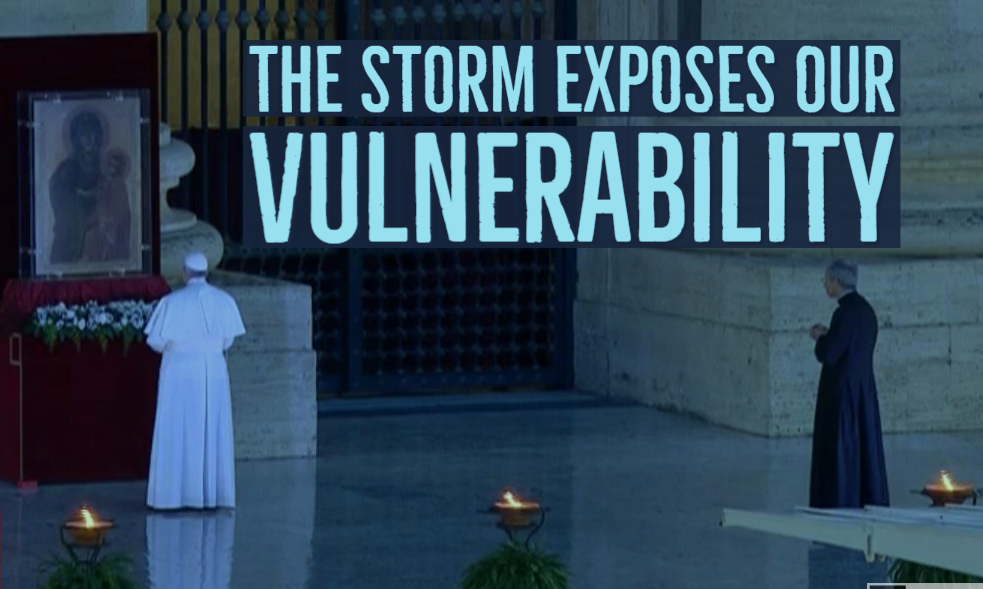





 Being Benedictine