Search

Being Benedictine

Living SoulFully as an Oblate of St. Benedict

Tag

St. Benedict

The Soul of a Pilgrim: A Benedictine Pilgrimage, Part 1

“A pilgrimage is an intentional journey into the experience of unknowing and discomfort for the sake of stripping away preconceived expectations. We grow closer to God beyond our own imagination and ideas.” The Soul of a Pilgrim: Eight Practices for the Journey Within, Christine Valters Paintner

Recently my Spirit Circle chose to read Christine Valters Paintner’s “The Soul of a Pilgrim”, a book that explores pilgrimage as both an inner and outer journey. Several of us were preparing for “Footsteps of St. Benedict and St. Scholastica,” a Benedictine pilgrimage to Germany, Austria, and Switzerland sponsored by the Benedictine Oblates of Christ the King Priory.

9781933495873_p0_v1_s550x406

By definition, a pilgrimage is a sacred journey or holy expedition, but we do not need to travel a great distance to go on pilgrimage. It is more about choosing to be “attentive to the divine at work in our lives through deep listening, patience, opening ourselves to the gifts that arise in the midst of discomfort, and going out to our own inner wild edges to explore new frontiers.”

The purpose of going on a journey “is always to return home carrying the new insight back to everyday life,Paintner writes. “When we take inward and outward journeys, we can be pilgrims as long as we stay open to new experiences.”  A week of hard work, becoming a new parent, losing a loved one, resolving a relationship conflict, or going on a spiritual retreat can all be a pilgrimage if one seeks to learn, reflect and be transformed from the experience.

These insights from the first few chapters and the book “The Soul of a Pilgrim” travel with me on my two-part pilgrimage. First, I visit cousins in Germany and then I join thirty-six other pilgrims to learn more about St. Benedict and to visit sacred sites including churches, monasteries, abbeys, castles, small villages, and large cities.

Three weeks, three days I will be gone. As I journey from Nebraska to Europe, I reflect on both my outer and inner experiences—the people, places, feelings and insights that I encounter on the journey. Continue reading “The Soul of a Pilgrim: A Benedictine Pilgrimage, Part 1”

Be Yourself! The Call of a Christian

Evangelization used to be a scary word to me. I thought it meant that I must convince another of what to believe in or, on the other hand, that I, held captive, would be the recipient of a sales pitch about another’s faith. Both situations make me extremely uncomfortable.

I have come to feel differently about this intimidating word, “evangelization”, through the insight of Fr. Mauritius Wilde, OSBshared in spiritual direction and guided retreats on the topic.  He captures those thoughts in his newest book, Be Yourself! The Call of a Christian. He writes, “Faith is about what I believe, who I am in my innermost heart…It isn’t good to constantly hold back what is in our hearts. If your heart is full, let it overflow!” What evangelization really means is “to get the word out…to share your joy.”  Continue reading “Be Yourself! The Call of a Christian”

Trust: Justice Breaks Forth Like the Light

Deep prayer, or contemplation, requires a commitment. Prayer can happen anytime, anywhere, in an instant, but deep prayer requires attention and intention to create pockets of silence in our day to listen to what the Divine is revealing. God speaks always and in diverse ways, but it is our own awareness that must be cultivated.

presence of god

The practice of Lectio and Visio Divina, sacred reading and seeing, is a prayer practice that helps me slow down, to be quiet, to become aware and to listen. The value of Lectio Divina is that our understanding of Scripture or other spiritual writing is influenced by what is happening in our life. The richness of what we read can breathe new life into us and bring new thoughts for us to consider again and again. Continue reading “Trust: Justice Breaks Forth Like the Light”

I Don’t Know Nothin’

I don’t know nothin’.

Eight years ago today, my father-in-law Marv passed away—so today, more than usual, I am thinking of him and missing our kitchen table conversations. We would talk about politics and religion, the economy and education, and the best brands of Cabernet for the cheapest prices. After sharing his wisdom, attempting to solve world problems, and philosophizing over a glass of wine, Marv would throw up his hands in disbelief and exclaim, “What do I know? I don’t know nothin’.”

131207_10200564020853354_135052895_o
Marv and I enjoying some cheap Cabernet in Las Vegas.

He had thoughts, opinions and plenty of experience, but, self-admittedly, he felt he still didn’t know much. Marv said it often enough that it was the opening line in the eulogy my husband gave for his dad’s funeral. This phrase, “I don’t know nothin’” holds so much meaning, far beyond a simple or flippant segue into another subject, rather I believe he was saying “I have ideas, but I will stay open to other possibilities.”

I’m sure there was a time or two when he knew exactly how things should be, but they didn’t turn out the way he expected, as so often happens. Perhaps he meant—I surrender needing to know. Perhaps he meant—I don’t know it all. I don’t know the big picture. I don’t have all the answers. I thought I knew a lot, but now, I wonder if I know much at all. I am humbled by what I do not know. Continue reading “I Don’t Know Nothin’”

St. Scholastica: A Woman of Great Love

“From the little known of Scholastica, it is clear that she was a strong woman who was deeply devoted to her religious life. She is celebrated by Benedictine women’s religious communities around the world as a woman who could “do more because she loved more” (Gregory the Great). She was a witness to the truth that love bears all things, believes all things, hopes all things, endures all things. Love never fails (1 Cor. 13:7-8).”-Benedictine Sisters of Erie

In celebration of St. Scholastica’s Feast Day, February 10, I share an edited previous post about St. Scholastica, St. Benedict and the value of spiritual friendships.

I received the gift of the Holy Spirit when I was nine years old. It took many months of catechism class to prepare to receive the sacrament of Holy Confirmation in the Catholic Church. There were dozens of questions about doctrine and faith to study, like:

What is a sacrament?  A sacrament is an outward sign made by Christ to give grace.
What is grace? Grace is any gift from God.
How many persons are there in God? There are three Persons in God. Continue reading “St. Scholastica: A Woman of Great Love”

In Praise of Words and Less Words

Sometimes I just don’t know when to shut up. Words, words, and more words.

I love words—to write them and to read them. I have been considering how I use words after reading The Power of Words by Joe Kay at Living Gracefully. It ­shined a light on the word wars often waged in my head, in conversation, in writing—either on social media or my personal journaling.

In some ways, I give words too much power. I think if I keep talking I might find just the right words to communicate my point better. Maybe my words weren’t effective, or they weren’t heard the way I intended, or my words were rejected—so I try again with more words, thinking “this time” I will be understood or be able to help another understand. Maybe “this time” we will come to an agreement or reach a hoped-for reconciliation.

But words do have power, Kay writes “Martin Luther King, Jr., understood the power of words. He spoke so beautifully and prophetically about his dream of a world in which everyone is treated as an equally beloved child of God.

mlk

Words have the power to inspire us, touch us, and transform us for better or worse, depending upon which words we choose to allow inside of us. They can bring us more peace, love and justice, or they can increase our levels of division, fear and hatred. In the last few months, we’ve been reminded how easy it is to get sucked into the pool of hateful words. Continue reading “In Praise of Words and Less Words”

Begin Again: New and Improved!

The most used words in marketing campaigns and on product packaging are new and improved. This expression taps into our deepest desires to improve our lives and our circumstances. Marketers know this—that most of us want better and that we want to BE better, to be more of this or less of that—and so come the advertisements for weight loss, exercise facilities, home improvement, travel and more. Of course, the superficial and material never satisfy and leave us still wanting more, or less.

The essence of making New Year’s resolutions—everything from setting financial, career and relationship goals to considering new ways of being and doing—is that we desperately seek the chance to “do over.” It might sound elementary, and even impossible, but we long for it anyway.

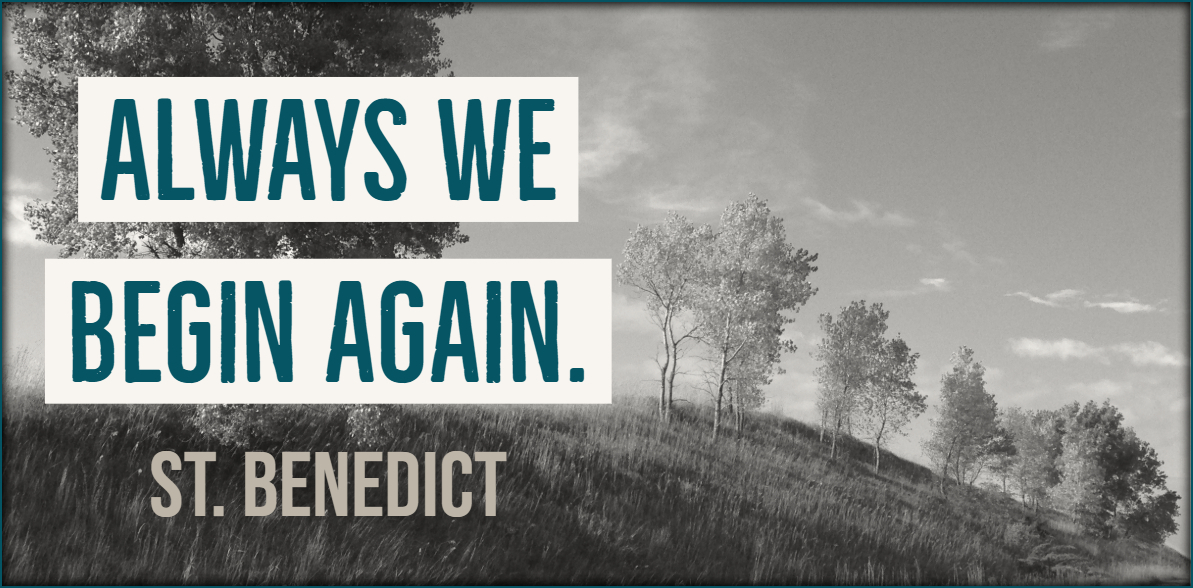
Celebrating the beginning of a new year is a reminder of our opportunity to “always begin again”—the embodiment of Being Benedictine. It’s not as simple as a “do over” but January 1, merely just one day that follows December 31, gives us a definitive time and space to honor our deepest longing to begin again.

always begin again

I’ve long since quit making resolutions. Well, not really—I make them and break them so quickly and consistently, that I’ve chosen to look at them more gently, as beginning again. Each year I select a word that will help guide me in the New Year. Continue reading “Begin Again: New and Improved!”

Sobriety: The Nature of our Need

Fr. Mauritius Wilde, Prior of Sant’ Anselmo in Rome, has a new podcast series on the Benedictine understanding of sobriety.

Can you get caught up in the swirl and chaos of fear, violence, and anger assaulting our world today? Practicing soberness means being detached from emotions, both overly negative or positive feelings. It is not good to be “drunk” on either extreme.

Soberness is taking just what we need. What do I take with me? What do I take in? What do I consume? How much wine, money, noise, whatever? Is it too much? The journey of soberness is to become more aware of whether there was too much.

But soberness is more than an absence of something—there is its own positive quality. The absence of the noise of tv is more than just turning off the tv. We begin to discover how beautiful silence is. Once you taste it, you want to have more of it.

Capture


Flood the World with Love

Weekend mornings are made for slowing down—for sipping coffee crowned in frothy milk, catching up on reading, and listening to some of my favorite music. This morning my meditation consisted of listening countless times to “I Heard an Owl” by Carrie Newcomer, much-loved folk singer and spiritual teacher, and accidentally reading 1 Corinthians 13:4-6.

Both song and scripture are a meditation of love, peace and courage—and a good reminder of how to be a living light in the world. As the antidote to confusion, fear, hatred, and darkness, we must flood the world with love. Continue reading “Flood the World with Love”

Blog at WordPress.com.

Up ↑