Search

Being Benedictine

Living SoulFully as an Oblate of St. Benedict

Tag

wonder

Light and Shadow: Atoms of Delight

A Contemplative Day

A contemplative day
morning to dusk, I return to the window.
Heavenly light casting shadows,
I center my heart’s attention on the one thing
Tree in eternal standstill.
Earth spinning on its axis, in and out of daylight
Subtle changes, shifting shadows.
The one thing is still the one thing.
Cloaked with leaves from green to golden yellow or in winter, naked
The tree is still the tree.
Light and dark, a blanket of snow and shadow branches.
Insights shifting with the shadow.
Perspective is everything.
Shadow deepens, lengthens, lightens, disappears.
For shadow, for me, the Source of Light is essential.
The only lasting truth is change.

(written by me! © Jodi Blazek Gehr)

“Wonders are the signpost to the Wonderful. Wonders will not cease while time keeps unfolding. Time left ahead assures us of wonder’s returning.” –excerpt from Ceaseless Wonders, Ana Lisa de Jong, Living Tree Poetry, February 2025

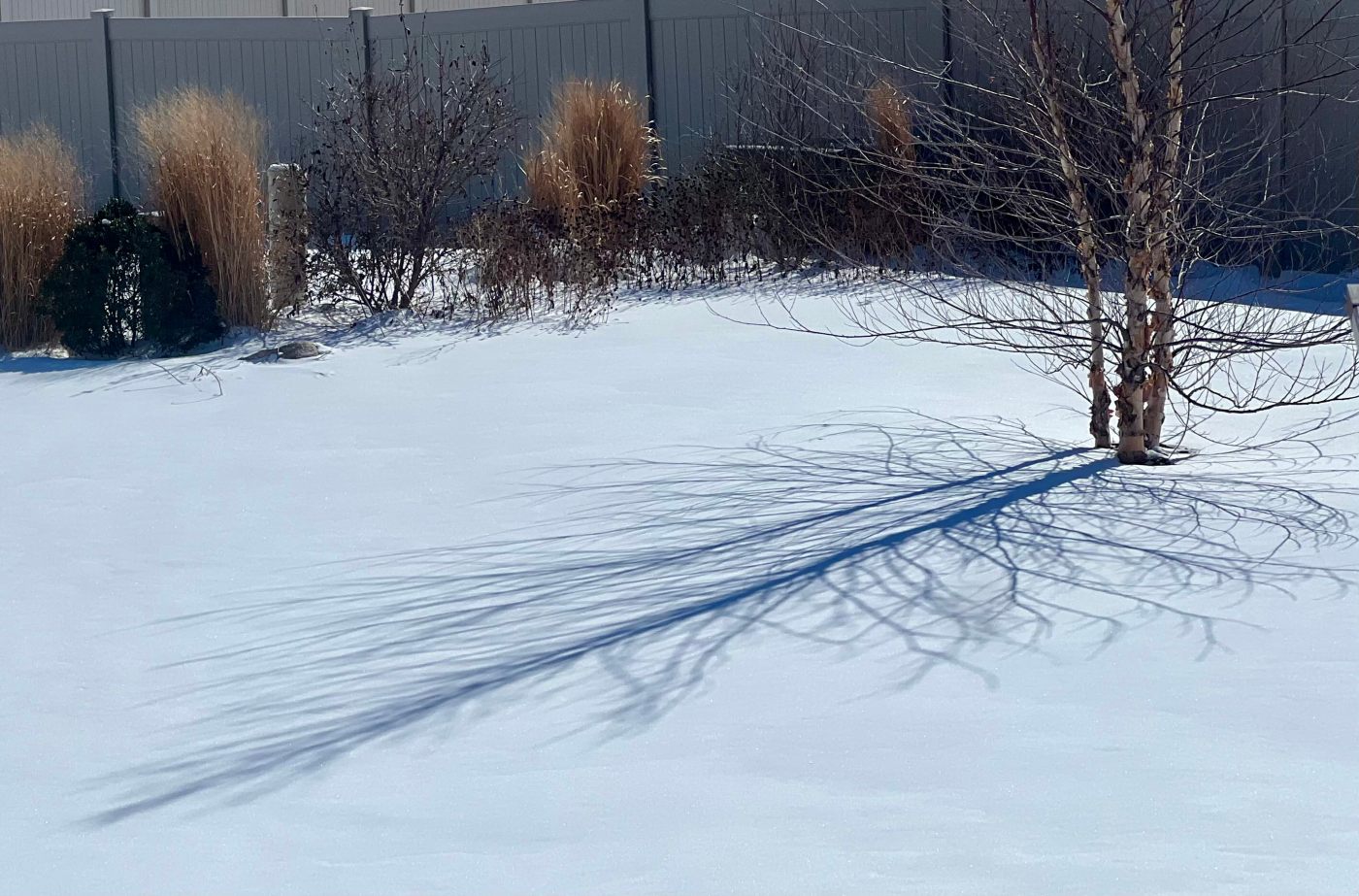
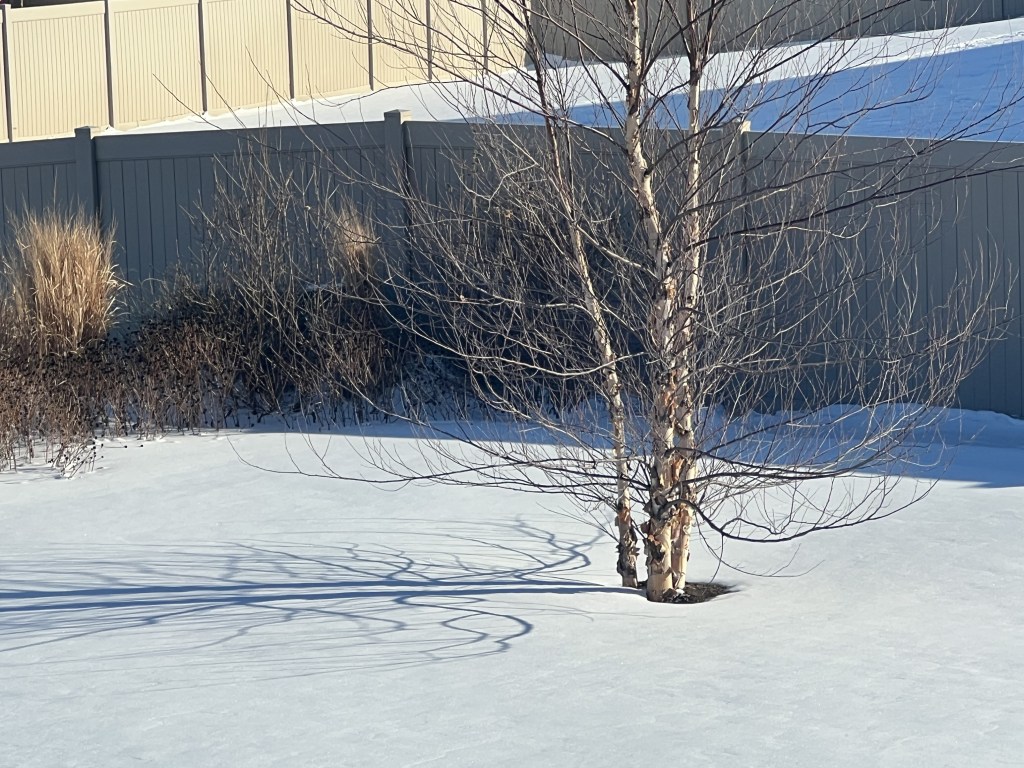
Wonder captured me the other day as I was working in the kitchen. Our first measurable snowfall didn’t happen until February this year in southeast Nebraska. The sunlight on a backyard birch tree elicited the most intricate artwork on the fresh snow. I returned a time or two to see how the shadow shifted, deciding to make it contemplative prayer throughout the day.

Continue reading “Light and Shadow: Atoms of Delight”

Curiosity is good for the soul, and for democracy too!

Cultivating curiosity is Being Benedictine.

As an educator and lover of learning, I appreciate the reference to schools in the Rule of St. Benedict. In the Prologue of The Rule, Benedict writes that the monastery is “a school for God’s service.” Whether in the monastery, home, or work—we are learning to live and love in community. Our life is a school of becoming—a continual learning.

Learning does not happen in solitude.

“A school is a community of learners: a group that comes together to learn with and from each other…education should expand our consciousness, capabilities, sensitivities, and cultural understanding. It should enlarge our worldview.”  –What Is Education For? by Sir Ken Robinson and Kate Robinson, Edutopia, March 2, 2022.

As a teacher, whether it was my high school students or those who attend retreats I lead, I appreciate a curious learner—someone who is open to new ideas, willing to listen, to question, to consider diverse perspectives, and, with humility, understand that there is always something new to learn.

Curiosity is a good first step toward living SoulFully and being Benedictine.

Being Benedictine, in my experience, is a genuine attempt to meet others in love and compassion, listening with the intent to understand, encouraging inclusiveness, and respecting diversity.  It is a blessing to share our feelings, faith, or perspectives and to have someone truly listen, especially those who might believe differently. Listening is the doorway to learning from others and growing in compassion; curiosity is the key.

“The spiritual life takes discipline,” Joan Chittister writes in The Rule of St. Benedict, A Spirituality for the 21st Century. “It is something learned, to be internalized. It’s not a set of daily exercises; it’s a way of life, an attitude of mind, an orientation of soul. And it is gotten by being schooled until no rules are necessary.”

Curiosity is good for the soul.

In Women Who Runs with the Wolves, Clarissa Pinkola Estes, defines the wild woman archetype as one who listens deeply, is intuitive, creative, playful, courageous, curious, loyal, and passionate. There is some wildness of divinity in us all, calling us to live fully, to reach beyond ourselves and, to discover something new. “When you limit your life to the one frame of thinking, you close out the mystery,” writes John O’ Donohue in Eternal Echoes: Celtic Reflections on Our Yearning to Belong.

Curiosity is good for community. Wonder is good for the world.

Wonder, my 2023 word of the year, is an attitude of curiosity, a willingness to withhold judgment, and to be open to what happens. Dacher Keltner in Awe: The New Science of Everyday Wonder and How It Can Transform Your Life writes, “People who find more everyday awe show evidence of living with wonder. They are more open to new ideas. To what is unknown. To what language can’t describe…to the strengths and virtues of other people.”  

Is it possible to behold our neighbor with wonder, in the spirit of hospitality? Could we hold a curious heart even when we passionately disagree with one another? Rather than defaulting to the shoulds and should-nots of orthodoxy, or a deeply held conviction, could we practice curiosity instead? Rather than seeking to change another’s opinion or defend our own, could we simply stand in awe of this great universe that holds such diversity of thought? Is it possible to let a disagreement stand to the side, while the desire to learn about the other steps forward?

Curiosity leads to wonder. Wonder leaves room for the unexpected, for learning something new.

This is how Lectio Divina, the Benedictine practice of sacred reading, can work in community. We hear different perspectives, drawing on the experiences and insights of those in our community. We can release the need for the one right way to interpret what we read and be curious about what others bring to the table. I share reflections from the richness of our oblate community discussions on this website but with a disclaimer,

“I cannot claim to have captured all the wisdom shared in our monthly oblate discussions or that I represent all oblates in attendance. The group discussion is a starting point for this reflection, but it is my interpretation of what I heard and what resonated with me. There could easily be as many different blog posts or reflections as oblates. Each of us comes to Lectio from our personal experience of God at that moment and we receive what we need in that moment as well. The beauty of Lectio Divina is that the reading, insights, and discussion may fall differently on each of our hearts. How blessed we are that there are “many dwelling places” (John 14:2)” and we are all invited to “listen with the ear of the heart.” (RB Prologue)”

Curiosity is good for democracy.

In Healing the Heart of Democracy: The Courage to Create a Politics Worthy of the Human Spirit, Parker Palmer encourages us to consider “What do I have in common with people who, for example, regard their religious or political convictions as so authoritative that they feel no need to listen to anyone who sees things differently—especially that small subgroup of extremists who would use violence to advance their views?”

This can be difficult. I get it. I know too well how disagreements can escalate, and how estrangements result. I have appreciated discussions where curiosity is a motivation to more deeply understand, but I also know the heartbreak of rejection when another is not interested in my story, feelings, or perspective. The door is slammed shut for exploring possibilities, another proclaims they know what they know and there is no need to share ideas or learn something new. But I believe for many situations curiosity, wonder, listening, and a little respect could be the remedy. It may not change minds or beliefs, but it can change hearts. I believe, as Palmer does, that I can find even “the smallest patch of common ground” with others whose views are different than mine. I can disagree with another while also being Benedictine.

Continue reading “Curiosity is good for the soul, and for democracy too!”

Apollo 8: Christmas Eve, December 24, 1968

Since the beginning of time, peoples of all cultures and religions have beheld the beauty of the earth, endeavoring to understand the universe and their place in it. We long for this sacred knowing. Just a century ago, we could not have conceived of the technology and space exploration that would produce photographs and telescopic images, inspiring such awe and wonder, my word for 2023. We are imbued with the grandeur of God.

Hildegard of Bingen, the 12th Century Benedictine Abbess and founder of German scientific natural history, captures this wonder:

“Glance at the sun. See the moon and the stars. Gaze at the beauty of earth’s greenings. Now, think. What delight God gives to humankind with all these things. All nature is at the disposal of humankind. We are to work with it. For without we cannot survive.” 

Hildegard of Bingen

Since 1990, the Hubbel Telescope has captured the wonder of our universe’s distant past, more than 13.4 billion light-years away, capturing images of black holes, galaxies, and the birth and death of stars, changing how we look at our cosmos.

The James Webb Telescope launched on Christmas Day, 2021, has even greater potential, using infrared capabilities to see through dusty regions of space viewing objects that are too old, faint, or distant for the Hubble Space Telescope.

It is astounding to behold the images of what is beyond us, but, perhaps, even more profound are the images captured on Christmas Eve, 1968, of Earth. The three astronauts of Apollo 8 completed the first manned orbit around the moon, becoming the first humans to see, and photograph, the Earth from space.

The first color photograph taken beyond Earth’s orbit was later titled Earthrise. The film “Earthrise” tells the story of this image captured by the Apollo 8 astronauts—Bill Anders, Frank Borman, and Jim Lovell—and recounts their experiences, exploring the beauty, awe, and grandeur of the Earth against the blackness of space.

The vast loneliness is awe-inspiring and it makes you realize just what you have back on Earth. The Earth from here is a grand oasis in the big vastness of space.”

Astronaut Jim Lovell, Apollo 8

Looking beyond, looking upon, looking around, and within—all are filled with wonder.

“…take a look around you. Ponder how the solid-seeming ground beneath your feet is quietly shaking with the force of billions of years of cosmic collisions. Go outside…watch the wind blow through the trees … The endless comings and goings of galaxies, stars, and planets create a melding of songs that you are part of too. It’s a reminder that the world always has been, and always will be, worthy of wonder.”–Adam Frank, The Constant Fire

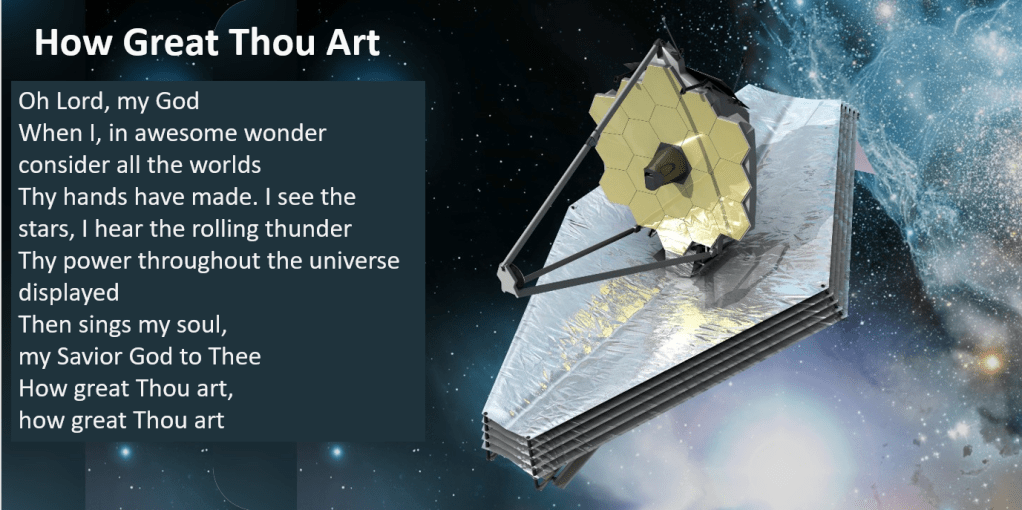
In awesome wonder, may your Christmas be filled with reminders of the beautiful mystery that surrounds you. May your prayer begin with “How Great Thou Art.”

How Great Thou Art performed by Chris Rice.

More reflections on awe and wonder.

© Jodi Blazek Gehr, Being Benedictine Blogger

Poems Come Out of Wonder

After canceling everything on my calendar this weekend (between a teacher work week and our first week with students….yes, eye twitching and back-to-school dreams are real), I revisited a poem and a SoulCollage® card I created on The Grandeur of God: Living Life with Wonder and Awe retreat. I gave myself permission to hunker down, pull back from social activities, and center myself in silence and solitude for my 27th year of teaching.

I love this poem from a book called Out of Wonder: Poems Celebrating Poets.

“Majestic” (Celebrating Maya Angelou)

I am one who” reflection:

It is only after taking time to pause, that I am able to celebrate “the wonder of daybreak.”

I will be phenomenal after a weekend of rest.

© Jodi Blazek Gehr, Being Benedictine Blogger

The Grandeur of God: Care for Creation and for the Vulnerable

I have been enchanted by the poem The Grandeur of God, by Gerard Manley Hopkins, for years. I practiced Lectio Divina, a sacred reading practice, with this poem and wrote about it in God’s Grandeur: Praying with Poetry.

I cannot confess to understanding every word of this Victorian-era sonnet, published nearly 30 years after Hopkins’ death in 1889, but I feel the same passion for the beauty and sacredness of creation “that gathers to a greatness like the ooze of oil / Crushed” with which he writes. Hopkins writes with celebratory confidence,

“And for all this, nature is never spent;
There lives the dearest freshness deep down things”

But we know as global temperatures rise, more droughts, storms, rising sea levels, melting glaciers and warming oceans are impacting both human and animal life. Nature has been used and abused in so many ways. Is it true that “nature is never spent?” Can this earth withstand the heavy burden of “man’s smudge…and smell?” Indeed, we seek comfort in the notion that the sun will always rise as “the brown brink eastward, springs” and always sets as “last lights off the black West went.”

We hope for the future of our planet, but we must be caretakers, not just takers. We must be co-creators with the Divine to ensure the “grandeur of God,” our planet, is full of wonder and awe for future generations.

“Glance at the sun. See the moon and the stars. Gaze at the beauty of earth’s greenings. Now, think. What delight God gives to humankind with all these things. All nature is at the disposal of humankind. We are to work with it. For without we cannot survive.”

-Hildegard of Bingen
Continue reading “The Grandeur of God: Care for Creation and for the Vulnerable”

Wonder Begins in the Present Moment

Our being is often crowded out by our doing. Each day we are summoned to be creators of the present moment. Artists know the value of white space. Sometimes what isn’t there enables us to see what is.

Macrina Weiderkehr

In art and design, white space, also called negative space, is the area of a page without images or text. It is the space between lines, margins, graphics, and other design elements. Without white space a reader would be terribly distracted, having difficulty understanding the message or determining what is most important to see.

So, too, with our lives. Our moments can be filled with distractions, both in our thinking and in the many daily responsibilities we have. Macrina Wiederkehr, Benedictine sister, suggests that we are the creators of our present moment. We must, as the artists of our life, create our own white space—perhaps in simply being rather than doing, taking moments of silence to pause between activities, or practicing creativity or contemplation. It is when we create white space in our lives that we see differently, appreciating the wonder of an ordinary day.  

Recently I guided a retreat called “The Grandeur of God: Living Life with Wonder and Awe.” Taking a retreat, time away from ordinary life, can be the “white space” that one needs to relax, rejuvenate, and refocus. When we look at our life as a means to an end, something to endure until things get better, we steal opportunities to live a life with wonder and awe.

It is not always possible to leave our homes, families, or places of employment, but science and religion unequivocally agree on the importance of creating white space in our daily life to experience wonder and awe. Experiences of awe, what C.S. Lewis calls “golden moments,” can reduce stress, loneliness, and physical distress, and bring one a sense of expanded time, perspective, and connection.

Continue reading “Wonder Begins in the Present Moment”

The Awe of Moral Beauty: The Story of Regina & Achim

Life is difficult. The first three words in M. Scott Peck’s classic The Road Less Traveled, which I read in my early twenties, left me feeling both comforted and troubled. Oh, thank God, I’m not the only one going through hard things; this is normal…but oh my God, is life really this hard? As I “grew up”, I learned that despite the challenges of life there are plenty of opportunities to practice gratitude and seek joy and wonder.

I am inspired, and filled with awe, by those who meet challenges and overcome obstacles with resilience, courage, kindness, and positivity. In Awe: The New Science of Everyday Wonder and How It Can Transform Your Life, author Dacher Keltner outlines eight wonders of life that bring us a sense of awe and wonder. Music, nature, spiritual practices, and more influence us, but “we are most likely to feel awe when moved by moral beauty…in fact, it was other people’s courage, kindness, strength, or overcoming” that inspire us most.

This leads me to the story of Regina and Achim—I am inspired by them both. Regina met the challenge of a life-threatening illness with humor, positivity, faith, and courage. Achim showed selfless kindness and generosity by becoming Regina’s lifeline.

Continue reading “The Awe of Moral Beauty: The Story of Regina & Achim”

I Wonder About Hildegard and A Spoiler Alert

I wonder about Hildegard.

Recently I shared this image and quote attributed to St. Hildegard of Bingen:

The quote and image so resonated with me, that I shared it on my Being Benedictine Facebook page. Just as I was posting it, two finches, as seen in the image, landed just a few feet away near the birdfeeder I received as a Mother’s Day gift, hung just the day before.  (For more on my love of birdwatching, see Birds Are Still My Prayer.)

I love synchronicities like this, little holy surprises—the same birds, the same colors, the same postures, at the same moment I shared the image. It’s a whoa, you-need-to-pay-attention kind of moment. Curious, I began a deeper dive into what context Hildegard had made the statement.

I love Hildegard. I was enthralled with my visit to the Abbey of St. Hildegardin Germany on pilgrimage in 2019. I love that she was a 12th-century mover and shaker, truly a woman who used her voice. Hildegard, a German Benedictine nun, was a mystic and theologian, prophet and artist, poet, playwright and composer, healer, naturalist, and pharmacist. She became a Benedictine abbess, was both challenged and received affirmation from church clergy, bishops, and popes, moved her monastery of sisters to be independent of the male monastery, and, throughout her life, had visions of the Divine that she was reluctant, but ultimately encouraged, to share in writing.

But spoiler alert: The quote in the image is NOT a direct quote from St. Hildegard. It is from an article written ABOUT Hildegard. Here is some context I discovered that contains (closely) the quote from the shared image:

“We often look to someone like Hildegard or to other great people throughout the ages as if what they have is not ours to have; we admire them, honor them, study them. We want to make use of them, and we allow them to consummate our inner light for us. We allow them to be the still point of our turning world. We feel incapable, yet the world wants to infuse us and to be infused by us. At that point no one can help us, not angels, not men, not Hildegard, not Jung, not Rilke. We cannot live securely in a world which is not our own, in a world which is interpreted for us by others. An interpreted world is not a home. Part of the terror is to take back our own listening, to put our ears to our own inner voices, to see our own light, which is our birthright, and comes to us in silence.” (Source: Hildegard of Bingen, Warrior of Light, Elaine Bellezza, Gnosis magazine, vol 21, 1991)

The quote, incorrectly attributed to Hildegard of Bingen in sermons, social media posts, and even books, has been widely shared. There is no doubt that the image and quote need to be attributed correctly—to Elaine Bellezza not Hildegard of Bingen.  

Continue reading “I Wonder About Hildegard and A Spoiler Alert”

The Gift of Curiosity: There is no such thing as wasted learning!


Curiosity is the dawn of potential–a desire to learn something new, grow in awareness, and become more than we could be on our own. Curiosity, the birthplace of our becoming, is embodied in WONDER, my 2023 Word of the Year.

I think, at a child’s birth, if a mother could ask a fairy godmother to endow it with the most useful gift, that gift would be curiosity.

Eleanor Roosevelt

Surely my dad was blessed by a fairy godmother, endowed with the gift of curiosity, and he passed that down to me. Many Saturday mornings in my childhood, my dad would take my brother and me to local historical attractions and museums, and tell us stories about the “old days.” In retirement, my dad is passionate about learning history, particularly about his hometown of Valparaiso, compiling several books with the research he has done. His hobby and passion started with curiosity.

There are many similarities between my dad and me, even though how we have arrived at our curiosity and love of learning is different. I enjoyed the traditional school setting, spent many hours “playing school,” and was naturally drawn to becoming a teacher. He had an aversion to school and could not wait to get out. But, we both share a passion for gathering information, learning, and, then, sharing what we learn with others. It is an attitude of wonder and the love of storytelling that motivates us.

Wonder, the mental state of openness, questioning, curiosity, and embracing mystery, arises out of experiences of awe.

Dacher Keltner, Awe: The New Science of Everyday Wonder and How It Can Transform Your Life

WONDER opens our eyes to synchronicity.

WONDER leaves room for the unexpected, for learning something new.

Curiosity led to an unexpected experience of “teachable moments” on a recent trip to Breckenridge, Colorado. My husband and a few family members took to the ski slopes, while my brother-in-law, Mark, and I did some sightseeing and enjoyed the mountain vistas. 

A day for wandering, we visited the Breckenridge International Snow Sculpture Championships and enjoyed a scenic gondola ride to the base of Peak 8. We sauntered by dozens of buildings listed on the National Register of Historic Places and stumbled upon a local church where a couple invited us in, sharing the building history and pointing out the original fixtures that shined the first electric lights in Breckenridge. We ambled into souvenir shops with coffee mugs, hats, and shirts–anything that a mountain logo could be printed on–and we walked past the Barney Ford House Museum. I had done plenty of research before this trip (of course), but I hadn’t planned to visit this museum. 

But now I wondered who Barney was and why he had a museum in his honor. With one more day to wander, I sought more information. With an internet search for the Barney Ford House Museum, I learned Barney is a pretty big deal in Breckenridge, that a PBS documentary had been recently filmed about him, and that the following day, February 1, was the first day of Black History Month AND Barney Ford Day in Colorado. Astonished by the synchronicity of learning about Ford just a day before this important date, I spent an hour watching the documentary. I was stunned by what I learned–the story of an enslaved man who, against all odds, becomes a successful entrepreneur. I teach an Entrepreneurship class, so I was already making plans to share Barney’s story with my students.

Continue reading “The Gift of Curiosity: There is no such thing as wasted learning!”

Blog at WordPress.com.

Up ↑