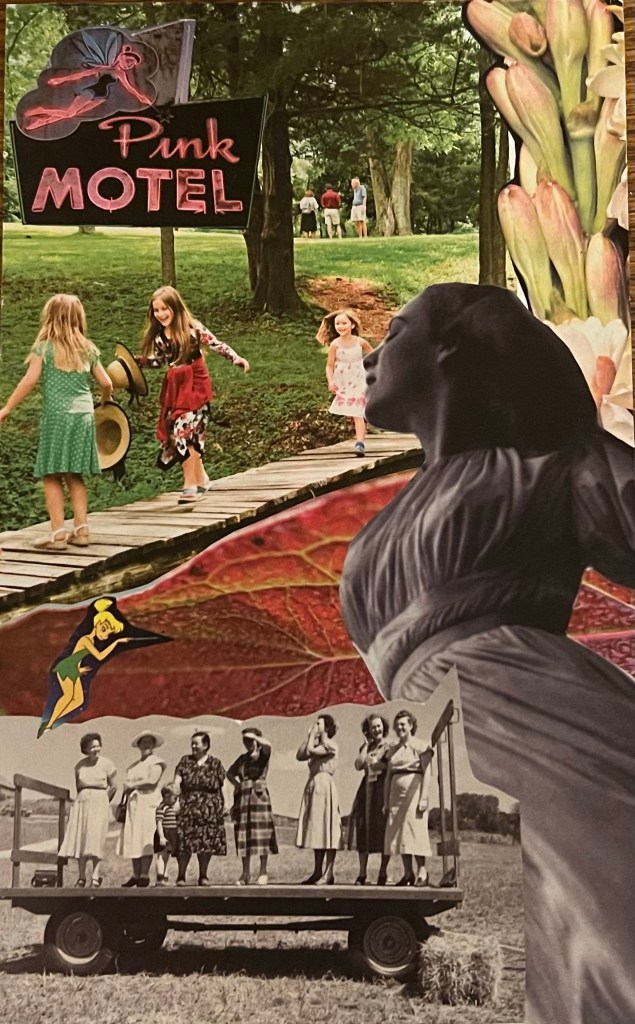
I am one who is playful, spirited, and connected in good company with wise women. The “pink motel” is a place of pixie dust and playfulness, joy, humor, carefree delights, childhood innocence, and magical moments.
One of the sweet surprises of SoulCollage® is when images come together to capture the essence of a memory, message, feeling, or archetype so effortlessly. This card reminds me of a recent playful, weekend gathering of friends. The women standing on the hayrack spoke to me of comradery, comfort, and community. It was later that I noticed the small child beside his mother. From a child’s vantage point, the energy in a room can easily shift from adult-ing to playfulness. Tinkerbell, the spirited fairy, spreads pixie dust and playfulness over adults and children alike—one can be both grown-up, wise, sober, AND playful, friendly, and funny. We can live more fully by embracing the playful child within.
My intention for 2024 is to live FULLY— “To be SoulFully You is to live prayerfully, joyfully, playfully, gratefully, mindfully, soulfully.” (2024 Word of the Year)
The spirit of Tinkerbell was alive and well on our farm weekend. Soom playful memories:
Choosing a word to focus on each year has become a nourishing, soulful ritual. I savor the word, that more so chooses me, throughout the year—it brings great joy when in perfect synchronicity, it appears over and again in what I read, hear, and see. I trust that the word, as it settles in my heart, will be a guiding light for months to come—challenging, inspiring, and transforming me.
My 2024 word of the year, FULLY, is a throwback to ten years ago when I birthed and named my first website and creative venture, SoulFully You. I participated in training to become a certified SoulCollage® facilitator, to lead retreats on creativity and spirituality. As a Marketing teacher, creating a brand name felt like the best first step. With my daughter Jessica and her friend Claire (both students of my high school classes) we brainstormed a variety of words, phrases, and combinations, and then it clicked, that “aha moment” of knowing I have come to trust—SoulFully You. I loved what it meant, and still do. The image at the top of this page, a SoulCollage® card to represent SoulFully You, came later.
Being SoulFully You is living with purpose, on purpose; being attentive to the present moment; practicing gratitude; making good choices and having no regrets; living with death daily before your eyes, as St. Benedict writes; and leaving something beautiful from a life well-lived. It is living life to the fullest, using the gifts and talents you have while being open and responsive to opportunities and surprises that come your way.
A tree gives glory to God by being a tree.
Thomas Merton
Being SoulFully You is discovering and becoming all that God has created you to be. Thomas Merton writes, “For me to be a saint means to be myself.” The call to be holy is the call to be more fully myself, just as a tree gives glory to God by being a tree.
Ever have one of those eyes-wide-open at 2:00 am moments of mind-racing, self-doubting, anxiety-stricken, what-if fretting? I had one such panic attack, recently, after making a big decision about the future of my work. I found myself wracked with despair, vacillating between whether I made the right decision or if I was making a mistake, despite having done my due diligence in heart, soul, and mind for many weeks.
In the morning light (and after several days), with the help of some calming meditation, conversations with good friends, and spiritual direction, I began to see more clearly—that it is normal when making big life changes to experience uncertainty, that I have been here before.
“For me, the process of discernment, especially when I have strong feelings or attachments, often begins with compulsive mental role-playing,” I wrote in 2019 when I was in a similar state of distress about making the right decision. But it was these words of wisdom that helped me get to the other side of anxiety, and at the root of it, fear.
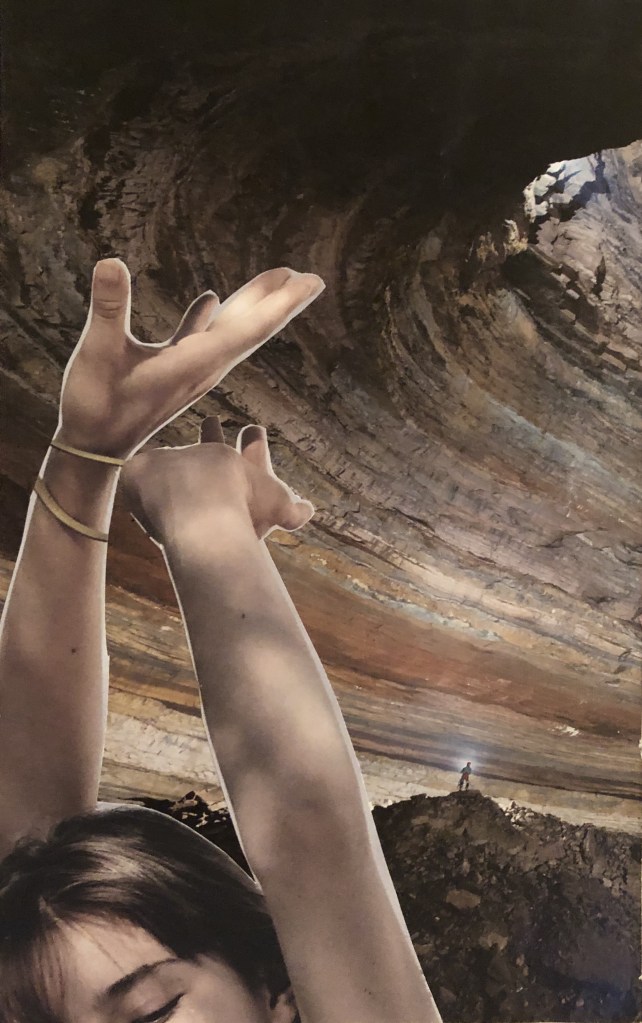
YOU ARE FREE.
“I am free to make THIS decision, or I am free to make THAT decision. I am free to choose. It was the decision-making process that was binding me, making me a prisoner of my own thoughts. The freedom came from not being attached to one possibility or the other, one reaction, one outcome, one person, or one feeling. Accompanied by a stream of what ifs, fear had become the primary consideration in discerning what if I did THIS or what if I did THAT.”
This reflection on my 2019 word(s) of the year,YOU ARE FREE, still rings true today. Fear is at the root of anxiety, a response to uncertainty. Ironically, the only thing that is certain IS uncertainty. All else is an illusion of control. Brene Brown in Atlas of the Heart writes, “In a world where perfection, pleasing, and proving are used as armor to protect our egos and our feelings, it takes a lot of courage to show up and be all in when we can’t control the outcome.”
Fear of making mistakes, a symptom of perfectionism, can sabotage even soulful decision-making. Fear can lead to a sense of feeling trapped, nearly immobile, agonizing about whether there is a right or wrong, rather than accepting that a decision is simply a decision, that often there is no one right way. The Divine works in all our decisions no matter what forks in the road we may take. Fear, or regret, limits our ability to be open to surprises and from being fully present to what is. I am free to make this or that decision, trusting, knowing that I will continue to listen to how the Divine is working in new ways. It is freedom that brings peace.
“Yes, you are free, too,” I wrote. “These words can be a prayer, an intention for yourself. Try it as an experiment. Ask yourself—What if I choose love instead of fear? What if I let go of what I am holding onto? What if I detach from what I want and, instead, accept that I am free, that God is with me whether I choose this or choose that?”
I captured the essence of these three words in a SoulCollage® card that embodies this sense of freedom. The image and words, YOU ARE FREE, have become a prompt for me to reflect on a dilemma or state of uncertainty from this perspective of liberation, encouraging me to move forward peacefully, soulfully, without obligation, burden, or restriction, in freedom.
Since the beginning of time, peoples of all cultures and religions have beheld the beauty of the earth, endeavoring to understand the universe and their place in it. We long for this sacred knowing. Just a century ago, we could not have conceived of the technology and space exploration that would produce photographs and telescopic images, inspiring such awe and wonder, my word for 2023. We are imbued with the grandeur of God.
Hildegard of Bingen, the 12th Century Benedictine Abbess and founder of German scientific natural history, captures this wonder:
“Glance at the sun. See the moon and the stars. Gaze at the beauty of earth’s greenings. Now, think. What delight God gives to humankind with all these things. All nature is at the disposal of humankind. We are to work with it. For without we cannot survive.”
Hildegard of Bingen
Since 1990, the Hubbel Telescope has captured the wonder of our universe’s distant past, more than 13.4 billion light-years away, capturing images of black holes, galaxies, and the birth and death of stars, changing how we look at our cosmos.
The James Webb Telescope launched on Christmas Day, 2021, has even greater potential, using infrared capabilities to see through dusty regions of space viewing objects that are too old, faint, or distant for the Hubble Space Telescope.
It is astounding to behold the images of what is beyond us, but, perhaps, even more profound are the images captured on Christmas Eve, 1968, of Earth. The three astronauts of Apollo 8 completed the first manned orbit around the moon, becoming the first humans to see, and photograph, the Earth from space.
The first color photograph taken beyond Earth’s orbit was later titled Earthrise. The film “Earthrise” tells the story of this image captured by the Apollo 8 astronauts—Bill Anders, Frank Borman, and Jim Lovell—and recounts their experiences, exploring the beauty, awe, and grandeur of the Earth against the blackness of space.
The vast loneliness is awe-inspiring and it makes you realize just what you have back on Earth. The Earth from here is a grand oasis in the big vastness of space.”
Astronaut Jim Lovell, Apollo 8
Looking beyond, looking upon, looking around, and within—all are filled with wonder.
“…take a look around you. Ponder how the solid-seeming ground beneath your feet is quietly shaking with the force of billions of years of cosmic collisions. Go outside…watch the wind blow through the trees … The endless comings and goings of galaxies, stars, and planets create a melding of songs that you are part of too. It’s a reminder that the world always has been, and always will be, worthy of wonder.”–Adam Frank, The Constant Fire
In awesome wonder, may your Christmas be filled with reminders of the beautiful mystery that surrounds you.May your prayer begin with “How Great Thou Art.”
I am one who sees the fullness of darkness and light. I see golden. I see through the eyes of a child, as well as the wise and wondering woman. I see myself reflected in beauty and patterns, knowing there is a big and a small picture.
I am one who is looking forward while also considering the past. Both/and. The wise woman and the apprehensive child. I am one who sees there is more than meets the eye, and that things aren’t always as they seem.
I am one who reflects what is. When I change my stance, what I see in myself may be different. The sculpture embodies stability. It stands firm, but the images that result can be changed. It captures the essence of being Benedictine—there is stability and movement.
I am one who is responsive, seeing beyond what is.
Consider using images and collage to learn more about who you are. What does A Golden Threshold mean to you? Meditate on the image and see what intuitively comes to you about darkness and light, about embracing both as a golden moment. Is there a threshold moment in your life that could use this way of seeing?
Source: The Oblate Life, edited by Gervase Holdaway, OSB, 2008
Men and women who have made monastic vows, called monks, practice stability by committing to a specific monastery. “The monk is an archetype, whether we live in a monastery or not, we have a sense of what it means to be a monk. We long to be together with God in solitude.” (Fr. Mauritius Wilde, OSB)
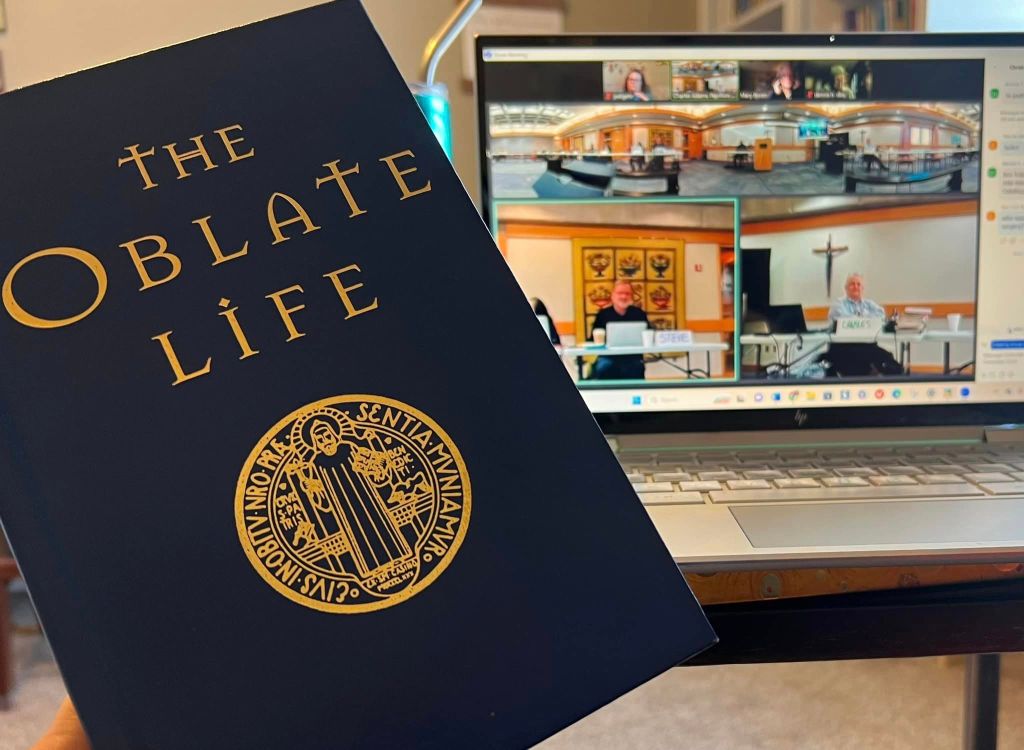
Being Benedictine as an oblate is making a commitment to a monastery, living the core values of obedience, conversion of life, and stability while following the Rule of St. Benedict as monks “in the world,” meeting monthly to practice Lectio Divina and discussing a spiritual reading. In the age of Zoom meetings (in which I, gratefully, participated this month), it is a good reminder that it is the monastery that I am drawn to—to the sacred rhythm of prayer and respect for silence, the theme of our discussion (December 2023.)
Grateful for the option of Zooming in to Oblate meetings, but it’s never quite the same. I love to go to our monastery and retreat center.
“If we are to learn about silence and cultivate its art form, the monastery is the first place to visit, for it is within the ancient tradition of monasticism, that we can begin to understand the relevance and the need for silence as a discipline, and a way of life. It is highly relevant that the very first word of the rule of Saint Benedict is listen.”—Susie Hayward, Silence, The Oblate Life
In silence, we can be transformed. “We will begin to see the ‘world’ differently, our breathing will become more rhythmical, surrounding color will intensify and brighten and our eyes will see more clearly and with greater perception.” (Hayward) We become more attentive. We notice the details around us, and we notice what is happening within us.
I had this experience during a contemplative prayer retreat over 20 years ago, my first visit to the monastery and retreat center that has become such an important part of my life. Even during our meals, we sat in silence, which contributed to a heightening of my senses—the quiet and stillness provided a backdrop through which I appreciated the color and tastes of ordinary foods—lettuce, tomatoes, bread, pasta, butter, milk. It was pure ecstasy to look, touch, and taste—to interact with my food. This sentiment—the sensitivity to physical, tangible cues—carried over into watching fish swim in the pond, grasshoppers jump from one station of the cross to the next, a candle flickering. All things seemed to be created for me. Every movement, color, taste, and sensation seemed special, whereas just days before it was ordinary.
Silence magnifies an experience. The practice of silence helps cultivate attentiveness to others and to how God is working in our lives. Thomas Merton writes, “By learning to listen… we can find ourself engulfed in such happiness that it cannot be explained: the happiness of being at one with everything in that hidden ground of Love for which there can be no explanations.” This type of interior silence must be cultivated. Visiting a monastery where there is silence can help, but one can create physical spaces in our own homes to remind us that times of silence are needed.
Hayward writes that “without silence, God has no voice.” No doubt silencing the noise of our daily lives can help us be more aware of the divine—in creation, in others, in words we read, in the thoughts that run through our mind, and in the story we tell ourselves. Indeed, silence allows us to experience the sacred, but many of us have felt God working, “God’s voice,” through the written or spoken words of others. In discussion, we wonder—do we really need absolute silence to hear God?
Perhaps Hayward means that we need to silence ourselves—to shut our mouths, to let go of thoughts and stories, and to be truly present wherever we find ourselves. If we are in conversation with another, there is sound, not silence, but we can practice interior silence by deeply listening to the other and standing witness to another’s story. It is important to remember that the first word in the Rule of St. Benedict is “Listen.” We must practice silence, both in words and thoughts, in the presence of the divine, including others.
Hayward writes about “the experience of feeling the total ‘presence’ of another person, in such a profound way that ‘in that moment’ we will have felt absolutely heard, totally cared for and completely understood.” What a gift to be heard and to hear others without the noise in our heads! She continues, “Listening reflectively in this attentive and empathic way allows each person to respond to the other fruitfully.”
God is working in this ‘total presence,’ the compassionate listening to another’s story. May we practice silence, to listen, see, and fully experience the humility of unknowing all that we think we know, to experience a oneness with our Creator, with creation, and with all those whom we share both.
Meeting the Pope is a big deal. Recently I wrote about the 5th World Congress of Benedictine Oblates and the private audience that Oblates had with Pope Francis. Jaime Williams, an Oblate of Christ the King Priory, was in the private audience and was profoundly impacted. I asked him to share his experience and he graciously accepted.
A “Being Benedictine” Reflection by Jaime Williams:
Two plus weeks after the most extraordinary handshake in my life, I still struggle to comprehend how my journey from an inauspicious upbringing in small-town Iowa led to meeting Pope Francis and visiting the two most important holy sites associated with our beloved St. Benedict and St. Scholastica in Italy – nearly 30 years after graduating high school and leaving home. After spending a significant portion of my career traveling extensively through parts of the developing world, I don’t consider my childhood to be been one rooted in poverty, but certainly, my parents had to work hard to make ends meet and there was no shortage of stress present throughout my childhood. I generally consider the Christian formation I received while growing up to be relatively poor, and our participation in church of any kind was sporadic and inconsistent: we were members of Presbyterian, Nazarene, and Methodist congregations at various times during my youth, and moved constantly between northeast Iowa, and east and west coast towns in Florida, before finally settling in southern Iowa where I spent most of my high school years. It is no surprise to me that of our Oblate promises Stability is what I cherish most from my family and Oblate community!
The image and story behind the Chipko movement inspired us to do some of our own tree-hugging! The Chipko movement of the 1970s (chipko meaning ‘to cling to or hug ‘ in Hindi) led to tree-hugging movements throughout the Himalayan regions, forcing reforms and moratoriums in the forestry industry that saved thousands of trees. The peasant women of the Garhwal Hills of India, pictured below, literally threw their arms around trees to save them (Ecologically Conscious.) Their actions were inspired by events of 1730 when soldiers were ordered to fell trees in the Bishnois villages of India to build a palace. 294 men and 69 women, belonging to a branch of Hinduism, were massacred while they desperately clung to their trees. Eventually, their action led to a royal decree that prohibited the cutting down of trees, and their forests flourish today.
Across the centuries and throughout the world, the existence of trees has been threatened in the name of progress, to pad the pockets of the greedy, or, sadly, out of sheer ignorance, yet the original tree huggers continue to influence environmentalist efforts. Those Indigenous to the land see clearly that their existence is connected to the survival of trees. We can follow in their footsteps by recognizing our connection with and responsibility to the earth, which is so in need of our aid.
We have spent a few autumn weekends through the years at our friend Joyce’s family farm in the sandhills of Nebraska, near Loup City, but this year, on the heels of reading Braiding Sweetgrass: Indigenous Wisdom, Scientific Knowlege, and the Teachings of Plants, we feel a longing to connect to the land that Joyce’s great grandparents had homesteaded, to return to the home her mother grew up in, to hear their stories, and to remember and honor the Indigenous who lived with the land, in humility, gratitude, and reciprocity.
Joyce extended the invitation to the weekend with these words: “We will walk upon the land in honor of those who have walked the land before us and in sacredness to our Mother Earth and all she has provided to us. For a weekend, we will become ‘Indigenous to place’”.
What does it mean to become Indigenous to a place? Robin Wall Kimmerer, a scientist, professor, citizen of the Potawatomi Nation, and author of Braiding Sweetgrass describes it as “living as if your children’s future mattered, to take care of the land as if our lives, both material and spiritual, depended on it…To become indigenous is to grow the circle of healing to include all of Creation.” This weighs heavily on our minds and in our spirits as we create a weekend getaway to honor our connection with each other and all of Creation.
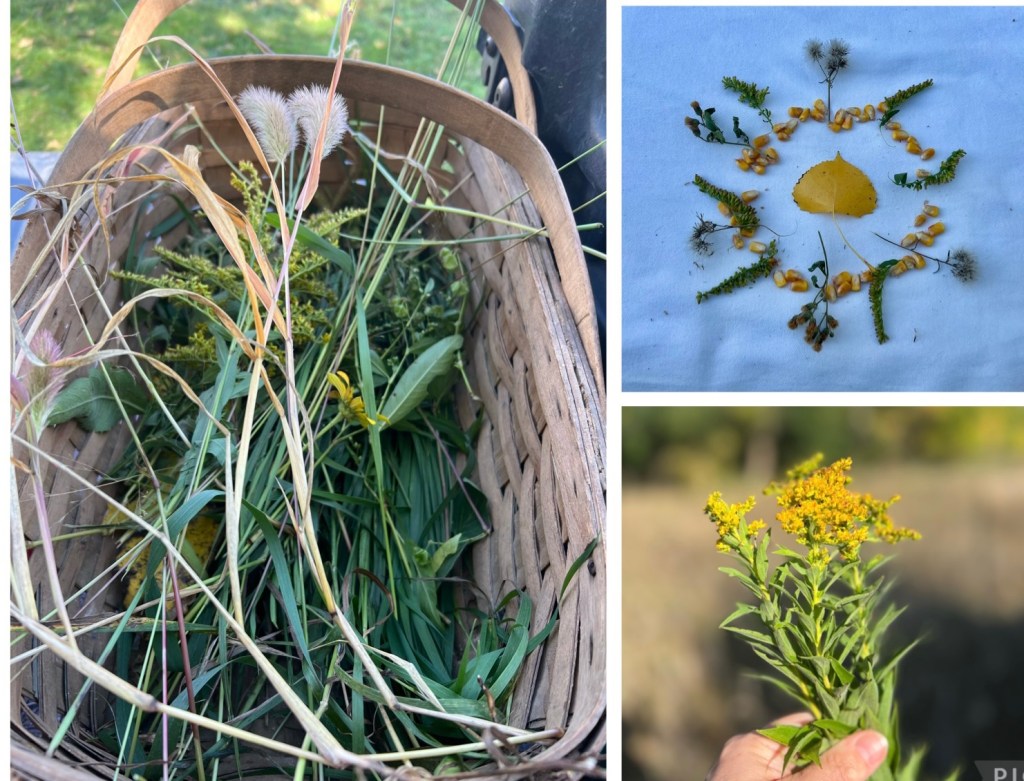
Our weekend was a medley of adventure, gratitude, creativity, good conversation, and play. We took the Gator out into the pasture and hills, enjoyed incredible vistas, laughed a lot while swinging from an old oak tree, and, afterward, thanked it with a big group hug. We searched for sweetgrass, gathered nature artifacts, created nature mandalas, and discussed Braiding Sweetgrass—reading segments of it out loud and discussing its impact on our lives and on our world.
Being silly before breakfast, we played with morning shadows, losing all sense of time. On a tractor-pulled hayrack, we rode up the hill and into the pasture to play—blowing bubbles, flying kites, and watching the sunset and the rise of the Full Harvest Moon. We danced in the moonlight to moon songs (think Fly Me to the Moon and Blue Moon), gazed at the stars, shared stories, reflected on the past, and imagined the future. How blessed we are to enjoy time in nature, on land that is loved and shared so generously.
We are here as part of creation, not as consumers of it.
-Joan Chittister
“If the universe unfolds in God, who fills it completely… there is a mystical meaning to be found in a leaf, in a mountain trail, in a dewdrop, in a poor person’s face. The world sings of an infinite Love: how can we fail to care for it?” Pope Francis addresses our responsibility to care for our common home in his newest exhortation, Laudete Deum, an urgent follow-up message to Laudato Si (Papal Encyclical, “Care for Our Common Home”, 2015).
Our weekend is filled with gratitude for the “infinite Love” displayed in the rolling hills, big oak trees, waving seas of tall grass, and the yet-to-be-harvested corn. Indeed, how can we fail to care for it? We hear the warnings of climate change and reports of how much damage has already been done, the hundreds of years needed to reverse course IF we were to make necessary changes now. Both Braiding Sweetgrass and Laudete Deum, brilliantly researched and exquisitely written, are cries for help on behalf of Mother Earth, who is speaking to us in ways we refuse to hear. I encourage you to read these powerful texts contemplatively, in the spirit of Lectio Divina, and to consider our responsibilities, what Kimmerer refers to as our “moral covenant of reciprocity.”
“The moral covenant of reciprocity calls us to honor our responsibilities for all we have been given, for all that we have taken… Whatever our gift, we are called to give it and to dance for the renewal of the world. In return for the privilege of breath.”
–Braiding Sweetgrass: Indegenous Wisdom, Scientific Knowledge and the Teachings of Plants
In Braiding Sweetgrass, Kimmerer refers to the changing roles of women as they “spiral through the phases of life, like the changing phase of the moon.” As we grow older, we have an opportunity to widen our circle of care, to “walk the Way of the Teacher, becoming models for younger women to follow…The spiral widens, farther and farther, so that the sphere of a wise woman is beyond herself, beyond her family, beyond the human community, embracing the planet, mothering the earth.”
As Pope Francis writes, “Everything is connected, and no one is saved alone.” (LD, 19) We share this earth with everyone on it, with those who came before us and those who will follow. What kind of world, and appreciation for it, do we hope to leave behind for future generations? We must remain hopeful that there will be a world to leave behind, but we must also do something to ensure it.
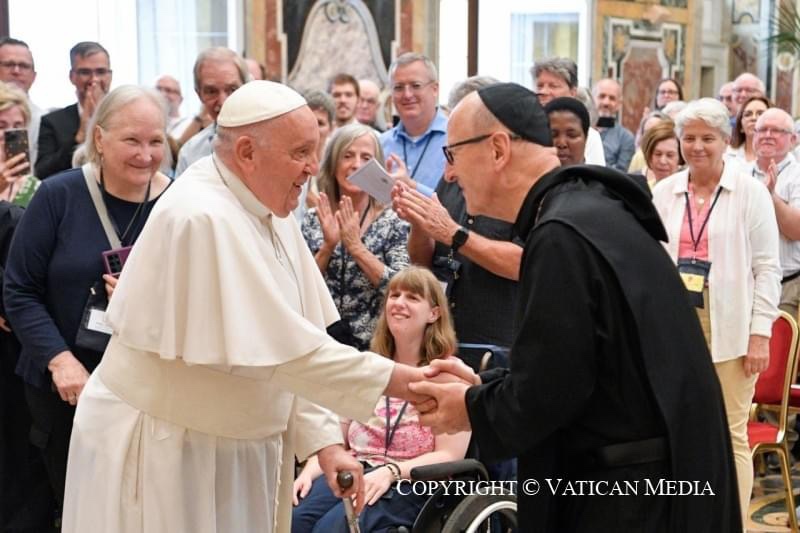
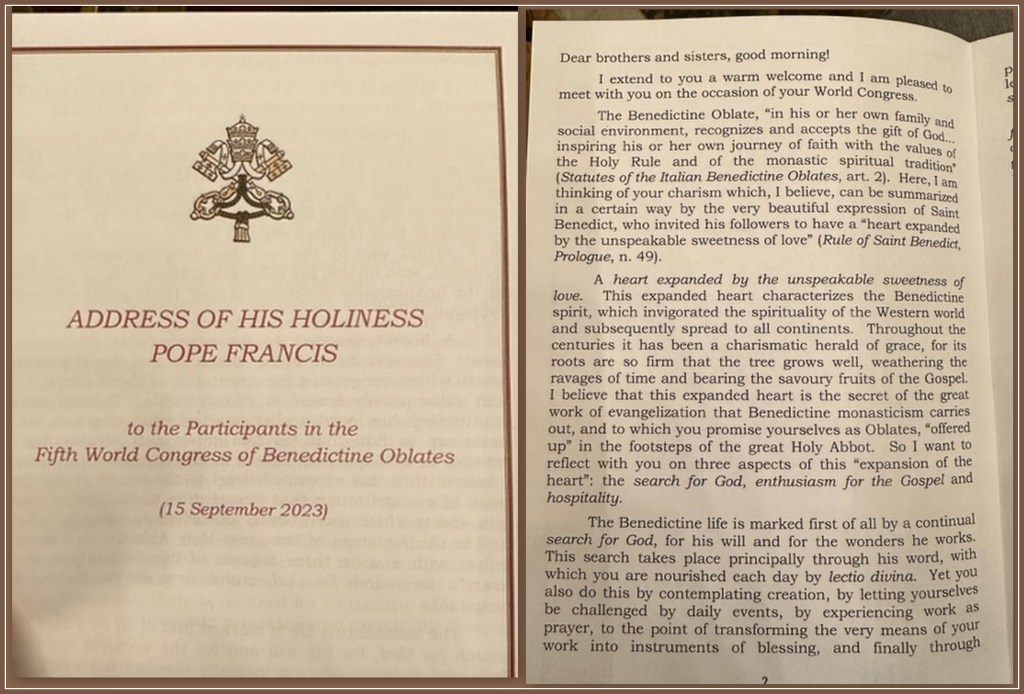
The Benedictine spirit is characterized by “a heart expanded by the unspeakable sweetness of love.” Pope Francis addressed the 5th World Congress of Benedictine Oblates in a private audience on September 15, 2023, as reported by Vatican News. The Congress theme, “Moving forward: Living the Wisdom of the Rule,” is an opportunity for Oblates, lay associates of a Benedictine monastery, to learn about their calling as monks in the world.
I participated in the 2017 Congress in Rome, attending the General Audience of Pope Francis at St. Peter’s Square. I reflected, “We were delighted to be seated on the platform, very near where the Holy Father was also seated. His message on the Eucharist was followed with a welcome for visiting groups with a special mention of Benedictine Oblates. For many oblates, this was one of the most magical moments of the week.” Indeed, it was very special.
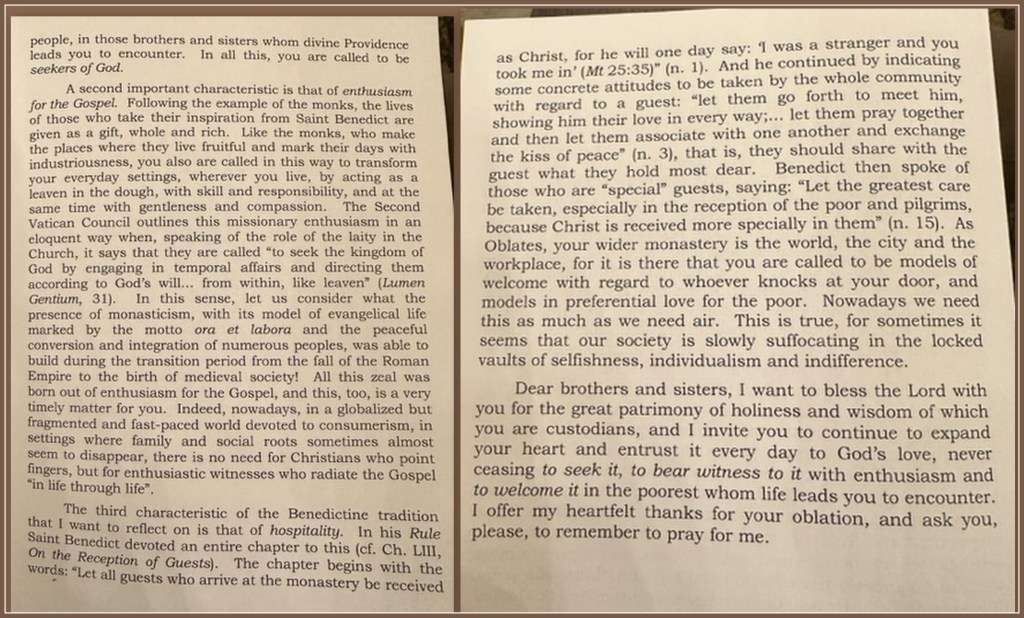
But I can only imagine that a private audience with Pope Francis has left oblates still pinching themselves. Jaime Williams, Oblate from Christ the King Priory where I also belong, shared he cannot find the words to describe the experience (although he has promised a guest post when the words begin to flow.) Jaime shared photos of the program with the words of Pope Francis’ message, of which I will comment.
Jaime Williams, Oblate of Christ the King Priory, Schuyler NE, in the background (blue shirt) as Pope Francis greets Abbot Primate Gregory Polan.
The Holy Father spoke to three aspects of this “expansion of heart”: the search for God, enthusiasm for the Gospel, and hospitality. “The Benedictine life is marked first of all by a continual search for God, for His will and for the wonders He works,” the Pope said. He emphasized the importance of practicing contemplation with the practice of Lectio Divina, as well as contemplation of creation, the challenges of daily life, the experience of work as prayer, and especially through other people.
Like the monks,” he said, “who make the places where they live fruitful and mark their days with industriousness, you also are called in this way to transform your everyday settings, wherever you live, by acting as a leaven in the dough, with skill and responsibility, and at the same time with gentleness and compassion.”
Finally, Pope Francis reflected on the characteristic of “hospitality,” noting that Benedict instructed monks to receive guests at the monastery as they would receive Jesus Himself. As Oblates our “wider monastery is the world, the city, and the workplace, for it is there that you are called to be models of welcome with regard to whoever knocks at your door, and models in preferential love for the poor.”
Pope Francis captures what being Benedictine means to me. It is not about interpreting the literal words in the gospel, but how I take its timeless message into my daily life—in my work, family, relationships, community, environment, and more. The words of Franciscan monk, Richard Rohr, resonate with me, “I’m convinced that one of the only reasons Roman Catholicism has lasted is because we have these satellites of freedom on the edge of the inside—religious communities of Benedictines, Jesuits, Dominicans, Franciscans, Sisters of Charity, Sisters of Mercy, and many more.” It is the connection with my favorite monks, our monastery, and Benedictine spirituality, a 1600-year-old tradition, that has sustained my search for God, my desire to learn from the ancient texts and rituals, and to practice hospitality as a monk in the world.













 Being Benedictine