Search

Being Benedictine

Living SoulFully as an Oblate of St. Benedict

Category

Lectio Divina

His Heart Was Moved

September 2025 Oblate Reflections

“In a delightful letter on the contemplative life called The Ladder of Monks, Guigo II (a 12th-century Carthusian monk) divides the experience of Lectio into four phases or degrees: reading, meditation, prayer, contemplation. Reading, he says, puts food whole into the mouth. Meditation chews it, digs for treasure. Prayer extracts the flavor and helps us to get to know the treasure. Contemplation embraces and welcomes the thirsty soul.” (A Tree Full of Angels: Seeing the Holy in the Ordinary, Macrina Weiderkehr)

Lectio Divina: Matthew 9:1-13; 35-36

He entered a boat, made the crossing, and came into his own town. And there people brought to him a paralytic lying on a stretcher. When Jesus saw their faith, he said to the paralytic, “Courage, child, your sins are forgiven.” At that, some of the scribes said to themselves, “This  man is blaspheming.” Jesus knew what they were thinking, and said, “Why do you harbor evil thoughts? Which is easier, to say, ‘Your sins are forgiven,’ or to say, ‘Rise and walk’? But that you may know that the Son of Man has authority on earth to forgive sins”—he then said to the paralytic, “Rise, pick up your stretcher, and go home.” He rose and went home. When the crowds saw this they were struck with awe and glorified God who had given such authority to human beings.

As Jesus passed on from there, he saw a man named Matthew sitting at the customs post. He said to him, “Follow me.” And he got up and followed him. While he was at table in his house, many tax collectors and sinners came and sat with Jesus and his disciples. The Pharisees saw this and said to his disciples, “Why does your teacher eat with tax collectors and sinners?”

He heard this and said, “Those who are well do not need a physician, but the sick do. Go and learn the meaning of the words, ‘I desire mercy, not sacrifice.’ I did not come to call the righteous but sinners.” Jesus went around to all the towns and villages, teaching in their synagogues, proclaiming the gospel of the kingdom, and curing every disease and illness. At the sight of the crowds, his heart was moved with pity for them because they were troubled and abandoned, like sheep without a shepherd.

In our oblate group, we read, reflect, respond, and rest in sacred scripture. There is a synergy that results from sharing a word or phrase that resonates within, as well as the wisdom or insight each has received. I leave with a greater understanding of other perspectives and of how I am called to follow Christ.

Some reflections from our reading:

Courage, child, your sins are forgiven…Rise, pick up your stretcher, and go home. Jesus’ first instruction is to have courage and to know that sins are forgiven. Many aspects in our life require our courage—difficult conversations, facing our own limitations, expressing love, making or adapting to changes, dealing with physical or emotional suffering, feeling despair, and understanding our next steps in each season of life, to name a few. Life requires courage. Some questions we might consider in taking Jesus’ advice: What is our stretcher or our crutch? Where might we be trapped or paralyzed? We are not to harbor evil thoughts about others or ourselves, knowing that nothing can separate anyone from the love of God. Jesus asks us to rise—right where we are, no matter who we are, and go home. Our home is much more than a brick-and-mortar dwelling. Home is a place of peace, where we can be seen and heard, loved and believed, held and yet free. Home accepts all the parts of our self, our truest self.

Home is where you belong. It is your shelter and place of rest, the place where you can be yourself.  –John O’ Donohue, Eternal Echoes: Celtic Reflections on Our Yearning to Belong

They were struck with awe and glorified God who had given such authority to human beings. We are to become like Christ. We can rise up, go home, follow, listen, have our hearts moved, give mercy, have courage, doubt, choose, forgive and be forgiven, be filled with awe, mix and mingle with the “tax collectors and sinners” of our day (the poor, oppressed, and marginalized), and be compassionate. In a very short story, Jesus asks much and gives much. He is an example of who we can be to others. The crowds were struck with awe by what Jesus did. We, too, can stand in awe of the kindness of others, a spectacular sunrise, or a day of feeling healthy. In each day, there are countless ways to choose awe and gratitude, glorifying God in all.

I did not come to call the righteous but sinners. Accepting both the righteous and the sinner within ourselves is a sort of homecoming. Accepting with humility that we are not one or the other—saint or sinner—is the way to integration and accepting others. Jesus tells the crowd that he desires mercy. We can be merciful, too, slow to judge ourselves and others.

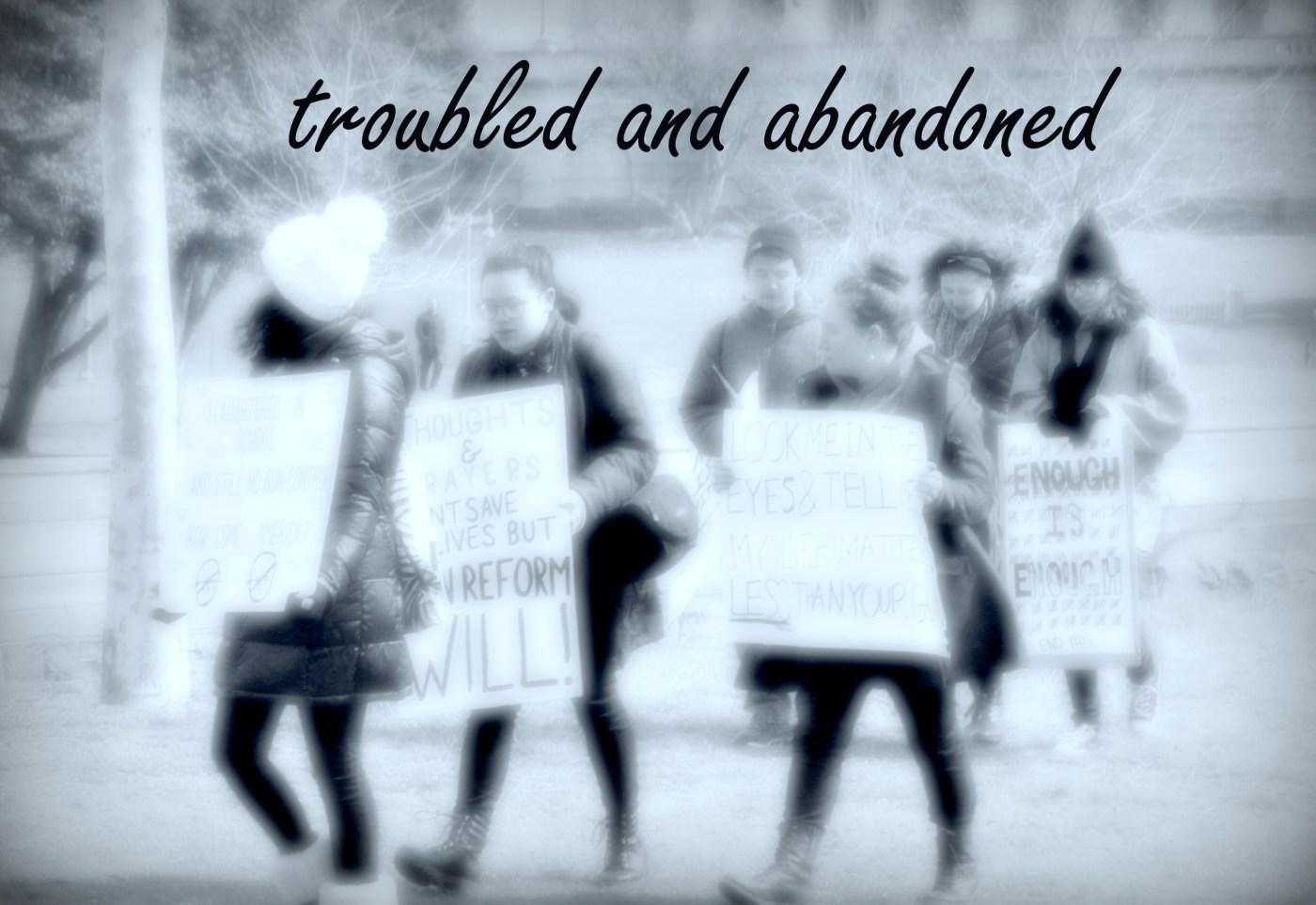
His heart was moved. This line resonated with me the most. Jesus, in his humanity, felt pity for the “troubled and abandoned.” Beyond our bodies, Jesus sees our inner wounds, our fears and anxieties, our feelings. He sees beyond the physical to our spiritual and emotional needs. This, too, we must ask—who might the troubled and abandoned be today?  We can only know who they are by deep listening, extending hospitality, and having compassion as Jesus did. And then we must ask, how are we responding to them? With judgment or with a moved heart?

More on compassion here.

© Jodi Blazek Gehr, Being Benedictine Blogger

Curiosity is good for the soul, and for democracy too!

Cultivating curiosity is Being Benedictine.

As an educator and lover of learning, I appreciate the reference to schools in the Rule of St. Benedict. In the Prologue of The Rule, Benedict writes that the monastery is “a school for God’s service.” Whether in the monastery, home, or work—we are learning to live and love in community. Our life is a school of becoming—a continual learning.

Learning does not happen in solitude.

“A school is a community of learners: a group that comes together to learn with and from each other…education should expand our consciousness, capabilities, sensitivities, and cultural understanding. It should enlarge our worldview.”  –What Is Education For? by Sir Ken Robinson and Kate Robinson, Edutopia, March 2, 2022.

As a teacher, whether it was my high school students or those who attend retreats I lead, I appreciate a curious learner—someone who is open to new ideas, willing to listen, to question, to consider diverse perspectives, and, with humility, understand that there is always something new to learn.

Curiosity is a good first step toward living SoulFully and being Benedictine.

Being Benedictine, in my experience, is a genuine attempt to meet others in love and compassion, listening with the intent to understand, encouraging inclusiveness, and respecting diversity.  It is a blessing to share our feelings, faith, or perspectives and to have someone truly listen, especially those who might believe differently. Listening is the doorway to learning from others and growing in compassion; curiosity is the key.

“The spiritual life takes discipline,” Joan Chittister writes in The Rule of St. Benedict, A Spirituality for the 21st Century. “It is something learned, to be internalized. It’s not a set of daily exercises; it’s a way of life, an attitude of mind, an orientation of soul. And it is gotten by being schooled until no rules are necessary.”

Curiosity is good for the soul.

In Women Who Runs with the Wolves, Clarissa Pinkola Estes, defines the wild woman archetype as one who listens deeply, is intuitive, creative, playful, courageous, curious, loyal, and passionate. There is some wildness of divinity in us all, calling us to live fully, to reach beyond ourselves and, to discover something new. “When you limit your life to the one frame of thinking, you close out the mystery,” writes John O’ Donohue in Eternal Echoes: Celtic Reflections on Our Yearning to Belong.

Curiosity is good for community. Wonder is good for the world.

Wonder, my 2023 word of the year, is an attitude of curiosity, a willingness to withhold judgment, and to be open to what happens. Dacher Keltner in Awe: The New Science of Everyday Wonder and How It Can Transform Your Life writes, “People who find more everyday awe show evidence of living with wonder. They are more open to new ideas. To what is unknown. To what language can’t describe…to the strengths and virtues of other people.”  

Is it possible to behold our neighbor with wonder, in the spirit of hospitality? Could we hold a curious heart even when we passionately disagree with one another? Rather than defaulting to the shoulds and should-nots of orthodoxy, or a deeply held conviction, could we practice curiosity instead? Rather than seeking to change another’s opinion or defend our own, could we simply stand in awe of this great universe that holds such diversity of thought? Is it possible to let a disagreement stand to the side, while the desire to learn about the other steps forward?

Curiosity leads to wonder. Wonder leaves room for the unexpected, for learning something new.

This is how Lectio Divina, the Benedictine practice of sacred reading, can work in community. We hear different perspectives, drawing on the experiences and insights of those in our community. We can release the need for the one right way to interpret what we read and be curious about what others bring to the table. I share reflections from the richness of our oblate community discussions on this website but with a disclaimer,

“I cannot claim to have captured all the wisdom shared in our monthly oblate discussions or that I represent all oblates in attendance. The group discussion is a starting point for this reflection, but it is my interpretation of what I heard and what resonated with me. There could easily be as many different blog posts or reflections as oblates. Each of us comes to Lectio from our personal experience of God at that moment and we receive what we need in that moment as well. The beauty of Lectio Divina is that the reading, insights, and discussion may fall differently on each of our hearts. How blessed we are that there are “many dwelling places” (John 14:2)” and we are all invited to “listen with the ear of the heart.” (RB Prologue)”

Curiosity is good for democracy.

In Healing the Heart of Democracy: The Courage to Create a Politics Worthy of the Human Spirit, Parker Palmer encourages us to consider “What do I have in common with people who, for example, regard their religious or political convictions as so authoritative that they feel no need to listen to anyone who sees things differently—especially that small subgroup of extremists who would use violence to advance their views?”

This can be difficult. I get it. I know too well how disagreements can escalate, and how estrangements result. I have appreciated discussions where curiosity is a motivation to more deeply understand, but I also know the heartbreak of rejection when another is not interested in my story, feelings, or perspective. The door is slammed shut for exploring possibilities, another proclaims they know what they know and there is no need to share ideas or learn something new. But I believe for many situations curiosity, wonder, listening, and a little respect could be the remedy. It may not change minds or beliefs, but it can change hearts. I believe, as Palmer does, that I can find even “the smallest patch of common ground” with others whose views are different than mine. I can disagree with another while also being Benedictine.

Continue reading “Curiosity is good for the soul, and for democracy too!”

The way and the truth and the life

July 2023 Lectio Divina and Oblate Reflections

Sources

Lectio Divina—I am the way and the truth and the life, John 14:1-12

Book DiscussionThe Oblate Life, edited by Gervase Holdaway, OSB, 2008

Disclaimer:

I cannot claim to have captured all of the wisdom shared in our monthly oblate discussions or that I represent all oblates in attendance. The group discussion is a starting point for this reflection, but it is my interpretation of what I heard and what resonated with me. There could easily be as many different blog posts or reflections as oblates. Each of us comes to Lectio from our personal experience of God at that moment and we receive what we need in that moment as well. The beauty of Lectio Divina is that the reading, insights, and discussion may fall differently on each of our hearts. How blessed we are that there are “many dwelling places” (John 14:2)” and we are all invited to “listen with the ear of the heart.” (RB Prologue)

“Just as the word ‘oblate’ comes from a root word denoting the offering of a gift, each oblate’s life is an offering to God and a gift to the Benedictine community, which is enriched by the oblate’s presence and prayer…. A Benedictine way is not to be harsh or burdensome but is offered to those who seek God and the sweetness of God’s voice.”

The Oblate Life

Do not let your hearts be troubled

The opening verse of John 14:1-12 implies that we can let or NOT let our hearts be troubled. We have agency–we can choose or not to follow the way Jesus shares with his disciples. This way, having faith in God, will relieve us of our troubles. 

In my Father’s house, there are many dwelling places. If there were not, would I have told you that I am going to prepare a place for you?” Jesus asks. As a personal offer, he tells them “I will come back again and take you to myself, so that where I am you also may be.” 

Continue reading “The way and the truth and the life”

Lectio and Visio Divina during Lent

I am always amazed at new understanding and insight that come through meditative reading and discussion. St. Benedict Center is hosting a five-week Zoom retreat called Lent: Lectio and Visio Divina led by Steven Blum, PhD. to provide an opportunity to gain new understanding of often-heard Scripture.

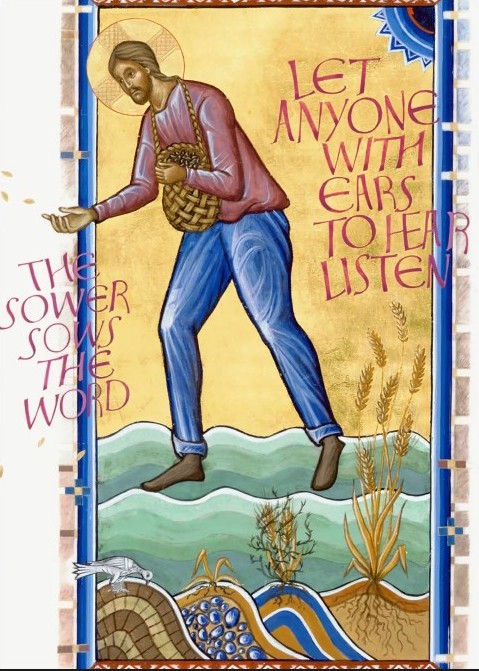
During the first week’s session, we connect with over 140 participants to learn about the ancient practices of Lectio Divina (sacred reading) and Visio Divina (sacred seeing) using the Gospel reading, Mark 4: 13–20 and the Sower illumination from The Saint John’s Bible.

There are four phases of Lectio Divina. The movement through the steps of these practices engages the heart, mind, and spirit, as we sit together in periods of silence, reading, gazing, reflecting, prayer, and contemplation. We seek to have the Lord awaken “the ears and eyes of our hearts.”

In practicing Lectio Divina, after reading the Scripture out loud, we contemplate, consider and reflect on what we have heard. The Scripture is read again, and perhaps again for a third time. After some time of silence, we are welcomed to share or journal a word or phrase that speaks to us.

Continue reading “Lectio and Visio Divina during Lent”

A time for everything under the heavens

August Lectio Divina and Oblate Discussion

SourcesLectio Divina, Ecclesiastes 3:1-11, There is a time for everything under the heavens.

Come, let us worship God who holds the world and its wonders in his creating hand.

-Antiphon, Week 3 Saturday

Such an affirming antiphon for times when I think I am the glue that holds all things together. I am most definitely not. It is God who holds the world and its wonders in his creating head. And I just need to remember.

This morning, I remind myself of this as feelings of guilt creep in that I have not posted on behalf of my oblate family since April. Much has happened in this time for me: I finished a year of teaching during during a pandemic (how many people can say that?), I led a retreat, I went to a retreat, I helped my daughter plan her summer wedding, I helped my parents with health issues that surprised us ten days before the wedding AND most wonderfully, we celebrated the marriage of our daughter, Jessica, to John Holland. It has been a summer full of ALL of the emotions.

Much as happened, we can assume, in each of our lives. Knowing this, we can give ourselves and others compassion when we feel we are falling short, when we don’t meet the expectations we have placed on ourselves. Each of us has a story. There is a time for everything, and how wonderfully TIMELY is our lectio reading for today:

Continue reading “A time for everything under the heavens”

Put on a Heart of Compassion

February 2021 Lectio Divina and Oblate Reflections

Sources: Colossians 3:12-17; Always We Begin Again: The Benedictine Way of Living by John McQuiston II (pages 17-22)

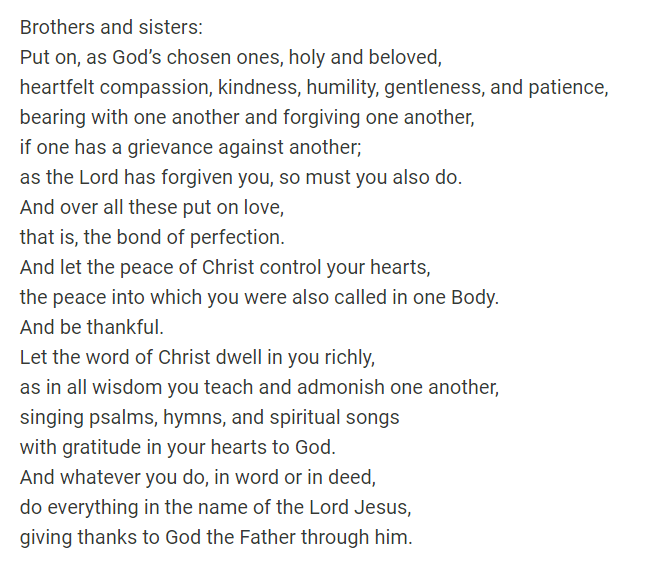
For our Lectio Divina practice, we read more deeply Colossians 3:12-17

We share aloud, some of the words and phrases that resonate with us:

God’s chosen ones, holy and beloved. Put on…heartfelt compassion, kindness, humility, gentleness, and patience.

Bearing with one another. Forgiving one another. Put on love….that is the bond of perfection.

Let the peace of Christ control your hearts. Be thankful.

Let the word of Christ dwell in your richly. Gratitude in your hearts. 

Compassion: We think of compassion as feeling sorry for someone, but it is to feel with someone, to enter into the sufferings and joys of another person. Jesus had compassion for us, entering fully into our lives. He is one with us. We are called to emulate this kind of compassion with others. Sometimes there may not be much we can say to another, but we can give our presence, a physical touch. Wordless gestures are just as compassionate, perhaps even more so.

Continue reading “Put on a Heart of Compassion”

Waters of Peace: Psalm 23

November 2020 Lectio Divina and Oblate Reflections

Topic: The Psalms

Sources: Psalm 23; Study Guide for The Rule of St. Benedict, pages 90-97, Maria-Thomas Beil, OSB

St. Benedict used the Psalms extensively in writing his Rule and suggested that we ought to pray all 150 Psalms at least once a week. This is a tall order for the average person, but perhaps we pray a psalm every day, contemplating its meaning in our hearts as a start. Psalm 23 is one of the most loved and most known of the Psalms, a comforting Psalm for our challenging times.

 For our Lectio Divina, we used the following translation of Psalm 23.

Our November 2020 Oblate meeting had participants both in person and via Zoom. This is the version of Psalm 23 with which we practiced Lectio Divina .

There were many words and phrases that resonated with us:

Phrases from Psalm 23 that resonated with us.
Continue reading “Waters of Peace: Psalm 23”

You Are Not Alone: My Peace I Give to You

August 2020 Oblate Reflections and Lectio Divina

Topic: Seek Peace and Pursue It, Rule of St. Benedict: Prologue 17

Sources: John 14:27 and John 16:29-33; Study Guide for The Rule of St. Benedict, pages 13-15, Maria-Thomas Beil, OSB

IMG_9812
Fr. Volker shares reflections and music for our August meeting.

The questions that guided our discussion were: How can we remain peaceful despite the anxiety caused by the pandemic and political division? And in light of our Lectio Divina readings: What did Jesus mean by the gift of peace? Oblates of Christ the King Priory met in person at St. Benedict Center for our August meeting, respectfully following safety guidelines of physically distancing at least six feet apart and wearing face coverings. Those who were not able to make the drive had the option to Zoom in.  All are encouraged to follow the 11th Commandment:

IMG_9813

Continue reading “You Are Not Alone: My Peace I Give to You”

God’s Grandeur: Praying with Poetry

The Jesuit poet, Gerard Manley Hopkins, was born July 28, 1884. I spent time in prayer, the practice of Lectio Divina, with his poem “God’s Grandeur.”

95254825_10222035129977663_186492500809089024_n

God’s Grandeur, Gerard Manley Hopkins (1844-1889)

The world is charged with the grandeur of God.
It will flame out, like shining from shook foil;
It gathers to a greatness, like the ooze of oil
Crushed. Why do men then now not reck his rod?
Generations have trod, have trod, have trod;
And all is seared with trade; bleared, smeared with toil;
And wears man’s smudge and shares man’s smell: the soil
Is bare now, nor can foot feel, being shod.

And for all this, nature is never spent;
There lives the dearest freshness deep down things;
And though the last lights off the black West went
Oh, morning, at the brown brink eastward, springs–
Because the Holy Ghost over the bent
World broods with warm breast and with ah! bright wings. Continue reading “God’s Grandeur: Praying with Poetry”

Blog at WordPress.com.

Up ↑