Meeting the Pope is a big deal. Recently I wrote about the 5th World Congress of Benedictine Oblates and the private audience that Oblates had with Pope Francis. Jaime Williams, an Oblate of Christ the King Priory, was in the private audience and was profoundly impacted. I asked him to share his experience and he graciously accepted.
A “Being Benedictine” Reflection by Jaime Williams:
Two plus weeks after the most extraordinary handshake in my life, I still struggle to comprehend how my journey from an inauspicious upbringing in small-town Iowa led to meeting Pope Francis and visiting the two most important holy sites associated with our beloved St. Benedict and St. Scholastica in Italy – nearly 30 years after graduating high school and leaving home. After spending a significant portion of my career traveling extensively through parts of the developing world, I don’t consider my childhood to be been one rooted in poverty, but certainly, my parents had to work hard to make ends meet and there was no shortage of stress present throughout my childhood. I generally consider the Christian formation I received while growing up to be relatively poor, and our participation in church of any kind was sporadic and inconsistent: we were members of Presbyterian, Nazarene, and Methodist congregations at various times during my youth, and moved constantly between northeast Iowa, and east and west coast towns in Florida, before finally settling in southern Iowa where I spent most of my high school years. It is no surprise to me that of our Oblate promises Stability is what I cherish most from my family and Oblate community!
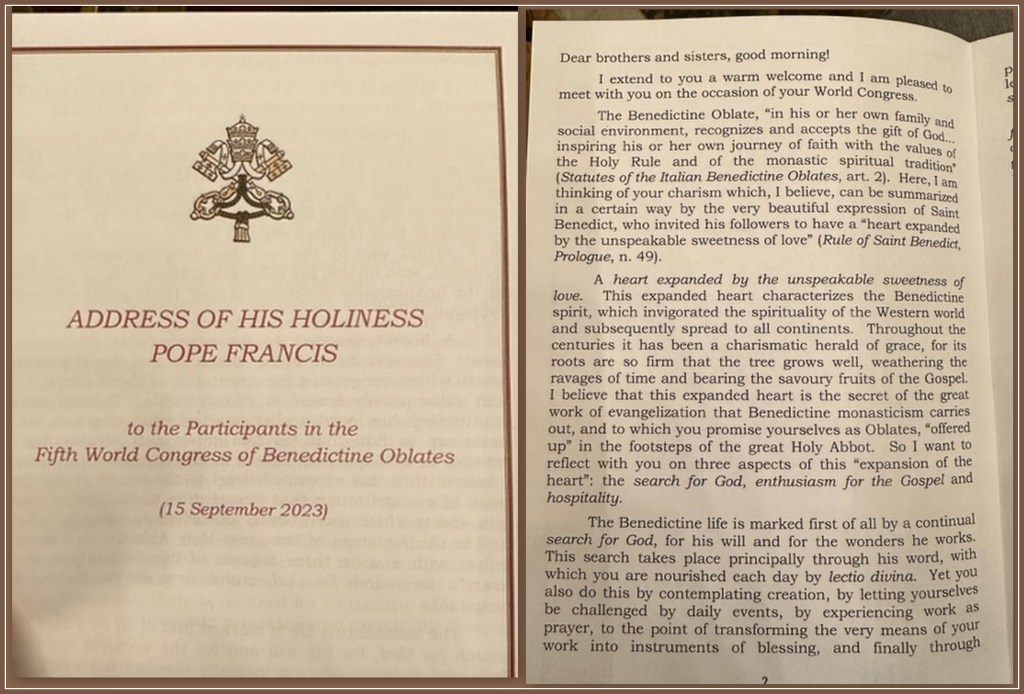
The Benedictine spirit is characterized by “a heart expanded by the unspeakable sweetness of love.” Pope Francis addressed the 5th World Congress of Benedictine Oblates in a private audience on September 15, 2023, as reported by Vatican News. The Congress theme, “Moving forward: Living the Wisdom of the Rule,” is an opportunity for Oblates, lay associates of a Benedictine monastery, to learn about their calling as monks in the world.
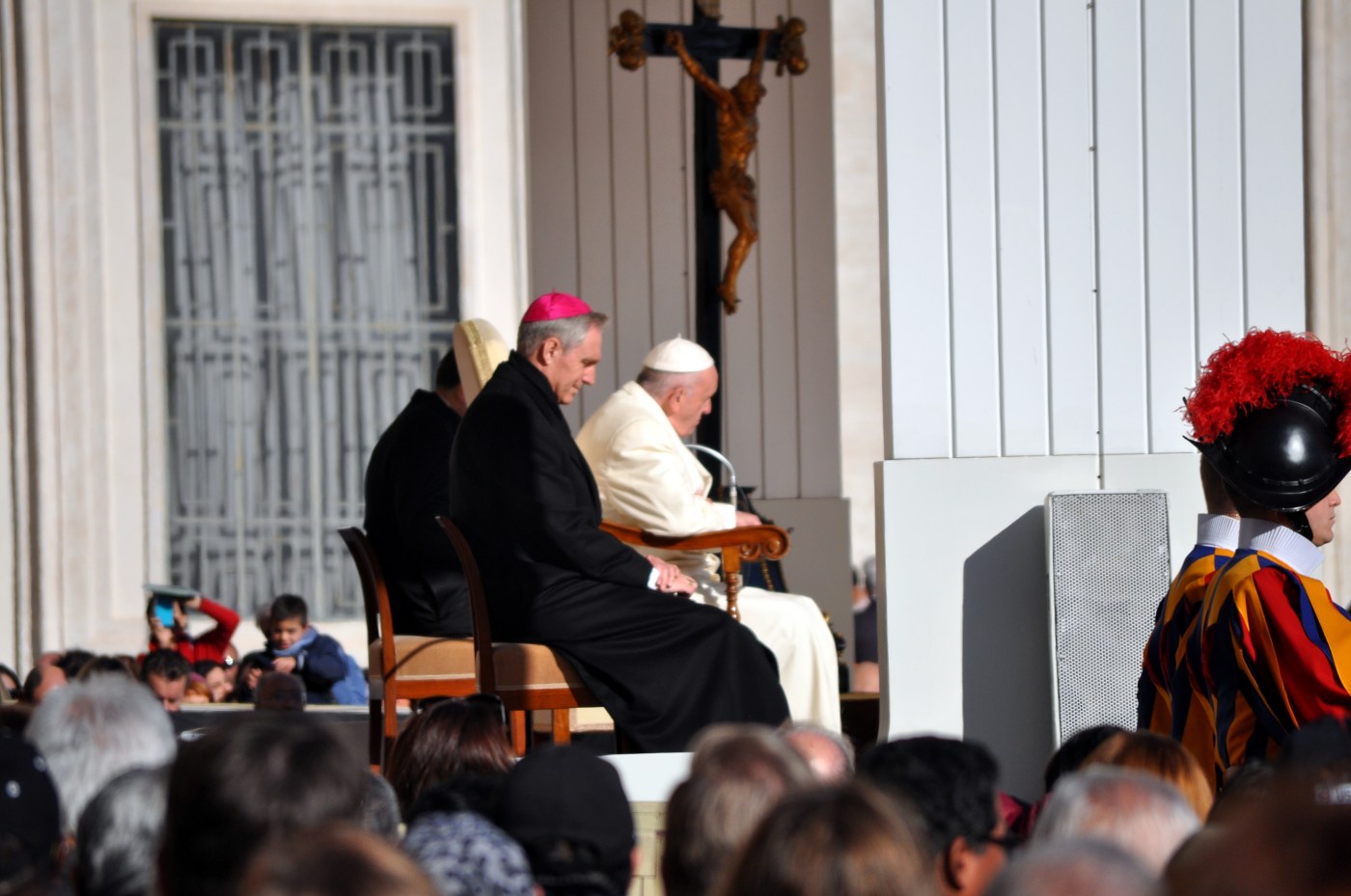
I participated in the 2017 Congress in Rome, attending the General Audience of Pope Francis at St. Peter’s Square. I reflected, “We were delighted to be seated on the platform, very near where the Holy Father was also seated. His message on the Eucharist was followed with a welcome for visiting groups with a special mention of Benedictine Oblates. For many oblates, this was one of the most magical moments of the week.” Indeed, it was very special.
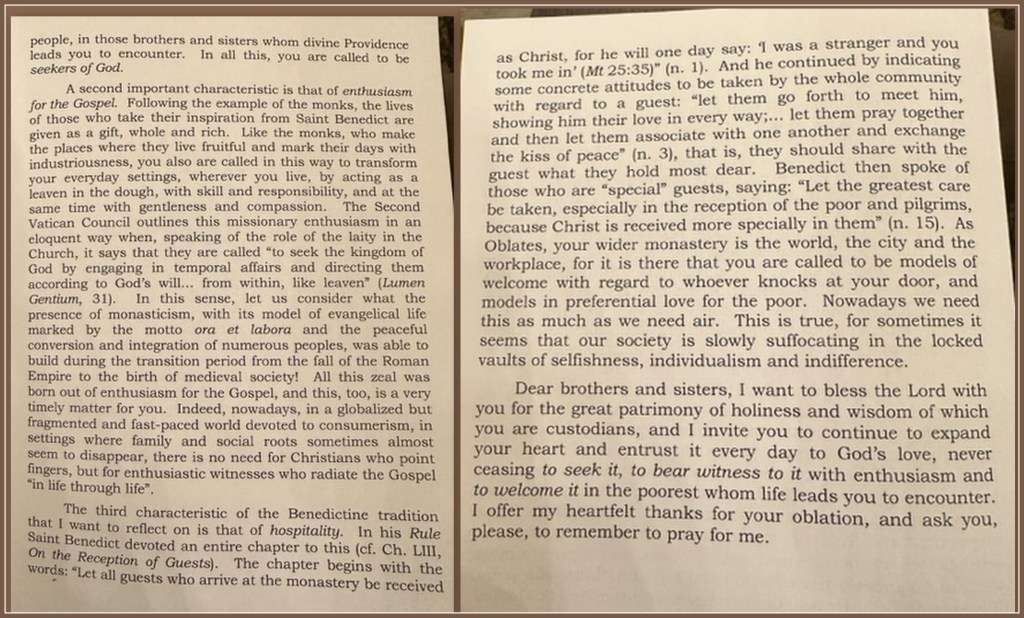
But I can only imagine that a private audience with Pope Francis has left oblates still pinching themselves. Jaime Williams, Oblate from Christ the King Priory where I also belong, shared he cannot find the words to describe the experience (although he has promised a guest post when the words begin to flow.) Jaime shared photos of the program with the words of Pope Francis’ message, of which I will comment.
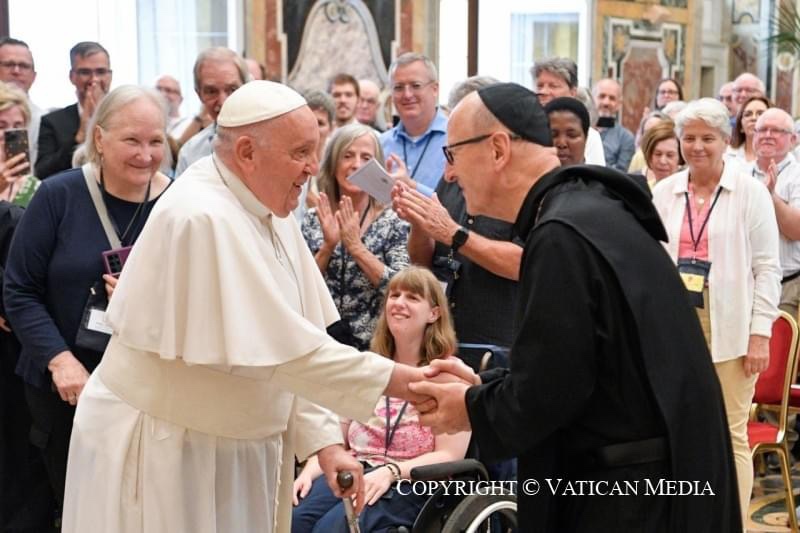
Jaime Williams, Oblate of Christ the King Priory, Schuyler NE, in the background (blue shirt) as Pope Francis greets Abbot Primate Gregory Polan.
The Holy Father spoke to three aspects of this “expansion of heart”: the search for God, enthusiasm for the Gospel, and hospitality. “The Benedictine life is marked first of all by a continual search for God, for His will and for the wonders He works,” the Pope said. He emphasized the importance of practicing contemplation with the practice of Lectio Divina, as well as contemplation of creation, the challenges of daily life, the experience of work as prayer, and especially through other people.
Like the monks,” he said, “who make the places where they live fruitful and mark their days with industriousness, you also are called in this way to transform your everyday settings, wherever you live, by acting as a leaven in the dough, with skill and responsibility, and at the same time with gentleness and compassion.”
Finally, Pope Francis reflected on the characteristic of “hospitality,” noting that Benedict instructed monks to receive guests at the monastery as they would receive Jesus Himself. As Oblates our “wider monastery is the world, the city, and the workplace, for it is there that you are called to be models of welcome with regard to whoever knocks at your door, and models in preferential love for the poor.”
Pope Francis captures what being Benedictine means to me. It is not about interpreting the literal words in the gospel, but how I take its timeless message into my daily life—in my work, family, relationships, community, environment, and more. The words of Franciscan monk, Richard Rohr, resonate with me, “I’m convinced that one of the only reasons Roman Catholicism has lasted is because we have these satellites of freedom on the edge of the inside—religious communities of Benedictines, Jesuits, Dominicans, Franciscans, Sisters of Charity, Sisters of Mercy, and many more.” It is the connection with my favorite monks, our monastery, and Benedictine spirituality, a 1600-year-old tradition, that has sustained my search for God, my desire to learn from the ancient texts and rituals, and to practice hospitality as a monk in the world.
Benedictine Oblates have a commitment to a specific monastery to live out their spirituality in the world according to the Rule of St. Benedict. But what is the future of Benedictine monasticism? As monastic vocations decrease, monasteries have been forced to consider their future, either merging with other monasteries or closing altogether. How might Oblates respond to this uncertain future?
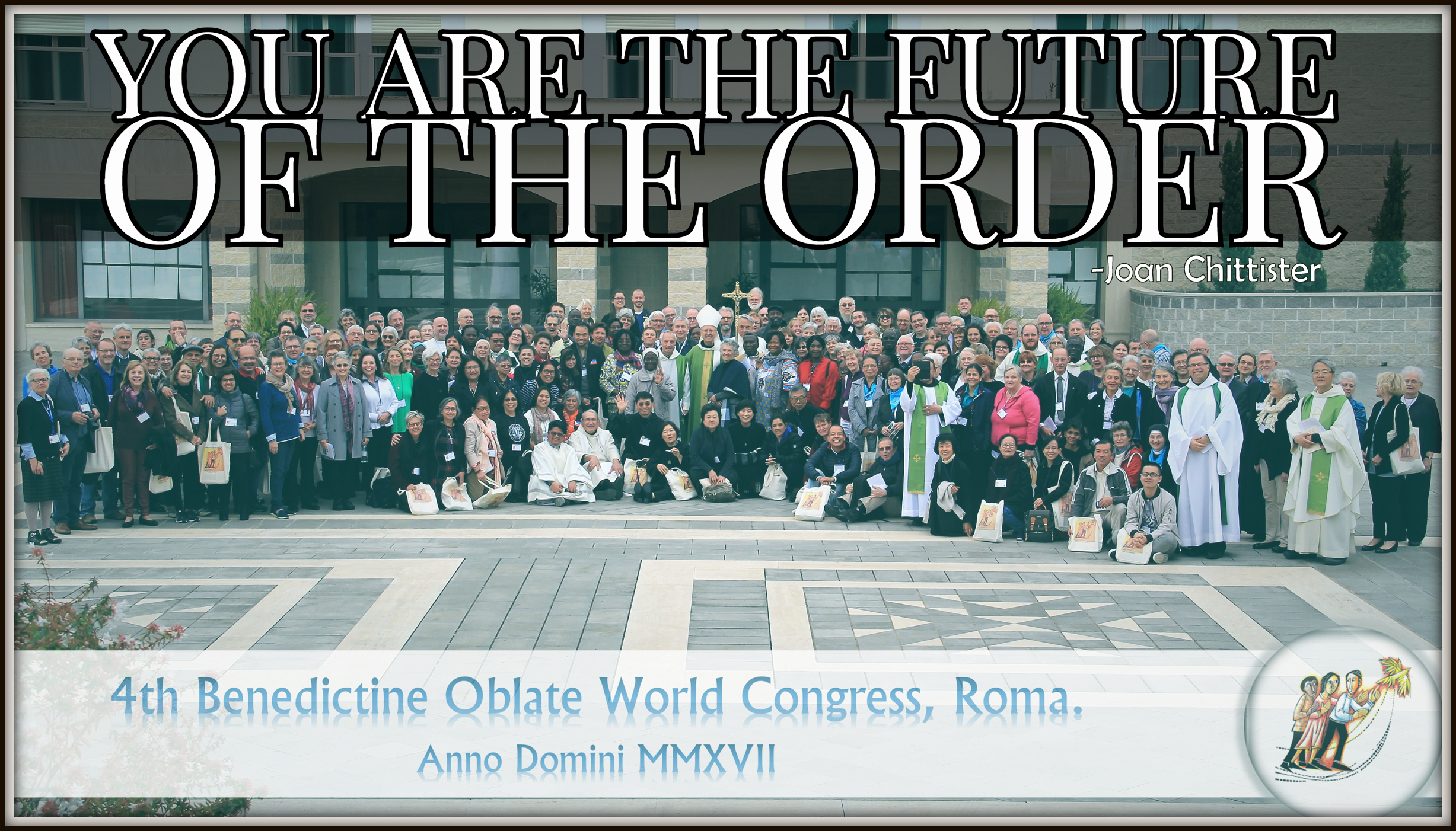
Sister Joan Chittister addressed this theme at the World Congress of Benedictine Oblates in Rome in November 2017. She asks, “The question of the day is a simple one but potentially life-changing one: the question is why would anyone even bother to get attached to a Benedictine monastery?”
He begins: “We can ask ourselves why we are raising this question or topic in the first place. What prompts us to raise it? It is certainly not because the Oblate community is diminishing! Is it because the some of the communities to which Oblates belong are diminishing and Oblates might be left high and dry? Or perhaps it is a concern about Oblate communities in lands where Benedictine life is new, communities are young and the Oblate experience has no precedence? Or is there something about our culture, our American culture that makes the question of the future so important?
While I do not consider myself a prophet in the sense of predicting a future for Benedictine life let alone Oblate life, I can fall back on the Prophet Joel. The best future I can invite you to consider is to listen to the word of God through the prophet Joel who simply says: “It shall come to pass (code words for the future) I will pour out my spirit on all flesh…” It is clear enough. The future lies with the Spirit and our willingness and readiness to recognize its presence. According to the prophet, old and young, sons and daughters, male and female, servants and slaves will receive this gift of the spirit. The Spirit is God’s future or plan. When we can trust that Spirit, we are standing in God. And being in God is the future for ourselves, as well as humanity and our created world. If we co-opt God’s Spirit or start writing God’s plan, then theologically, we have no future. Any threads of the future will have to have the deep and inexhaustible richness of color of the Spirit. The future of anything Christian, including the Benedictine monastic way, lies with the Spirit. It is assumed that the Benedictine way is itself a gift of the Spirit and so holds within it the Spirit’s creative power.Continue reading “The Future Is The Spirit’s Work”→
There are layers of history in Rome—“layers like lasagna”—one tour guide suggested. Literally, layers were built on top of layers, buildings that had been destroyed by war and natural disaster were covered with dirt and new buildings were erected over ruins. Symbolically, many Christian churches were built over ancient pagan sites.
The architecture, art, and religious history communicate something spiritual, a deeper story with layers of meaning, like lasagna. I’ll share some of my favorite places, and the journey, from my trip to Rome to attend the World Congress of Benedictine Oblates:
Hearing from speakers, having small group discussions, sharing meals and worshipping in daily prayers and Mass were on the agenda for 5 out of the 6 days of the conference. The exception, Wednesday, November 8, was a special day for the participants of the 4th World Congress of Benedictine Oblates.
Our morning started with attending the General Audience of Pope Francis at St. Peter’s Square. We were delighted to be seated on the platform, very near where the Holy Father was also seated. His message on the Eucharist was followed with a welcome for visiting groups with a special mention of Benedictine Oblates. For many oblates, this was one of the most magical moments of the week. Continue reading “Pilgrimage Day for the World Congress of Benedictine Oblates, Part 4”→
Attending the 4th World Congress of Benedictine Oblates was an opportunity to experience a sense of community with and to learn from our oblate family around the world.
An important component of the Congress was meeting in small groups during the six-day event. We discussed the values embraced in Benedictine spirituality, addressed obstacles we face, including program formation, diminishing monasteries, and promotion of the oblate way of life, and brainstormed a vision for the future.
Our conversations touched on a number of challenging questions: What does it mean to be an oblate? As an oblate, how can I change my way of life to be a good example? What can our oblate groups do locally, regionally or internationally to ensure the future of Benedictine spirituality? What personal skills or abilities can I offer my oblate program?
My small group ~ Bottom right: Judith Valente. Excerpts from her article, “Benedictine Oblates stand at a crossroads in monastic history” are shared in this post.
The 4th World Congress of Benedictine Oblates continued with Mass celebrated by Emeritus Abbot Primate Notker Wolf, OSB. Originally from the Benedictine Archabbey of St. Ottilien, Wolf served as the ninth Abbot Primate from 2000-2016 and was the initiator of the World Oblate Congresses. He has written many books, speaks a number of languages and is a well-known musician, playing everything from classical to jazz. He graced us with a beautiful thank you gift by playing his flute at a special luncheon in his honor.
I was blessed to meet Abbot Notker at Christ the King Priory in Schuyler just a few months ago. Upon his retirement, he was gifted with a trip around the world to visit monasteries that had supported his ministries through the years. I was struck by how friendly and joy-filled he is. When we met again at the Congress, his hands were full so he said, “I cannot hug you, but I give you a kiss instead.” And he kissed my cheek. A very kind man, indeed, with a heart for oblates. Continue reading “4th World Congress of Benedictine Oblates, part 2”→
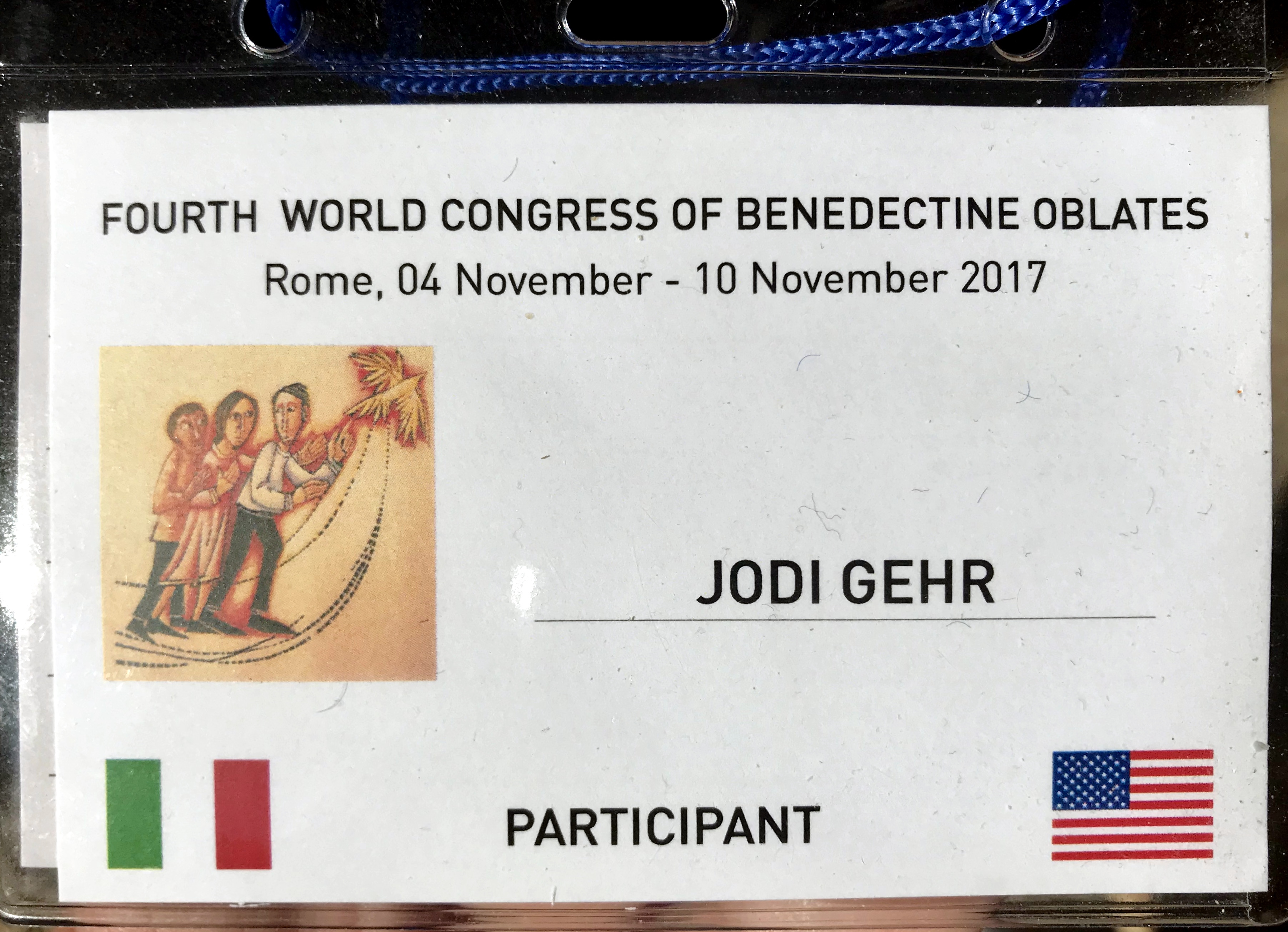
Greetings from the 4th World Congress of Benedictine Oblates at Fraterna Domus in Rome, Italy!
Benedictine Oblates from every continent, 36 countries in all, have gathered in the Eternal City to consider the Congress theme: “A Way Forward—The Benedictine Community in Movement.” The conference started on Saturday, November 4 with a welcome from Fr. Edward Linton, Director of International Benedictine Formation and a monk from St. Meinrad Archabbey in Indiana. The first day we enjoy good food, Benedictine hospitality, time to connect with those we know and those we hope to know better and, of course, prayer. Continue reading “4th World Congress of Benedictine Oblates, part 1”→











 Being Benedictine