Search

Being Benedictine

Living SoulFully as an Oblate of St. Benedict

Category

The Rule of St. Benedict

Gratitude or Grumbling: A Thanksgiving Choice

November 2025 Oblate Reflections

“Do not grumble or think ill of others.” (Rule of St. Benedict Ch. 4:39)

What is the key to practicing gratitude rather than grumbling? How can we live a grateful life in the midst of pain and suffering, our own, that of others, and that of the world around us? Is it possible to be thankful for challenging experiences?

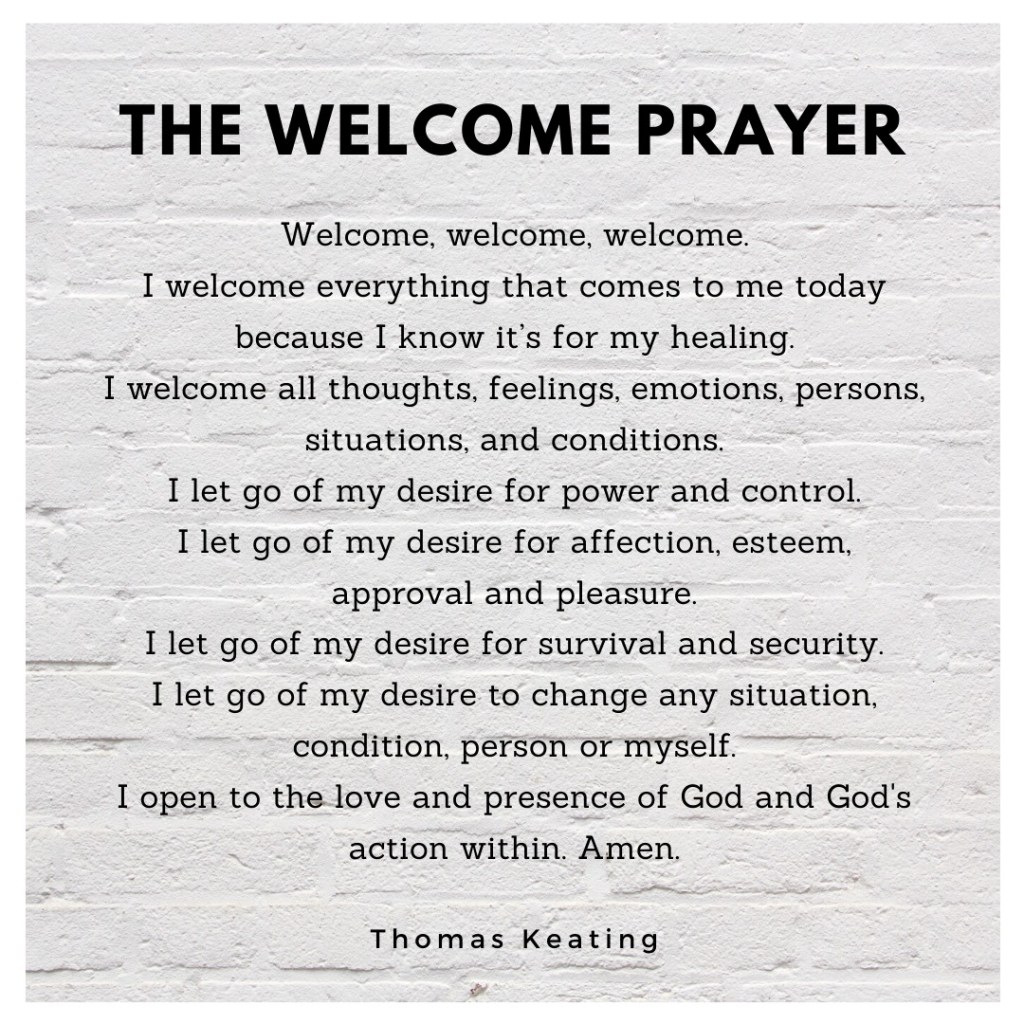
We use the Rule of St. Benedict and Scripture to address these questions at our November oblate meeting. We opened our meeting with the Welcome Prayer written by Fr. Thomas Keating).

If we truly practice this prayer to welcome all of the above, we find that the benefit of grumbling is minimal. In fact, grumbling is self-sabotage. The benefit of welcoming everything is that through the moments of distress, unease, discomfort, or suffering, we learn that another way could be a blessing. What can be difficult about the Welcome Prayer is the “letting go” of our control—and oh my, how much we prefer when things go our way.

St. Benedict has a few things to say about grumbling, a form of letting go of our own gripes, opinions, and negativity for the greater good of the community and ultimately our own selves. He encourages his monks to cultivate humility, patience, and a joyful acceptance of their station in life. It requires a surrender of pride to be content even when it is challenging to be.

We read the following excerpts and practice Lectio Divina as a group, sharing the insights we gained.

Continue reading “Gratitude or Grumbling: A Thanksgiving Choice”

10 Reasons Benedictines Love Silence

I carefully consider everything that I write and share here, especially the more personal or contentious reflections. I rarely write and post on the same day. Not so with my speech. I find myself saying often enough, “Did I just say that out loud?” Words fly out of my mouth much faster than they flow from my pen or keyboard.

 Perhaps this is why I enjoy journaling and writing so much. It slows my mind down. In silence, I can be more deliberate, careful, and organized in what I share. A healthy respect for silence could save me some angst in times when my mouth works faster than my mind.

At our annual oblate retreat, with the theme “Building Community Through Our Oblate Promises,” the importance of silence was the topic of the opening session led by Fr. Thomas Leitner, the administrator of St. Benedict Center and a monk who lives at the monastery across the road. Throughout the weekend, we would learn about and practice silence.

Why is silence so fundamental to Benedictine spirituality?

Silence is the way to self-knowledge. A discipline of silence confronts us with ourselves. “Silence is a way for us to put up with ourselves the way we are. Not everything that comes to mind at times of silence is pleasant. Repressed needs and wishes may come up, repressed anger, and perhaps missed opportunities,” Fr. Thomas shared. Silence gives our wounds space to surface, allowing us time to wrestle with and soothe our pain in healthy ways. Silence allows us to see ourselves unfiltered without the influence of others.

In The Interior Castle, St. Teresa of Avila uses imagery of a castle for our soul, emphasizing “how necessary this room (of self-knowledge) is…we shall never completely know ourselves if we don’t strive to know God.” She writes that God dwells within us, and to know God, we must first know ourselves. Hard, but necessary, work to “know thyself,” as the ancient Greek maxim suggests.

Silence connects us to the Divine. Seventh-century bishop and theologian, St. Isaac of Syria, writes:

We enter this “treasure house,” our very soul, through the practice of prayer. Some of us may be conditioned to think of prayer as a transactional bubble-gum-machine approach to asking God for what we want. We put in a coin; God supplies the big gumball. Our prayers are “answered.” Yet this is not the kind of prayer that leads to self-knowledge or to a connection with God. Consider a poem by the 19th-century Danish theologian Søren Kierkegaard that points to a different kind of prayer.

Silence builds confidence and leads to self-respect.

“As my prayer became more and more devout and interior,” I come to know myself with greater depth. This knowing builds my confidence: I have been created just as I am, in the image of God. I forgive myself for weaknesses and celebrate my gifts. I seek less approval from others. I have “less and less” to say to justify, convince, or plead my case of worthiness to myself or others.

Teacher, writer, and friend, Parker Palmer, writes,One of our most debilitating illusions (is) that the answer to our problems is always ‘out there’ somewhere, never ‘in here.’ It’s an illusion that’s constantly reinforced by educational and religious institutions that make us dependent on “experts” and “authorities.” We need not look for knowledge in others; we can trust our own interiority, the Divine Expert Within. I can grow in self-respect, knowing God is within me, intimately speaking to me when I am silent long enough.

Continue reading “10 Reasons Benedictines Love Silence”

To Love and Be Loved: The Monk and The Marriage

But now faith, hope, and love remain, these three; but the greatest of these is love. –1 Corinthians 13:13

This scripture verse is one of the most frequently read at wedding ceremonies, but it is meant for more than those getting married. We are created to love and be loved—all of us, no matter who we are or our chosen paths in life, whether monk or married.

Our deepest longing is to be loved. Love is the thread that runs through all the world’s religions. In Christianity, the Great Commandment is to “love the Lord your God with all your heart, and with all your soul, and with all your mind” and to “love your neighbor as yourself.” 

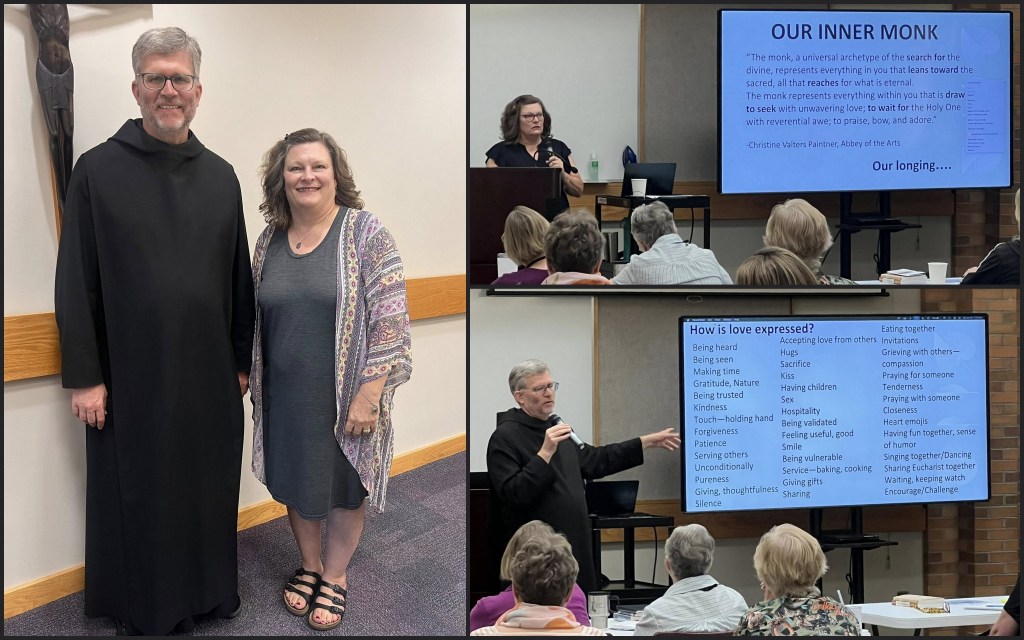
Several years ago, during spiritual direction with Benedictine monk, Fr. Mauritius Wilde, we discussed, despite our different vocations, how much we have in common. We each have a holy longing—to love God, to have a healthy love for ourselves, and to give and receive love. Practically speaking, we are the same age, we are both teachers and retreat leaders, have one brother, have the same middle name (Marie—seriously, what are the odds on that?), we share similar Enneagram personality traits, and each of us professed our marriage or monastic vows 40 years ago, a day apart. I was married on August 17, 1985, and Fr. Mauritius entered the monastery as a novice on August 18, 1985.

After one of many conversations where one of us would say, “That is exactly how it is for me!” or “Me, too!”, I half-seriously, half-jokingly suggested that we write a book about how, setting the whole monk vs. being married thing aside, we experience our love of God and others in many of the same ways. Nearly forgotten, this idea resurfaced a year or so ago, and we decided that leading a retreat together would be a good beginning. Our theme would be love, specifically how the Rule of St. Benedict can help us grow in love and to discover our “inner monk.”

“The monk, a universal archetype of the search for the divine, represents everything in you that leans toward the sacred, all that reaches for what is eternal. The monk represents everything within you that is drawn to seek with unwavering love; to wait for the Holy One with reverential awe; to praise, bow, and adore.” -Christine Valters Paintner

The Rule of St. Benedict shows us the path of love, of nurturing the monk within while living in community. During our retreat, held in July 2025, we shared how the monk’s promises—stability, obedience, and conversion of life—are the foundation for learning and growing in the “school for God’s service.” (RB Prologue 45) For the monk, this place of learning is the monastery. For me, it begins in my family as wife and mother. But each of us is more than our role as a monk or a married person. Each can be transformed by practicing love in our friendships, workplaces, community, and environment.

Continue reading “To Love and Be Loved: The Monk and The Marriage”

Tree of Life

“Everything in this world—every quark, atom, dust speck, heartbeat—quivers with the presence of God and is the presence of God…a kind of fourth dimension to all of life.”

-Thomas Keating: The Making of a Modern Christian Mystic by Cynthia Bourgeault

I find this divine quivering in the creative process of SoulCollage®, writing, planning retreats, deep listening with kindred spirits, reading good books and poetry, and in this season, beholding the beauty of springtime in the shimmering of every conceivable shade of green.

The presence of God quivers especially in the holy surprise of synchronicities, often referred to as a “thin place” by the Celts. Just minutes after creating a SoulCollage® card titled Tree of Life, I stumbled upon the most perfect poem.

Continue reading “Tree of Life”

Benedictine Spirituality of Work

November 2024 Oblate Reflections

Sources

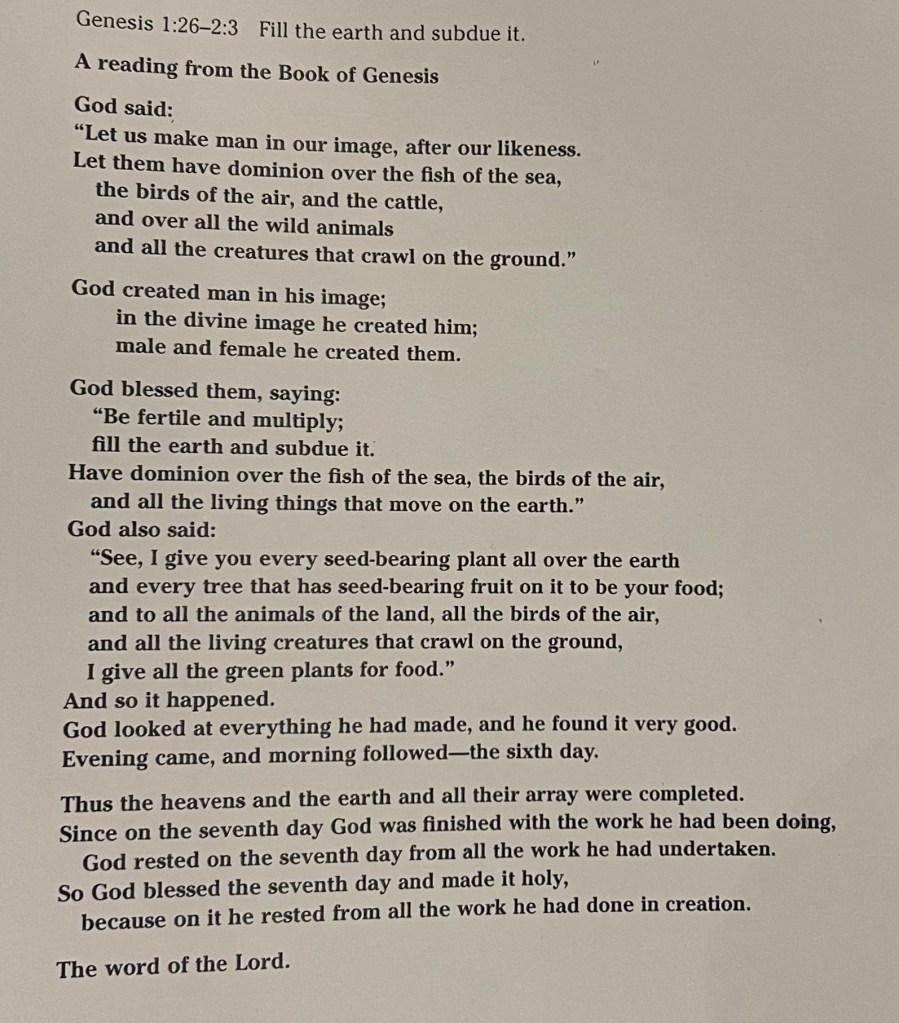
Lectio Divina—Genesis 1:26-2:3, Fill the earth and subdue it. 

Book DiscussionThe Oblate Life: Spirituality at Work, Dermot Tredget. Edited by Gervase Holdaway, OSB, 2008

Topics: Prayer, work, rest and study together provide a foundation for a Christian spirituality of work. St. Benedict recognized that work has a transformative power and for the monk is the principal means to seeking God. Our discussion flowed from words or phrases that resonated from sources listed above.

God created man in his image, in the divine image he created them.

We are created in the image of our Creator; we are creators, too, and it is our responsibility to contribute to the act of creation. Creation is not a once and done effort. Creation requires constant movement, growing, expanding, and even resting. We must ask ourselves if our work is valuable. Does my work add value to God’s creation? “We cannot speak about a spirituality of work without talking about an ethics of work.” (Dermot Tredget)

I give you every seed-bearing plant

In the image of our Creator, our work is to plant the seeds we are given which becomes our food. This isn’t quick and easy work; we need to rest, recover and have patience. We are in relationship with the Divine as co-creators. The Divine is not out of the picture. There is an unseen aspect of work–God is working even while we rest. Even further, what we see as useless toil may show value later. All is sacred.

Continue reading “Benedictine Spirituality of Work”

The Final Threshold: Take This Body Home

Day by day remind yourself that you are going to die.
Hour by hour keep careful watch over all you do,
aware that God’s gaze is upon you, wherever you may be.

Rule of St. Benedict 4:47-49

One of the gifts of a pilgrimage is those you connect with on the journey—greeting each other in the morning, offering small kindnesses, enjoying meals together, appreciating the sacredness of the sights, and sharing insights. On a recent Celtic Christianity pilgrimage to Ireland and Scotland, I knew only one person, my friend, SoulCollage® companion, and travel roommate, Sara, who I met several years ago at St. Benedict Center as a Benedictine Oblate.

Sara and I had decided to begin our pilgrimage four days earlier at the Cliffs of Moher, in the west of Ireland, and then travel by train to Dublin to catch up with the group once they arrived. Many pilgrims knew each other beforehand, so introductions in Zoom meetings and social media proved to be a helpful head-start to our shared time. Just a few days into our pilgrimage, I shared breakfast with one of the pilgrims, Mike, at a two-person table.

We ordered porridge and discussed the lengthy lines for fancy coffee from the European espresso machines, hoping for just a quick pot of black coffee. I was clearly more irritable about getting my first cup when Mike commented that he recently started taking a spiritual approach, a detachment from coffee, he said. If he gets coffee in the morning, all the better, but not getting coffee would not be a deal-breaker for his day. He would not allow the absence of coffee to interfere with his interior peace.

As I calmed down about the lack of morning caffeine, our conversation continued to a depth not often reached in such a short time. We shared that through the years our spirituality had changed, impacting how we experience life, especially how we respond viscerally as we witness racism, homophobia, injustice, and hateful behavior in our country. We shared our deepest grief about the estrangements in our family and the uncertainty of how healing might come.

Navigating long lines and crowds in the breakfast area, we finally achieved the goal of a cup of coffee.  Mike commented that people were not even looking at each other while getting food and drink. He was right. Mike’s comments remained in my heart throughout the day and I am grateful to have had such a meaningful conversation with him.

The gift of a pilgrimage “lies in the gaps of the agenda, in the conversations and relationships with others, and in the details of the day that cannot be planned or controlled. This is where the grace of God enters—sometimes it is in the form of discomfort and challenges and other times in opportunities that new insights and “aha moments” of new understanding bring.” (A Busload of Hospitality: A Benedictine Pilgrimage, Part 4, Jodi Blazek Gehr)

Continue reading “The Final Threshold: Take This Body Home”

A Heart Expanded by The Unspeakable Sweetness of Love: World Oblate Congress 2023

The Benedictine spirit is characterized by “a heart expanded by the unspeakable sweetness of love.” Pope Francis addressed the 5th World Congress of Benedictine Oblates in a private audience on September 15, 2023, as reported by Vatican News. The Congress theme, “Moving forward: Living the Wisdom of the Rule,” is an opportunity for Oblates, lay associates of a Benedictine monastery, to learn about their calling as monks in the world.

I participated in the 2017 Congress in Rome, attending the General Audience of Pope Francis at St. Peter’s Square. I reflected, “We were delighted to be seated on the platform, very near where the Holy Father was also seated. His message on the Eucharist was followed with a welcome for visiting groups with a special mention of Benedictine Oblates. For many oblates, this was one of the most magical moments of the week.” Indeed, it was very special.

But I can only imagine that a private audience with Pope Francis has left oblates still pinching themselves. Jaime Williams, Oblate from Christ the King Priory where I also belong, shared he cannot find the words to describe the experience (although he has promised a guest post when the words begin to flow.) Jaime shared photos of the program with the words of Pope Francis’ message, of which I will comment.

Jaime Williams, Oblate of Christ the King Priory, Schuyler NE, in the background (blue shirt) as Pope Francis greets Abbot Primate Gregory Polan.

The Holy Father spoke to three aspects of this “expansion of heart”: the search for God, enthusiasm for the Gospel, and hospitality. “The Benedictine life is marked first of all by a continual search for God, for His will and for the wonders He works,” the Pope said. He emphasized the importance of practicing contemplation with the practice of Lectio Divina, as well as contemplation of creation, the challenges of daily life, the experience of work as prayer, and especially through other people.

Like the monks,” he said, “who make the places where they live fruitful and mark their days with industriousness, you also are called in this way to transform your everyday settings, wherever you live, by acting as a leaven in the dough, with skill and responsibility, and at the same time with gentleness and compassion.”

Finally, Pope Francis reflected on the characteristic of “hospitality,” noting that Benedict instructed monks to receive guests at the monastery as they would receive Jesus Himself. As Oblates our “wider monastery is the world, the city, and the workplace, for it is there that you are called to be models of welcome with regard to whoever knocks at your door, and models in preferential love for the poor.”

Pope Francis captures what being Benedictine means to me. It is not about interpreting the literal words in the gospel, but how I take its timeless message into my daily life—in my work, family, relationships, community, environment, and more. The words of Franciscan monk, Richard Rohr, resonate with me, “I’m convinced that one of the only reasons Roman Catholicism has lasted is because we have these satellites of freedom on the edge of the inside—religious communities of Benedictines, Jesuits, Dominicans, Franciscans, Sisters of Charity, Sisters of Mercy, and many more.” It is the connection with my favorite monks, our monastery, and Benedictine spirituality, a 1600-year-old tradition, that has sustained my search for God, my desire to learn from the ancient texts and rituals, and to practice hospitality as a monk in the world.

Read more about the 2017 World Congress: The Future Is The Spirit’s Work

Jaime William’s 2023 World Congress reflections.

© Jodi Blazek Gehr, Being Benedictine Blogger

The Divine Presence is Everywhere

September 2023 Lectio Divina and Oblate Reflections

Lectio Divina—Chapters 19 and 20, Rule of St. Benedict

Book DiscussionThe Oblate Life, edited by Gervase Holdaway, OSB, 2008

Being Benedictine is to believe that the Divine Presence is everywhere, as the opening of Chapter 19 in the Rule of St. Benedict states.

“We believe that the divine presence is everywhere and “that in every place the eyes of the Lord are watching the good and the wicked” (Proverbs 15:3). But beyond the least doubt we should believe this to be especially true when we celebrate the divine office.”

Chapter 19, The Rule of St. Benedict

What is the Divine Office?

The Divine Office, also known as the Liturgy of the Hours or Opus Dei, the “Work of God”, is a daily prayer of psalms, readings, hymns, and prayers. Traditionally during a week, with prayers seven times a day, all 150 Psalms are recited by monks. The Psalms are prayers that Jesus and his disciples recited as part of the Jewish liturgy expressing the depth of human experience and emotion from joy, anger, thanks, praise, suffering, sorrow, contrition, petition, and more.

Continue reading “The Divine Presence is Everywhere”

Mindfulness and a Blue Heron

What is good medication for this time of conflict and anxiety? This question was posed by Fr. Mauritius Wilde, OSB, Ph.D. at a retreat he led called “Sober and Merciful: St. Benedict’s Journey of Mindfulness.”

Fr. Mauritius suggests we can learn how to approach the tensions in our lives and the conflicts in our family, community, and world by looking at the recommendations for selecting a leader of a monastic community in The Rule of St. Benedict, Chapter 64.  This chapter suggests that good leadership requires living the values of sound judgment, wisdom in teaching, pure motives, moderation, prudence, loving behavior, discernment, and as the retreat title suggests, soberness and mercy, among others.

Leadership starts with leading oneself. Cultivating the values of being sober and merciful can help us be our better selves in tough times. So often we want to escape or numb ourselves to any pain we may feel—to simply run away from our feelings, people, or situations. At other times we might become overwhelmed by distress or completely absorbed by worries. Neither of these approaches is effective to deal with conflict and anxiety but practicing soberness can provide a middle way—a more balanced, Benedictine way to help us accept our reality as it is, yet not becoming attached to it.

To be sober (Latin: sobrium) is to have an attitude of acceptance, to be temperate, and to take people, things, and activities just as they are. We can become “drunk with anxieties” of daily life, but as one who can compulsively think, ponder, wonder and what-if, this tendency can block one from seeing the truth of the way things truly are. It’s as if an alternate reality is created, one that takes us far away from the present moment.

Emotions can make us drunk; they can completely absorb us. Being sober and vigilant (1 Peter 5:8) is the absence of being drunk on emotion or being overcome with anxiety. By practicing mindfulness, we learn soberness tastes better—the purity and truth of circumstances are clear. One begins to sense when something is just too much—emotions, noise, activity, food, or drink—and is more able to set boundaries for what disturbs. Wanting more of this sobriety is craving what is real—the present moment, an ecstatic peace for only God can fill us with. To be sober is to be free. We must remain vigilant, alert, and open, for what God fills us with, for moments when Christ is revealed in our daily lives.

This retreat weekend is one of the last before I begin a new school year, so there is no shortage of uncertainty or anxiety. What I have learned about soberness is wisdom I will carry with me, a reminder to be gentle with myself while also being watchful and mindful of my tendency to be absorbed in emotion and the circumstances of a school day, whether it is a conflict with a student or colleague, disappointments of unmet expectations, or a frantic pace and frequent interruptions.

Continue reading “Mindfulness and a Blue Heron”

Blog at WordPress.com.

Up ↑