Sources: Mark 1:7-11; Always We Begin Again: The Benedictine Way of Living by John McQuiston II (Preface-p. 14)
For our Lectio Divina practice, we read more deeply Mark 1:7-11, the baptism of Jesus.
Words and phrases that resonate with us, shared in our discussion:
It is with great humility that John proclaims there is one more powerful than I. In an area of rabid individualism, it is hard to turn things over, to admit that I am not the fount of all wisdom. Even if we feel called to speak truth to power, to share our faith or ideas that may differ from another, we must humble ourselves as John did. John admits he is not to untie the sandals of Jesus, and even stoops down to show his humility. Indeed, there is one more powerful than I.
Both John and Jesus show humility. By going down into the water, Jesus foreshadows going down into the tomb. It is a descent, a submission to the obedience of the will of God, and then a rising. Jesus chose to be baptized; he did not have to be, but he chose to be weak, to become humble. This is the beginning of his service. He has been chosen to be Messiah. Jesus did not shy away from this service.
As part of Jesus’ baptism—the heavens were torn apart. Jesus’ identity was affirmed by the father; this is how we get our identity too. The heavens are torn apart for us as well. We live our lives in the balance of humility and knowing that we are made in the image of God.
Always We Begin Again—A new year, a new book.
We begin 2021 by reading the introduction and first section of Always We Begin Again: The Benedictine Way of Living by John McQuiston II (Preface through page 14.) The Rule of St. Benedict provided guidelines for monastic living by giving order to the monk’s day with a balance of prayer and work. Although it may be impossible to follow the Rule strictly while maintaining a life in the world, it is the longing of the Benedictine oblate to have a “creatively balanced framework for life.”
December 2020 Lectio Divina and Oblate Reflections
Sources: Luke 1:67-79; The Rule of St. Benedict, Chapter 72 Study Guide for The Rule of St. Benedict, Maria-Thomas Beil, OSB, page 180-185
For our Lectio Divina practice, we read more deeply the well-known Benedictus that is prayed every morning in the Divine Office, Luke 1:67-79.
Words and phrases that resonate with us, shared in our discussion:
Save us from our enemies….to show mercy….to set us free… without fear…. knowledge of salvation….forgiveness of our sins….the way of peace…promise….prepare his way…you, my child…tender compassion.
The Benedictus proclaims what God is doing and will do for us—not what we do. Many of us have grown up with the image of an angry God, but that is not the God we are shown in Scripture. We are promised a God of tender compassion, not a bookkeeper of judgments. Mercy is God’s loving response to suffering. God is not watching from afar; God is suffering with us.
The dawn from on high breaks upon us—God is breaking in with the incarnation and gives us hope. Benedict was not harsh, but practical, just as God is tender. God enters our history to experience our suffering with us, but we must expose our wounds for the tender compassion of our God to work. To prepare our heart, we must invite God in. Advent was a time to prepare our hearts for God to enter—although this task is never fully completed. We must live in perpetual Advent, inviting God in and humbling ourselves without fear, to receive the tender compassion of our loving God.
What do Christmas crèches, Wisconsin cheese, Benedictine Oblates, and Pilgrimages have in common?
For those who know and love him, the answer is obvious. Fr. Volker Futter.
Each is an expression of his hospitality. A true gentleman with a heart for one who needs compassion and comfort and the most energetic man I have ever met celebrates his 80th birthday today, December 29, 2020. Fr. Volker has touched many lives through his work as a Missionary Benedictine—as Oblate Director, Sub-Prior, and Mission Procurator—known especially for his hospitality. He is the living example of the instructions of St. Benedict, “Let all guests who arrive be received as Christ, because He will say: “I was a stranger and you took Me in” (Mt 25:35).”
St. Benedict instructs that “every time you begin a good work, you must pray to him most earnestly to bring it to perfection.” (RB: Prologue vs. 4)
Embedded in the guidance from St. Benedict in his Rule is that we must both pray and work, ora et labora. The prayers offered by religious at the Democratic National Convention embody the longing for peace and justice that, as Americans, we hope for and work towards. The prayers offered must not be declared only once but be the prayer of our hearts and in our every breath.
My Benedictine Oblate friend, Gloria, invited me to pray with her each day the prayers that Sr. Simone Campbell and Fr. James Martin, SJ shared at the DNC. Her suggestion gave me the idea to invite all who desire peace in the United States of America to also join us in daily prayer.
I share below the text and video of the prayers offered by Sister Simone Campbell, Executive Director of NETWORK and leader of Nuns on the Bus; Fr. James Martin, S.J., editor at large at America Media; Rabbi Lauren Berkun of Shalom Hartman Institute of North America; and Imam Al-Hajj Talib ‘Abdur-Rashid from The Mosque of Islamic Brotherhood.
Sister Simone Campbell
“The very first paragraph of the Scripture that informs the three Abrahamic traditions tells us: The Divine Spirit breathed over the waters of chaos and brought forth a new creation. Encouraged by this promise that a new creation can come from chaos, let us pray:
O Divine Spirit!
During the weeks and months ahead, stir our hearts and minds that we might fight for a vision that is worthy of you and your call to honor the dignity of all of your creation.
A vision of who we are as a people, grounded in community and care for all, especially the most marginalized.
A vision that cares for our earth and heals the planet.
A vision that ends structural racism, bigotry and sexism so rife now in our nation and in our history.
A vision that ensures hungry people are fed, children are nourished, immigrants are welcomed.
O Spirit, breathe in us and our leaders a new resolve…that committed to this new American promise, we will work together to build a national community grounded in healing, fearlessly based on truth, and living out of a sense of shared responsibility.
In the name of all that is holy, O Spirit, bring out of this time of global and national chaos a new creation, a new community that can, with your help, realize this new promise that we affirm tonight.
Topic: Seek Peace and Pursue It, Rule of St. Benedict: Prologue 17
Sources: John 14:27 and John 16:29-33; Study Guide for The Rule of St. Benedict, pages 13-15, Maria-Thomas Beil, OSB
Fr. Volker shares reflections and music for our August meeting.
The questions that guided our discussion were: How can we remain peaceful despite the anxiety caused by the pandemic and political division? And in light of our Lectio Divina readings: What did Jesus mean by the gift of peace? Oblates of Christ the King Priory met in person at St. Benedict Center for our August meeting, respectfully following safety guidelines of physically distancing at least six feet apart and wearing face coverings. Those who were not able to make the drive had the option to Zoom in. All are encouraged to follow the 11th Commandment:
My birthday, July 11, coincides with the Feast of St. Benedict. I cannot think of a better cause to support than the Missionary Benedictines in Schuyler, Nebraska, where I am a Benedictine oblate.
For my birthday this year, I’m asking for donations to Benedictine Mission House. I’ve chosen this nonprofit because their mission means a lot to me, and I hope you’ll consider contributing as a way to celebrate with me. 100% of donations go to their missions reaching out to underprivileged in developing countries, enabling them to help themselves and thus better their life through education on all levels, healthcare, farming, and animal husbandry.
Who are the Missionary Benedictines?
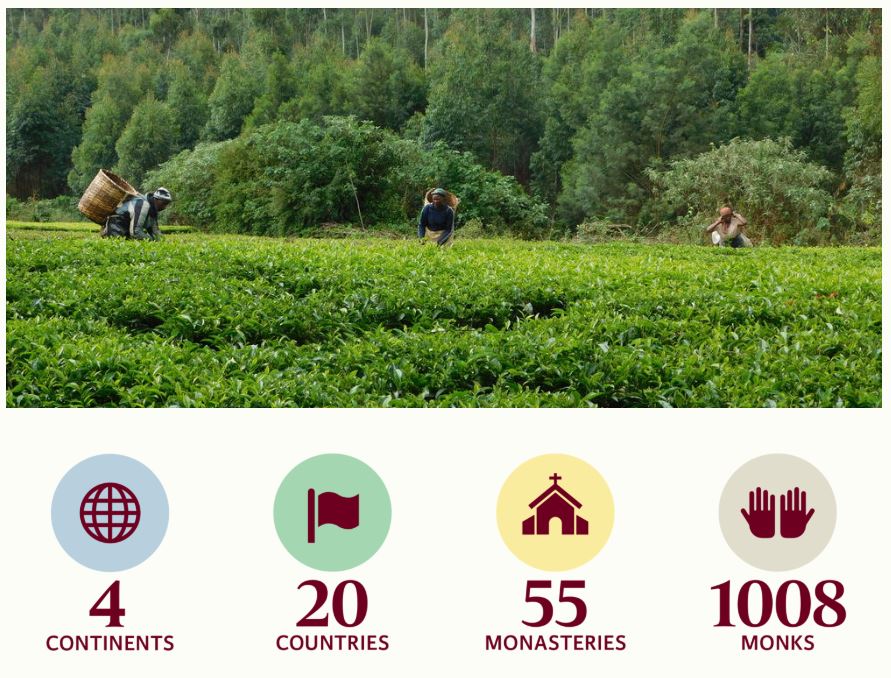
The Missionary Benedictines are a worldwide congregation of 19 abbeys and priories. 1100 monks live and work in Africa, the Americas, Asia, and Europe according to the Benedictine tradition in self-supporting monastic communities. Their work focuses on four primary areas: healthcare, education, hunger relief/environment, and evangelization.
As a teacher, education of young people is a cause close to my heart. Missionaries realized early on that education is a critical issue to help developing nations in their struggle towards independence and economic stability. The gathering place for children or adults, willing to learn the basics of the three “R’s” — reading, writing, and arithmetic by a missionary monk or sister was under a tree; later on the one classroom buildings with crude furnishings and often without doors or windows could be found on the parish property. Today, the standard of a school building is advanced compared to those of years ago. More info about education HERE.
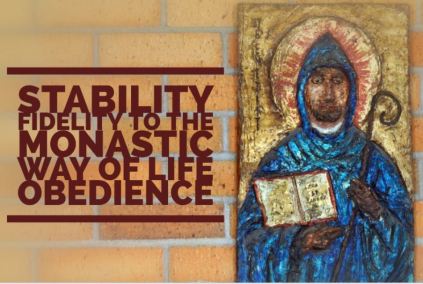
Benedictine Oblates are ordinary people: men and women, married and single, lay and ordained; Catholic and non-Catholic Christians; retired, working in the home and the community. Members of the Oblate community at Christ the King Priory are from Schuyler, Omaha, Lincoln, Missouri, South Dakota — even as far away as New York and Louisiana. What they have in common is a deep desire to live as members of the Body of Christ in a special way — according to the principles of the Rule of Saint Benedict. The promises Oblates (and monks) is to the conversion of life, stability, and obedience. For more information, click HERE.
As each one has received a gift, use it to serve one another as good stewards of God’s varied grace. — 1 Peter 4:10
Topic: The Emmaus Story, Creating a Peaceful Environment
Sources: Luke 24:13-35
After a successful inaugural Zoom meeting in April, the Oblates of Christ the King Priory were excited to meet again “virtually” as we continue to physically distance and adapt to the uncertainty that the pandemic brings. We began our morning with introductions, personal prayer intentions and Morning Prayer from the breviary.
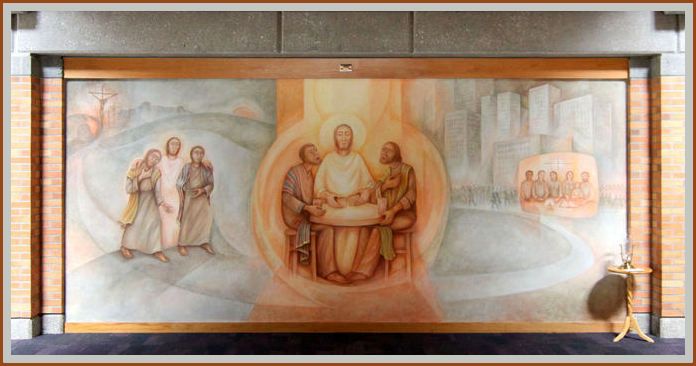
The Emmaus Story painted by Josef Mahler of Sautee Nacoochee, Georgia
Our Lectio Divina reading was Luke 24:13-35, the Emmaus Story.At St. Benedict Center, adjacent to Christ the King Priory and our typical oblate meeting place, all who enter are greeted with a mural of the Emmaus Story. It is the hope of the monks that visitors to the Center may have an Emmaus experience. “Were not our hearts burning within us as He spoke?” (Luke 24:32) Just as Jesus opened the Scriptures, revealing himself in the breaking of the bread, so too can those on the spiritual journey meet the living Christ.
Rich in meaning, there are many words and phrases that resonate with our group:
Stay with us. Initially, the disciple’s eyes were prevented from seeing the Risen Christ when encountering him on the road. They are talking, debating, and rehashing the events of the last days. They are downcast; disappointed, that the one they had hoped would redeem Israel was crucified. They are incredulous, sharing that the women of their group had reported that Jesus’ body was gone. The stranger promptly gave them an Old Testament lesson— “Oh, how foolish you are! How slow of heart to believe all that the prophets spoke!” The disciples ask the stranger to stay with them. In the breaking of the bread, they see him. Isn’t it interesting, an oblate shared, that the disciples were not put off with Jesus immediately vanishing? He vanishes, and yet now they recognize him. It is a paradox that he is gone, but also present. Continue reading “Hearts Burning Within Us”→
Planting trees is a big deal in Nebraska…so important that the planting and preservation of trees are celebrated with an actual holiday, Arbor Day, started right here in Nebraska and now observed in all fifty states and in several countries.
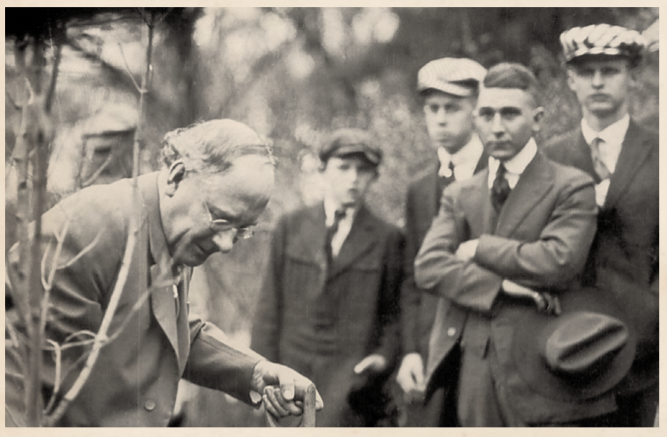
The founder of Arbor Day, J. Sterling Morton, was a transplant to the Nebraska Territory from Detroit in the mid-1850s. He was a journalist, newspaper editor and served as President Grover Cleveland’s Secretary of Agriculture. Morton understood the importance of trees to agriculture, for windbreaks to keep soil in place, for fuel and building materials, and for shade from the hot sun.
He believed in getting everyone, particularly students, involved in planting trees. An estimated one million trees were planted in Nebraska on April 10, 1872, encouraged by contests between counties and promotion in schools. “Students of different grades met at their respective school rooms in the morning for the purpose of planting at least one tree. Each tree that was planted was labeled with the grade, the time planted, and was to be specially cared for by that grade.” (The History of Arbor Day)
On the final Friday of April every year thereafter, Arbor Day has been celebrated. Throughout the year the Arbor Day Foundation works to “help others understand and use trees as a solution to many of the global issues we face today, including air quality, water quality, a changing climate, deforestation, poverty, and hunger” through conservation and education programs.
Each generation takes the earth as trustees. —J. Sterling Morton
Arbor Day Lodge is open for tours–we were just there a few months ago! Many activities and, of course, lots of trees in Nebraska City, Nebraska.
I recently finished reading The Overstory, the Pulitzer Prize-winning novel by Richard Powers and I have not stopped thinking about trees since. I think about climate change, our responsibility to creation and to future generations, the beauty of trees, the importance of nature in our spiritual lives, about knowing our place in the world, about Arbor Day and EarthDay and all the things that conscientious people do to make a difference.
Trees fall with spectacular crashes. But planting is silent and growth is invisible. –Richard Powers, The Overstory
The Overstory weaves together the stories of nine characters, their relationship to trees, and their awareness of and desire to stop the destruction of forests. The characters, each with a short story of their own, are the backdrop of a narrative that is less about them and more about trees. The Overstory was a reminder of how destructive humans have been and how significant non-human elements are to the survival of our planet.
“There would be neither an economic crisis in the world today, nor an ecological threat, were it not for the evil done by greed. Monastic poverty means being content with the simple things that sustain human existence in its inherent goodness. This poverty allows man to live in harmony with field and forest, without feeling the need to brutally strip the earth of her resources in order to realize an immediate gain. (Brother Philip Anderson, Prior Our Lady of Clear Creek Abbey )
Abbot John Klassen, OSB of St. John’s Abbey in Minnesota writes about our responsibility to the environment in Benedictine Life and Care for the Environment (highly recommended!) St. Benedict wrote about humility, stability, and frugality in The Rule he used for his monastic communities…there is much we can learn from his wisdom even 1500 years later.
In honor of Arbor Day, I share “Benediction of the Trees”, written and performed by Derek Dibben. This prayerful song is a recognition that Nature blesses us with trees for our healing, enjoyment, leisure, and protection. Our very breath is dependent on the Benediction of the Trees.
Benediction of the Trees
From the Heart to the Heavens
Rooted in the Earth
Branching out above us
Healing what was hurt
Reaching down to lift us
Swing us in the breeze
the air we breathe She gives us
Benediction of the Trees
Home before our houses
Cornered us inside
Gentle arms around us
Above the rising tide
Can you hear them calling?
Like music in a dream
The leaves are always falling
A Benediction from the Trees
A shout becomes a whisper
A Sermon into Song
It’s useless to resist her
She’s where we all belong
In our Sanctuary Forest
Beneath the Pleiades
Cicadas in the chorus
Benediction to the Trees
As the moon reflects the sunlight
From a million miles away
I’ll try to get the words right
So you can hear her say
In a melody familiar
That brings us to our knees
In Liturgy peculiar
Benediction to the Trees
April 2020 Oblate Lectio Divina and Discussion Topic: Lent Sources: Rule of St. Benedict, Chapter 49; John 11:45-56
“We dwell in grief and despair to be surprised into life again with resurrection—each year we are invited to make this sacred journey together.” –Engaging Benedict, Laura Swan
As Oblates of Christ the King Priory we “make this sacred journey together” meeting once a month for connection, prayer, and study. We gather in Schuyler, Nebraska on the second Saturday of the month for our Oblate meeting including morning prayers, Lectio Divina, Mass, lunch, and discussions both in full and small groups.
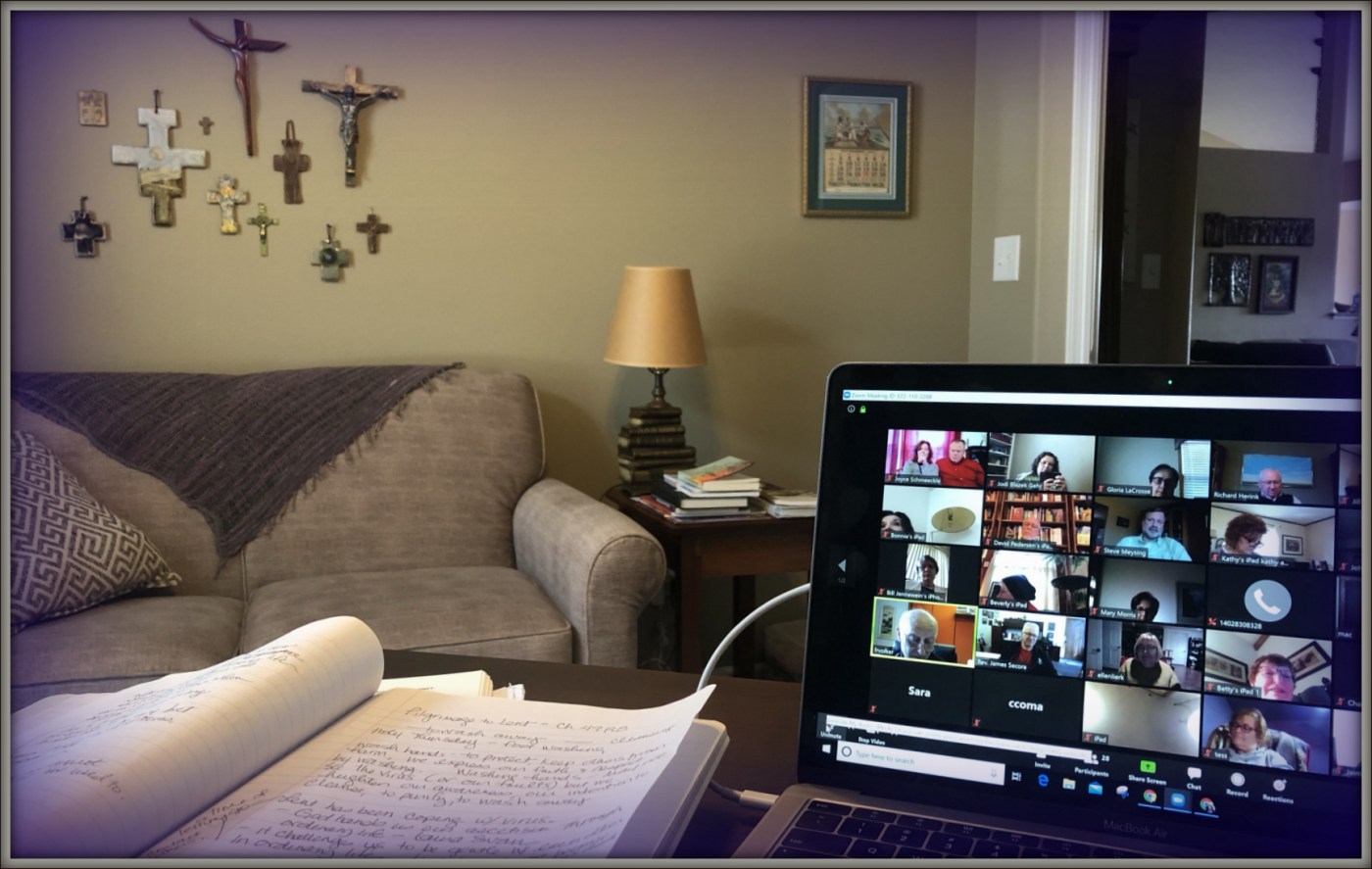
Our inaugural Zoom Oblate Meeting was a huge success!!
Yet, in this time of uncertainty when we cannot meet in person, we still crave the connectedness and the spiritual grounding of our Oblate promises. Being creative problem-solvers, several of our oblates organized a Zoom event for our April meeting. Fr. Volker reflects, “It worked out beyond any expectation and was a wonderful event. Our social media technology and the present challenging Coronavirus Pandemic turn out to be a hidden blessing.” We had 28 Oblates participate, many who typically cannot make the day trip for our monthly meeting. We started as we usually do with a few announcements, prayers and Lectio Divina, each in our own home, and yet we were together.
Our Lectio Divina reading:
There were many words and phrases that resonated with us:
You know nothing. Gather into one. What are we going to do? If we leave him alone. Began to believe in him. All will believe in him. Jesus would die for the nation. They looked for Jesus. The whole nation may not perish. What do you think? Jesus no longer walked about in public among the Jews.














 Being Benedictine