In 2014, I started this blog/website to share my writing and reflections on Benedictine spirituality. I recently learned that Being Benedictine has been identified as one of the Top 20 Benedictine Blogs by Feedspot. THANK YOU for following, sharing, commenting and supporting Being Benedictine for these years!
You can follow new posts and see over 100 entries in the archives HERE.
Our favorite pandemic pastime has been sitting on the deck in our backyard. We enjoy the sights and sounds of nature regardless of the weather. Nature has been healing for us, even if it means bundling up with coats, hats and mittens and plugging in a few outdoor heaters. We enjoy home-cooked meals, whiskey tastings, long conversations, and an occasional cigar (for one of us.) As Covid cases decrease and more people are vaccinated, we are encouraged to return to life as usual, but I find that given the option, my favorite entertainment is still in my own backyard.
Let me seek, then, the gift of silence, and poverty, and solitude, where everything I touch is turned into prayer: where the sky is my prayer, the birds are my prayer, the wind in the trees is my prayer, for God is in all.
— Thomas Merton, Thoughts In Solitude
One year ago, I wrote,“Birds chirping, frogs croaking, raindrops meeting their “splat” on the flowerpots and patio chairs, wind rustling in the trees—the simple sounds suggest that all is well with the world.” I feel the exactly the same—all is MOST well when I am attentive to the sights and sounds of nature, when I witness creation unfolding in my own backyard.
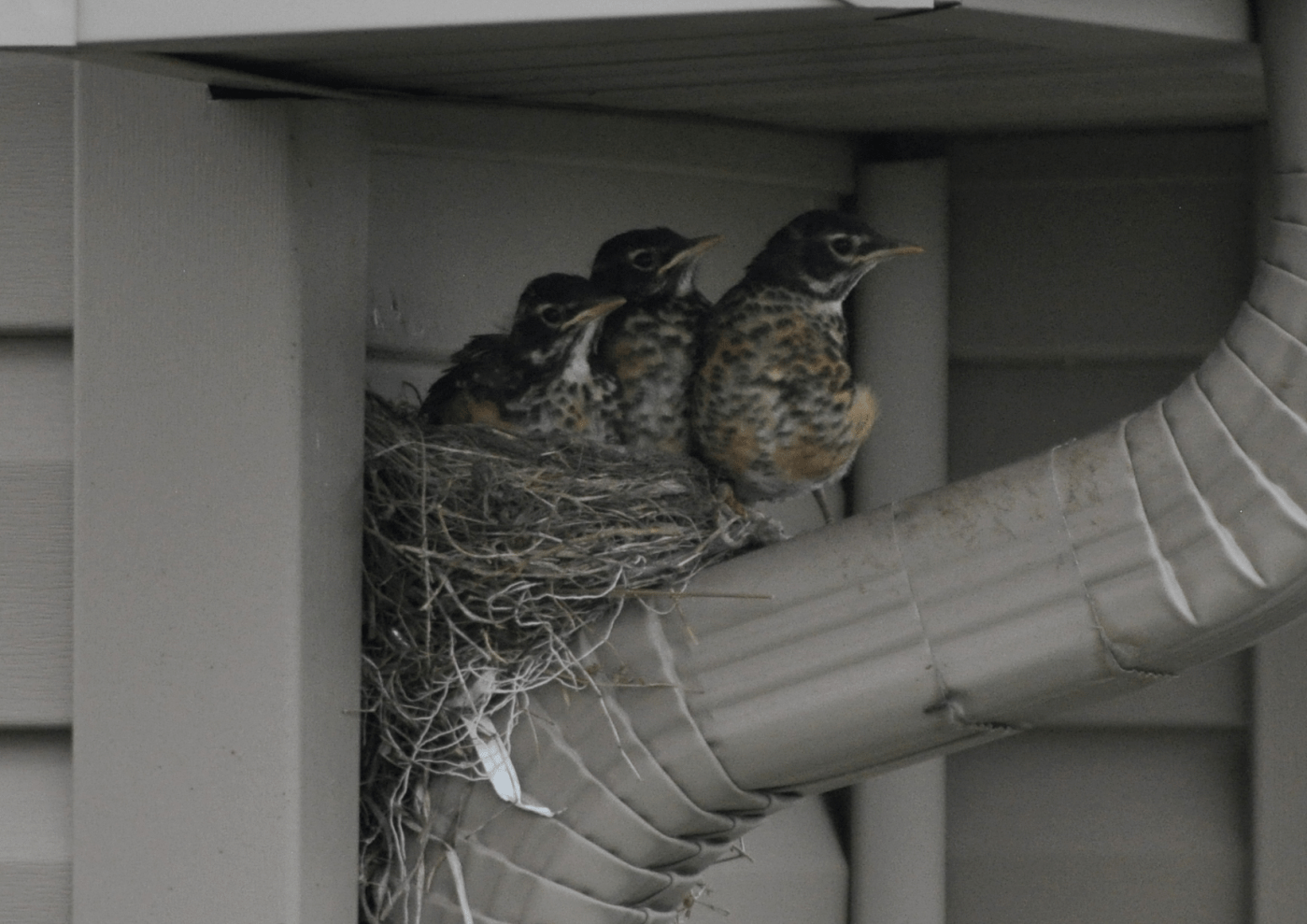
A few weeks ago (April 29, 2021), we noticed the resourcefulness of this mama robin who had built a nest on the downspout of our neighbor’s house. A bird’s home is its castle, as seen from our deck.
A few weeks later (May 14, 2021), we see the first feeding of the baby birds.
Being Jessica’s mother is the greatest gift and honor of a lifetime. I will never forget the moment she was born. “You got your girl,” my husband said. I had all but forgotten that the baby would have a gender while laboring. This excerpt from The Red Tent resonates about that moment:
“There should be a song for women to sing at this moment, or a prayer to recite. But perhaps there is none because there are no words strong enough to name that moment. Like every mother since the first mother, I was overcome and bereft, elated and ravaged. I had crossed over from girlhood. I beheld myself as an infant in my mother’s arms, and caught a glimpse of my own death. I wept without knowing whether I rejoiced or mourned.”
Anita Diamant, The Red Tent
It’s been a few years since Jess and I have spent an official Mothers’ Day together. For the past five years, she has done some serious adulting—graduating from college, moving from Lincoln to Washington, DC. to Madison, Wisconsin, working full-time, going to graduate school, getting her first apartment on her own, and finding love.
2020 was a big year. Besides enduring a pandemic that abruptly ended her graduate studies sans proper graduation ceremony, Jessica started a new job with the Wisconsin Department of Health Services as a Children’s Services Program and Policy Analyst. And on the third Sunday of Advent—called Gaudete Sunday, Latin for joy—John Holland asked Jessica to marry him on a hilltop in historic Galena, Illinois where more than 5,000 candlelit luminaries lined the streets, steps, sidewalks, and store windows. Jessica’s smile says it all — PURE JOY.
Sources: Lectio Divina, Mark 16: 9-15, “Go into the whole world and proclaim the Gospel to every creature.”
Book Discussion, Always We Begin Again by John McQuiston II
It was the first time in over a year that many of our oblates met in person. All of those present were fully vaccinated, thank God!
We begin our Oblate Meeting with Lectio Divina practice reading Mark 16: 9-15:
9 When Jesus had risen, early on the first day of the week, he appeared first to Mary Magdalene, out of whom he had driven seven demons.
10 She went and told his companions who were mourning and weeping.
11 When they heard that he was alive and had been seen by her, they did not believe.
12 After this he appeared in another form to two of them walking along on their way to the country.
13 They returned and told the others; but they did not believe them either.
14 But later, as the Eleven were at table, he appeared to them and rebuked them for their unbelief and hardness of heart because they had not believed those who saw him after he had been raised.
15 He said to them, “Go into the whole world and proclaim the Gospel to every creature.”
Between sunset on Holy Saturday evening and sunrise on Easter Sunday, the Easter Vigil is celebrated. I have spent the Holy Days, the three days leading up to Easter, with the Benedictine monks in Schuyler many times. The prayers and chants are the most beautiful of the liturgical year.
The Easter Vigil readings begin with the Book of Genesis—the story of creation when heaven and earth, darkness and light, water and sky, land, plants, animals, birds, fish, and humans were created—and continue through New Testament readings. Between each of the several readings is a Psalm that is sung by cantor and congregation.
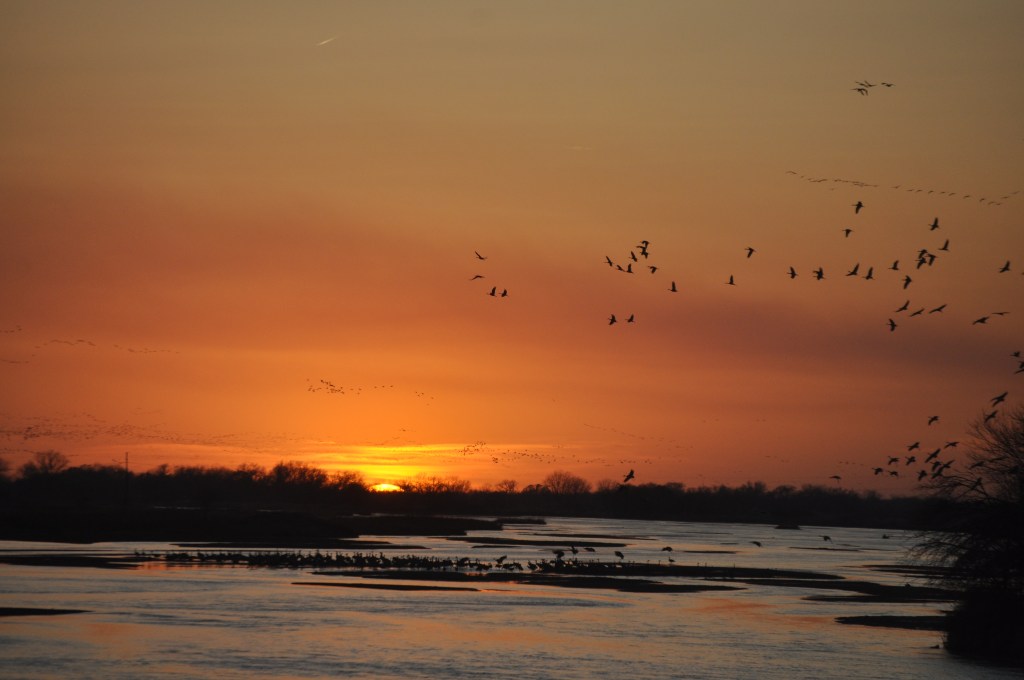
This year I spent the Holy Days listening to a different kind of song, the call of the Sandhill Crane. I missed the familiar chants of the monks, participating virtually when possible, but the experience of observing the oldest living birds feasting in the fields and wetlands of Nebraska was likewise a sacred experience.
Inspired to learn more about Mary Magdalene and especially by Cynthia Bourgeault’s book, The Meaning of Mary Magdalene, Alana Levandoski puts words and music to what she imagined in a journey with Jesus. See Easter through Mary Magdalene’s eye in song. Links below.
“In thanks to the example of Mary Magdalene, we won’t be hiding out somewhere waiting to see what happens. Instead, we can walk with Mary, who never left Jesus, through it all, and go to the very heart of this planet, reconciling all things, and come Sunday, find out that we are more involved in the resurrected presence than we think.”
-Alana Levandoski
I would know those feet
Anywhere
Like you would know mine
Human one
And it breaks my heart
To see them so
Like it would break yours
Human one
I feel helpless
You feel forsaken
But love is stronger
Love is stronger
You said follow
And I will follow
Wherever you’re going
I will go
There go those feet
Descending
And so will my feet
Human one
Into the heart of the world
Reconciling all things
I will hold fast with you
Human one
And all the hell that ever was
Has nothing on us
‘cause love is stronger
Love is stronger
You said follow
And I will follow
Wherever you’re going
I will go
What’s this I see
Your feet again
Here in our garden
Human one
But I cannot cling
The ripple’s gone out
Beyond the stars and back
Human one
But neither death nor life
Can separate us
‘cause love is stronger
Love is stronger
You said follow
And we will follow
Wherever you’re going
We will go
Human One directed, filmed, and edited by Alana Levandoski song written, performed, and produced by Alana Levandoski
Listening to the sweet and soulful songs of Alana Levandoski is prayer itself. I discovered Alana through the Center for Action and Contemplation and have used her contemplative songs and chants in retreats I have led and in my own prayer practice. Whether setting music to her own words, or lyrics drawn from poetry or scripture, her singing is elevated prayer.
Ring Out, Wild Bells, a poem sung by Alana, is a heartfelt, prayerful intention to ring out the old of 2020, a year of great challenges, and to ring in the new of 2021. The poem, In Memoriam, (Ring out, wild bells) was written during a time of grief, nearly 150 years ago by Alfred Lord Tennyson (1809-1892). The lyrics ring true for both letting go and welcoming in—letting go of the false, feuding, dying, grief, pride, partisan divide, and civic slander WHILE welcoming in the new, true, noble, sweet, pure, love, truth, light, and peace. Read more HERE.
Sources: Luke 18: 9-14; Good Work; Teaching and Learning—Always We Begin Again by John McQuiston II
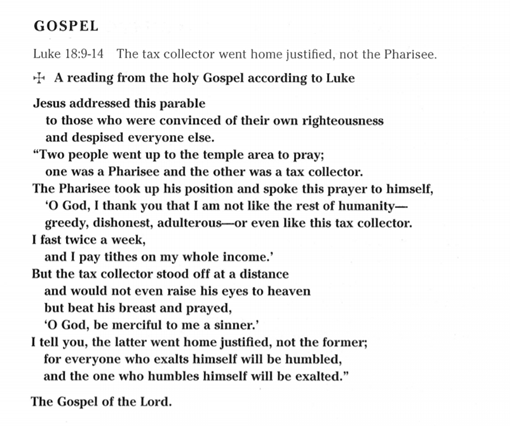
We begin our Oblate Meeting with Lectio Divina practice by reading Luke 18:9-14.
We began our discussion with the question: Can I find myself in both the Pharisee and the tax collector? There is no doubt that we have each of them within us, not just one or the other.
We can dig deeper by asking: How can I come into relationship with Jesus and others knowing I am a multi-facetedperson, not all good or all bad. This parable is addressed to those who feel their righteousness (I’m a good guy), and may despise others for not being as good. We compare ourselves to others—our good works become a score card rather than a gift from our heart. We must avoid creating a tally of our good works or making comparisons with others about how good or bad I am (or how good or bad someone else is)—we are ALL sinners and in need of God’s mercy; not one of us is more worthy than another.
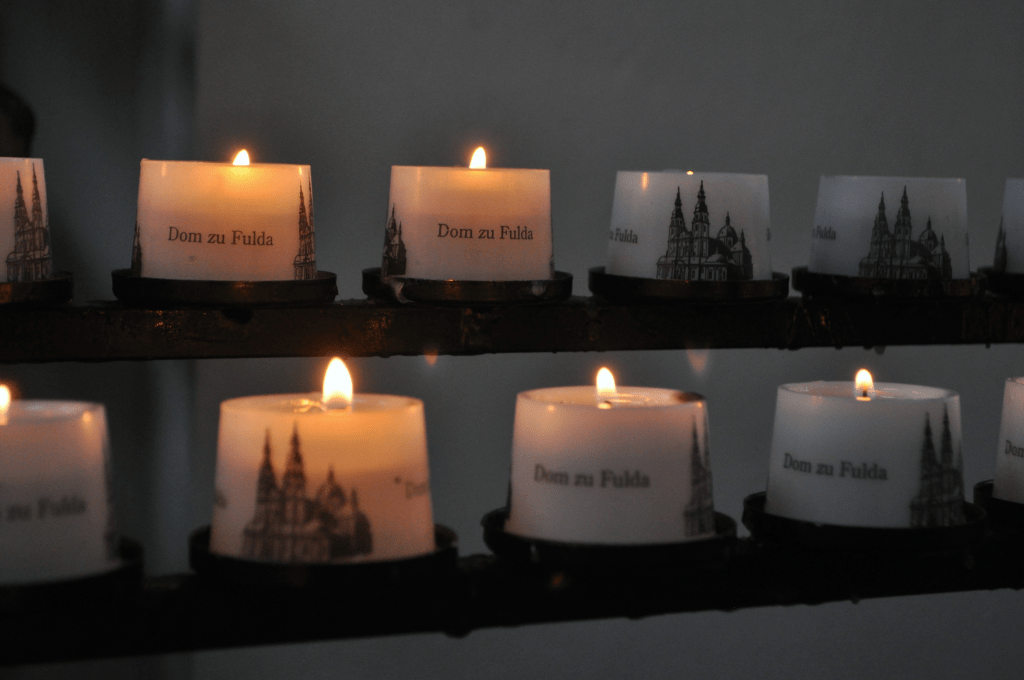
Lighting a candle is a sacred ritual in many religions. It is a prayerful intention to remember a loved one or to pray for those who have died. We can pray using words or in silence, but the act of lighting a candle can be itself prayer. It is expression, longing, remembering, hoping. A candle is a symbol of Christ-light entering into our darkness.
I am drawn to the display of candles in churches, chapels, basilicas and other places of prayer. When alone in prayer or in meditation with friends, a candle is lit. When away from my family on trips, I light a candle for them. When 500,000 people in my country die in less than a year, I am moved to pray with candles.
Fulda, Germany
Join me in prayer, a visio divina, for the 500,000 who have lost their lives to Covid in the United States, for those who have died throughout the world and for all their loved ones. May their lives and memories be a blessing.
February 2021 Lectio Divina and Oblate Reflections
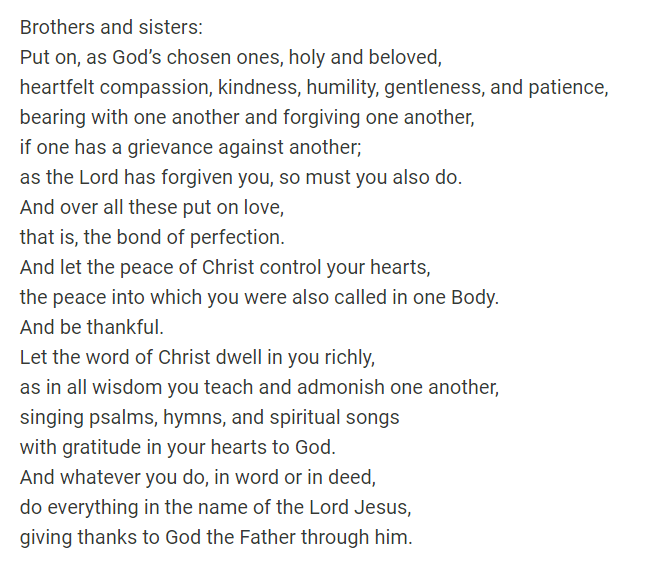
Sources: Colossians 3:12-17; Always We Begin Again: The Benedictine Way of Living by John McQuiston II (pages 17-22)
For our Lectio Divina practice, we read more deeply Colossians 3:12-17
We share aloud, some of the words and phrases that resonate with us:
God’s chosen ones, holy and beloved. Put on…heartfelt compassion, kindness, humility, gentleness, and patience.
Bearing with one another. Forgiving one another. Put on love….that is the bond of perfection.
Let the peace of Christ control your hearts. Be thankful.
Let the word of Christ dwell in your richly. Gratitude in your hearts.
Compassion: We think of compassion as feeling sorry for someone, but it is to feel with someone, to enter into the sufferings and joys of another person. Jesus had compassion for us, entering fully into our lives. He is one with us. We are called to emulate this kind of compassion with others. Sometimes there may not be much we can say to another, but we can give our presence, a physical touch. Wordless gestures are just as compassionate, perhaps even more so.










 Being Benedictine