Search

Being Benedictine

Living SoulFully as an Oblate of St. Benedict

Tag

Benedictine Spirituality

Announcing an International Traveling Benedictine Art Exhibit

“Looking at art is one way of listening to God.”

Sister Wendy Beckett, A Child’s Book of Prayer in Art

Listen, the first word in the Rule of St. Benedict, is the source of all creativity. Before the first word of a poem or essay can be written or a stroke of a paintbrush can be made, one must listen to self, soul, and the Divine. From listening, a flash of insight may strike, an idea bubbles up…

Life Through A Different Lens, an international traveling Benedictine art exhibit, is an idea that came from the deep soul-listening of Benedictine Oblates Linda Mingos (Benedictine Sisters of Virginia) and Kent Onah (Ewu Monastery, Nigeria).

The vision of Life Through a Different Lens is to celebrate “the light and grace of God, alive in the Rule of St. Benedict, illuminated through time, and reflected in every race and culture throughout the world today.”  Our hope is to communicate the importance of Benedictine spirituality and monasticism through art and creativity.

Each creative piece in the traveling exhibit—a reflection, poem, or visual art—will reflect the Benedictine way of life through the charisms of the Rule of Benedict within the artist’s current culture and society. Visual art, poems, reflections, and more can illuminate the values of hospitality, community, justice, listening, humility, silence, prayer, and work, to name a few.

We are seeking individuals who create (artists and writers), monasteries in the United States and Africa, where the artwork can reside for three months before it moves to its next location, and financial sponsors, to help make all this happen in 2027. An exhibit catalog of all art and creative work, and a companion study guide for personal reflection or small-group discussion, will accompany the traveling exhibit.

Capturing our creativity through art is both prayer and work. And for those who will see it, like viewing art in a museum or reading a good book, listening to the message or intent of the artist can be a spiritual practice. Both creativity and listening are ways to pray.  

Our first planned exhibition site and opening ceremony will be held at the Ewu Monastery in Nigeria, the birthplace of monasticism in the prayer and work of desert mothers and fathers of the desert of Africa. If you would like to be a part of Life Through A Different Lens, we would love to hear from you.

“All art is a terrific bridge…Music, paintings, words, they really do speak to the soul, to the heart, to the spirit…” 

-Julia Cameron

Artwork will be juried for admission into the exhibit. See submission examples below. If you would like to learn more about this project, please email mingoslindaj@gmail.com. Your response should include: your name, email address, the name of your monastery, the country in which you live, and the language you speak.

Some guidelines:

  • Artwork size 2’ x 3’ minimum, 3’x 4’ maximum, shipped ready to hang.
  • Written work should not exceed 500 words single-spaced or 250-300 words double-spaced, 12 pt font, 1” margins.
  • Submissions accepted from committed or professed Benedictines, monks or oblates.

Submission Examples

Reflection Submission—From Cave to Community by Linda Land-Closson, Oblate Benet Hill Monastery, Colorado Springs, Colorado

Benedict of Nursia: born in Rome four short years after the fall of the western roman empire, an aristocrat in a crumbling world. so much to lose. more to fear. yet tethered to Scholastica, the one with whom he shared a womb.

He fled that world at 20 or so and retreated to a cave. I get that. In my bones. I get that urge to escape what a collapsing empire feels like: the power-grabbing, the unfettered egos, the lies, manipulation, violence. the fear-based finger pointing, gaslighting, and scapegoating: all slung about as distractions, magic sleight-of-hand, them-Them-THEM…not-us. I’d return to the womb if I could. a cave—any cave—will do.

Run away. oh, how I want to run away! how I want to lock myself in a room and have a Veruca-Salt-sized temper tantrum: “I want the world to go away, Daddy, and I want that now!”

Three years of solitude sounds about right. three years of praying, of silence, of only-enough-human-contact-to-resupply and nothing more. Three years of not listening to news and fake news and fake news about fake news, of not hearing the voices of those with the power to be heard above the din of oppression and social decay. Maybe it will all be over in three years.

Three years did something for Benedict. He came out of his cave, out of his solitude, and he wrote about community. He wrote for community because community becomes resistance when the Sirens of despair call. Who knows what Benedict riddled for three years, but he realized community was the answer, the answer to power-over, the answer to ego and to malaise, the answer to anger, the answer to our feigned independence. His life began by sharing the most intimate of spaces with another person, after all.

Community is the Way, Love-centered, God-centered community. This is where we find forgiveness-grace-mercy, sometimes for the first time. Where we find ourselves, usually for the first time. and somewhere, sometime, somehow, this is where we find forgiveness-grace-mercy for the Other. over and over, knitted into benign and seemingly meaningless moments, words, and actions. Community finds us and we find the Other. We find that both—that all—contain the divine spark.

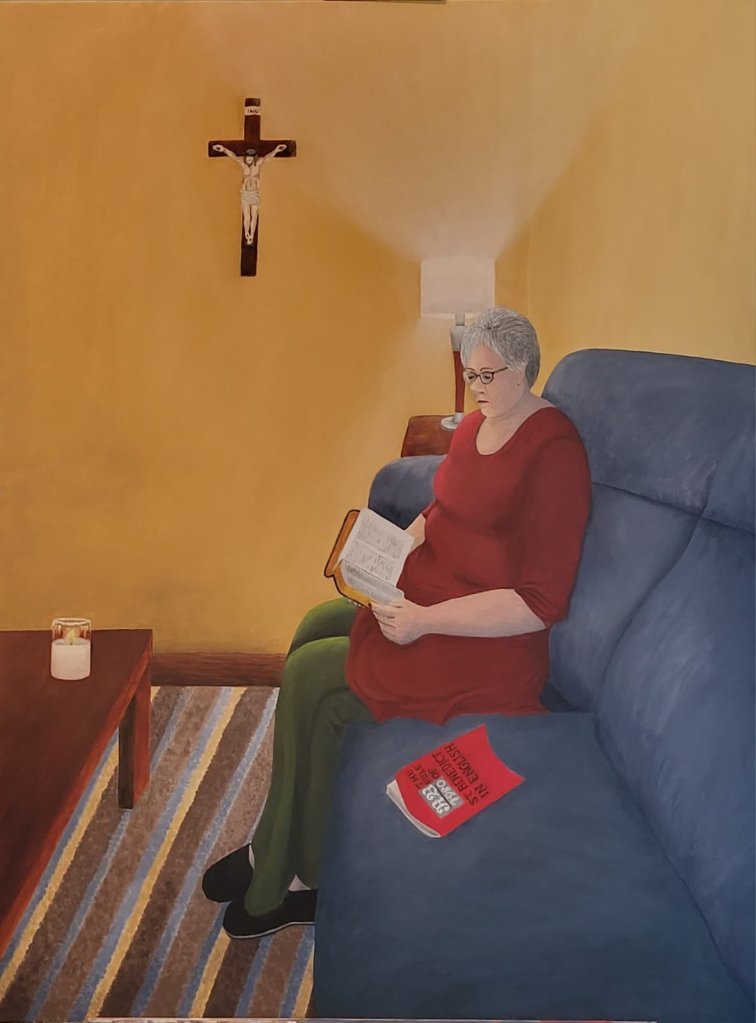
Visual Art SubmissionOil on Canvas by Linda Mingos, Oblate, Benedictine Sisters of Virginia, Bristow, Virginia
Poetry Submission—The Smiling Heart Serves by Mike Gurak, Benedictine Sisters of Virginia, Bristow, Virginia

© Jodi Blazek Gehr, Being Benedictine Blogger
10 Reasons Benedictines Love Silence

I carefully consider everything that I write and share here, especially the more personal or contentious reflections. I rarely write and post on the same day. Not so with my speech. I find myself saying often enough, “Did I just say that out loud?” Words fly out of my mouth much faster than they flow from my pen or keyboard.

 Perhaps this is why I enjoy journaling and writing so much. It slows my mind down. In silence, I can be more deliberate, careful, and organized in what I share. A healthy respect for silence could save me some angst in times when my mouth works faster than my mind.

At our annual oblate retreat, with the theme “Building Community Through Our Oblate Promises,” the importance of silence was the topic of the opening session led by Fr. Thomas Leitner, the administrator of St. Benedict Center and a monk who lives at the monastery across the road. Throughout the weekend, we would learn about and practice silence.

Why is silence so fundamental to Benedictine spirituality?

Silence is the way to self-knowledge. A discipline of silence confronts us with ourselves. “Silence is a way for us to put up with ourselves the way we are. Not everything that comes to mind at times of silence is pleasant. Repressed needs and wishes may come up, repressed anger, and perhaps missed opportunities,” Fr. Thomas shared. Silence gives our wounds space to surface, allowing us time to wrestle with and soothe our pain in healthy ways. Silence allows us to see ourselves unfiltered without the influence of others.

In The Interior Castle, St. Teresa of Avila uses imagery of a castle for our soul, emphasizing “how necessary this room (of self-knowledge) is…we shall never completely know ourselves if we don’t strive to know God.” She writes that God dwells within us, and to know God, we must first know ourselves. Hard, but necessary, work to “know thyself,” as the ancient Greek maxim suggests.

Silence connects us to the Divine. Seventh-century bishop and theologian, St. Isaac of Syria, writes:

We enter this “treasure house,” our very soul, through the practice of prayer. Some of us may be conditioned to think of prayer as a transactional bubble-gum-machine approach to asking God for what we want. We put in a coin; God supplies the big gumball. Our prayers are “answered.” Yet this is not the kind of prayer that leads to self-knowledge or to a connection with God. Consider a poem by the 19th-century Danish theologian Søren Kierkegaard that points to a different kind of prayer.

Silence builds confidence and leads to self-respect.

“As my prayer became more and more devout and interior,” I come to know myself with greater depth. This knowing builds my confidence: I have been created just as I am, in the image of God. I forgive myself for weaknesses and celebrate my gifts. I seek less approval from others. I have “less and less” to say to justify, convince, or plead my case of worthiness to myself or others.

Teacher, writer, and friend, Parker Palmer, writes,One of our most debilitating illusions (is) that the answer to our problems is always ‘out there’ somewhere, never ‘in here.’ It’s an illusion that’s constantly reinforced by educational and religious institutions that make us dependent on “experts” and “authorities.” We need not look for knowledge in others; we can trust our own interiority, the Divine Expert Within. I can grow in self-respect, knowing God is within me, intimately speaking to me when I am silent long enough.

Continue reading “10 Reasons Benedictines Love Silence”

Being Benedictine: Beginning the Journey

Some things change your life forever—getting married, having a baby, getting a new job, or a promotion. Finding St. Benedict Center in June 2002, twenty years ago, makes my “forever” list. It was the beginning of a connection that has changed my life in countless ways. It started my journey of Being Benedictine.

As a busy mom, wife, and teacher, I had a desire for silence and prayer. I learned about a four-day silent contemplative prayer retreat at St. Benedict Center in Schuyler, Nebraska from an advertisement in our local newspaper. I loved the silence; although the twenty-minute meditation sittings throughout the day were a little more challenging, I knew I would come back to this oasis of peace.

St. Benedict Center sponsors many retreats each year—these opportunities have nurtured my spiritual longing and love of learning. I wasn’t sure if I would come back for a silent retreat, but I knew I would return to this sacred getaway soon. It started out that I came two or three times a year….and it gradually increased over time to be once or twice a month. There was one summer that I came every week, and it was suggested that I build a little cabin out back. I’ve particularly enjoyed attending retreats given by the monks of Christ the King Priory, visiting monks, and by authors like Macrina Weiderkehr (who became a dear friend), Joyce Rupp, Anselm Gruen, Helen Prejean, and Michael Casey. I have even come back for more silent retreats too, and I eagerly look forward to them now.

Continue reading “Being Benedictine: Beginning the Journey”

From who we are to who we might become

February 2019 Oblate Lectio Divina and Discussion

Topic: Conversion

Luke 5:27-32Jesus saw a tax collector named Levi sitting at the customs post. He said to him, “Follow me.” And leaving everything behind, he got up and followed him. Then Levi gave a great banquet for him in his house, and a large crowd of tax collectors and others were at table with them. The Pharisees and their scribes complained to his disciples, saying, “Why do you eat and drink with tax collectors and sinners?” Jesus said to them in reply, “Those who are healthy do not need a physician, but the sick do. I have not come to call the righteous to repentance but sinners.”

Jesus saw something in Levi—that he was both a tax collector and open to an invitation to follow him. Levi worked with the oppressive Roman Empire, likely judged as greedy and affluent at the expense of others, but Jesus saw his potential.

So often we see people or situations as either/or, not both/and. We see the tax collector, or a politician, or social media as either good or bad, quickly making blanket statements or judgments to categorize into one or the other. But Jesus does not see Levi as one or the other, he sees Levi, and us, as both/and—as who we are and who we might become. Continue reading “From who we are to who we might become”

Rome: Confessions, Truths and Carpe Diem!

Confession: I feel a little guilty for taking nine days off during the school year.

Truth: But not enough that I wouldn’t seize this once-in-a-lifetime opportunity to travel to Rome.

It’s unheard of for a teacher to take off two weeks during the school year. First, we only get eleven days off for sick or vacations days per school year. Second and more importantly, it’s a lot of work to be gone, planning what students will do, securing a trusted substitute teacher to deliver curriculum, and “letting go” of controlling my classroom. (Perhaps this has something to do with being a bit of a perfectionist, control-freak, as I’m learning about Enneagram, Type One.)  Usually, teachers take time off for a wedding or funeral, a child starting college, an important doctor’s appointment, but a two-week long trip? Nope. Continue reading “Rome: Confessions, Truths and Carpe Diem!”

Prayer during Lent (and other times too)

March 2017 Oblate Reflections and Lectio Divina

Topics: Lent for Benedictines; Ways to Pray

Source for discussion: Study Guide for the Rule of St. Benedict with Reflections for Oblates and All Who Seek God, Maria-Thomas Beil, OSB
Readings in the Rule of Saint Benedict: RB 48:14-15 THE DAILY MANUAL LABOR, RB 49:1-10   THE OBSERVANCE OF LENT

St. Benedict states that the life of a monk ought to be a continuous Lent  (RB:49). St. Benedict in his wisdom knew few would have the strength for this, so he has other suggestions. Fr. Volker Futter, Oblate Director, shared two important ideas:

  1. Lent is self-offering, not denial, it comes from the heart.
  2. We need to acknowledge  the presence of God then we can do sacrifice.  Sacrifice can be giving up something specific like food, TV or internet, or we can give a positive sacrifice.

Oblates shared that “giving of your time is priceless—you can’t get it back”.  So a short visit to the nursing home, or a visit to a neighbor or sending someone a long overdue card—that is your gift of time. “This may sound simple, but one of the hardest things for me to do is find that priceless gift of time for others.  It really is a sacrifice.”

A definition of compunction of heart was requested.  Compunction of heart is when we have an uneasiness or anxiety of the conscience because of something we may have done that may have caused worry, fear, etc. in someone’s heart.  When we give this up we receive more in return. Continue reading “Prayer during Lent (and other times too)”

The road ahead is uncertain. But isn’t it always?

The road ahead is uncertain. But isn’t it always?

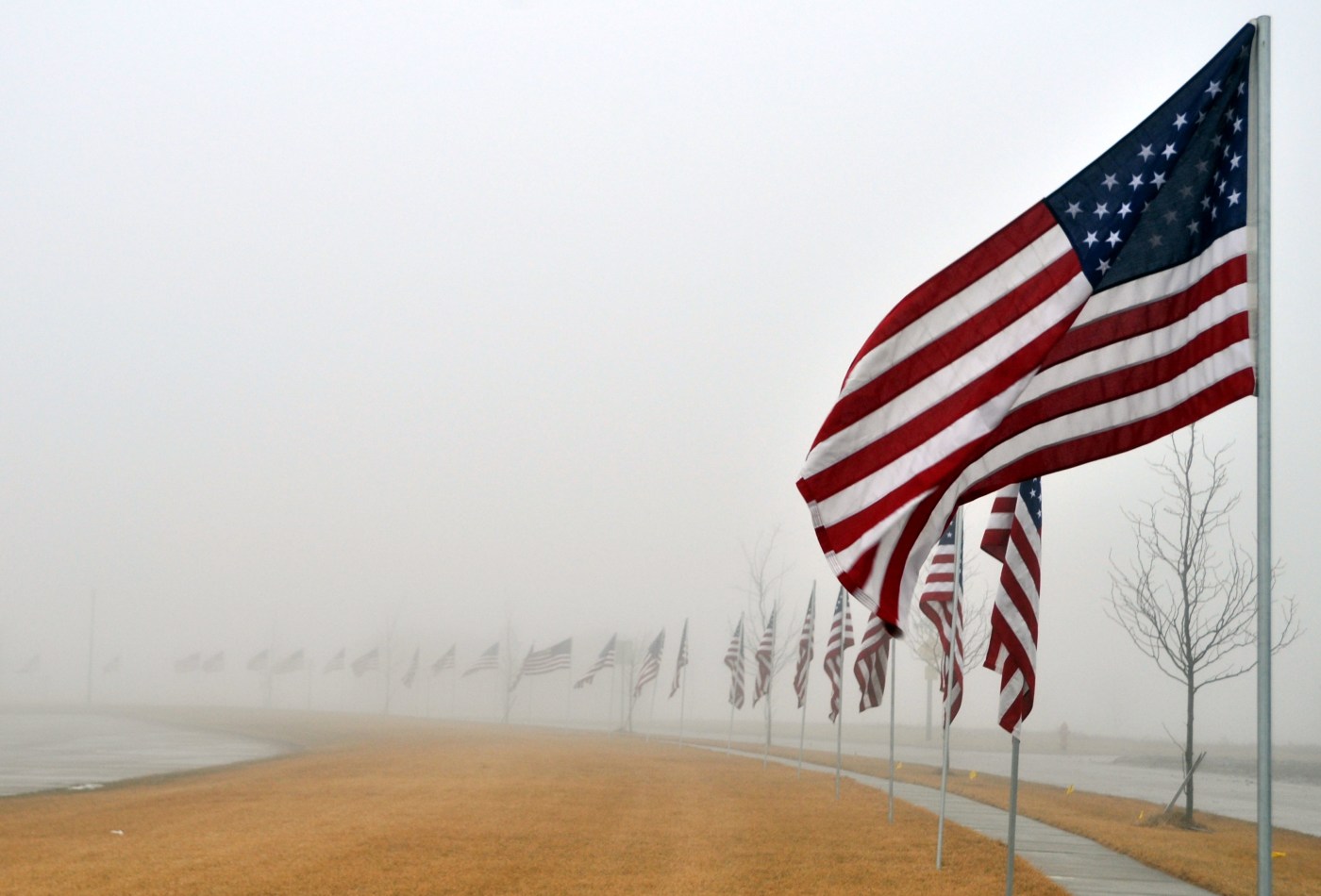
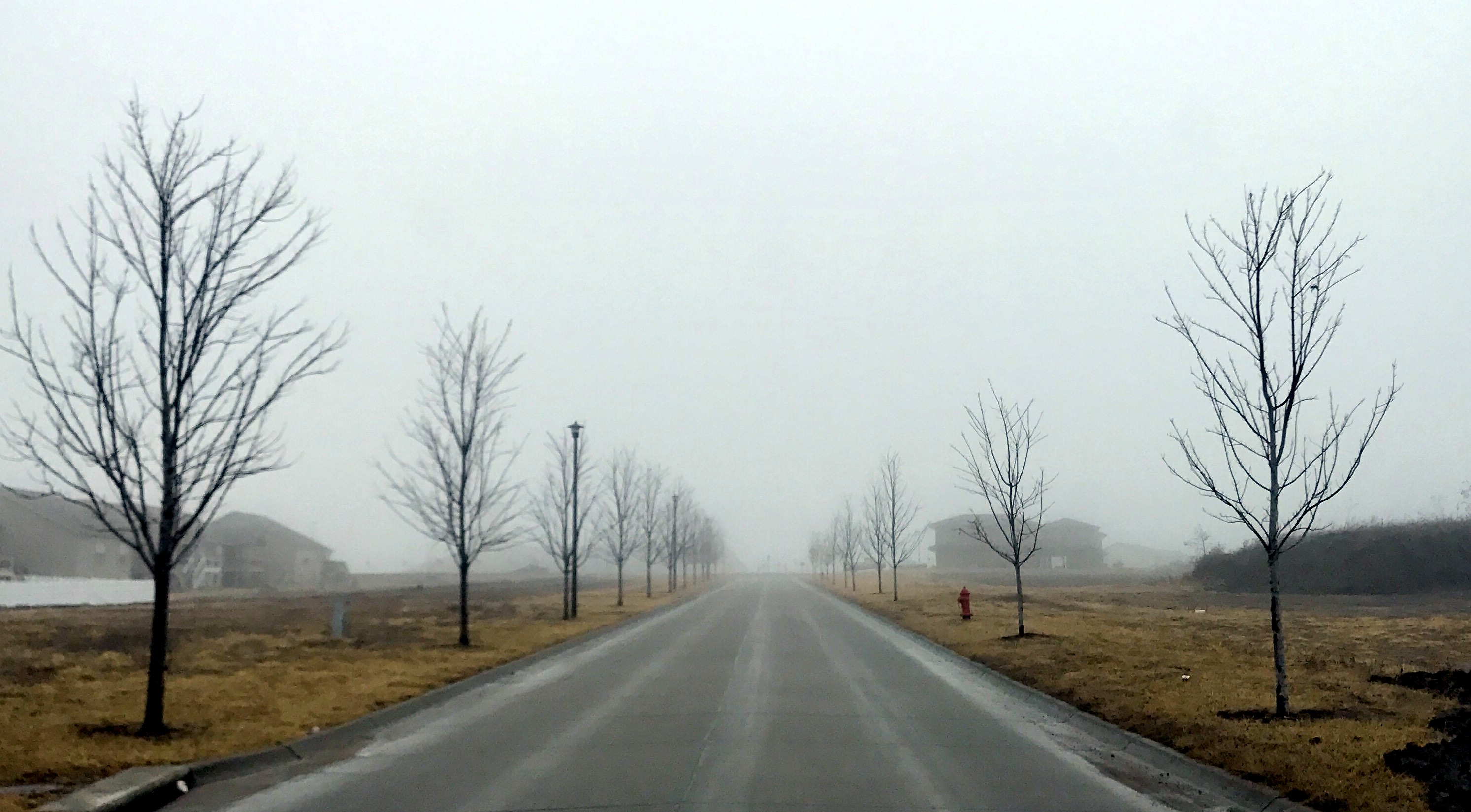
Today’s weather, on this day of the inauguration, reflects how I have felt for several weeks now. It’s a little dreary, foggy, rainy; the road ahead is unclear.  But weather can change quickly in Nebraska, so I imagine that my feelings will likely change soon enough as well. There’s also a good chance that even if circumstances stay the same, how I see them will change. One day it won’t seem so foggy and dreary. I know this is true, both for the weather and for myself.

fullsizerender-29

Earlier this week I posted photos of the ice storm that created such dangerous conditions, closing schools and businesses for a few days; today there is haze and drizzle; and, tomorrow it’s supposed to be 50 degrees. Only in the state of Nebraska can we experience so many seasons in one week! As for my state of mind, foggy actually feels pretty good compared to the earthquake, tsunami-sized feelings that came on the heels of a simultaneously frigid and fiery election season.  But I know that how I felt November 8 is different than it was a month, a week, or even a few days ago. Continue reading “The road ahead is uncertain. But isn’t it always?”

Blog at WordPress.com.

Up ↑