
September 2023 Lectio Divina and Oblate Reflections
Lectio Divina—Chapters 19 and 20, Rule of St. Benedict
Book Discussion—The Oblate Life, edited by Gervase Holdaway, OSB, 2008

Being Benedictine is to believe that the Divine Presence is everywhere, as the opening of Chapter 19 in the Rule of St. Benedict states.
“We believe that the divine presence is everywhere and “that in every place the eyes of the Lord are watching the good and the wicked” (Proverbs 15:3). But beyond the least doubt we should believe this to be especially true when we celebrate the divine office.”
Chapter 19, The Rule of St. Benedict
What is the Divine Office?
The Divine Office, also known as the Liturgy of the Hours or Opus Dei, the “Work of God”, is a daily prayer of psalms, readings, hymns, and prayers. Traditionally during a week, with prayers seven times a day, all 150 Psalms are recited by monks. The Psalms are prayers that Jesus and his disciples recited as part of the Jewish liturgy expressing the depth of human experience and emotion from joy, anger, thanks, praise, suffering, sorrow, contrition, petition, and more.
Of course, as oblates, we might find it more difficult to create these pauses during our workday and to find time for all the prayers. But that doesn’t mean we are not participating in the work of God. Those that pray the Divine Office are offering prayers for the world and we are doing our work as we are called to do.
Words or phrases that resonated with our group included: the divine presence is everywhere, humility and sincere devotion, purity of heart, short and pure, tears of compunction, our minds in harmony with our voices, humbly and respectfully, how we ought to behave in the presence of God.
Who can we bring to the Divine?
Indeed, we have both the good and the wicked in us, but these chapters are less about judging ourselves, and more about who we can let ourselves authentically be and who we can become in the presence of the Divine. We can bring our hidden self, our shadow, our pain, vulnerabilities, shortcomings, and failures to God.
In self-judgment and desire for perfection, we know that we are accepted as we humbly pause and give our attention to the presence of the Divine. In the Divine Office, or in our personal prayer, we give God a chance to talk back to us. The Divine Office is rich with tradition, history, the story of human experience and emotion. It meets us where we are in our life, in each moment, in the present moment. It is God who is speaking to us through the ages. It is worth our effort to incorporate some aspect of the Divine Office into our lives even if we cannot do it perfectly. Perhaps this is what prevents us from beginning at all. Consider saying, “Lord, open my lips. Let my mouth proclaim your praise,” as you rise each morning and when in need, “Lord, make haste to help me.” These words provide some connection to ancient prayer while also being brief.

Who can we become in the Divine Presence?
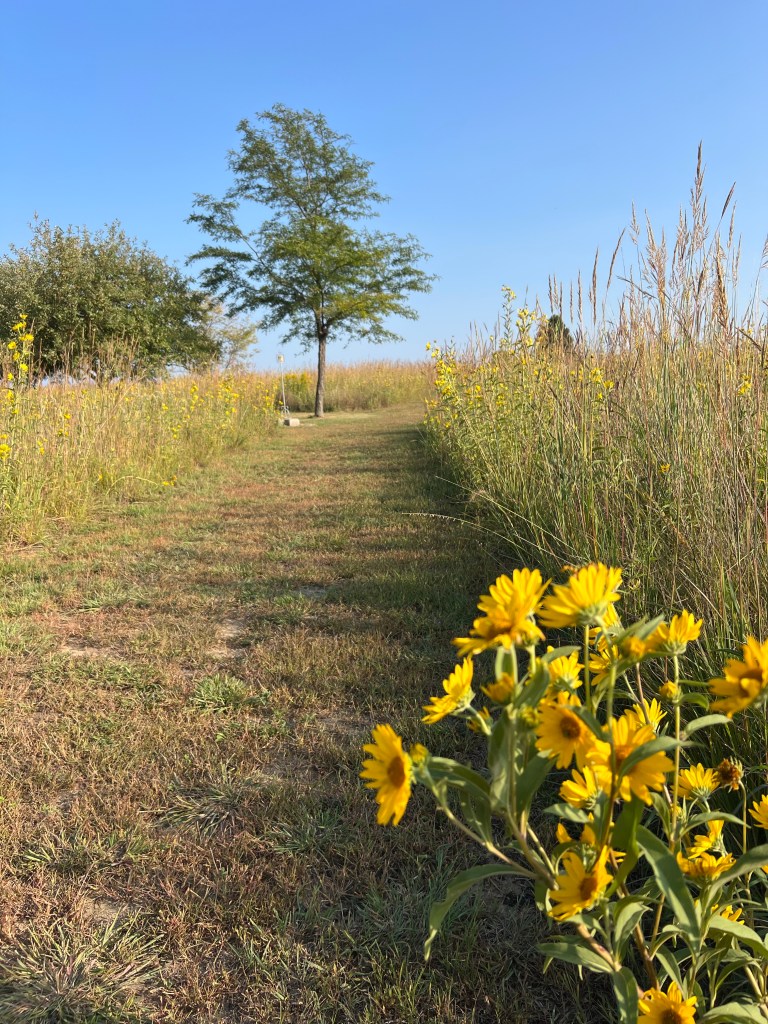
The image of a sunflower came to mind during Lectio Divina when reflecting on who we can become in the Divine Presence. Part of my oblate meeting experience is walking the beautiful grounds of St. Benedict Center. While walking the stations of the cross, the natural prairie bursting with yellow, I was capturing photos to share, when the back of a flower grabbed my attention. The flower is so much like us! We have a side of ourselves we show to others, that we want to receive attention for, but there is another side to each of us—the side we want to hide. But the Divine meets us there, too, in the tension, the conflict, the other side, in all the details, in “our purity of heart and tears of compunction,” in what we see and what we do not see. There is much to contemplate about the other side of the flower—it might not be what we see most often, yet we behold its beauty. Can we let the Divine Presence bring this acceptance for ourselves and others?
The flower is a metaphor for all the beauty within and in the world. We can see the Divine Presence in everything, humbly, even in another side of ourselves, a situation, a decision, a conflict, and more. There is always more to the story, another side. When we pause long enough, we see the presence of God, even when it is not obvious.
When we pray the Divine Office, we are never alone. We join with the angels and saints and all those praying the same words around the world, the same words that Jesus prayed as a devout Jew. To learn more about being an oblate or the prayers of the monks, explore the website of Christ the King Priory and St. Benedict Center.

You might also like A Story Behind Everything.


 Being Benedictine
September 10, 2023 at 3:35 pm
Beautifully done, Jodi. Thank you so much! SHALOM!The English translation “peace” hardly conveys the fullness and mystery of the Hebrew greeting. Shalom combines a sense of completeness, healing, mercy, truth, faithfulness, justice, infinite goodness of God, INNER PEACE. At the last supper, Christ said “Shalom I leave you, my Shalom do I give you.” It was his last gift and wish. Christ’s Shalom coexists in a soul’s most troubled night. It is INNER PEACE which endures even in the crazy, absurd, heartbreak moments. His gift is an inner peace which becomes the unshakable foundation of our life. Sometimes Shalom is as close as breathing; at other times it is the grail we seek. Shalom is an adventure lasting a lifetime. Albert J. Morel, SC
LikeLiked by 1 person
September 10, 2023 at 4:12 pm
Thank you so much. This writing on Shalom is so beautiful!
LikeLike