
May today there be peace within. May you trust God that you are exactly where you are meant to be. May you not forget the infinite possibilities that are born of faith. May you use those gifts that you have received, and pass on the love that has been given to you. May you be content knowing you are a child of God. Let this presence settle into your bones, and allow your soul the freedom to sing, dance, praise and love. It is there for each and every one of us. ―Saint Terese of Lisieux
During a season of uncertainty and anxiety, I typed out the prayer above, laminated it, taped it to my desk at school, and posted it in the bathroom I got ready in every day. While waiting for additional tests after receiving a cancer diagnosis, this prayer brought peace that excessive research and reason could not. What soothed my soul was a daily routine of silent meditation and praying the words written by Saint Thérèse of Lisieux (1873-1897), also known as the “Little Flower” whose Feast Day we observe on October 1. As with Lectio Divina, one word or phrase might speak to me differently, and I could carry it throughout the day. This practice helped me keep my sanity when literally nothing else helped.
Twelve years have passed since I was diagnosed with chronic lymphocytic leukemia (CLL). Thankfully, medical treatment has not been required, and if I continue to be symptom-free, I only need to visit my oncologist every six months. As healthy months turn into years, I think about my diagnosis less. There are periods when I even forget that I have CLL, but the diagnosis changed my life forever. I am deeply intentional about living Soulfully; living with purpose, on purpose; being attentive to the present moment; practicing gratitude; making good choices and having no regrets; keeping “death daily before your eyes,” as St. Benedict writes; and leaving something beautiful from a life well-lived. But somewhere along the way, I stopped reading this prayer every day.
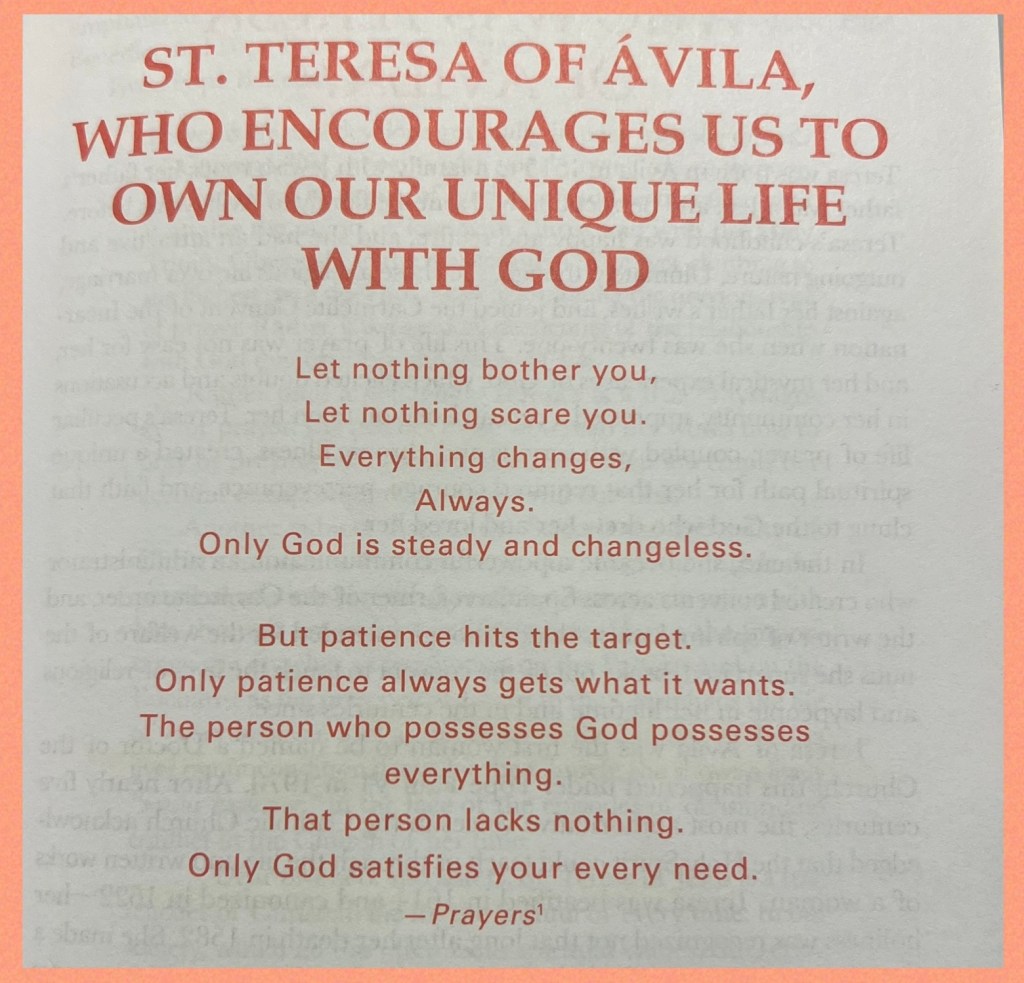
Let nothing disturb you,
Let nothing frighten you,
All things are passing away:
God never changes.
Patience obtains all things
Whoever has God lacks nothing;
God alone suffices.
— St. Teresa of Avila
I am reminded of the strength of Thérèse of Lisieux’s prayer as I participate in a study of The Interior Castle, a spiritual classic written by St. Teresa of Avila (1515-1582), the first female Doctor of the Church, Carmelite nun, writer, mystic, and reformer of the Carmelite Order. St. Teresa of Avila lived three centuries before Thérèse of Lisieux but their writings are often confused. St. Teresa, whose Feast Day is observed on October 15, uses the castle as a symbol of our soul, of our interior life where we grow in union with God. The castle is the home where the Divine dwells within us; its doorway is prayer. Kieren Kavanaugh writes in the Study Edition of The Interior Castle, “We are structured in such a way that God lives in his own dwelling place with us, more so than he does in the whole cosmos….We are not merely sparks of God, but God actually lives in us and makes us beautiful by his light.”
The Interior Castle contains seven dwelling places, or chambers, where we grow in intimacy with the Divine. In the second dwelling place, Teresa writes “Can there be an evil greater than that of being ill at ease in our own house? What hope can we have at finding rest outside of ourselves if we cannot be at rest within? If we don’t obtain peace in our own house we’ll not find it outside. Let this war be ended.”
It can feel like a war raging within. Yet, we must persevere in prayer, being gentle with ourselves during times of uncertainty, anxiety, or spiritual dryness. Taking time for prayer is a practice of tending soul, caring for our home, and the dwelling place for God. Both Teresa and Thérèse give the soulful advice–let nothing bother us, this moment shall pass, God is always present. St. Teresa sympathizes with those who have a difficult time in prayer: “All the trials we endure cannot be compared to these interior battles…The important thing is not to think much but to love much.” She encourages her readers to make peace by gaining self-knowledge.
The peace we desire is deeper than the world can give. Inner peace is hope and trust in our relationship with Christ regardless of what is happening in the world or our lives. It is a conscious decision, a seeking of Christ that brings stability of emotion, not a roller coaster of highs and lows. Inner peace is not a response, but an assurance that Christ is present and within us. (You Are Not Alone: My Peace I Give to You). As St. Benedict writes in The Rule, we must seek peace and pursue it (RB Prologue 17)
I am touched by the Nanci Griffith song titled “Saint Teresa of Avila”, written after a childhood friend, Teresa Paulissen, died by suicide, followed by the deaths of three other friends within a few months. “It was overwhelming,” Griffith said of the losses. “We went to a school that was headed by a Carmelite order of nuns,” Griffith said. “They’re the people who chant and sing … and create the harmony of Earth in voice. We wanted to write our own chant for Teresa’s memory to St. Teresa, in hopes it would be heard – to pray for her soul.” (The Spokesman Review, May 7, 1997)
This song is a prayer for peace—for the friend who passed, that “all her sorrows” be lifted, and for help “in the stillness” for those left behind. I understand this deep grief that seems to leave no peace, but there is comfort in prayer, music, and the communion of saints.
(Nanci Griffith – Margaret Mary Graham – Mikki Griffith)
Saint Teresa, your patron child’s come home
Were you there to greet her?
Did your angels know her songs?
And all her sorrows
Did you lift them from her brow?
Did you kiss her hand that took her soul
Back up to you
Our Patron saint of harmony and vow
Help me in this stillness
Tell me things I need to know
How we loved your patron child
We say, so long and so long ago
Saint Teresa
Can you speak to me at all
Ah, from here where will we go?
Saint Teresa
Saint Teresa, she was our sister of arms
Gone now the trio
To Our Lady, Kate and John
And fare to fare
Of the tears that cannot fall
We send this melody please help her sing along
Back up to you
Our Patron saint of harmony and song
Back up to her Patron saint
Beyond our wood those lights
Saint Teresa of Avila
Discalced de Carmelites
Saint Cecilia to Saint Teresa
“Your patron child is home”
(There are lights beyond our woods)
May we draw strength, insight, and peace from both Teresas– Saint Terese of Lisieux and Saint Teresa of Avila–as we journey through life circumstances and within our interior castle.
Additional Resources:
Telling them apart: Teresa, Teresa, Thérèse, and Edith
St. Thérèse of Lisieux, St. Teresa of Ávila


 Being Benedictine
October 16, 2024 at 1:02 pm
Jody,
Loved these offerings. Thanks for sharing these prayers and your experience.
Lee
LikeLiked by 1 person
October 16, 2024 at 9:26 pm
Beautiful, Jodi. Thanks for sharing this one!
LikeLiked by 1 person
October 16, 2024 at 9:27 pm
Thank you, dear!
LikeLike
October 20, 2024 at 3:12 pm
Jodi, this is one of the most beautiful and profound things I’ve ever read from you. Thank you.Jenn VintonSent from my iPhone
LikeLiked by 2 people
October 20, 2024 at 4:41 pm
Wow, well thank you!!
LikeLike