
But now faith, hope, and love remain, these three; but the greatest of these is love. –1 Corinthians 13:13
This scripture verse is one of the most frequently read at wedding ceremonies, but it is meant for more than those getting married. We are created to love and be loved—all of us, no matter who we are or our chosen paths in life, whether monk or married.
Our deepest longing is to be loved. Love is the thread that runs through all the world’s religions. In Christianity, the Great Commandment is to “love the Lord your God with all your heart, and with all your soul, and with all your mind” and to “love your neighbor as yourself.”
Several years ago, during spiritual direction with Benedictine monk, Fr. Mauritius Wilde, we discussed, despite our different vocations, how much we have in common. We each have a holy longing—to love God, to have a healthy love for ourselves, and to give and receive love. Practically speaking, we are the same age, we are both teachers and retreat leaders, have one brother, have the same middle name (Marie—seriously, what are the odds on that?), we share similar Enneagram personality traits, and each of us professed our marriage or monastic vows 40 years ago, a day apart. I was married on August 17, 1985, and Fr. Mauritius entered the monastery as a novice on August 18, 1985.
After one of many conversations where one of us would say, “That is exactly how it is for me!” or “Me, too!”, I half-seriously, half-jokingly suggested that we write a book about how, setting the whole monk vs. being married thing aside, we experience our love of God and others in many of the same ways. Nearly forgotten, this idea resurfaced a year or so ago, and we decided that leading a retreat together would be a good beginning. Our theme would be love, specifically how the Rule of St. Benedict can help us grow in love and to discover our “inner monk.”
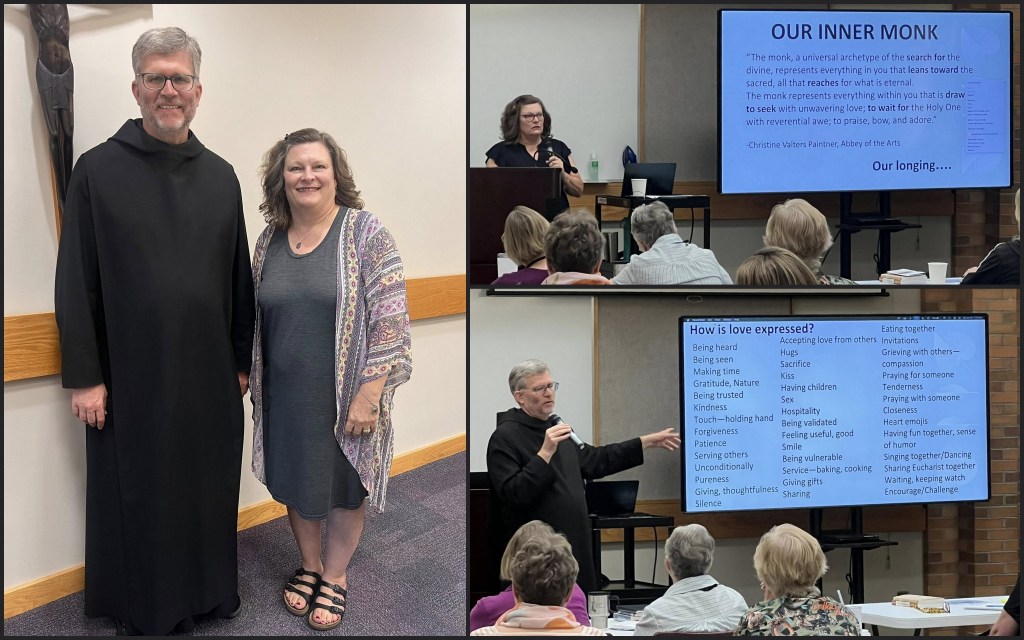
“The monk, a universal archetype of the search for the divine, represents everything in you that leans toward the sacred, all that reaches for what is eternal. The monk represents everything within you that is drawn to seek with unwavering love; to wait for the Holy One with reverential awe; to praise, bow, and adore.” -Christine Valters Paintner

The Rule of St. Benedict shows us the path of love, of nurturing the monk within while living in community. During our retreat, held in July 2025, we shared how the monk’s promises—stability, obedience, and conversion of life—are the foundation for learning and growing in the “school for God’s service.” (RB Prologue 45) For the monk, this place of learning is the monastery. For me, it begins in my family as wife and mother. But each of us is more than our role as a monk or a married person. Each can be transformed by practicing love in our friendships, workplaces, community, and environment.
We show our love for someone with the promise of stability— when we stay and do not run away from challenges and difficulties. It takes patience and courage to stay, to remain present, to see what we discover. Things might not be perfect at this moment—perhaps we need to work through some tension or resolve a conflict—but we stay to see things through. We continue to practice—whether it’s loving our spouse, friend, or parent, learning a musical instrument, or committing ourselves to a new career.
Stability is not stagnation, though; there is movement and growth by committing to consersatio morium, a conversion of life. I am faithful to a lifelong journey of spiritual transformation, to always becoming. With a growth mindset, I am open to being converted again and again. Michaelango said, “I am still learning.” So am I.
To cultivate love, or whole-soul-fulness, we must resist the temptation to be upwardly mobile, to be always on the move, to pull up our roots and fly to the mythic kingdom of Elsewhere.”― Sam Keen, To Love and Be Loved
Too often, we think the grass might be greener on the other side of the fence. We consider what it might be like had we made different decisions. Would our life be easier, more fulfilling? Or do we have what the kids call “FOMO,” a fear of missing out on the paths not chosen? Are we fantasizing about other possibilities—a different job, a different family, a different life? What is our “mythic kingdom of Elsewhere?”
When I first discovered the monastery, I romanticized the silence and peace I experienced. The slow pace of the monk compared to my hurried one, the peaceful rhythm of prayer and work compared to multitasking, and the countless decisions I needed to make in a teacher’s day. My friends and I would discuss how challenging our re-entry to the world was after a retreat–more noise, a faster pace, and even more fires to put out. I learned over time that the monastery isn’t a magic wand–it is a reminder of how to live more fully in my own life, that being Benedictine takes practice. It is the practice of beginning again, of practicing love right where we are and not going somewhere else, even in our minds. Being able to authentically love requires being fully present.
Love is patient; love is kind; love is not envious or boastful or arrogant or rude. It does not insist on its own way; it is not irritable; it keeps no record of wrongs; it does not rejoice in wrongdoing but rejoices in the truth. It bears all things, believes all things, hopes all things, endures all things. Love never ends. –1 Corinthians 13:4-7
Love never ends because it must always be expressed, and we can never exhaust all the ways to show our love. We express it by being kind, not being envious or rude, by not always having things OUR way, by listening to others. St. Benedict must have considered listening to be of great importance—it is the first word of the Rule.
“Listen carefully to the master’s instructions, and attend to them with the ear of your heart.”
“Obedience” is derived from the Latin word “ob-audire,” which means to hear or to listen to. Many marriage vows included a promise to obey, but this was removed in the early 1900s. I get it…I can buy into “listening” much more than “obeying,” but that does not make this Benedictine promise of obedience any less critical. Listening requires us to pause, to have silence, and to be open to seeing in a new way. Listening can lead to a shift in perspective, a flash of insight, a new understanding. When you listen closely to another, it is an expression of love.

Our inner monk seeks to hear the voice of God, to see in new ways, recognizing the sacred in the ordinary, practicing gratitude, and growing in compassion. Obedience isn’t blind following. It allows for possibilities beyond what our own minds can conceive.
Our deepest longing is to be loved. Fr. Mauritius writes, “Sometimes we feel that there is not enough love in our lives. We think that our spouse, our confrere, our fellow human being, could love us more. God could love us even more. Our desire for love is so deep and comprehensive that it is hardly possible to satisfy it completely. We should not feel guilty about this longing. That is simply how we are made.”
How might we rest into this longing to be loved? In “Believe That You Are Loved,” a reflection on Wilde Monk: Cherishing God Above All, Fr. Mauritius emphasizes the importance of our belief in and acceptance of God’s love.

Fr. Mauritius is a priest and monk living in Rome, Italy. He teaches at Sant’ Anselmo, the Benedictine study house in Rome. He is the author of several books, including Be Yourself: The Call of a Christian (Paulist), and directs retreats regularly. You can find his blog HERE.
It is in my daily life as a wife, mother, friend, teacher, retreat leader, and blog writer where I live the monk’s promises as an Oblate of St. Benedict, a “monk in the world.” More on marriage: Our Ruby Anniversary: 40 Years of Marriage


 Being Benedictine
Leave a comment