SoulCollage® Facilitator, Benedictine Oblate of Christ the King Priory,
Retreat Leader at St. Benedict Center, Blogger at Being Benedictine and SoulFully You,
Teacher, Mother, Wife, Friend, Lover of learning, reading, creativity and spirituality.
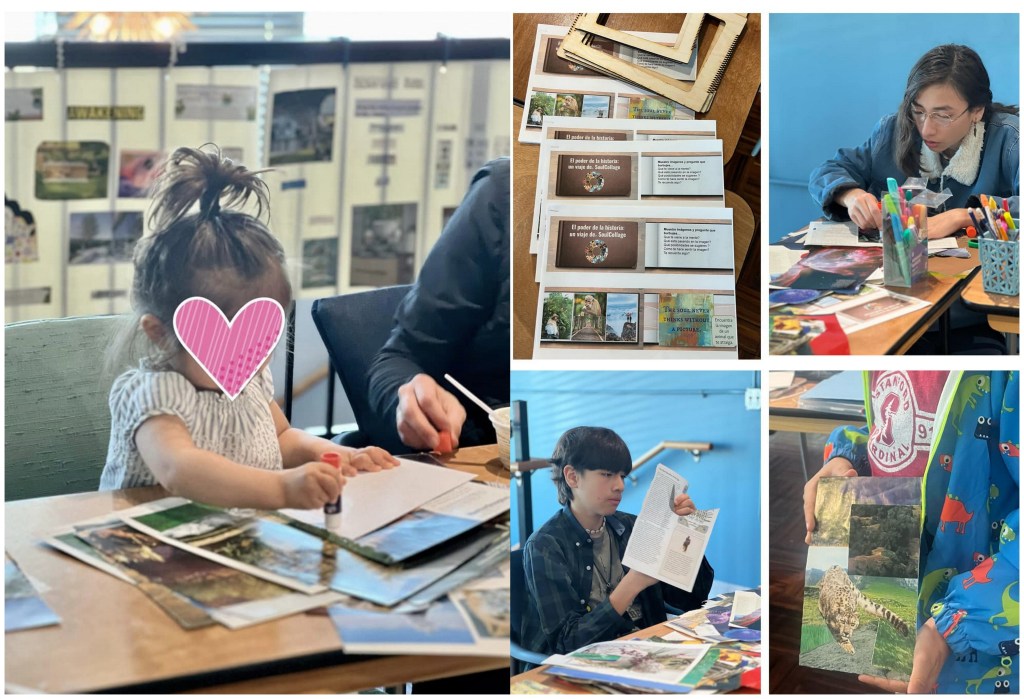
ECHO Collective connects and empowers refugee and immigrant women providing opportunities for personal growth and cross-cultural relationships. With a grant from the Nebraska Arts Council, ECHO is offering a weaving class to women and children using SoulCollage® as a springboard for a tapestry design. In the first session, we explored the power of their unique stories, reflected with images to create a SoulCollage card, and discussed how weaving their stories together can bring healing. Mothers, teens, and young children participated, including my youngest ever–a two-year-old sweet girl particularly attracted to images of white bunnies. Participants will learn weaving techniques for several weeks to create their own and a community tapestry.
“The promise of peace comes through story. When we are willing to bear witness to one another, to take other’s and joy seriously, to listen deeply, with full attention, to tell other’s stories over–we reweave the bonds of civil society.“- Rabbi Dr. Ariel Burger
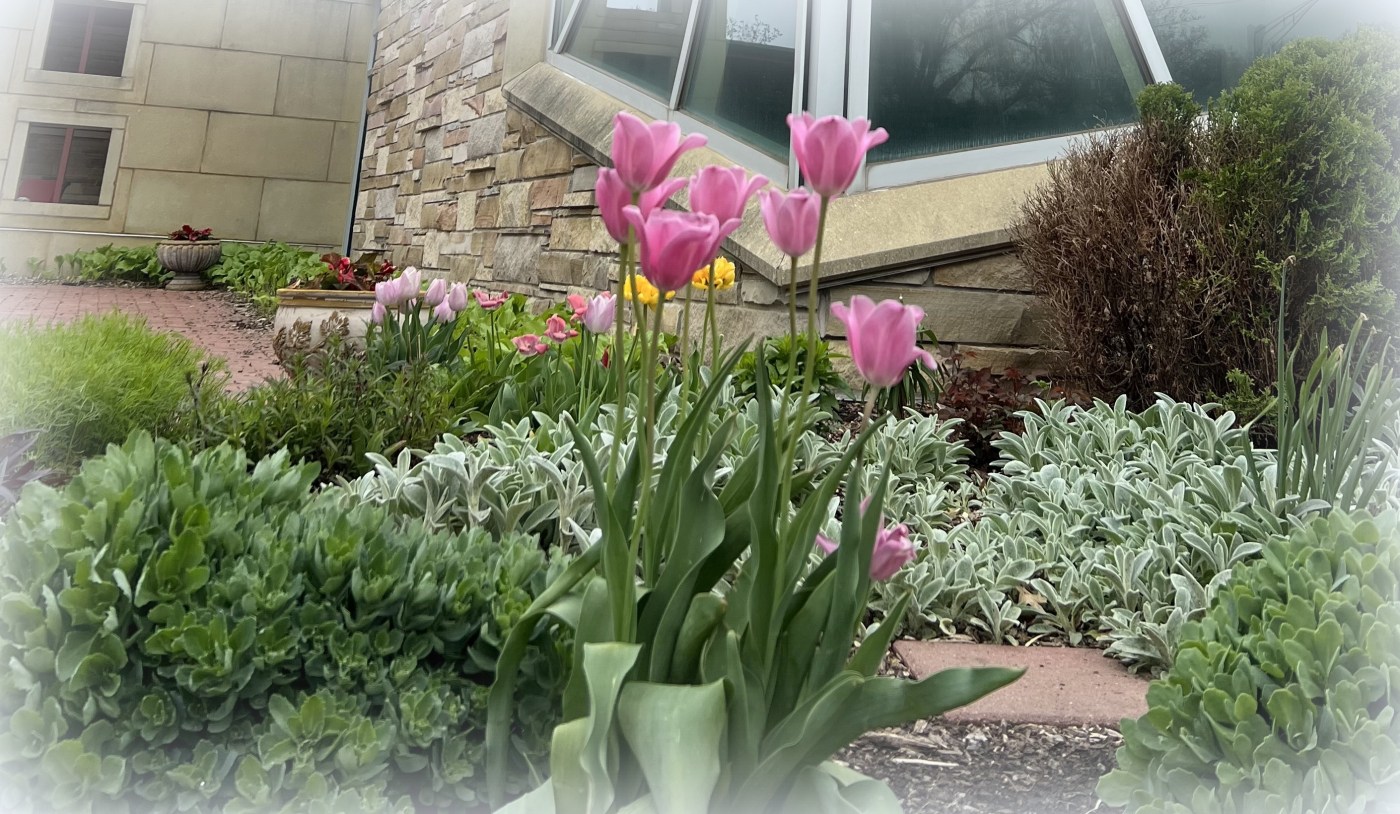
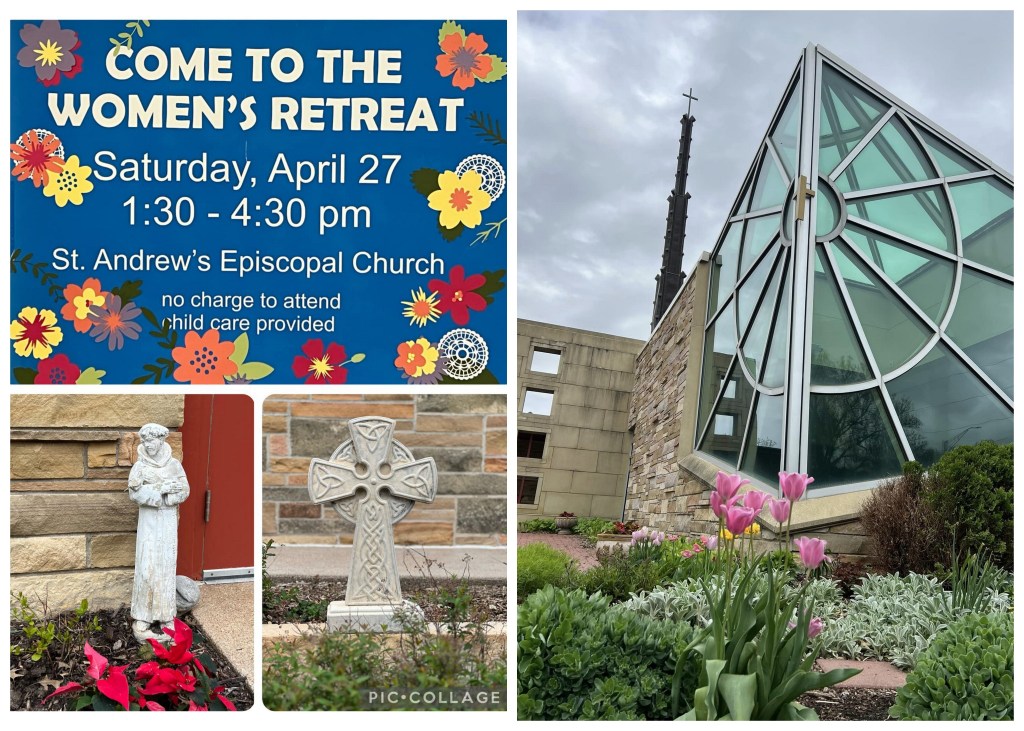
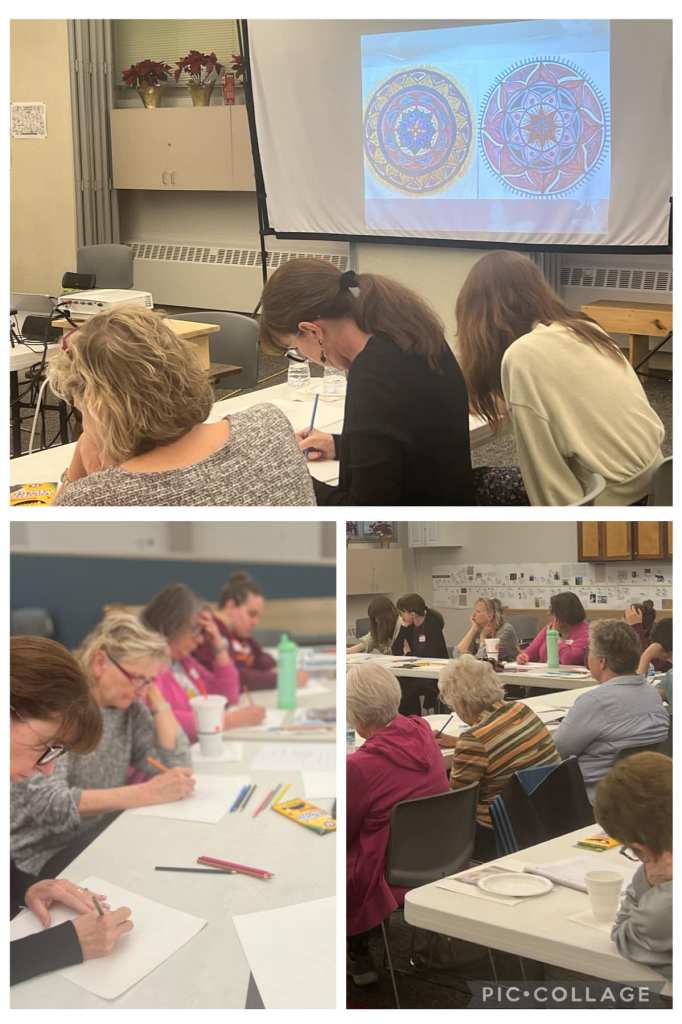
St. Andrew’s Episcopal Church hosted a women’s retreat titled “SoulFully You: Many Ways to Pray” that focused on finding God in music, movement, nature, words, and creativity. Richard Rohr writes, “We are already in the presence of God. What is absent is our awareness.” Twenty participants practiced Lectio Divina with the poem I Happened to Be Standing by Mary Oliver and learned how to create mandalas. Group discussions, journaling, and prayerful activities highlighted the wisdom of Simone Weil, that “pure attention is prayer.”
If you begin to live life looking for the God that is all around you every moment becomes a prayer.” -Frank Bianco
For more information about SoulFully You retreats, see upcoming retreats held at St. Benedict Center and possible retreat themes here. If you are interested in having a retreat or workshop created for your organization, church, or special interest group, contact me here.
Just for a moment, at 10:06 pm tonight, March 19, 2024, darkness and light will be held in perfect balance. Equinox, meaning “equal night” in Latin, is when the sun is directly over the Earth’s equator, causing day and night to be equal moments. In the northern hemisphere, where I live, we will begin to have longer days with more sunshine and hours of light. As the earth continues moving around the sun, the position of the sunrise and sunset will change quickly, and the balance between night and day will not last long.
Indeed, an apt metaphor for the balance we seek in our daily lives. It is good to remember that even in the cosmos there is either more dark or more light. This is life.
During pre-Christian Europe, the pagan goddess, Ostara, was celebrated during the spring equinox. She was honored for renewal, rebirth, fertility, balance, and the coming of spring. In Western Christian churches, Easter is celebrated on the first Sunday after the first full moon following the spring equinox. The cosmic connection between spring equinox and Easter, the crucifixion, death, and resurrection of Jesus, cannot be missed–they follow the rhythm of nature and point to more light, either literally or through Christ.
I have been feeling some guilt this Lent season. St. Benedict devotes an entire chapter to observing Lent with advice for monks. He writes, “Let each one deny himself some food, drink, sleep, needless talking and idle jesting, and look forward to holy Easter with joy and spiritual longing (RB 49: 7).” I have not made any grand gestures of sacrifice, quite the opposite. During my spring break from school, which occurs during Lent, we tend to travel out of state to see our daughter and son-in-law, we wine and dine, gather with friends and family, and generally celebrate time on vacation. Return from spring break marks the beginning of the last quarter, or nine weeks, of school when teachers begin to see the light at the end of the tunnel.
My Lent intention is to “hold it all”– to live as prayerfully, joyfully, playfully, gratefully, mindfully, and soulfully as possible while balancing my school and home life. Striking a perfect balance in one’s life is more of an ideal than a reality. The celebrations of the liturgical and astronomical calendar are reminders that our spiritual longings can be met by following the rhythms of nature. Each season we have another opportunity to set new intentions and to honor them in sacred ritual. The Benedictine idea of balance comes from the monk’s life, moving between prayer and work, ora et labora. So, too, do those who live as “monks in the world” seek this balance–sometimes there is more work, less prayer–but both are seen as necessary, sacred, and part of the whole.
“Blessed are you, spring, season of resurrection, sacrament of promise. Like Jesus you rise up out of the darkness, leaving around you a wake of new life. Blessed are you, spring, season of hope and renewal. Wordless poem about all within us that can die. Each year you amaze us with the miracle of returning life.” -Excerpt from A Spring Blessing in The Circle of Life: The Heart’s Journey Through the Seasons by Joyce Rupp & Macrina Wiederkehr
What do a threshold, a cow, fire, and water have in common?
St. Brigid of Kildare!
Recently I was introduced to St. Brigid while preparing for a Celtic Christianity pilgrimage and she could not have arrived at a more apt time for me. Admittedly, I’ve fallen down the rabbit hole (or holy well?) of the legends and stories of St. Brigid, a 5th-century abbess and founder of monasteries. St. Brigid is known by many names —Bhride, Bride, Brighid, Brigid, Bridget—and many titles including Muire na nGael (Mary of the Irish) Brigid of the Mantle, Brigid of the Fire, and Mary of the Gael. Brigid is recognized as the patron of midwives including new beginnings, birth, thresholds, and transformation. She has also been linked to fire, blacksmiths, wells, healing waters, springs, and poets. This year, 2024, is the 1500th anniversary of the death of St. Brigid with many celebrations and for the first year has been declared a national holiday in Ireland.
The Threshold
Legend holds that Brigid was born in the doorway of a barn at dawn, at the threshold between light and dark, inside and outside, winter and spring. She is celebrated on February 1, the anniversary of her death, and the same day as the Celtic Feast of Imbolc. Imbolc, a celebration of the Celtic sun goddess Brigid is the halfway point between the Winter Solstice and Spring Equinox in the Northern Hemisphere. Imbolc, which literally means “in the belly”, celebrates the change of seasons, a threshold time of welcoming more sunlight in the day. What is hidden in the earth’s dark belly is beginning to stir—darkness gives way to light and spring is coming!
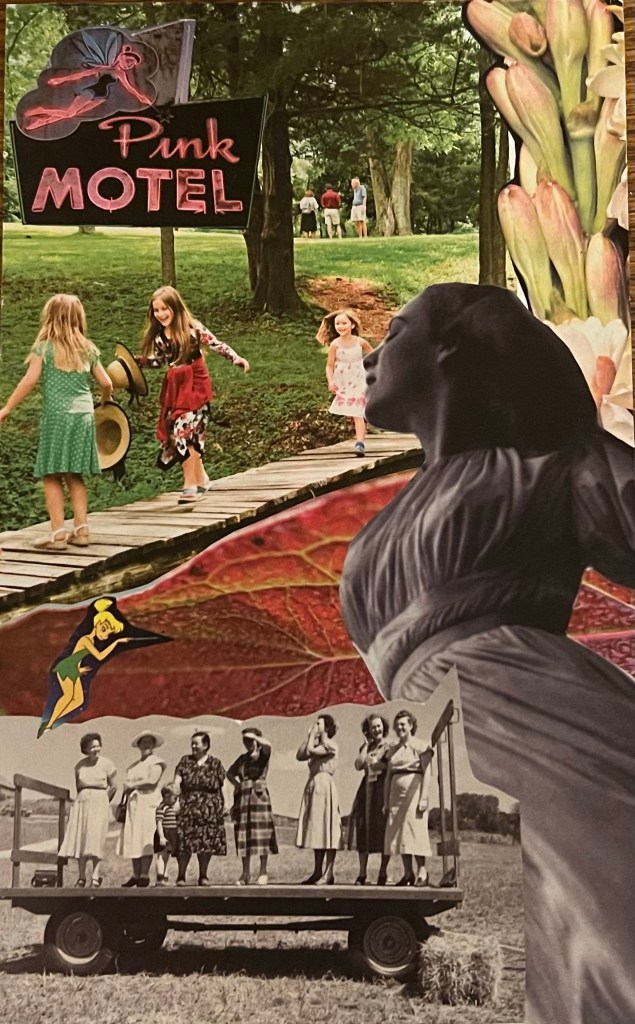
I am one who is playful, spirited, and connected in good company with wise women. The “pink motel” is a place of pixie dust and playfulness, joy, humor, carefree delights, childhood innocence, and magical moments.
One of the sweet surprises of SoulCollage® is when images come together to capture the essence of a memory, message, feeling, or archetype so effortlessly. This card reminds me of a recent playful, weekend gathering of friends. The women standing on the hayrack spoke to me of comradery, comfort, and community. It was later that I noticed the small child beside his mother. From a child’s vantage point, the energy in a room can easily shift from adult-ing to playfulness. Tinkerbell, the spirited fairy, spreads pixie dust and playfulness over adults and children alike—one can be both grown-up, wise, sober, AND playful, friendly, and funny. We can live more fully by embracing the playful child within.
My intention for 2024 is to live FULLY— “To be SoulFully You is to live prayerfully, joyfully, playfully, gratefully, mindfully, soulfully.” (2024 Word of the Year)
The spirit of Tinkerbell was alive and well on our farm weekend. Soom playful memories:
Choosing a word to focus on each year has become a nourishing, soulful ritual. I savor the word, that more so chooses me, throughout the year—it brings great joy when in perfect synchronicity, it appears over and again in what I read, hear, and see. I trust that the word, as it settles in my heart, will be a guiding light for months to come—challenging, inspiring, and transforming me.
My 2024 word of the year, FULLY, is a throwback to ten years ago when I birthed and named my first website and creative venture, SoulFully You. I participated in training to become a certified SoulCollage® facilitator, to lead retreats on creativity and spirituality. As a Marketing teacher, creating a brand name felt like the best first step. With my daughter Jessica and her friend Claire (both students of my high school classes) we brainstormed a variety of words, phrases, and combinations, and then it clicked, that “aha moment” of knowing I have come to trust—SoulFully You. I loved what it meant, and still do. The image at the top of this page, a SoulCollage® card to represent SoulFully You, came later.
Being SoulFully You is living with purpose, on purpose; being attentive to the present moment; practicing gratitude; making good choices and having no regrets; living with death daily before your eyes, as St. Benedict writes; and leaving something beautiful from a life well-lived. It is living life to the fullest, using the gifts and talents you have while being open and responsive to opportunities and surprises that come your way.
A tree gives glory to God by being a tree.
Thomas Merton
Being SoulFully You is discovering and becoming all that God has created you to be. Thomas Merton writes, “For me to be a saint means to be myself.” The call to be holy is the call to be more fully myself, just as a tree gives glory to God by being a tree.
Ever have one of those eyes-wide-open at 2:00 am moments of mind-racing, self-doubting, anxiety-stricken, what-if fretting? I had one such panic attack, recently, after making a big decision about the future of my work. I found myself wracked with despair, vacillating between whether I made the right decision or if I was making a mistake, despite having done my due diligence in heart, soul, and mind for many weeks.
In the morning light (and after several days), with the help of some calming meditation, conversations with good friends, and spiritual direction, I began to see more clearly—that it is normal when making big life changes to experience uncertainty, that I have been here before.
“For me, the process of discernment, especially when I have strong feelings or attachments, often begins with compulsive mental role-playing,” I wrote in 2019 when I was in a similar state of distress about making the right decision. But it was these words of wisdom that helped me get to the other side of anxiety, and at the root of it, fear.
YOU ARE FREE.
“I am free to make THIS decision, or I am free to make THAT decision. I am free to choose. It was the decision-making process that was binding me, making me a prisoner of my own thoughts. The freedom came from not being attached to one possibility or the other, one reaction, one outcome, one person, or one feeling. Accompanied by a stream of what ifs, fear had become the primary consideration in discerning what if I did THIS or what if I did THAT.”
This reflection on my 2019 word(s) of the year,YOU ARE FREE, still rings true today. Fear is at the root of anxiety, a response to uncertainty. Ironically, the only thing that is certain IS uncertainty. All else is an illusion of control. Brene Brown in Atlas of the Heart writes, “In a world where perfection, pleasing, and proving are used as armor to protect our egos and our feelings, it takes a lot of courage to show up and be all in when we can’t control the outcome.”
Fear of making mistakes, a symptom of perfectionism, can sabotage even soulful decision-making. Fear can lead to a sense of feeling trapped, nearly immobile, agonizing about whether there is a right or wrong, rather than accepting that a decision is simply a decision, that often there is no one right way. The Divine works in all our decisions no matter what forks in the road we may take. Fear, or regret, limits our ability to be open to surprises and from being fully present to what is. I am free to make this or that decision, trusting, knowing that I will continue to listen to how the Divine is working in new ways. It is freedom that brings peace.
“Yes, you are free, too,” I wrote. “These words can be a prayer, an intention for yourself. Try it as an experiment. Ask yourself—What if I choose love instead of fear? What if I let go of what I am holding onto? What if I detach from what I want and, instead, accept that I am free, that God is with me whether I choose this or choose that?”
I captured the essence of these three words in a SoulCollage® card that embodies this sense of freedom. The image and words, YOU ARE FREE, have become a prompt for me to reflect on a dilemma or state of uncertainty from this perspective of liberation, encouraging me to move forward peacefully, soulfully, without obligation, burden, or restriction, in freedom.
Since the beginning of time, peoples of all cultures and religions have beheld the beauty of the earth, endeavoring to understand the universe and their place in it. We long for this sacred knowing. Just a century ago, we could not have conceived of the technology and space exploration that would produce photographs and telescopic images, inspiring such awe and wonder, my word for 2023. We are imbued with the grandeur of God.
Hildegard of Bingen, the 12th Century Benedictine Abbess and founder of German scientific natural history, captures this wonder:
“Glance at the sun. See the moon and the stars. Gaze at the beauty of earth’s greenings. Now, think. What delight God gives to humankind with all these things. All nature is at the disposal of humankind. We are to work with it. For without we cannot survive.”
Hildegard of Bingen
Since 1990, the Hubbel Telescope has captured the wonder of our universe’s distant past, more than 13.4 billion light-years away, capturing images of black holes, galaxies, and the birth and death of stars, changing how we look at our cosmos.
The James Webb Telescope launched on Christmas Day, 2021, has even greater potential, using infrared capabilities to see through dusty regions of space viewing objects that are too old, faint, or distant for the Hubble Space Telescope.
It is astounding to behold the images of what is beyond us, but, perhaps, even more profound are the images captured on Christmas Eve, 1968, of Earth. The three astronauts of Apollo 8 completed the first manned orbit around the moon, becoming the first humans to see, and photograph, the Earth from space.
The first color photograph taken beyond Earth’s orbit was later titled Earthrise. The film “Earthrise” tells the story of this image captured by the Apollo 8 astronauts—Bill Anders, Frank Borman, and Jim Lovell—and recounts their experiences, exploring the beauty, awe, and grandeur of the Earth against the blackness of space.
The vast loneliness is awe-inspiring and it makes you realize just what you have back on Earth. The Earth from here is a grand oasis in the big vastness of space.”
Astronaut Jim Lovell, Apollo 8
Looking beyond, looking upon, looking around, and within—all are filled with wonder.
“…take a look around you. Ponder how the solid-seeming ground beneath your feet is quietly shaking with the force of billions of years of cosmic collisions. Go outside…watch the wind blow through the trees … The endless comings and goings of galaxies, stars, and planets create a melding of songs that you are part of too. It’s a reminder that the world always has been, and always will be, worthy of wonder.”–Adam Frank, The Constant Fire
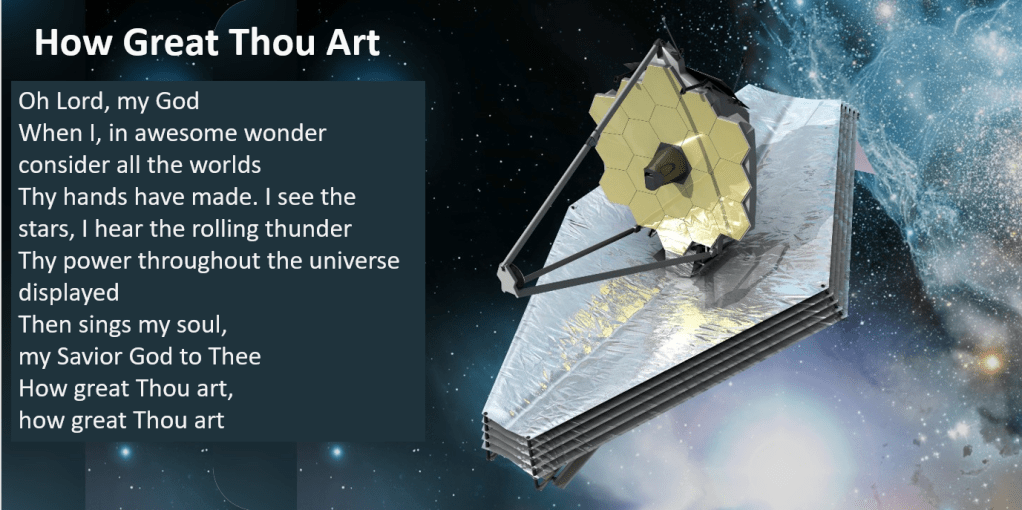
In awesome wonder, may your Christmas be filled with reminders of the beautiful mystery that surrounds you.May your prayer begin with “How Great Thou Art.”
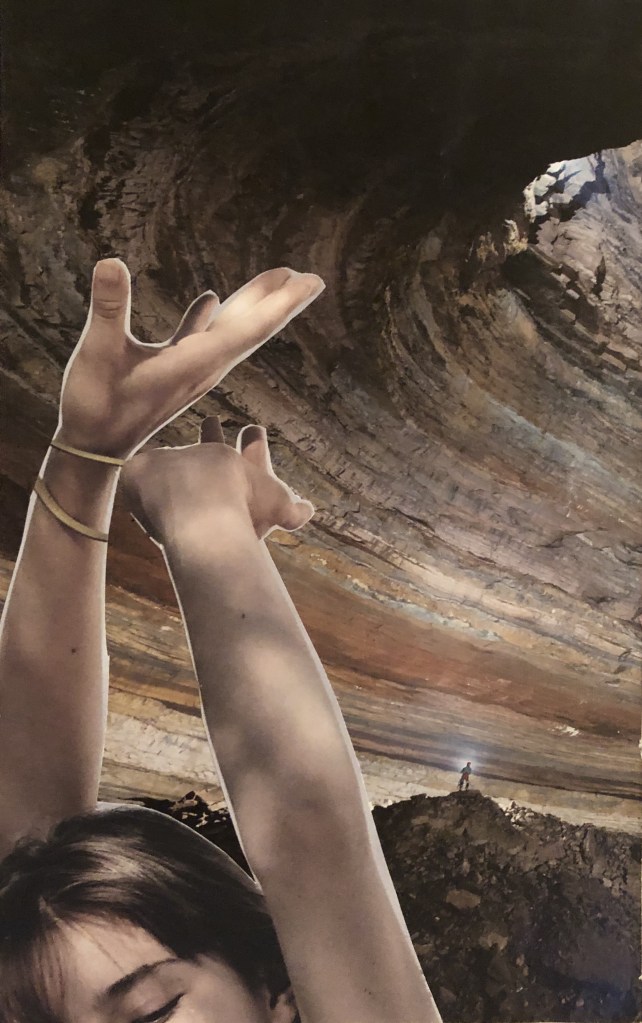
I am one who sees the fullness of darkness and light. I see golden. I see through the eyes of a child, as well as the wise and wondering woman. I see myself reflected in beauty and patterns, knowing there is a big and a small picture.
I am one who is looking forward while also considering the past. Both/and. The wise woman and the apprehensive child. I am one who sees there is more than meets the eye, and that things aren’t always as they seem.
I am one who reflects what is. When I change my stance, what I see in myself may be different. The sculpture embodies stability. It stands firm, but the images that result can be changed. It captures the essence of being Benedictine—there is stability and movement.
I am one who is responsive, seeing beyond what is.
Consider using images and collage to learn more about who you are. What does A Golden Threshold mean to you? Meditate on the image and see what intuitively comes to you about darkness and light, about embracing both as a golden moment. Is there a threshold moment in your life that could use this way of seeing?
Source: The Oblate Life, edited by Gervase Holdaway, OSB, 2008
Men and women who have made monastic vows, called monks, practice stability by committing to a specific monastery. “The monk is an archetype, whether we live in a monastery or not, we have a sense of what it means to be a monk. We long to be together with God in solitude.” (Fr. Mauritius Wilde, OSB)
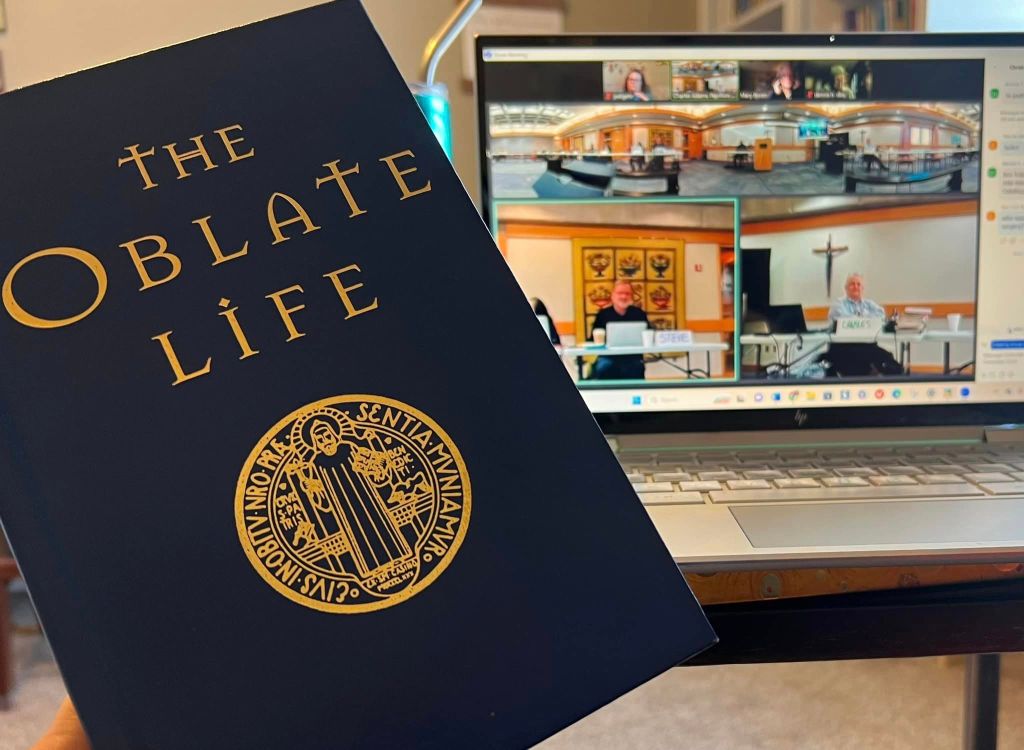
Being Benedictine as an oblate is making a commitment to a monastery, living the core values of obedience, conversion of life, and stability while following the Rule of St. Benedict as monks “in the world,” meeting monthly to practice Lectio Divina and discussing a spiritual reading. In the age of Zoom meetings (in which I, gratefully, participated this month), it is a good reminder that it is the monastery that I am drawn to—to the sacred rhythm of prayer and respect for silence, the theme of our discussion (December 2023.)
Grateful for the option of Zooming in to Oblate meetings, but it’s never quite the same. I love to go to our monastery and retreat center.
“If we are to learn about silence and cultivate its art form, the monastery is the first place to visit, for it is within the ancient tradition of monasticism, that we can begin to understand the relevance and the need for silence as a discipline, and a way of life. It is highly relevant that the very first word of the rule of Saint Benedict is listen.”—Susie Hayward, Silence, The Oblate Life
In silence, we can be transformed. “We will begin to see the ‘world’ differently, our breathing will become more rhythmical, surrounding color will intensify and brighten and our eyes will see more clearly and with greater perception.” (Hayward) We become more attentive. We notice the details around us, and we notice what is happening within us.
I had this experience during a contemplative prayer retreat over 20 years ago, my first visit to the monastery and retreat center that has become such an important part of my life. Even during our meals, we sat in silence, which contributed to a heightening of my senses—the quiet and stillness provided a backdrop through which I appreciated the color and tastes of ordinary foods—lettuce, tomatoes, bread, pasta, butter, milk. It was pure ecstasy to look, touch, and taste—to interact with my food. This sentiment—the sensitivity to physical, tangible cues—carried over into watching fish swim in the pond, grasshoppers jump from one station of the cross to the next, a candle flickering. All things seemed to be created for me. Every movement, color, taste, and sensation seemed special, whereas just days before it was ordinary.
Silence magnifies an experience. The practice of silence helps cultivate attentiveness to others and to how God is working in our lives. Thomas Merton writes, “By learning to listen… we can find ourself engulfed in such happiness that it cannot be explained: the happiness of being at one with everything in that hidden ground of Love for which there can be no explanations.” This type of interior silence must be cultivated. Visiting a monastery where there is silence can help, but one can create physical spaces in our own homes to remind us that times of silence are needed.
Hayward writes that “without silence, God has no voice.” No doubt silencing the noise of our daily lives can help us be more aware of the divine—in creation, in others, in words we read, in the thoughts that run through our mind, and in the story we tell ourselves. Indeed, silence allows us to experience the sacred, but many of us have felt God working, “God’s voice,” through the written or spoken words of others. In discussion, we wonder—do we really need absolute silence to hear God?
Perhaps Hayward means that we need to silence ourselves—to shut our mouths, to let go of thoughts and stories, and to be truly present wherever we find ourselves. If we are in conversation with another, there is sound, not silence, but we can practice interior silence by deeply listening to the other and standing witness to another’s story. It is important to remember that the first word in the Rule of St. Benedict is “Listen.” We must practice silence, both in words and thoughts, in the presence of the divine, including others.
Hayward writes about “the experience of feeling the total ‘presence’ of another person, in such a profound way that ‘in that moment’ we will have felt absolutely heard, totally cared for and completely understood.” What a gift to be heard and to hear others without the noise in our heads! She continues, “Listening reflectively in this attentive and empathic way allows each person to respond to the other fruitfully.”
God is working in this ‘total presence,’ the compassionate listening to another’s story. May we practice silence, to listen, see, and fully experience the humility of unknowing all that we think we know, to experience a oneness with our Creator, with creation, and with all those whom we share both.