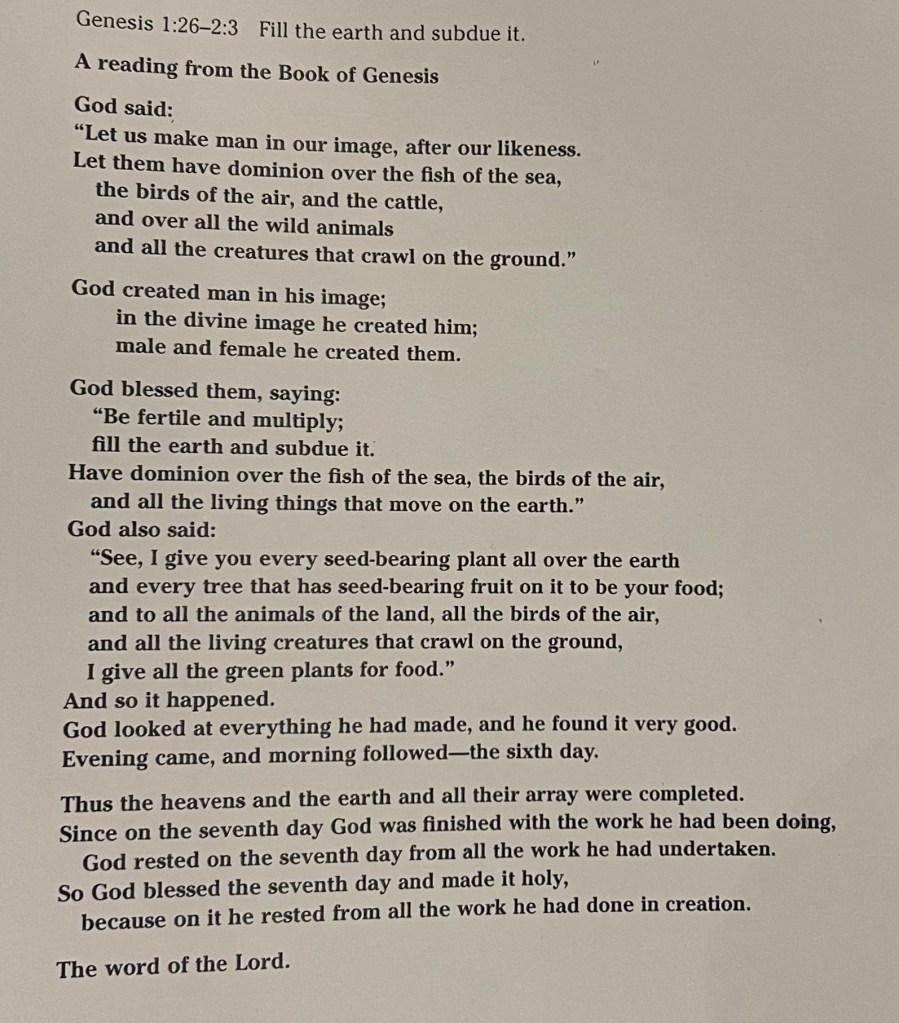
Lectio Divina—Genesis 1:26-2:3, Fill the earth and subdue it.
Book Discussion—The Oblate Life: Spirituality at Work, Dermot Tredget. Edited by Gervase Holdaway, OSB, 2008
Topics: Prayer, work, rest and study together provide a foundation for a Christian spirituality of work. St. Benedict recognized that work has a transformative power and for the monk is the principal means to seeking God. Our discussion flowed from words or phrases that resonated from sources listed above.
God created man in his image, in the divine image he created them.
We are created in the image of our Creator; we are creators, too, and it is our responsibility to contribute to the act of creation. Creation is not a once and done effort. Creation requires constant movement, growing, expanding, and even resting. We must ask ourselves if our work is valuable. Does my work add value to God’s creation? “We cannot speak about a spirituality of work without talking about an ethics of work.” (Dermot Tredget)
I give you every seed-bearing plant
In the image of our Creator, our work is to plant the seeds we are given which becomes our food. This isn’t quick and easy work; we need to rest, recover and have patience. We are in relationship with the Divine as co-creators. The Divine is not out of the picture. There is an unseen aspect of work–God is working even while we rest. Even further, what we see as useless toil may show value later. All is sacred.
Choosing a word to focus on each year has become a nourishing, soulful ritual. I savor the word, that more so chooses me, throughout the year—it brings great joy when in perfect synchronicity, it appears over and again in what I read, hear, and see. I trust that the word, as it settles in my heart, will be a guiding light for months to come—challenging, inspiring, and transforming me.
My 2024 word of the year, FULLY, is a throwback to ten years ago when I birthed and named my first website and creative venture, SoulFully You. I participated in training to become a certified SoulCollage® facilitator, to lead retreats on creativity and spirituality. As a Marketing teacher, creating a brand name felt like the best first step. With my daughter Jessica and her friend Claire (both students of my high school classes) we brainstormed a variety of words, phrases, and combinations, and then it clicked, that “aha moment” of knowing I have come to trust—SoulFully You. I loved what it meant, and still do. The image at the top of this page, a SoulCollage® card to represent SoulFully You, came later.
Being SoulFully You is living with purpose, on purpose; being attentive to the present moment; practicing gratitude; making good choices and having no regrets; living with death daily before your eyes, as St. Benedict writes; and leaving something beautiful from a life well-lived. It is living life to the fullest, using the gifts and talents you have while being open and responsive to opportunities and surprises that come your way.
A tree gives glory to God by being a tree.
Thomas Merton
Being SoulFully You is discovering and becoming all that God has created you to be. Thomas Merton writes, “For me to be a saint means to be myself.” The call to be holy is the call to be more fully myself, just as a tree gives glory to God by being a tree.
Meeting the Pope is a big deal. Recently I wrote about the 5th World Congress of Benedictine Oblates and the private audience that Oblates had with Pope Francis. Jaime Williams, an Oblate of Christ the King Priory, was in the private audience and was profoundly impacted. I asked him to share his experience and he graciously accepted.
A “Being Benedictine” Reflection by Jaime Williams:
Two plus weeks after the most extraordinary handshake in my life, I still struggle to comprehend how my journey from an inauspicious upbringing in small-town Iowa led to meeting Pope Francis and visiting the two most important holy sites associated with our beloved St. Benedict and St. Scholastica in Italy – nearly 30 years after graduating high school and leaving home. After spending a significant portion of my career traveling extensively through parts of the developing world, I don’t consider my childhood to be been one rooted in poverty, but certainly, my parents had to work hard to make ends meet and there was no shortage of stress present throughout my childhood. I generally consider the Christian formation I received while growing up to be relatively poor, and our participation in church of any kind was sporadic and inconsistent: we were members of Presbyterian, Nazarene, and Methodist congregations at various times during my youth, and moved constantly between northeast Iowa, and east and west coast towns in Florida, before finally settling in southern Iowa where I spent most of my high school years. It is no surprise to me that of our Oblate promises Stability is what I cherish most from my family and Oblate community!
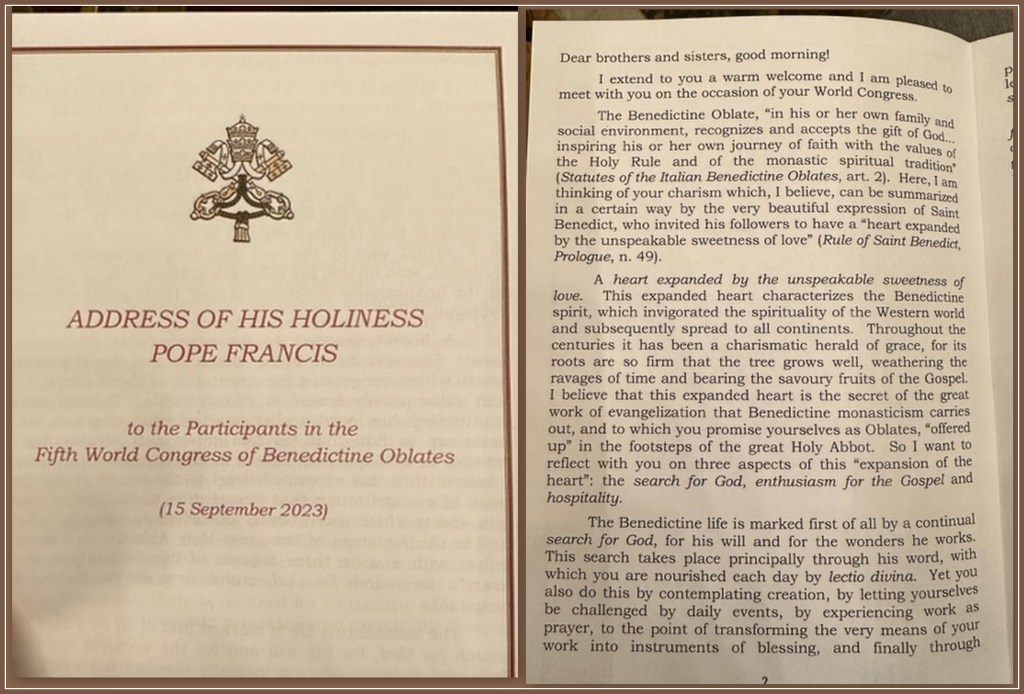
The Benedictine spirit is characterized by “a heart expanded by the unspeakable sweetness of love.” Pope Francis addressed the 5th World Congress of Benedictine Oblates in a private audience on September 15, 2023, as reported by Vatican News. The Congress theme, “Moving forward: Living the Wisdom of the Rule,” is an opportunity for Oblates, lay associates of a Benedictine monastery, to learn about their calling as monks in the world.
I participated in the 2017 Congress in Rome, attending the General Audience of Pope Francis at St. Peter’s Square. I reflected, “We were delighted to be seated on the platform, very near where the Holy Father was also seated. His message on the Eucharist was followed with a welcome for visiting groups with a special mention of Benedictine Oblates. For many oblates, this was one of the most magical moments of the week.” Indeed, it was very special.
But I can only imagine that a private audience with Pope Francis has left oblates still pinching themselves. Jaime Williams, Oblate from Christ the King Priory where I also belong, shared he cannot find the words to describe the experience (although he has promised a guest post when the words begin to flow.) Jaime shared photos of the program with the words of Pope Francis’ message, of which I will comment.
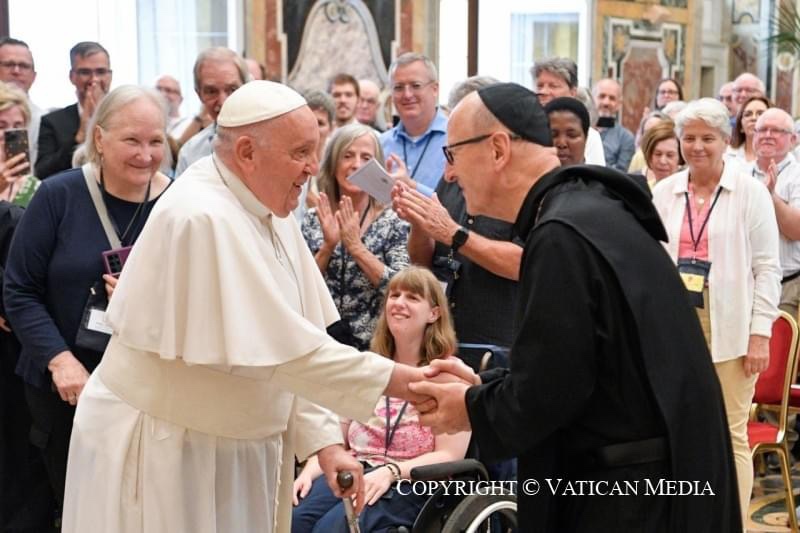
Jaime Williams, Oblate of Christ the King Priory, Schuyler NE, in the background (blue shirt) as Pope Francis greets Abbot Primate Gregory Polan.
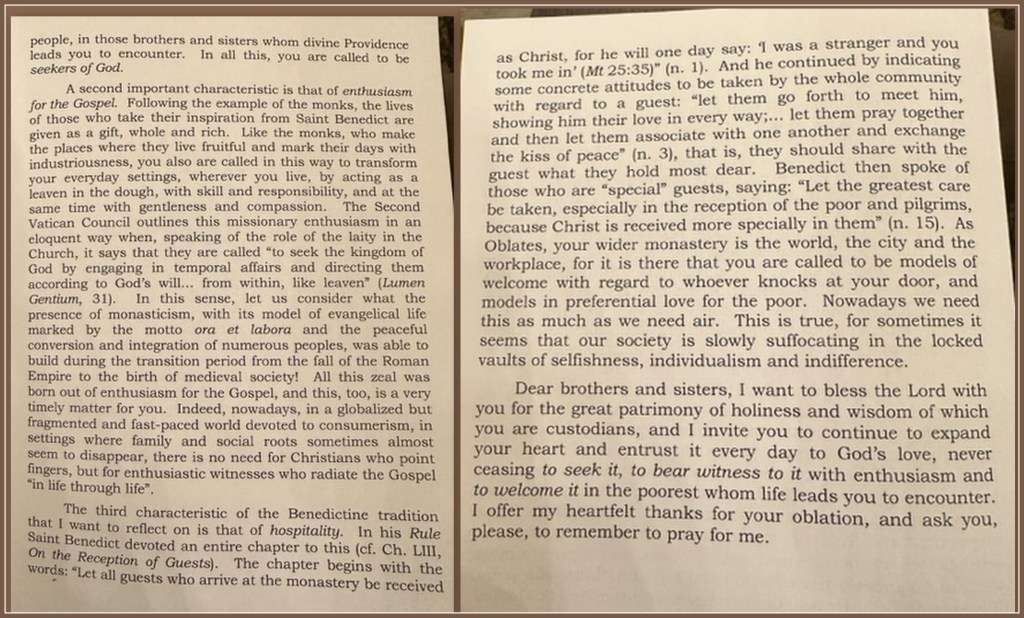
The Holy Father spoke to three aspects of this “expansion of heart”: the search for God, enthusiasm for the Gospel, and hospitality. “The Benedictine life is marked first of all by a continual search for God, for His will and for the wonders He works,” the Pope said. He emphasized the importance of practicing contemplation with the practice of Lectio Divina, as well as contemplation of creation, the challenges of daily life, the experience of work as prayer, and especially through other people.
Like the monks,” he said, “who make the places where they live fruitful and mark their days with industriousness, you also are called in this way to transform your everyday settings, wherever you live, by acting as a leaven in the dough, with skill and responsibility, and at the same time with gentleness and compassion.”
Finally, Pope Francis reflected on the characteristic of “hospitality,” noting that Benedict instructed monks to receive guests at the monastery as they would receive Jesus Himself. As Oblates our “wider monastery is the world, the city, and the workplace, for it is there that you are called to be models of welcome with regard to whoever knocks at your door, and models in preferential love for the poor.”
Pope Francis captures what being Benedictine means to me. It is not about interpreting the literal words in the gospel, but how I take its timeless message into my daily life—in my work, family, relationships, community, environment, and more. The words of Franciscan monk, Richard Rohr, resonate with me, “I’m convinced that one of the only reasons Roman Catholicism has lasted is because we have these satellites of freedom on the edge of the inside—religious communities of Benedictines, Jesuits, Dominicans, Franciscans, Sisters of Charity, Sisters of Mercy, and many more.” It is the connection with my favorite monks, our monastery, and Benedictine spirituality, a 1600-year-old tradition, that has sustained my search for God, my desire to learn from the ancient texts and rituals, and to practice hospitality as a monk in the world.
I have been so inspired by the writing and work of Christine Valters Painter, a Benedictine oblate, author, and online abbess of Abbey of the Arts. The Abbey is a virtual global online monastery offering pilgrimages, online classes & retreats, reflections, and resources which integrate contemplative spiritual practice and creative expression with monastic spirituality. They provide support and resources in becoming a monk in the world and an artist in everyday life.
Learning from members of the community in the Monk in the World Guest Post series has been a source of affirmation that, indeed, one can live according to the Rule of St. Benedict not only in the monastery but in the life one chooses to lead.
I am so honored to have my blog post shared on Abbey of the Arts on the Feast of St. Benedict! The full text is below or at Abbey of the Arts.
“I am delighted to share another beautiful submission to the Monk in the World guest post series. Read on for Jodi Blazek Gehr’s reflection on being a Benedictine oblate.
St. Benedict is special to me for a few reasons. First, we share a birthday. I admit I was disappointed when I first discovered this. My parents had given me an illustrated book of the “Lives of the Saints” to commemorate my Confirmation. As any nine-year-old would do, I immediately looked to see who the saint was for July 11, my birthday. Perhaps Elizabeth, Mary, or Theresa would be my special saint.
Instead, I see an illustration of a man with a dark hood, a scary-looking bird, a crooked cane, and an unusual name I had only associated with Benedict Arnold. July 11, St. Benedict, Abbot, it said. I had never heard of him and surely did not know what an Abbot was. Through the years, I returned to this image of St. Benedict, thinking that I should have some connection with my patron saint.
Fast forward 26 years. With a full and busy life—married with a young daughter, a career as a high school teacher and club sponsor—I felt a deep longing for times of silence.I answered the call of my heart and responded to an advertisement for a silent contemplative prayer retreat. I discovered an oasis of peace just a few hours from home in the cornfields of Nebraska…called St. Benedict Center.
Hospitality is the foundation of Benedictine spirituality. St. Benedict insisted that hospitality be one of the highest values for monasteries, writing:
“Let all guests who arrive be received as Christ.”
Rule of St. Benedict 53:1
The “guest” may be a stranger, a friend in the making, those in our community who are marginalized, or our closest friends and family. Hospitality includes being truly present to others, becoming aware of their needs and challenges, and respectfully responding to them as much as one is able. For those close to us, we must welcome each other over and again, forgiving each other as we grow together or apart, giving each other grace and space as we become.
Recent news has caused me to reflect on how essential extending hospitality is to the health of our spirit and to the soul of organizations, communities, states, and countries; to consider how I have given and received hospitality, and how it has been withheld by myself or others.
Inadvertently or intentionally, we often do not extend welcome to others. We are human—busy, thoughtless, unaware—this is forgivable, but what we have witnessed—immigrants being lured to an undisclosed location with the promise of shelter and work—goes beyond withholding hospitality.
Diana Butler Bass writes about Radical Hospitality in her Cottage Sunday Musings, with commentary on the appalling news of “immigrants being lured from a shelter in San Antonio by the governor of Florida and shipped off to Massachusetts as a kind of political stunt is a profoundly cruel use of distressed people for political purposes. And the mirth and amusement that this episode inspired among self-declared “Christian” politicians has been nauseating… A church on Martha’s Vineyard sheltered unexpected arrivals, “angels unaware,” as guests worthy of dignified treatment, is a testimony to goodness and generosity, a vision of the world as God intends it to be — practicing hospitality toward strangers.”
She “makes the point that NO ONE can call themselves Christian unless they practice hospitality to strangers…Would that every faith community was like a swarm of bees, running out to meet the displaced, the lost, and the unexpected strangers with the same delight, zeal, and alacrity as the earliest Christians. Theologian Letty Russell once noted, “The word for hospitality in the Greek New Testament is philoxenia, love of the stranger. Its opposite is xenophobia, hatred of the stranger.” Philoxenia turns strangers into friends.
What a difference philoxenia would make a difference in our world — and in our politics — right now.”
I also offer excerpts and links to other reflections I have written on hospitality:
Fr. Mauritius suggests we can learn how to approach the tensions in our lives and the conflicts in our family, community, and world by looking at the recommendations for selecting a leader of a monastic community in The Rule of St. Benedict, Chapter 64. This chapter suggests that good leadership requires living the values of sound judgment, wisdom in teaching, pure motives, moderation, prudence, loving behavior, discernment, and as the retreat title suggests, soberness and mercy, among others.
Leadership starts with leading oneself. Cultivating the values of being sober and merciful can help us be our better selves in tough times. So often we want to escape or numb ourselves to any pain we may feel—to simply run away from our feelings, people, or situations. At other times we might become overwhelmed by distress or completely absorbed by worries. Neither of these approaches is effective to deal with conflict and anxiety but practicing soberness can provide a middle way—a more balanced, Benedictine way to help us accept our reality as it is, yet not becoming attached to it.
To be sober (Latin: sobrium) is to have an attitude of acceptance, to be temperate, and to take people, things, and activities just as they are. We can become “drunk with anxieties” of daily life, but as one who can compulsively think, ponder, wonder and what-if, this tendency can block one from seeing the truth of the way things truly are. It’s as if an alternate reality is created, one that takes us far away from the present moment.
Emotions can make us drunk; they can completely absorb us. Being sober and vigilant (1 Peter 5:8) is the absence of being drunk on emotion or being overcome with anxiety. By practicing mindfulness, we learn soberness tastes better—the purity and truth of circumstances are clear. One begins to sense when something is just too much—emotions, noise, activity, food, or drink—and is more able to set boundaries for what disturbs. Wanting more of this sobriety is craving what is real—the present moment, an ecstatic peace for only God can fill us with. To be sober is to be free. We must remain vigilant, alert, and open, for what God fills us with, for moments when Christ is revealed in our daily lives.
This retreat weekend is one of the last before I begin a new school year, so there is no shortage of uncertainty or anxiety. What I have learned about soberness is wisdom I will carry with me, a reminder to be gentle with myself while also being watchful and mindful of my tendency to be absorbed in emotion and the circumstances of a school day, whether it is a conflict with a student or colleague, disappointments of unmet expectations, or a frantic pace and frequent interruptions.
St. Benedict is special to me for a few reasons. First, we share a birthday. I admit I was disappointed when I first discovered this. My parents had given me an illustrated book of the “Lives of the Saints” to commemorate my Confirmation. As any nine-year-old would do, I immediately looked to see who the saint was for July 11, my birthday. Perhaps Elizabeth, Mary, or Theresa would be my special saint.
Instead, I see an illustration of a man with a dark hood, a scary-looking bird, a crooked cane, and an unusual name I had only associated with Benedict Arnold. July 11, St. Benedict, Abbot, it said. I had never heard of him and surely did not know what an Abbot was. Through the years, I returned to this image of St. Benedict, thinking that I should have some connection with my patron saint.
Fast forward 26 years. With a full and busy life—married with a young daughter, a career as a high school teacher and club sponsor—I felt a deep longing for times of silence. I answered the call of my heart and responded to an advertisement for a silent contemplative prayer retreat. I discovered an oasis of peace just a few hours from home in the cornfields of Nebraska…called St. Benedict Center.
The Tesla Roadster is said to go from zero to 60 miles per hour in 1.9 seconds. Whoa!
Who really needs to go that fast?! I understand better than most what it is like to be running late, hurrying to my destination and feeling like I need to drive a little faster—I’ve been known to have a lead foot in these cases a few too many times.
But is it smart, safe or the best thing for us and others? We know it is a wiser choice to slooooow down.
Likewise, I know all too well about reacting emotionally in challenging situations. My temper can go from zero to 60 in about 2 seconds. It is a benefit to slow down my thoughts, emotions, and reactions a bit to gain a better perspective.
The local, national or global news can cause one’s heart to race, from zero to 60, in the time it takes to read or hear just one reported sentence. It is all too easy to get caught up in the “swirl and chaos of fear, violence, and anger assaulting our world today. Practicing soberness means being detached from emotions, both overly negative or positive feelings. It is not good to be “drunk” on either extreme.” (Discerning Hearts)
Alternatively, we can meet all challenges with an attitude of soberness.