Search

Being Benedictine

Living SoulFully as an Oblate of St. Benedict

Tag

Prayer

All Saints of the Order of Saint Benedict, Feast Day: November 13

Happy Feast of All Saints of the Order of St. Benedict!

The number of Benedictine saints, including Sts. Benedict, Scholastica, Hildegard, and Henry, is large: “At the beginning of the fourteenth century the order is estimated to have comprised the enormous number of 37,000 monasteries giving the Church no less than 24 popes, 200 cardinals, 7,000 archbishops, 15,000 bishops, and over 1,500 canonized saints.” (Catholic Encyclopedia) Seven more centuries have only added to this sanctified group. You can find them listed here, from Abbo to Zosimus, all gathered under one faith and one Rule.

Benedict Gaughan (Being Part of the Benedictine Family, The Oblate Life) gathered feedback from their Oblate family about what it means to be a part of their community. Christine Michael shared, “Being part of the Benedictine family means that I can benefit from the tried and tested wisdom of Benedictines over the countless generations. The Benedictine ethos transcends all boundaries of tradition; a Benedictine is a Benedictine whether Anglican or Catholic, and from whatever part of the world.”

This sentiment resonates with words from our new Abbot Primate of the Benedictine Confederation, Jeremias Schröder OSB, of St. Ottilien Archabbey, who wrote, “Uniformity is not the goal of the Benedictine way. In a world that often seeks to simplify and streamline differences, the Benedictine tradition reminds us that true community is not about making everyone the same, but rather about embracing each person’s unique journey in faith.” He continues,

Benedictine life celebrates the beauty of individuality within the context of unity in Christ. Just as St. Benedict envisioned, our calling is to live together in love and respect, cherishing the distinct gifts God has given each of us. May we all strive to build communities rooted not in conformity, but in a shared commitment to love, faith, and mutual support.”

This is what I love about Being Benedictine. I don’t have to fit my faith in a box, I am part of the Benedictine circle where all are invited to learn, grow, and love.

We are all called to be saints, to grow in holiness, and to become closer to God by loving our neighbor.and self. Pope Francis in his 2013 Angelus wrote, “The Saints are not supermen, nor were they born perfect. They are like us, like each one of us. They are people who, before reaching the glory of heaven, lived normal lives with joys and sorrows, struggles and hopes. What changed their lives? When they recognized God’s love, they followed it with all their heart without reserve or hypocrisy. They spent their lives serving others, they endured suffering and adversity without hatred and responded to evil with good, spreading joy and peace. This is the life of a Saint.”

A tree gives glory to God by being a tree.

-Thomas Merton

Being SoulFully You is discovering and becoming all that God has created you to be. Thomas Merton writes, “For me to be a saint means to be myself.” The call to be holy is the call to be more fully myself, just as a tree gives glory to God by being a tree. It is sacred work to ponder what the saints have offered as role models on our journey to becoming more holy.

Photo: The doorway to St. Hildegard of Bingen Abbey church in Rudesheim, Germany. More here.

© Jodi Blazek Gehr, Being Benedictine Blogger

Vote: The Sound of One Voice

Many of us have likely traversed a range of emotions this election season, experiencing the impact on our mind, body, and spirit. I have gone from one extreme to the next—exhausted, energized, concerned, confident, afraid, assured.

There is a time for everything…a time to be silent and a time to speak. (Ecclesiastes 3: 1,7)

It is the time to speak—to use our voice and vote for the values we hold dear, to endorse the leader we believe can advance our hopes and dreams for the United States of America.

While visiting a church in the Bohemian Alps of Nebraska, I lit a candle as a prayer for this very divided country and the election.

May my one voice join with others, especially with marginalized ones, for the good of all. May you be inspired, as was I, by the lyrics of the The Wailin’ Jennys in One Voice:

This is the sound of one voice
One spirit, one voice
The sound of one who makes a choice

This is the sound of one voice

This is the sound of voices two
The sound of me singing with you
Helping each other to make it through
This is the sound of voices two


This is the sound of voices three
Singing together in harmony
Surrendering to the mystery
This is the sound of voices three

This is the sound of all of us
Singing with love and the will to trust
Leave the rest behind, it will turn to dust
This is the sound of all of us

This is the sound of one voice
One people, one voice
A song for every one of us
This is the sound of one voice
Source: Musixmatch

“For where two or three gather in my name, there am I with them.” (Matthew 18:20)

Continue reading “Vote: The Sound of One Voice”

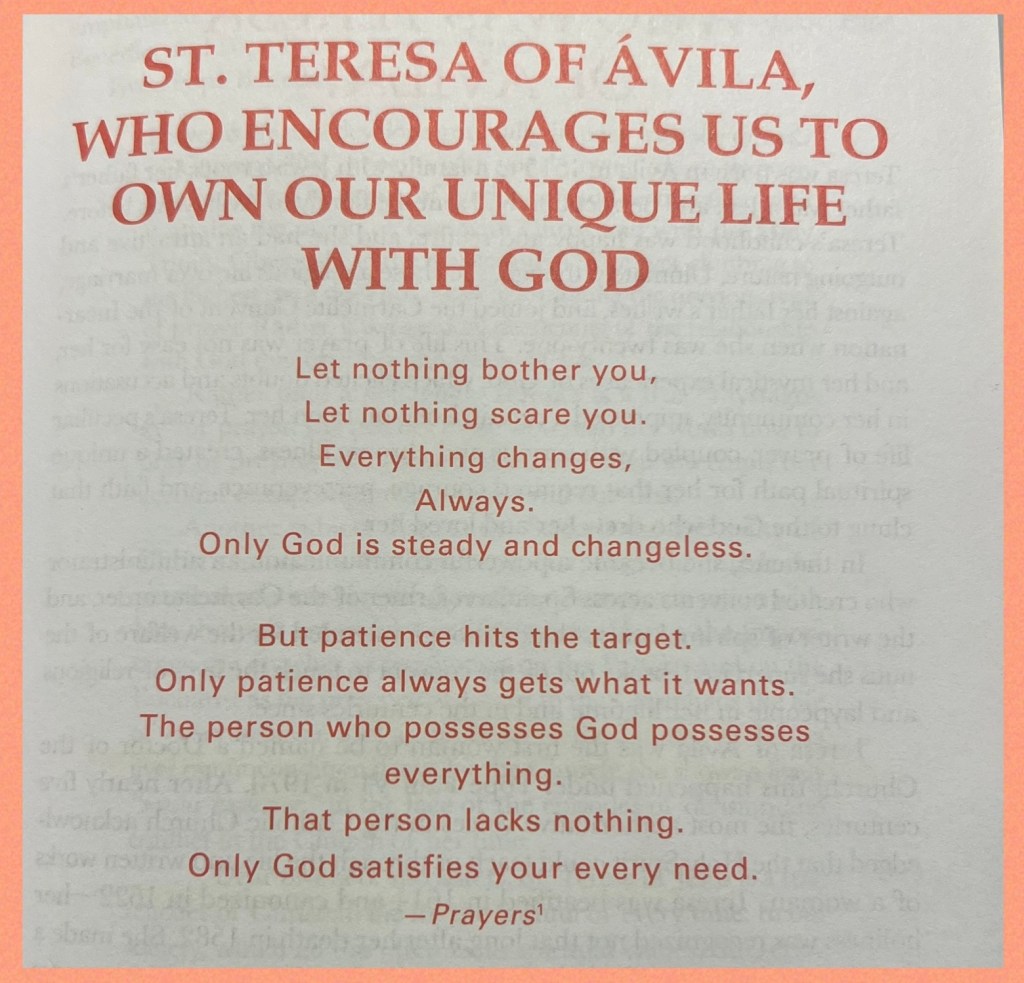
The Two Teresas and a Message of Peace

May today there be peace within. May you trust God that you are exactly where you are meant to be. May you not forget the infinite possibilities that are born of faith. May you use those gifts that you have received, and pass on the love that has been given to you. May you be content knowing you are a child of God. Let this presence settle into your bones, and allow your soul the freedom to sing, dance, praise and love. It is there for each and every one of us.Saint Terese of Lisieux

During a season of uncertainty and anxiety, I typed out the prayer above, laminated it, taped it to my desk at school, and posted it in the bathroom I got ready in every day. While waiting for additional tests after receiving a cancer diagnosis, this prayer brought peace that excessive research and reason could not. What soothed my soul was a daily routine of silent meditation and praying the words written by Saint Thérèse of Lisieux (1873-1897), also known as the “Little Flower” whose Feast Day we observe on October 1. As with Lectio Divina, one word or phrase might speak to me differently, and I could carry it throughout the day. This practice helped me keep my sanity when literally nothing else helped.

Twelve years have passed since I was diagnosed with chronic lymphocytic leukemia (CLL). Thankfully, medical treatment has not been required, and if I continue to be symptom-free, I only need to visit my oncologist every six months. As healthy months turn into years, I think about my diagnosis less. There are periods when I even forget that I have CLL, but the diagnosis changed my life forever. I am deeply intentional about living Soulfully; living with purpose, on purpose; being attentive to the present moment; practicing gratitude; making good choices and having no regrets; keeping “death daily before your eyes,” as St. Benedict writes; and leaving something beautiful from a life well-lived. But somewhere along the way, I stopped reading this prayer every day.

Set The World On Fire by Vinita Hampton Wright; translation of prayer by Carmen Acevedo Butcher. Original:
Let nothing disturb you, 
Let nothing frighten you, 
All things are passing away: 
God never changes. 
Patience obtains all things
Whoever has God lacks nothing; 
God alone suffices.

 
— St. Teresa of Avila

Continue reading “The Two Teresas and a Message of Peace”

The Final Threshold: Take This Body Home

Day by day remind yourself that you are going to die.
Hour by hour keep careful watch over all you do,
aware that God’s gaze is upon you, wherever you may be.

Rule of St. Benedict 4:47-49

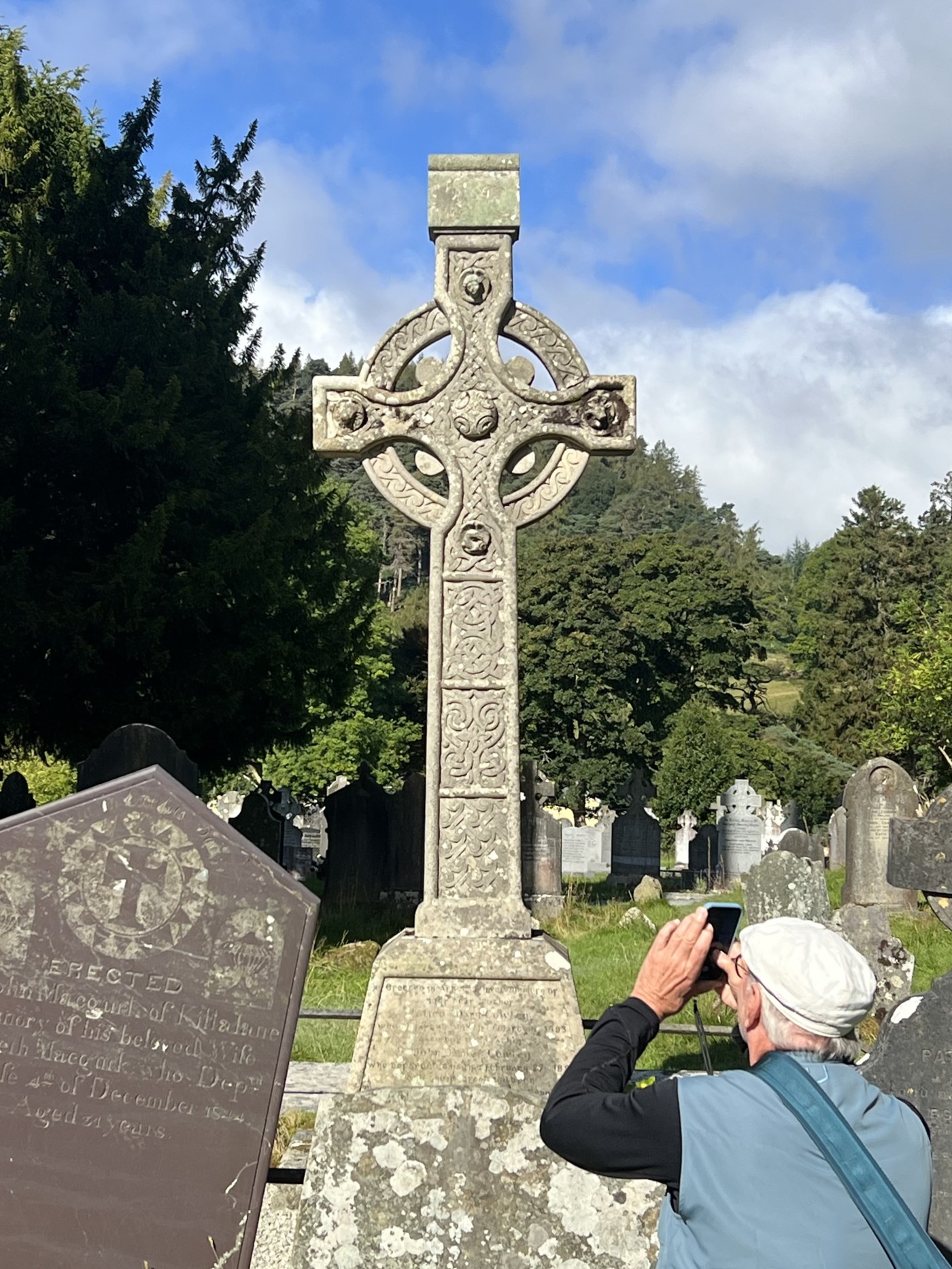
One of the gifts of a pilgrimage is those you connect with on the journey—greeting each other in the morning, offering small kindnesses, enjoying meals together, appreciating the sacredness of the sights, and sharing insights. On a recent Celtic Christianity pilgrimage to Ireland and Scotland, I knew only one person, my friend, SoulCollage® companion, and travel roommate, Sara, who I met several years ago at St. Benedict Center as a Benedictine Oblate.

Sara and I had decided to begin our pilgrimage four days earlier at the Cliffs of Moher, in the west of Ireland, and then travel by train to Dublin to catch up with the group once they arrived. Many pilgrims knew each other beforehand, so introductions in Zoom meetings and social media proved to be a helpful head-start to our shared time. Just a few days into our pilgrimage, I shared breakfast with one of the pilgrims, Mike, at a two-person table.

We ordered porridge and discussed the lengthy lines for fancy coffee from the European espresso machines, hoping for just a quick pot of black coffee. I was clearly more irritable about getting my first cup when Mike commented that he recently started taking a spiritual approach, a detachment from coffee, he said. If he gets coffee in the morning, all the better, but not getting coffee would not be a deal-breaker for his day. He would not allow the absence of coffee to interfere with his interior peace.

As I calmed down about the lack of morning caffeine, our conversation continued to a depth not often reached in such a short time. We shared that through the years our spirituality had changed, impacting how we experience life, especially how we respond viscerally as we witness racism, homophobia, injustice, and hateful behavior in our country. We shared our deepest grief about the estrangements in our family and the uncertainty of how healing might come.

Navigating long lines and crowds in the breakfast area, we finally achieved the goal of a cup of coffee.  Mike commented that people were not even looking at each other while getting food and drink. He was right. Mike’s comments remained in my heart throughout the day and I am grateful to have had such a meaningful conversation with him.

The gift of a pilgrimage “lies in the gaps of the agenda, in the conversations and relationships with others, and in the details of the day that cannot be planned or controlled. This is where the grace of God enters—sometimes it is in the form of discomfort and challenges and other times in opportunities that new insights and “aha moments” of new understanding bring.” (A Busload of Hospitality: A Benedictine Pilgrimage, Part 4, Jodi Blazek Gehr)

Continue reading “The Final Threshold: Take This Body Home”

SoulFully You: Special Programs in April 2024

It is a joy to create workshops and retreats for special projects. I had the opportunity to lead a few SoulFully You programs in April for ECHO Collective and St. Andrew’s Episcopal Church – Omaha.

ECHO Collective connects and empowers refugee and immigrant women providing opportunities for personal growth and cross-cultural relationships.  With a grant from the Nebraska Arts Council, ECHO is offering a weaving class to women and children using SoulCollage® as a springboard for a tapestry design. In the first session, we explored the power of their unique stories, reflected with images to create a SoulCollage card, and discussed how weaving their stories together can bring healing. Mothers, teens, and young children participated, including my youngest ever–a two-year-old sweet girl particularly attracted to images of white bunnies. Participants will learn weaving techniques for several weeks to create their own and a community tapestry.

The promise of peace comes through story. When we are willing to bear witness to one another, to take other’s and joy seriously, to listen deeply, with full attention, to tell other’s stories over–we reweave the bonds of civil society.“- Rabbi Dr. Ariel Burger

St. Andrew’s Episcopal Church hosted a women’s retreat titled “SoulFully You: Many Ways to Pray” that focused on finding God in music, movement, nature, words, and creativity. Richard Rohr writes, “We are already in the presence of God. What is absent is our awareness.” Twenty participants practiced Lectio Divina with the poem I Happened to Be Standing by Mary Oliver and learned how to create mandalas. Group discussions, journaling, and prayerful activities highlighted the wisdom of Simone Weil, that “pure attention is prayer.”

 If you begin to live life looking for the God that is all around you every moment becomes a prayer.” -Frank Bianco

For more information about SoulFully You retreats, see upcoming retreats held at St. Benedict Center and possible retreat themes here. If you are interested in having a retreat or workshop created for your organization, church, or special interest group, contact me here.

© Jodi Blazek Gehr, Being Benedictine Blogger

The Divine Presence is Everywhere

September 2023 Lectio Divina and Oblate Reflections

Lectio Divina—Chapters 19 and 20, Rule of St. Benedict

Book DiscussionThe Oblate Life, edited by Gervase Holdaway, OSB, 2008

Being Benedictine is to believe that the Divine Presence is everywhere, as the opening of Chapter 19 in the Rule of St. Benedict states.

“We believe that the divine presence is everywhere and “that in every place the eyes of the Lord are watching the good and the wicked” (Proverbs 15:3). But beyond the least doubt we should believe this to be especially true when we celebrate the divine office.”

Chapter 19, The Rule of St. Benedict

What is the Divine Office?

The Divine Office, also known as the Liturgy of the Hours or Opus Dei, the “Work of God”, is a daily prayer of psalms, readings, hymns, and prayers. Traditionally during a week, with prayers seven times a day, all 150 Psalms are recited by monks. The Psalms are prayers that Jesus and his disciples recited as part of the Jewish liturgy expressing the depth of human experience and emotion from joy, anger, thanks, praise, suffering, sorrow, contrition, petition, and more.

Continue reading “The Divine Presence is Everywhere”

Prayers of Peace for Ukraine

Let us pray.

Pray in whatever ways and words work for you–whether you are holding space, sending positive energy, visualizing hope and peace overflowing, creating a collage, writing your own thoughts, or reciting the words of the prayer Pope Francis has intended for the consecration of Russia and Ukraine to the Immaculate Heart of Mary (shown below.)

JUST PRAY.

There are no requirements to understand every word of the prayer, to be Catholic, or to believe in Mary’s Immaculate Heart, in order to grow in compassion and unite our intentions with others who pray, hold space, and send good energy. As I read (and prayed) Pope Francis’ prayer, I created bullet-prayers (not sure if that’s a thing, but it is for me now)–one-sentence intentions that I can offer up when I think of those suffering in Ukraine.

Turn our hearts towards love and peace. 🌻 May we hold space for those suffering.

Make visible our compassion. 🌻 May we remember what causes pain for others.

May we hold in our hearts the children, the hungry, the homeless, the fleeing, the mother, the father, the child, the beloved pet, the defenders, the truth-tellers, the fighters, the comforters. 🌻

May we ravage the earth with love. 🌻 Help me to think of others.

May we be, and follow, models of love and peace. 🌻 Help us remember that darkness can be overcome.

Untie the knots of our hearts. 🌻 Help us to forgive.

Water the dryness of our hearts. 🌻 Fill our hearts with peace. 🌻 Help us to pray.

Here is the full text of the prayer obtained by Catholic News Agency:

O Mary, Mother of God and our Mother, in this time of trial we turn to you. As our Mother, you love us and know us: no concern of our hearts is hidden from you. Mother of mercy, how often we have experienced your watchful care and your peaceful presence! You never cease to guide us to Jesus, the Prince of Peace.

Continue reading “Prayers of Peace for Ukraine”

Eat Cake and Pray

The prayer before dinner in “Don’t Look Up,” the satirical apocalyptic film setting Netflix records and nominated for many awards, keeps going through my mind.

“Dearest Father and Almighty Creator, we ask for your grace tonight despite our pride. Your forgiveness despite our doubt. Most of all Lord, we ask for your love to soothe us through these dark times. May we face whatever is to come in your divine will with courage and open hearts of acceptance.”

How will we spend the moments that could be our last?

How do we face tragedy with courage?

How can we find peace in our hearts when our world is falling apart?

How are the people of Ukraine, and others experiencing oppression around the world, facing their fears?

What can soothe in dark times? How can we help? Are prayers enough?

I was deeply touched by Oksana Potapova’s social media post that has gone viral.

Continue reading “Eat Cake and Pray”

Ring Out, Wild Bells! A New Year Prayer

Ring Out, Wild Bells, a poem set to music by Alana Levandoski, is a heartfelt, prayerful intention to ring out the old and ring in the new. The poem “In Memoriam (Ring out, wild bells)” was written during a time of grief, nearly 150 years ago, by Alfred Lord Tennyson (1809-1892). The lyrics ring true for both letting go and welcoming in—letting go of the false, feuding, dying, grief, pride, partisan divide, and civic slander while also welcoming in the new, true, noble, sweet, pure, love, truth, light, and peace.

“Music is a higher revelation than all wisdom and philosophy. Music is the electrical soil in which the spirit lives, thinks and invents.”

― LUDWIG VAN BEETHOVEN

(Image above taken at St. Jacob’s Church bell tower in Telc, Czechia)

Listening to the sweet and soulful songs of Alana Levandoski is prayer itself. A contemplative Christian composer, song and chant writer, and producer, she believes in “music’s illuminating power to catch glimpses of incarnation in and through all of life…We need artists, the poets, the healers, the carriers of stories that are as endangered and as alive as the forests.” I have used her contemplative songs and chants in retreats I have led and in my own prayer practice. Whether setting music to her own words or lyrics drawn from poetry or scripture, her music is elevated prayer.

Listen to the song and practicing Lectio Divina with the lyrics as a New Year’s prayer. Consider what needs to be let go of, what needs to die, or what is false in your life or in the world. What truth needs to be put into action? Where is our light needed? Let this poem, this song, be your hope for new beginnings. Let us ring out the darkness and ring in the light!

Ring Out, Wild Bells!

Ring out, wild bells, to the wild sky,
   The flying cloud, the frosty light:
   The year is dying in the night;
Ring out, wild bells, and let him die.

Ring out the old, ring in the new,
   Ring, happy bells, across the snow:
   The year is going, let him go;
Ring out the false, ring in the true.

Ring out the grief that saps the mind
   For those that here we see no more;
   Ring out the feud of rich and poor,
Ring in redress to all mankind.

Ring out a slowly dying cause,
   And ancient forms of party strife;
   Ring in the nobler modes of life,
With sweeter manners, purer laws.

Ring out the want, the care, the sin,
   The faithless coldness of the times;
   Ring out, ring out my mournful rhymes
But ring the fuller minstrel in.

Ring out false pride in place and blood,
   The civic slander and the spite;
   Ring in the love of truth and right,
Ring in the common love of good.

Ring out old shapes of foul disease;
   Ring out the narrowing lust of gold;
   Ring out the thousand wars of old,
Ring in the thousand years of peace.

Ring in the valiant man and free,
   The larger heart, the kindlier hand;
   Ring out the darkness of the land,
Ring in the Christ that is to be.

†Song recommendations

“Move Slowly” is one of my favorite meditative songs with Alana and James Finley. Practice Visio Divina with the “Just Float” card and Lectio Divina with the lyrics of “Move Slowly”. Find song and image HERE.  Find prompts for journaling, collage, or contemplation HERE

“There is a Peace” is a mindful meditation from Sanctuary, an album of recorded music, chant, and spoken word by songwriter Alana Levandoski and James Finley. I used this song during a retreat called “Sanctuary” during Advent last year. More songs and ideas for honoring Sanctuary HERE.

More about Alana Levandoski.

Other Being Benedictine posts on music:

St. Cecilia, Patron of Music—November 22 Saint of the Day

Music as Prayer ♫ This Journey Is My Own

Our (Piano Teacher) Family Tree Includes Beethoven!

© Jodi Blazek Gehr, Being Benedictine Blogger

Blog at WordPress.com.

Up ↑