Search

Being Benedictine

Living SoulFully as an Oblate of St. Benedict

Tag

Lectio Divina

The Good Zeal of Monks

December 2024 Oblate Reflections

Lectio Divina—Rule of St. Benedict, Chapter 72, The Good Zeal of Monks

In the 1500-year-old Rule of St. Benedict, monks who live in a monastic community are presented with a choice to guide their relationships—to embrace good zeal which monks should foster with fervent love rather than the zeal of bitterness. This choice is a call to holiness and contributes to an atmosphere of separation or togetherness in the community.

Benedict is clear—if monks choose to respond to their brothers with bitterness, they cultivate an environment of separateness. They become distant from God and the community. But if monks choose to foster enthusiasm for loving their brother, Benedict writes that it will “bring us all together to everlasting life.”

Love is the antidote to separation and bitterness. Benedict encourages enthusiasm and eagerness when expressing our fervent love to God, one’s abbot (or leader), and one’s brothers. He also provides an action plan to demonstrate love.

Chapter 72 begins and ends in love—what is hoped for (” a good zeal which separates from evil and leads to God and everlasting life) and what is the promised outcome ( to “bring us all together in everlasting life.”) The specific instructions to demonstrate “fervent love” are to show respect to others; be patient with other’s weaknesses; practice active listening; and to consider the best interest of others, not just our own.

God’s work and desire is to “bring us all together” through our acts of love. We must consciously choose between holding onto bitterness, which separates us from God and from others. We must be committed to this goal to keep a community, family, organization, or friendship from growing apart through conflict, misunderstandings, and the bitterness that might result. This can be hard, there is no denying it.

We demonstrate our preference for “nothing whatever but Christ” when we see and treat others as Christ. Christ dwells within us, defining who we are. Christ, then, is active in creating togetherness in the community.

In a community, each one matters. We cannot become holy without the other; we are responsible for co-creating and honoring connections with others. We live in context with everyone as a member of the body of Christ. God works in us as we work together. The whole thing falls apart when we do not consider the bigger picture.

The Rule is relevant today for Benedictine oblates, lay associates of a monastery, and those who find wisdom in the spiritual insights of St. Benedict to learn how to live in connectedness with family, friends, coworkers, team members, and in all our relationships. We have much to learn.

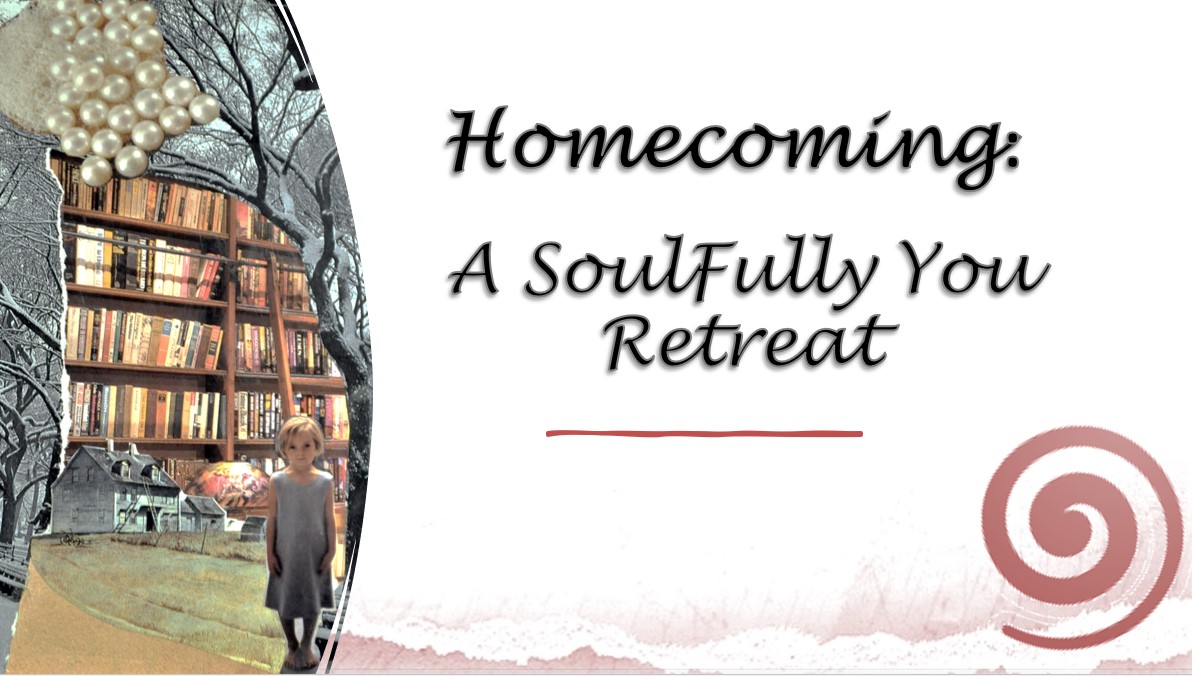
SoulFully You: Special Programs in April 2024

It is a joy to create workshops and retreats for special projects. I had the opportunity to lead a few SoulFully You programs in April for ECHO Collective and St. Andrew’s Episcopal Church – Omaha.

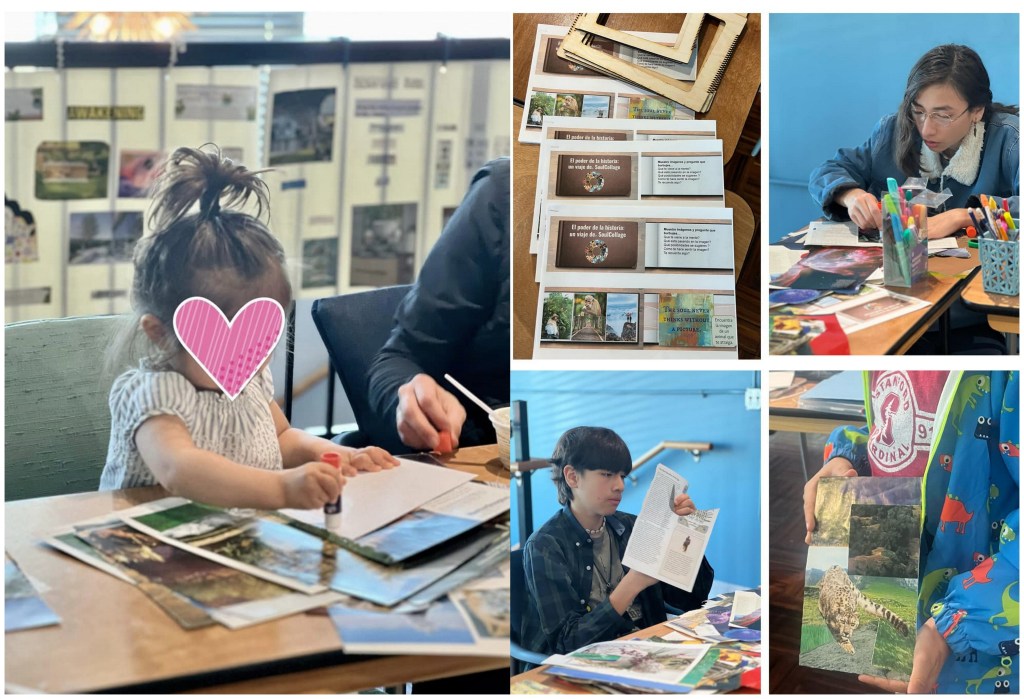
ECHO Collective connects and empowers refugee and immigrant women providing opportunities for personal growth and cross-cultural relationships.  With a grant from the Nebraska Arts Council, ECHO is offering a weaving class to women and children using SoulCollage® as a springboard for a tapestry design. In the first session, we explored the power of their unique stories, reflected with images to create a SoulCollage card, and discussed how weaving their stories together can bring healing. Mothers, teens, and young children participated, including my youngest ever–a two-year-old sweet girl particularly attracted to images of white bunnies. Participants will learn weaving techniques for several weeks to create their own and a community tapestry.

The promise of peace comes through story. When we are willing to bear witness to one another, to take other’s and joy seriously, to listen deeply, with full attention, to tell other’s stories over–we reweave the bonds of civil society.“- Rabbi Dr. Ariel Burger

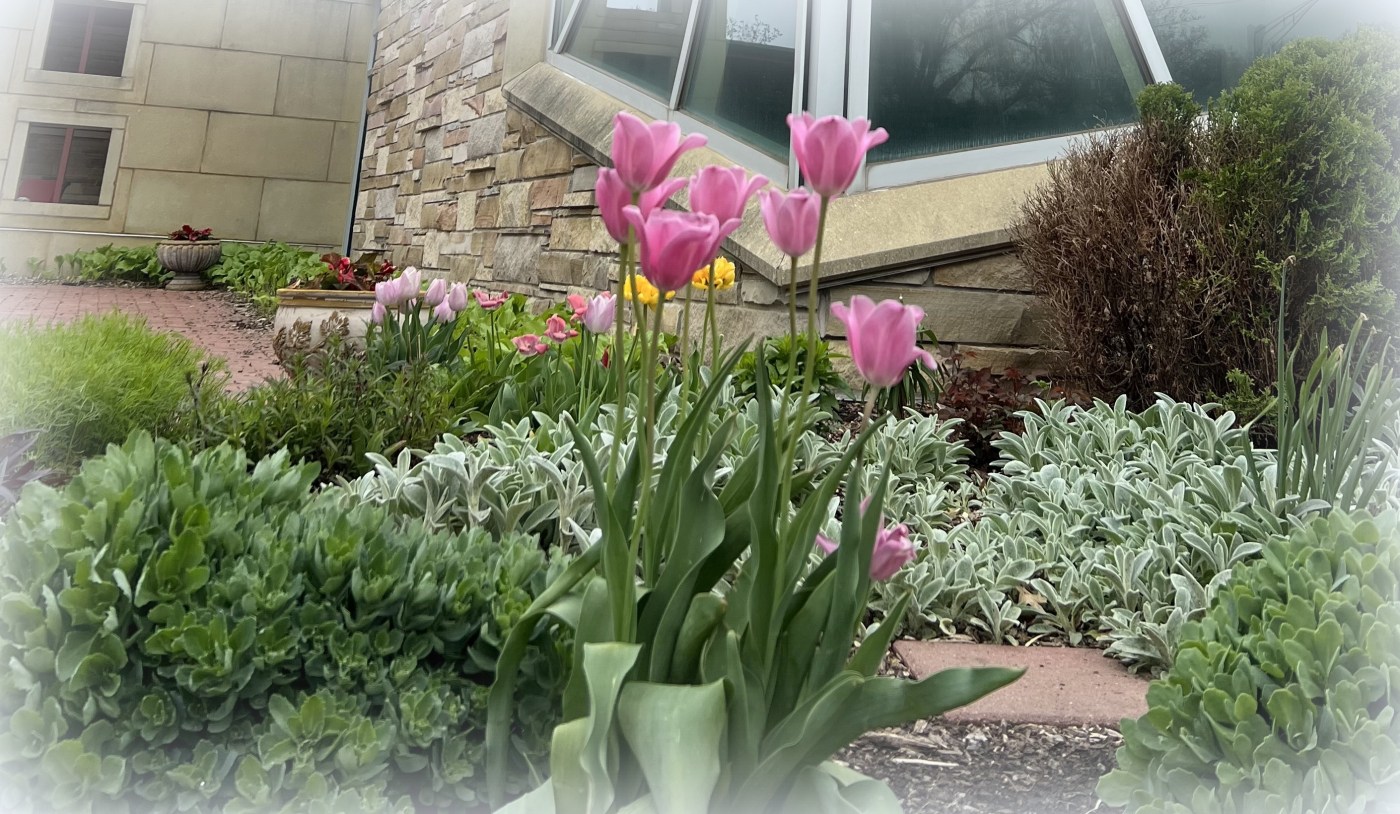
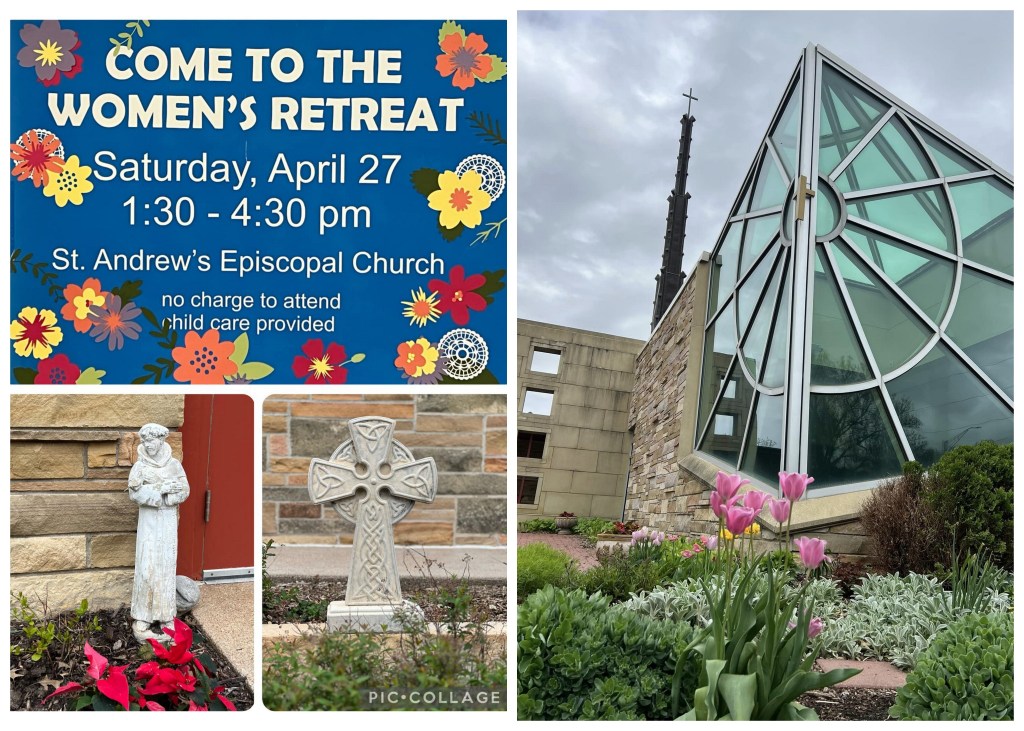
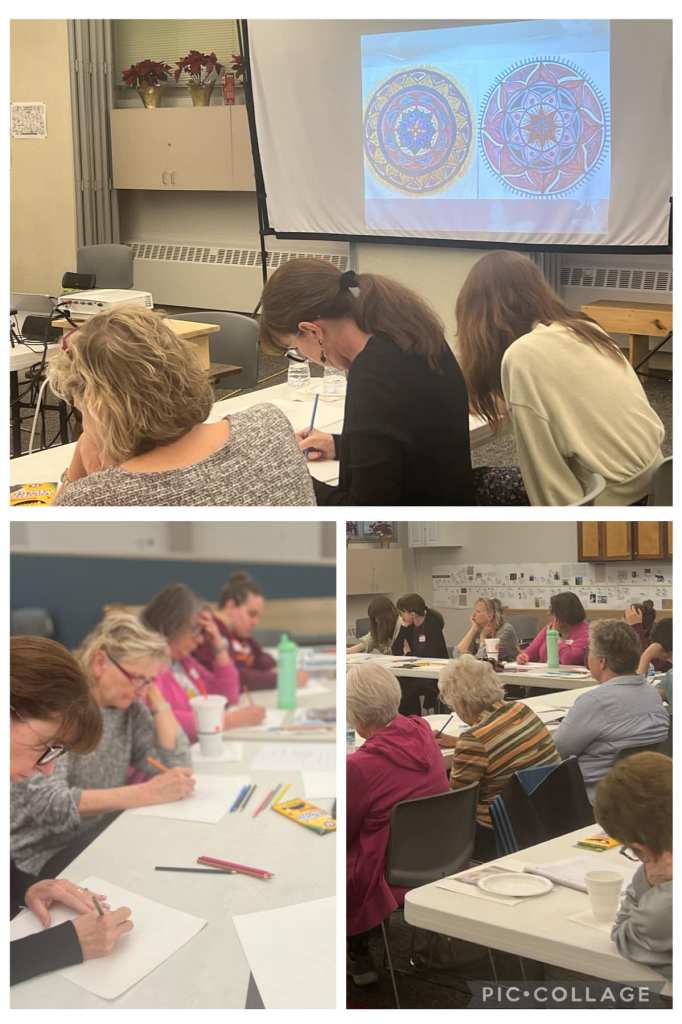
St. Andrew’s Episcopal Church hosted a women’s retreat titled “SoulFully You: Many Ways to Pray” that focused on finding God in music, movement, nature, words, and creativity. Richard Rohr writes, “We are already in the presence of God. What is absent is our awareness.” Twenty participants practiced Lectio Divina with the poem I Happened to Be Standing by Mary Oliver and learned how to create mandalas. Group discussions, journaling, and prayerful activities highlighted the wisdom of Simone Weil, that “pure attention is prayer.”

 If you begin to live life looking for the God that is all around you every moment becomes a prayer.” -Frank Bianco

For more information about SoulFully You retreats, see upcoming retreats held at St. Benedict Center and possible retreat themes here. If you are interested in having a retreat or workshop created for your organization, church, or special interest group, contact me here.

© Jodi Blazek Gehr, Being Benedictine Blogger

Lectio and Visio Divina during Lent

I am always amazed at new understanding and insight that come through meditative reading and discussion. St. Benedict Center is hosting a five-week Zoom retreat called Lent: Lectio and Visio Divina led by Steven Blum, PhD. to provide an opportunity to gain new understanding of often-heard Scripture.

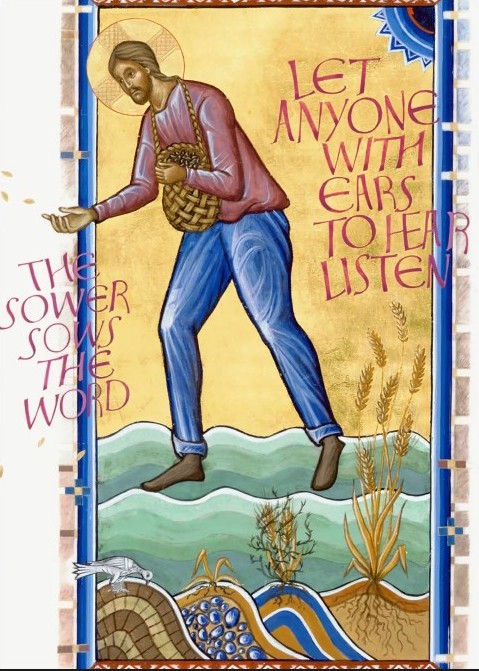
During the first week’s session, we connect with over 140 participants to learn about the ancient practices of Lectio Divina (sacred reading) and Visio Divina (sacred seeing) using the Gospel reading, Mark 4: 13–20 and the Sower illumination from The Saint John’s Bible.

There are four phases of Lectio Divina. The movement through the steps of these practices engages the heart, mind, and spirit, as we sit together in periods of silence, reading, gazing, reflecting, prayer, and contemplation. We seek to have the Lord awaken “the ears and eyes of our hearts.”

In practicing Lectio Divina, after reading the Scripture out loud, we contemplate, consider and reflect on what we have heard. The Scripture is read again, and perhaps again for a third time. After some time of silence, we are welcomed to share or journal a word or phrase that speaks to us.

Continue reading “Lectio and Visio Divina during Lent”

Not To Be Served, But To Serve

November 2021 Lectio Divina and Oblate Reflections

Sources: Lectio Divina, Mark 10:35-45

Book Discussion, Always We Begin Again by John McQuiston II, “Service”, page 53-54

Morning prayer

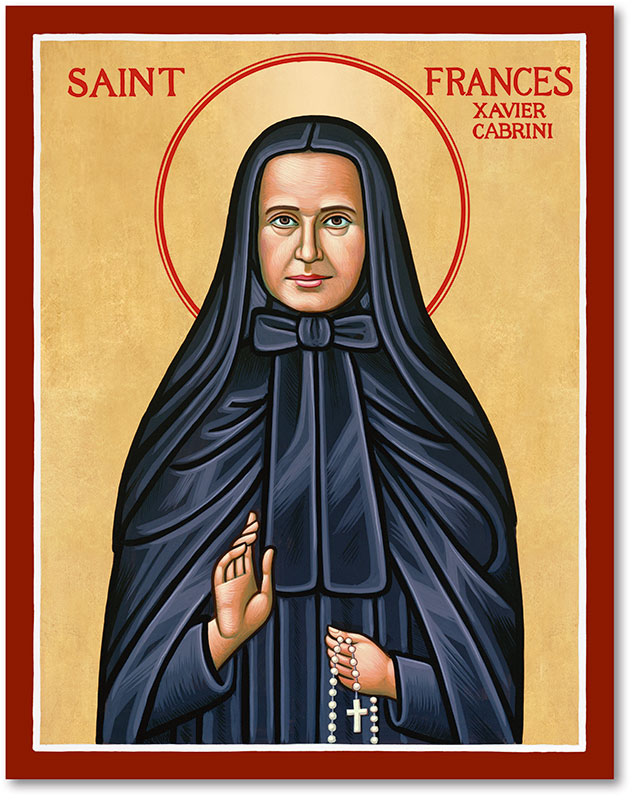
Saint of the Day: Francis Xavier Cabrini is a beautiful example of service to others and service to God. She humbly comforted the sick and infirm in the hospital and lent a helping hand to immigrants. She is a role model for our topic of service. For more information about Mother Cabrini.

Women Saints: St. Frances Cabrini Icon | Monastery Icons

Lectio Divina Reading: Mark 10:32-45

Some oblates meeting in person and some on Zoom.

Discussion

You do not know what you are asking. Can you drink the cup that I drink or be baptized with the baptism with which I am baptized?”

On their way to Jerusalem, Jesus shares with John and James what will inevitably happen to him. They certainly do not understand what they are requesting, to share in the glory of Jesus, and they do not want to believe that Jesus’ life will include suffering. “Grant that in your glory we may sit one at your right and the other at your left.” We must ask ourselves: Can we drink from the chalice that Jesus drinks? Or are we driven by ego, desiring the glory and honor for ourselves? Can we really DO life as Christ did? We may desire a journey with Jesus, the choice seat with God in glory and honor, but are we ready to face great suffering that accompanies it?

This applies to any part of our prayer life when we seek to follow Christ. We don’t know what we are in for! We must put ourselves wholly in the presence of Christ and be there for whatever happens–thy will be done. In the popular Christian song, Lord of the Dance, James and John are featured because they responded to the call of the Lord. With each passing verse, from morning to Sabbath to Good Friday, Jesus is the “Lord of the Dance.” We are called to that dance as well, as James and John were—we will have suffering. We are part of the dance, even when we find it difficult to consider the other first, to be more forgiving than self-centered, to accept that we aren’t just here for ourselves but to be of service to others.

Dance, then, wherever you may be,

I am the Lord of the Dance, said he,

And I’ll lead you all, wherever you may be,

And I’ll lead you all in the Dance, said he

Lord of the Dance, Ronan Hardiman
May be an image of tree, nature and sky

We are not in a good place spiritually when we are telling God what should be done, that we know what is best, our own power and glory. Bishop Barron addresses James and John’s ego-driven request in a Sunday Sermon, “Do You Really Want What God Wants?” Power and honor in themselves are not bad, but the problem is using power, not for God’s purpose, but for our own ego. Honor for its own sake is not helpful to others. Jesus flips the story on James and John…it isn’t all about you! You are here to serve. That is the dance you are called to.

Continue reading “Not To Be Served, But To Serve”

A time for everything under the heavens

August Lectio Divina and Oblate Discussion

SourcesLectio Divina, Ecclesiastes 3:1-11, There is a time for everything under the heavens.

Come, let us worship God who holds the world and its wonders in his creating hand.

-Antiphon, Week 3 Saturday

Such an affirming antiphon for times when I think I am the glue that holds all things together. I am most definitely not. It is God who holds the world and its wonders in his creating head. And I just need to remember.

This morning, I remind myself of this as feelings of guilt creep in that I have not posted on behalf of my oblate family since April. Much has happened in this time for me: I finished a year of teaching during during a pandemic (how many people can say that?), I led a retreat, I went to a retreat, I helped my daughter plan her summer wedding, I helped my parents with health issues that surprised us ten days before the wedding AND most wonderfully, we celebrated the marriage of our daughter, Jessica, to John Holland. It has been a summer full of ALL of the emotions.

Much as happened, we can assume, in each of our lives. Knowing this, we can give ourselves and others compassion when we feel we are falling short, when we don’t meet the expectations we have placed on ourselves. Each of us has a story. There is a time for everything, and how wonderfully TIMELY is our lectio reading for today:

Continue reading “A time for everything under the heavens”

He Appeared In Another Form

April 2021 Lectio Divina and Oblate Reflections

SourcesLectio Divina, Mark 16: 9-15, “Go into the whole world and proclaim the Gospel to every creature.”

Book Discussion, Always We Begin Again by John McQuiston II

It was the first time in over a year that many of our oblates met in person. All of those present were fully vaccinated, thank God!

We begin our Oblate Meeting with Lectio Divina practice reading Mark 16: 9-15:

9 When Jesus had risen, early on the first day of the week, he appeared first to Mary Magdalene, out of whom he had driven seven demons.

10 She went and told his companions who were mourning and weeping.

11 When they heard that he was alive and had been seen by her, they did not believe.

12 After this he appeared in another form to two of them walking along on their way to the country.

13 They returned and told the others; but they did not believe them either.

14 But later, as the Eleven were at table, he appeared to them and rebuked them for their unbelief and hardness of heart because they had not believed those who saw him after he had been raised.

15 He said to them, “Go into the whole world and proclaim the Gospel to every creature.”

Words or phrases that resonated:

Continue reading “He Appeared In Another Form”

Put on a Heart of Compassion

February 2021 Lectio Divina and Oblate Reflections

Sources: Colossians 3:12-17; Always We Begin Again: The Benedictine Way of Living by John McQuiston II (pages 17-22)

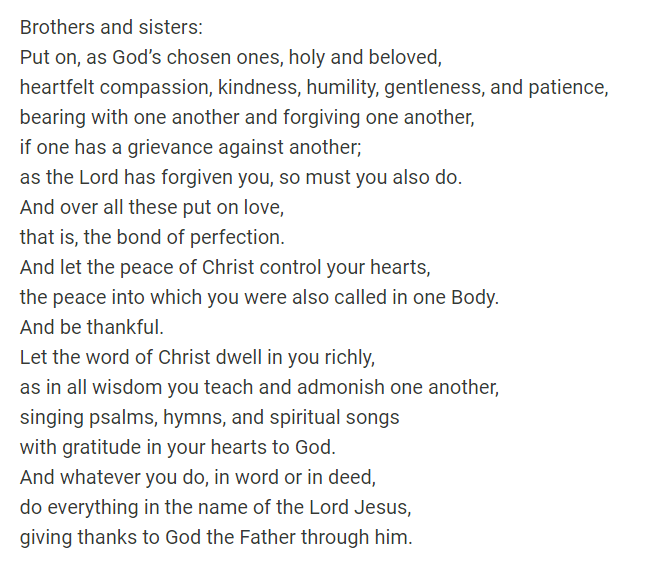
For our Lectio Divina practice, we read more deeply Colossians 3:12-17

We share aloud, some of the words and phrases that resonate with us:

God’s chosen ones, holy and beloved. Put on…heartfelt compassion, kindness, humility, gentleness, and patience.

Bearing with one another. Forgiving one another. Put on love….that is the bond of perfection.

Let the peace of Christ control your hearts. Be thankful.

Let the word of Christ dwell in your richly. Gratitude in your hearts. 

Compassion: We think of compassion as feeling sorry for someone, but it is to feel with someone, to enter into the sufferings and joys of another person. Jesus had compassion for us, entering fully into our lives. He is one with us. We are called to emulate this kind of compassion with others. Sometimes there may not be much we can say to another, but we can give our presence, a physical touch. Wordless gestures are just as compassionate, perhaps even more so.

Continue reading “Put on a Heart of Compassion”

Waters of Peace: Psalm 23

November 2020 Lectio Divina and Oblate Reflections

Topic: The Psalms

Sources: Psalm 23; Study Guide for The Rule of St. Benedict, pages 90-97, Maria-Thomas Beil, OSB

St. Benedict used the Psalms extensively in writing his Rule and suggested that we ought to pray all 150 Psalms at least once a week. This is a tall order for the average person, but perhaps we pray a psalm every day, contemplating its meaning in our hearts as a start. Psalm 23 is one of the most loved and most known of the Psalms, a comforting Psalm for our challenging times.

 For our Lectio Divina, we used the following translation of Psalm 23.

Our November 2020 Oblate meeting had participants both in person and via Zoom. This is the version of Psalm 23 with which we practiced Lectio Divina .

There were many words and phrases that resonated with us:

Phrases from Psalm 23 that resonated with us.
Continue reading “Waters of Peace: Psalm 23”

The Prodigal Son: Where Art and Beauty Run Rampant

“The artist Rembrandt was born on this day in 1606. When the soul is heavy and the work seems futile, a visit to an art museum––where art and beauty run rampant and meetings, proposals, finances, and debates have no place––revives the heart and makes it soft. Then going on seems possible; then life has vision again; then going on seems necessary.” ––from A Monastery Almanac, by Joan Chittister

compassion

Lectio Divina:

Insights one can gain by practicing Lectio Divina with Luke 15: 1-3, 11-32—The Parable of the Lost Son or Visio Divina by spending time with Rembrandt’s famous painting are manifold. Continue reading “The Prodigal Son: Where Art and Beauty Run Rampant”

Blog at WordPress.com.

Up ↑