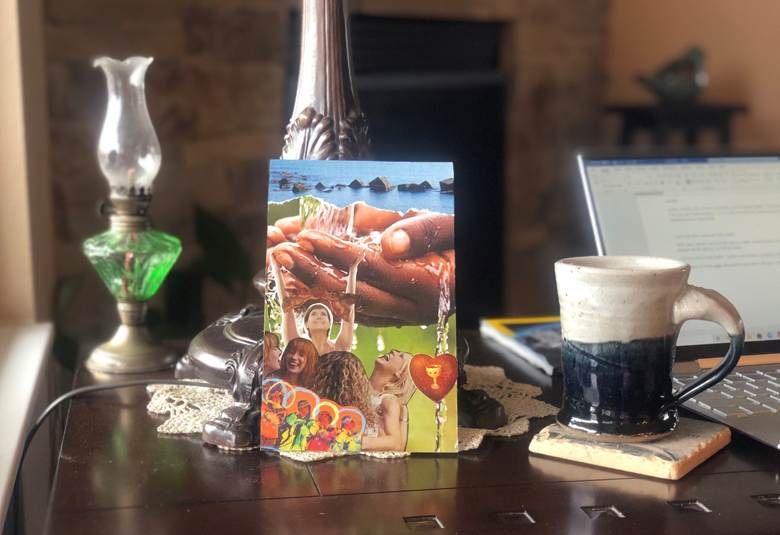
Rituals are a reminder of our values, an expression of our longing for connection and community. Rituals are an anchor to ground us in our beliefs and ideals, practices to guide us in becoming our best self. We can create or honor rituals in our daily lives—at work, in our morning routine, around the dinner table as a family, attending a religious service or celebrating on special holidays like Independence Day or Thanksgiving Day. Rituals are everywhere.
History tells us that the first Thanksgiving, in 1621, commemorated the Pilgrims’ gratitude for a bountiful harvest. This is a simplistic and perhaps mythical snapshot, but it is where the ritual of giving thanks begins for many Americans. Thanksgiving is celebrated in many other countries as well for a variety of historical, religious, and secular reasons.
Primarily, Thanksgiving is about just that—giving thanks. Thanksgiving is remembering to be grateful—even in times of division, darkness, or despair. Thanksgiving, as a legally observed holiday in the United States, was championed by Sarah Josepha Hale (October 24, 1788 – April 30, 1879), an American writer and author of the infamous nursery rhyme “Mary Had a Little Lamb“. Sarah, fortunate that her parents believed in education for girls, was home-schooled and eventually became a teacher herself and, later, an advocate of higher education and workplace rights for women. When Sarah was 34 years old, her husband died of a stroke—her oldest child was 7, and the youngest was born two weeks after her husband’s death.
It’s hard to imagine the sadness, grief, and dark days that Sarah Josepha Hale endured. So many in our time experience health care issues, financial struggles, estrangement or distance from loved ones, and grief and disappointments of all kinds. There is no one person, or period in history, who has exclusive claim on hard times. It is a universal experience. And yet Sarah believed in Thanksgiving. She wrote: “There is a deep moral influence in these periodical seasons of rejoicing, in which a whole community participate. They bring out, and together, as it were, the best sympathies of our nature…because all are privileged to be happy in their own way.”
While Sarah firmly opposed slavery, still she longed for reconciliation between the North and the South. Over three decades, she wrote countless letters urging American presidents, from Taylor to Lincoln, to proclaim Thanksgiving a national holiday: “We are already spread and mingled over the Union. Each year, by bringing us oftener together, releases us from the estrangement and coolness consequent on distance and political alienations; each year multiplies our ties of relationship and friendship. How can we hate our Mississippi brother-in-law?”
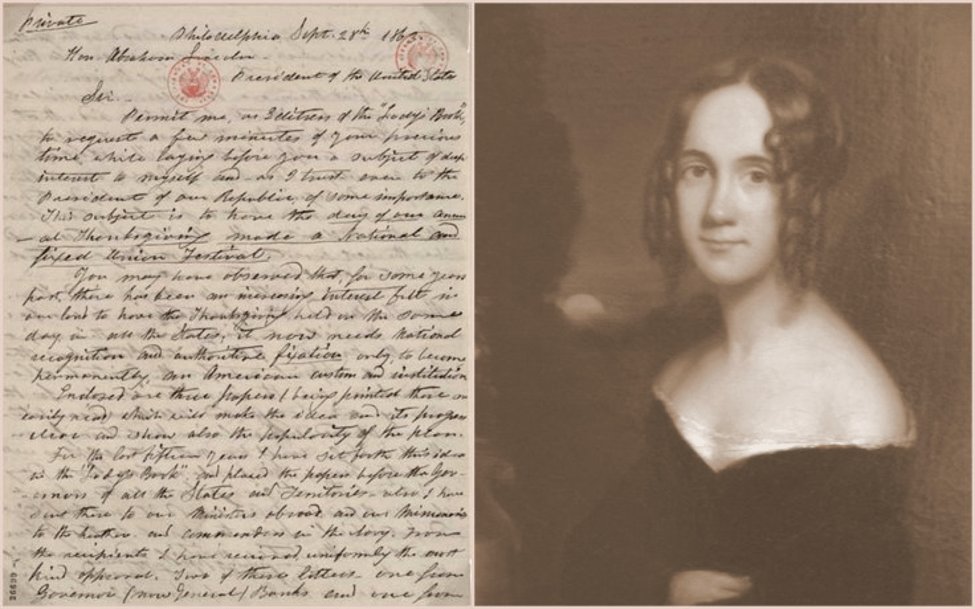
Finally, amid the turmoil of the Civil War, Abraham Lincoln agreed to make Thanksgiving a holiday that both the North and South would celebrate, hoping to unify a deeply divided country. It was an effort, a beginning of an American ritual.
Thanksgiving reminds us that we can, and must, practice gratitude even in the darkest of days—whether it’s the pain of a deeply divided nation, the woundedness of a broken heart, the tension of uncertainty or the storms of a conflicted relationship. We all are privileged to be happy in our own way.
But Thanksgiving isn’t just one day. Thanksgiving is a practice of gratitude rather than grumbling, as St. Benedict recommends: “Do not grumble or speak ill of others. Place your hope in God alone.”- Rule of St. Benedict, Ch. 4:39-41
Consider creating a SoulCollage® as a creative Thanksgiving ritual. Several years ago, I created a card that has become a prayer of gratitude and a reminder to keep reaching for life-giving “holy water” in all its forms. Using the “I am One Who” practice, I wrote the following:
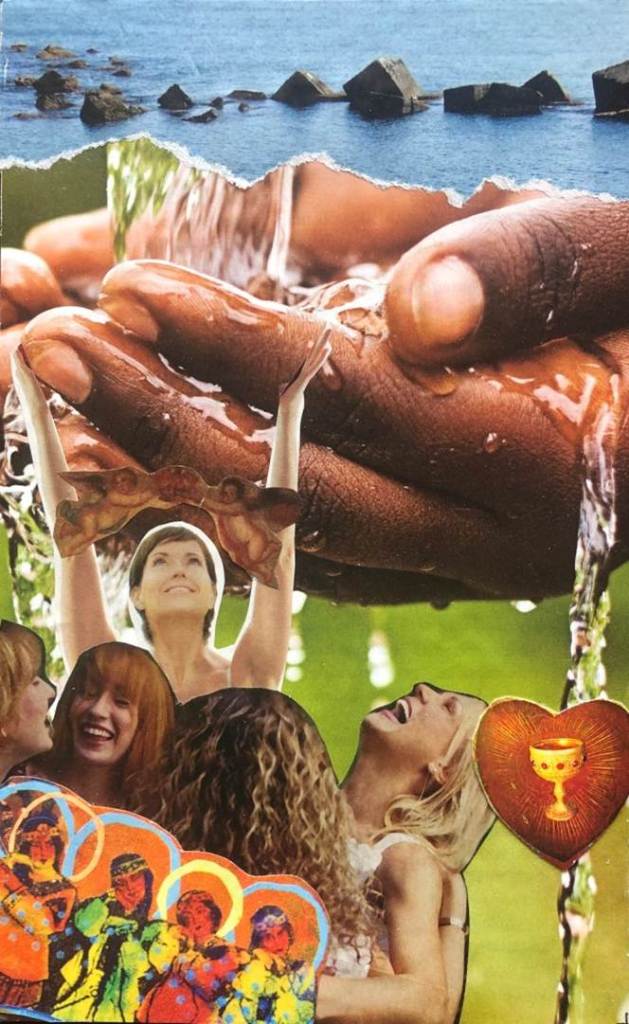
I am one who stands in a circle of women who hold each other up, who embrace life and each other, who are connected, who grow together. I am one and many.
I am one who recognizes Source in the still, holy water. Stones, upright, are less about unsettling the water, and more about propelling motion, continually adapting, always transforming or conforming to what comes in its way. I can trust the peaceful, holy water.
I am one who stands in the stream of life-giving, purifying water.
I am one who, with open arms, is anointed with holy water. With joy, faith and a sense of solidarity, I am blessed with nourishment in abundance—above, below, around, overflowing.
I am one who thirsts, not in an aching, despairing, dying, sort of way (at least not in this card, at this moment) but as a reminder that purification happens only when intentionally sought after and accepted. Water is the essential element to growth; I long for this fullness.
I am one who is grateful for thirst, to trust that the thirst will be quenched, and to drink from the chalice of holy water.
I imagine that on another day, with different circumstances, my “I am one who” might sound different—but this is today.
Thanksgiving is a ritual, not just one day. Thanksgiving Day is any day we choose to be grateful.
Norwood, Arlisha. “Sarah Hale.” National Women’s History Museum. National Women’s History Museum, 2017. Date accessed.
Baker, Peggy M. “THE GODMOTHER OF THANKSGIVING: the story of Sarah Josepha Hale” Pilgrim Society & Pilgrim Hall Museum 2007.
Maranzani, Barbara. “Abraham Lincoln and the “Mother of Thanksgiving”, October 3, 2013.


Leave a Reply