Search

Being Benedictine

Living SoulFully as an Oblate of St. Benedict

Tag

Oblate

Our Ruby Anniversary: 40 Years of Marriage

“I promise to be true to you in good times and in bad, in sickness and in health. I will love you and honor you all the days of my life.”

Forty year ago, my husband, Joe, and I made our marriage vows on August 17, 1985. As a 19-year-old bride, I had little understanding of what those words meant or would require. I imagine it is the same for many. We have hopes and expectations, albeit idealistic or romanticized. We may also have a good idea of what we hope our marriage will NOT be like. Surely, it’s a good place to start, but it is then that the real work of love begins.

Stability, a Benedictine value, is what is promised in marriage when we vow, “all the days of my life.”  We promise to stay, to not run away from challenges or difficulties; instead, we remain present to the relationship, to see what we discover about each other. After writing seventy-two chapters in The Rule, Benedict titles his last chapter, “This rule only a beginning of perfection.” In other words, marriage, or any commitment we make, requires practice—making mistakes, forgiveness, and always beginning again.

To love is a decision. A marriage is not made, once and for all, when the I-dos are exchanged. A marriage is constantly being recreated; it is always in the process of becoming. A marriage is made of moments. Moments we would like to forget, moments we must forgive, and moments that help us become more fully who we are. There are moments of joy, adventure, contentment, and the making of beautiful memories. When you string them all together, you get a picture of a life built together.

I love that the ruby, a precious gem, second only to the diamond in toughness and durability, is the traditional symbol for a 40th wedding anniversary. Throughout history, many cultures and religions have associated the ruby with mystical or spiritual qualities, representing love, passion, protection, vitality, and wealth. (Ruby Symbolism and Legends)

The word “ruby” comes from the Latin word “ruber,” meaning red. The red heart of Valentine’s Day reminds us of a desire for passion and romantic love. One also thinks of the redness of blood, which carries oxygen to all parts of the body, giving life.

Joe and I have experienced this “ruby” nature, not all in one day, month, or year, but over time and as a way of life. The ruby’s “inner glow” led to beliefs that it contained an inner fire or “an inextinguishable flame”. This inner glow, with a playful spirit and sense of humor, has fueled our commitment to protect our marriage, to be resilient, to learn, grow and change. We are wealthy in countless ways—a beautiful daughter and son-in-law, great friends and family connections, opportunities for travel, hobbies, personal interests, and, now, more time for together.

Our new season of retirement. After lengthy careers in law enforcement and education, both Joe and I have retired—letting go of our careers, but not what was at the heart of our vocation. We continue to work in other ways: I lead SoulFully You retreats and workshops on creativity and the spiritual life, write essays for Being Benedictine, and belong to a variety of book/study groups, including oblates. Joe drives senior citizens to recreational activities and appointments, enjoys travel with his siblings, meeting with friends, and cultivating his bourbon collection. We have time to slow down, take a nap when we want, read, and binge-watch TV shows, travel more, and enjoy spontaneous trips to be with our daughter Jessica and her husband, John.

Continue reading “Our Ruby Anniversary: 40 Years of Marriage” →

The Good Zeal of Monks

December 2024 Oblate Reflections

Lectio Divina—Rule of St. Benedict, Chapter 72, The Good Zeal of Monks

In the 1500-year-old Rule of St. Benedict, monks who live in a monastic community are presented with a choice to guide their relationships—to embrace good zeal which monks should foster with fervent love rather than the zeal of bitterness. This choice is a call to holiness and contributes to an atmosphere of separation or togetherness in the community.

Benedict is clear—if monks choose to respond to their brothers with bitterness, they cultivate an environment of separateness. They become distant from God and the community. But if monks choose to foster enthusiasm for loving their brother, Benedict writes that it will “bring us all together to everlasting life.”

Love is the antidote to separation and bitterness. Benedict encourages enthusiasm and eagerness when expressing our fervent love to God, one’s abbot (or leader), and one’s brothers. He also provides an action plan to demonstrate love.

Chapter 72 begins and ends in love—what is hoped for (” a good zeal which separates from evil and leads to God and everlasting life) and what is the promised outcome ( to “bring us all together in everlasting life.”) The specific instructions to demonstrate “fervent love” are to show respect to others; be patient with other’s weaknesses; practice active listening; and to consider the best interest of others, not just our own.

God’s work and desire is to “bring us all together” through our acts of love. We must consciously choose between holding onto bitterness, which separates us from God and from others. We must be committed to this goal to keep a community, family, organization, or friendship from growing apart through conflict, misunderstandings, and the bitterness that might result. This can be hard, there is no denying it.

We demonstrate our preference for “nothing whatever but Christ” when we see and treat others as Christ. Christ dwells within us, defining who we are. Christ, then, is active in creating togetherness in the community.

In a community, each one matters. We cannot become holy without the other; we are responsible for co-creating and honoring connections with others. We live in context with everyone as a member of the body of Christ. God works in us as we work together. The whole thing falls apart when we do not consider the bigger picture.

The Rule is relevant today for Benedictine oblates, lay associates of a monastery, and those who find wisdom in the spiritual insights of St. Benedict to learn how to live in connectedness with family, friends, coworkers, team members, and in all our relationships. We have much to learn.

Meeting Pope Francis: A Reflection from the Benedictine World Congress

Meeting the Pope is a big deal. Recently I wrote about the 5th World Congress of Benedictine Oblates and the private audience that Oblates had with Pope Francis. Jaime Williams, an Oblate of Christ the King Priory, was in the private audience and was profoundly impacted. I asked him to share his experience and he graciously accepted.

A “Being Benedictine” Reflection by Jaime Williams:

Two plus weeks after the most extraordinary handshake in my life, I still struggle to comprehend how my journey from an inauspicious upbringing in small-town Iowa led to meeting Pope Francis and visiting the two most important holy sites associated with our beloved St. Benedict and St. Scholastica in Italy – nearly 30 years after graduating high school and leaving home.  After spending a significant portion of my career traveling extensively through parts of the developing world, I don’t consider my childhood to be been one rooted in poverty, but certainly, my parents had to work hard to make ends meet and there was no shortage of stress present throughout my childhood.  I generally consider the Christian formation I received while growing up to be relatively poor, and our participation in church of any kind was sporadic and inconsistent: we were members of Presbyterian, Nazarene, and Methodist congregations at various times during my youth, and moved constantly between northeast Iowa, and east and west coast towns in Florida, before finally settling in southern Iowa where I spent most of my high school years.  It is no surprise to me that of our Oblate promises Stability is what I cherish most from my family and Oblate community!

Continue reading “Meeting Pope Francis: A Reflection from the Benedictine World Congress” →

The Divine Presence is Everywhere

September 2023 Lectio Divina and Oblate Reflections

Lectio Divina—Chapters 19 and 20, Rule of St. Benedict

Book Discussion—The Oblate Life, edited by Gervase Holdaway, OSB, 2008

Being Benedictine is to believe that the Divine Presence is everywhere, as the opening of Chapter 19 in the Rule of St. Benedict states.

“We believe that the divine presence is everywhere and “that in every place the eyes of the Lord are watching the good and the wicked” (Proverbs 15:3). But beyond the least doubt we should believe this to be especially true when we celebrate the divine office.”

Chapter 19, The Rule of St. Benedict

What is the Divine Office?

The Divine Office, also known as the Liturgy of the Hours or Opus Dei, the “Work of God”, is a daily prayer of psalms, readings, hymns, and prayers. Traditionally during a week, with prayers seven times a day, all 150 Psalms are recited by monks. The Psalms are prayers that Jesus and his disciples recited as part of the Jewish liturgy expressing the depth of human experience and emotion from joy, anger, thanks, praise, suffering, sorrow, contrition, petition, and more.

Continue reading “The Divine Presence is Everywhere” →

The way and the truth and the life

July 2023 Lectio Divina and Oblate Reflections

Sources: 

Lectio Divina—I am the way and the truth and the life, John 14:1-12

Book Discussion—The Oblate Life, edited by Gervase Holdaway, OSB, 2008

Disclaimer:

I cannot claim to have captured all of the wisdom shared in our monthly oblate discussions or that I represent all oblates in attendance. The group discussion is a starting point for this reflection, but it is my interpretation of what I heard and what resonated with me. There could easily be as many different blog posts or reflections as oblates. Each of us comes to Lectio from our personal experience of God at that moment and we receive what we need in that moment as well. The beauty of Lectio Divina is that the reading, insights, and discussion may fall differently on each of our hearts. How blessed we are that there are “many dwelling places” (John 14:2)” and we are all invited to “listen with the ear of the heart.” (RB Prologue)

“Just as the word ‘oblate’ comes from a root word denoting the offering of a gift, each oblate’s life is an offering to God and a gift to the Benedictine community, which is enriched by the oblate’s presence and prayer…. A Benedictine way is not to be harsh or burdensome but is offered to those who seek God and the sweetness of God’s voice.”

The Oblate Life

Do not let your hearts be troubled

The opening verse of John 14:1-12 implies that we can let or NOT let our hearts be troubled. We have agency–we can choose or not to follow the way Jesus shares with his disciples. This way, having faith in God, will relieve us of our troubles. 

“In my Father’s house, there are many dwelling places. If there were not, would I have told you that I am going to prepare a place for you?” Jesus asks. As a personal offer, he tells them “I will come back again and take you to myself, so that where I am you also may be.” 

Continue reading “The way and the truth and the life” →

Not To Be Served, But To Serve

November 2021 Lectio Divina and Oblate Reflections

Sources: Lectio Divina, Mark 10:35-45

Book Discussion, Always We Begin Again by John McQuiston II, “Service”, page 53-54

Morning prayer

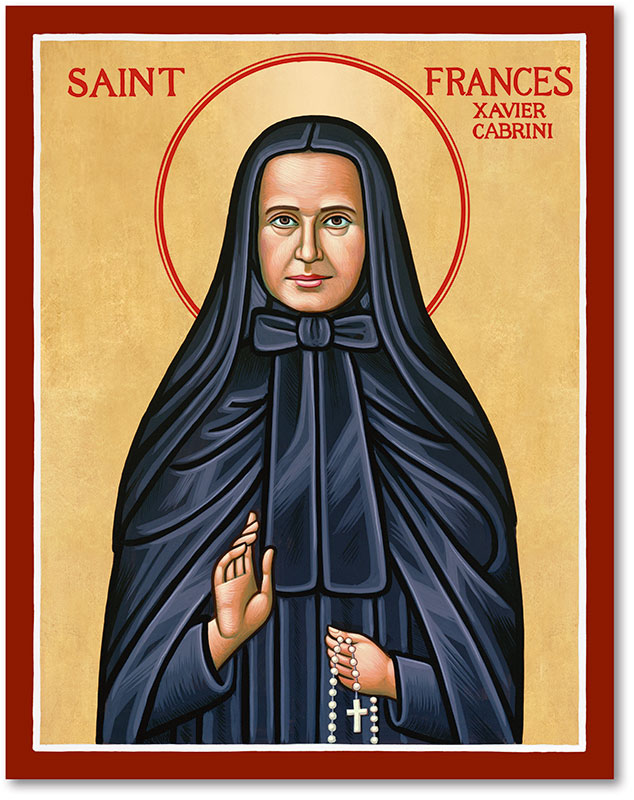
Saint of the Day: Francis Xavier Cabrini is a beautiful example of service to others and service to God. She humbly comforted the sick and infirm in the hospital and lent a helping hand to immigrants. She is a role model for our topic of service. For more information about Mother Cabrini.

Women Saints: St. Frances Cabrini Icon | Monastery Icons

Lectio Divina Reading: Mark 10:32-45

Some oblates meeting in person and some on Zoom.

Discussion

You do not know what you are asking. Can you drink the cup that I drink or be baptized with the baptism with which I am baptized?”

On their way to Jerusalem, Jesus shares with John and James what will inevitably happen to him. They certainly do not understand what they are requesting, to share in the glory of Jesus, and they do not want to believe that Jesus’ life will include suffering. “Grant that in your glory we may sit one at your right and the other at your left.” We must ask ourselves: Can we drink from the chalice that Jesus drinks? Or are we driven by ego, desiring the glory and honor for ourselves? Can we really DO life as Christ did? We may desire a journey with Jesus, the choice seat with God in glory and honor, but are we ready to face great suffering that accompanies it?

This applies to any part of our prayer life when we seek to follow Christ. We don’t know what we are in for! We must put ourselves wholly in the presence of Christ and be there for whatever happens–thy will be done. In the popular Christian song, Lord of the Dance, James and John are featured because they responded to the call of the Lord. With each passing verse, from morning to Sabbath to Good Friday, Jesus is the “Lord of the Dance.” We are called to that dance as well, as James and John were—we will have suffering. We are part of the dance, even when we find it difficult to consider the other first, to be more forgiving than self-centered, to accept that we aren’t just here for ourselves but to be of service to others.

Dance, then, wherever you may be,

I am the Lord of the Dance, said he,

And I’ll lead you all, wherever you may be,

And I’ll lead you all in the Dance, said he

Lord of the Dance, Ronan Hardiman
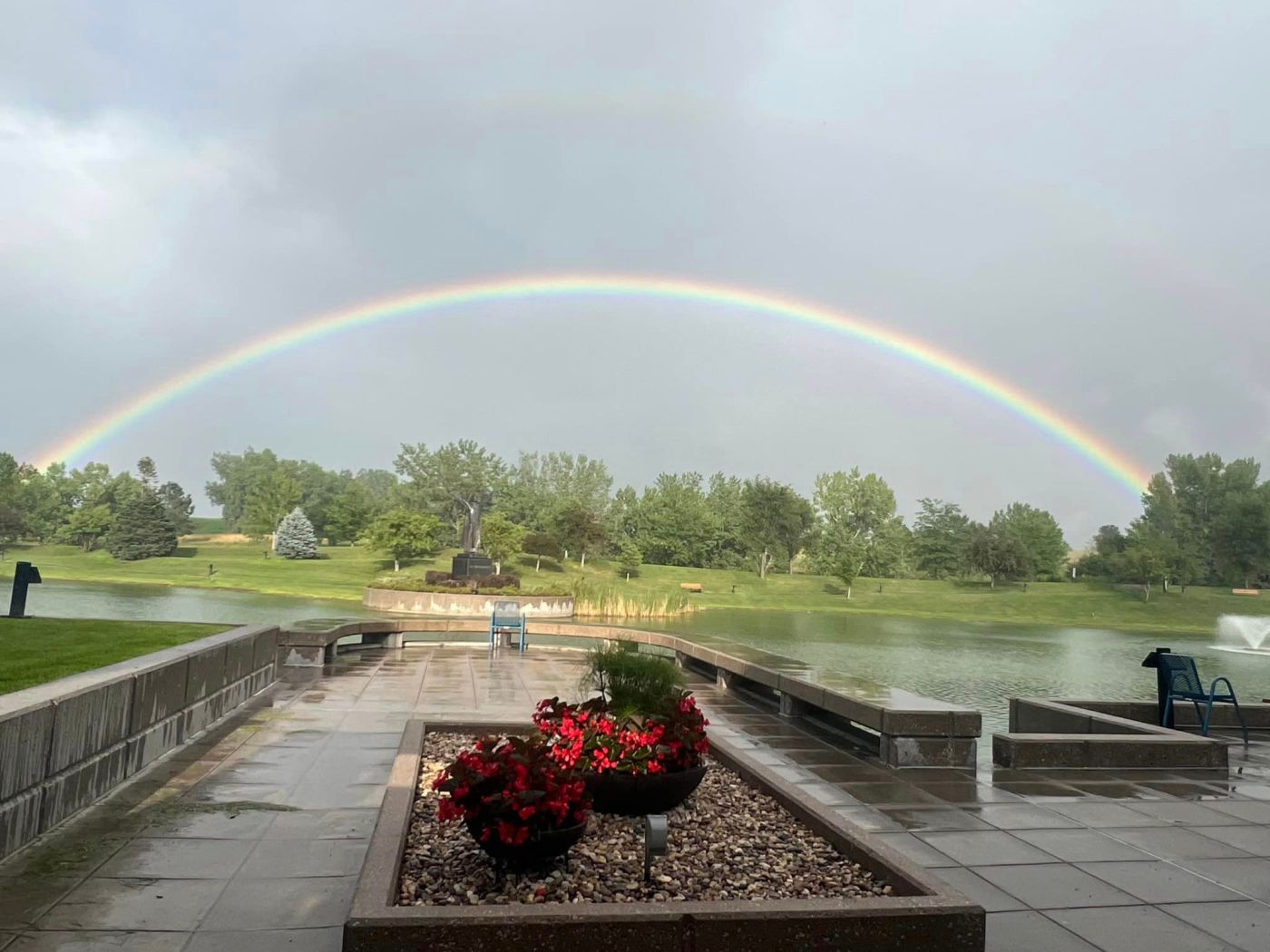
May be an image of tree, nature and sky

We are not in a good place spiritually when we are telling God what should be done, that we know what is best, our own power and glory. Bishop Barron addresses James and John’s ego-driven request in a Sunday Sermon, “Do You Really Want What God Wants?” Power and honor in themselves are not bad, but the problem is using power, not for God’s purpose, but for our own ego. Honor for its own sake is not helpful to others. Jesus flips the story on James and John…it isn’t all about you! You are here to serve. That is the dance you are called to.

Continue reading “Not To Be Served, But To Serve” →

A time for everything under the heavens

August Lectio Divina and Oblate Discussion

Sources: Lectio Divina, Ecclesiastes 3:1-11, There is a time for everything under the heavens.

Come, let us worship God who holds the world and its wonders in his creating hand.

-Antiphon, Week 3 Saturday

Such an affirming antiphon for times when I think I am the glue that holds all things together. I am most definitely not. It is God who holds the world and its wonders in his creating head. And I just need to remember.

This morning, I remind myself of this as feelings of guilt creep in that I have not posted on behalf of my oblate family since April. Much has happened in this time for me: I finished a year of teaching during during a pandemic (how many people can say that?), I led a retreat, I went to a retreat, I helped my daughter plan her summer wedding, I helped my parents with health issues that surprised us ten days before the wedding AND most wonderfully, we celebrated the marriage of our daughter, Jessica, to John Holland. It has been a summer full of ALL of the emotions.

Much as happened, we can assume, in each of our lives. Knowing this, we can give ourselves and others compassion when we feel we are falling short, when we don’t meet the expectations we have placed on ourselves. Each of us has a story. There is a time for everything, and how wonderfully TIMELY is our lectio reading for today:

Continue reading “A time for everything under the heavens” →

Happy Birthday to me…and St. Benedict!

St. Benedict is pretty special to me for a few reasons.

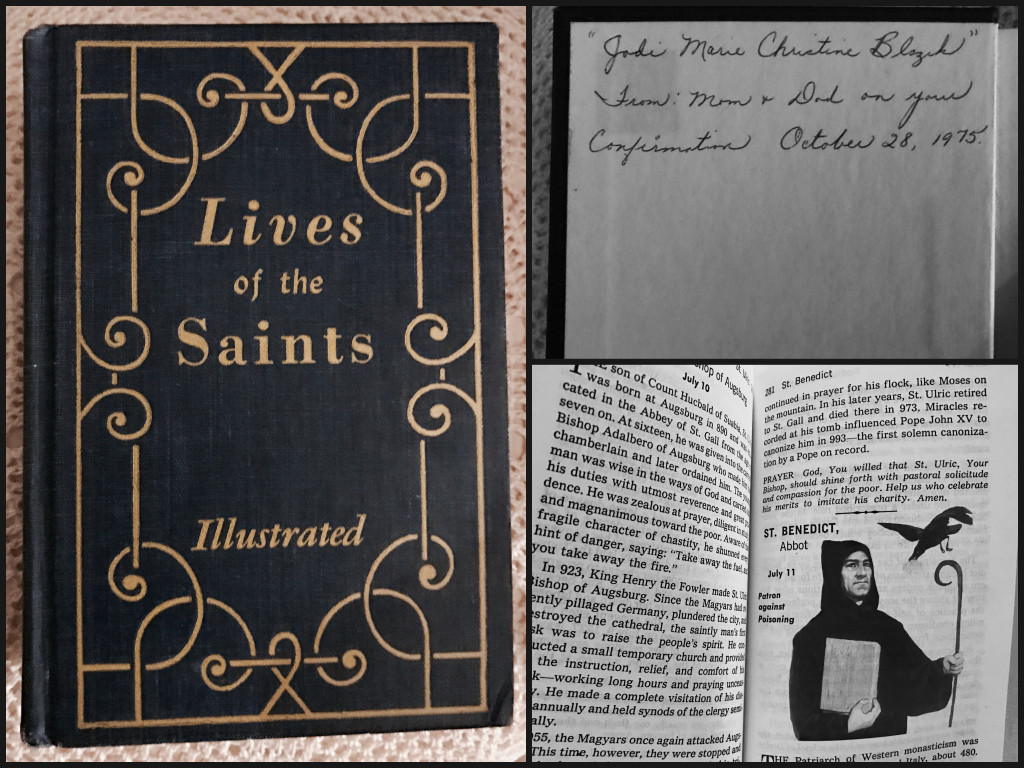
First, we share a birthday. I have to admit that I was pretty disappointed when I first discovered this. My parents had given me an illustrated book of the “Lives of the Saints” to commemorate my Confirmation. As any nine-year-old would do, I immediately looked to see who the saint was for July 11, my birthday. Perhaps Elizabeth or Mary, Theresa or Christine (my confirmation name) would be my special saint. A lovely woman saint with a beautiful name—I had hoped.

confirmation

Instead, I beheld an illustration of a man with a dark hood, a scary-looking bird, some sort of walking cane, and an unusual name that I had only associated with Benedict Arnold, a famous American traitor.

July 11, St. Benedict, Abbot, it said. Continue reading “Happy Birthday to me…and St. Benedict!” →

Gather Into One: A Sacred Journey

April 2020 Oblate Lectio Divina and Discussion
Topic: Lent   Sources: Rule of St. Benedict, Chapter 49; John 11:45-56

“We dwell in grief and despair to be surprised into life again with resurrection—each year we are invited to make this sacred journey together.” –Engaging Benedict, Laura Swan

journey together

As Oblates of Christ the King Priory we “make this sacred journey together” meeting once a month for connection, prayer, and study. We gather in Schuyler, Nebraska on the second Saturday of the month for our Oblate meeting including morning prayers, Lectio Divina, Mass, lunch, and discussions both in full and small groups.

img_5334
Our inaugural Zoom Oblate Meeting was a huge success!!

Yet, in this time of uncertainty when we cannot meet in person, we still crave the connectedness and the spiritual grounding of our Oblate promises. Being creative problem-solvers, several of our oblates organized a Zoom event for our April meeting. Fr. Volker reflects, “It worked out beyond any expectation and was a wonderful event. Our social media technology and the present challenging Coronavirus Pandemic turn out to be a hidden blessing.” We had 28 Oblates participate, many who typically cannot make the day trip for our monthly meeting. We started as we usually do with a few announcements, prayers and Lectio Divina, each in our own home, and yet we were together.

Our Lectio Divina reading: 

There were many words and phrases that resonated with us:

You know nothing. Gather into one. What are we going to do? If we leave him alone. Began to believe in him. All will believe in him. Jesus would die for the nation. They looked for Jesus. The whole nation may not perish. What do you think? Jesus no longer walked about in public among the Jews.

The layers of meaning in this Gospel reading are inexhaustible, especially as we consider the impact of the pandemic during Lent— Continue reading “Gather Into One: A Sacred Journey” →

Blog at WordPress.com.

Up ↑