
St. Benedict is pretty special to me for a few reasons.
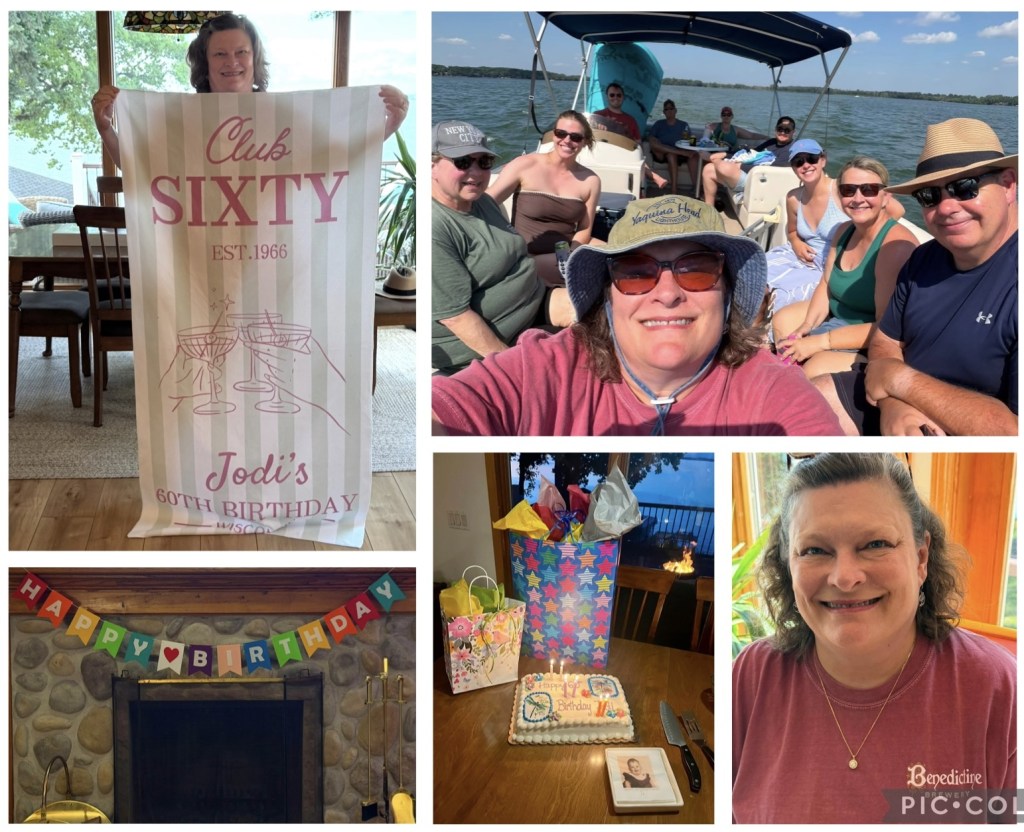
July 11, the Feast of St. Benedict, is also my birthday. (And oops, I was having so much fun celebrating my 60th birthday that I forgot to share this post.) Although I could not be more delighted to have St. Benedict as my patron saint, I must admit that I was pretty disappointed when I first discovered it.
My parents had given me an illustrated book of the “Lives of the Saints” for my Confirmation. As any nine-year-old would do, I immediately looked to see who the saint was for July 11, my birthday. A lovely woman saint with a beautiful name, I had hoped. Perhaps Elizabeth or Mary, Theresa or Christine (my confirmation name) would be my special saint.
Instead, I saw an illustration of a man with a dark hood, a scary-looking bird, some sort of walking cane, and an unusual name that I had only associated with Benedict Arnold, a famous American traitor.
July 11, St. Benedict, Abbot, it said.
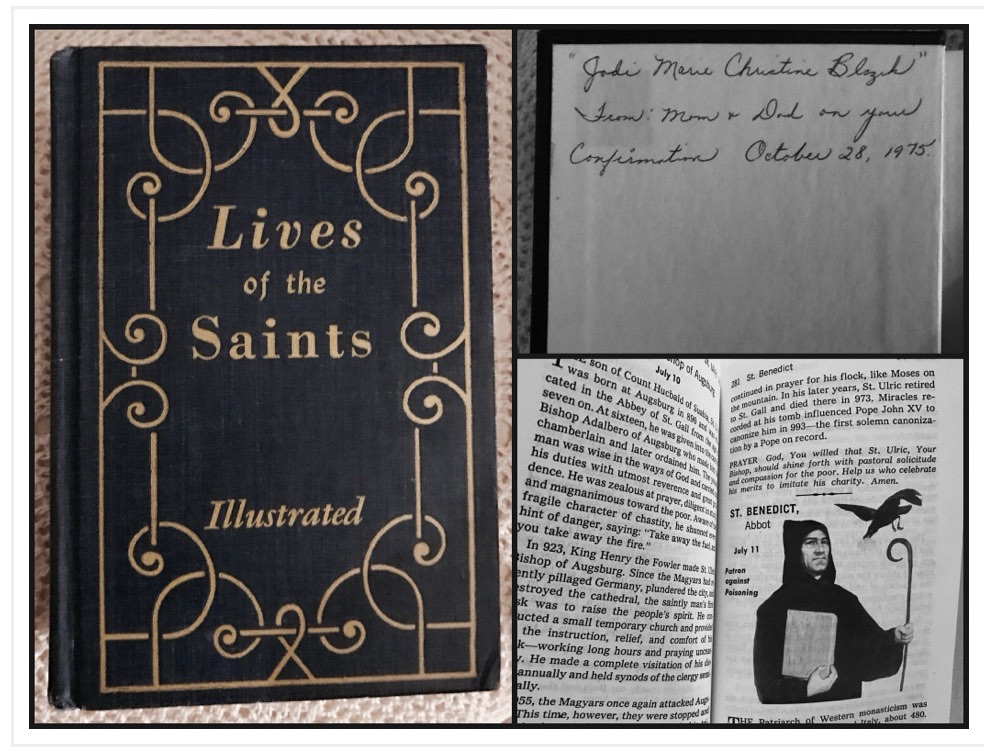
I had never heard of St. Benedict and surely did not know what an Abbot was. Through the years, I returned to these pages often, thinking that I should have some connection with this man, my patron saint.
Fast forward 26 years. Married, a mother of a seven-year-old daughter, a high school teacher, and a club sponsor, I had a full, busy, and satisfying life, yet also a longing for silence. An advertisement for a contemplative prayer retreat in our local newspaper caught my eye. It promised an “oasis of peace” at a retreat house in the cornfields of Nebraska called St. Benedict Center.
And then I remember St. Benedict. My saint.
Since 2002, when I went on that contemplative retreat, I have learned a lot about St. Benedict and Benedictine spirituality. I’ve been to dozens of workshops and retreats, became a Benedictine Oblate, and have been on three Benedictine pilgrimages to Europe. And I understand that sharing the same birthday as St. Benedict is the best (birthday) gift I could receive. I have learned that St. Benedict made the ultimate pilgrimage when he left his life as a student in Rome, frustrated with the political environment and the behavior of his classmates, to spend three years in solitude in a cave near Subiaco.
I understand this desire for solitude, to retreat (especially from political tension). Eventually, St. Benedict founded the Abbey of Montecassino and wrote the Rule monks would live by. But, as with all pilgrimages, it didn’t happen overnight or easily. Benedict became famous and was sought out as a monastery leader, but he was also resented and despised, and some monks even tried to kill him. Benedict was surely on an inner and outer pilgrimage.
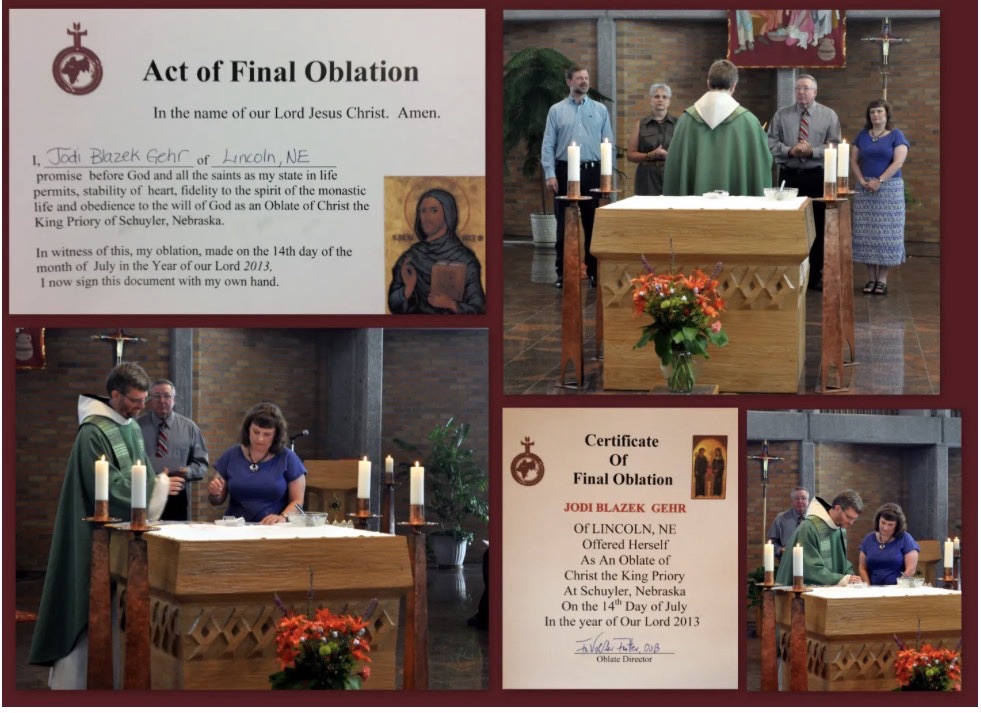
Becoming a Benedictine Oblate in 2013 has been an integral part of my spiritual journey. Oblates long to live as a monk in the world, seeking God, and striving to become holy in everyday life, in their family and workplace. Oblates are associated with a monastic community (for me that is Christ the King Priory in Schuyler, Nebraska), offering their lives to God through prayer and service. Oblates make three promises–stability, obedience, and conversion of life.
Fr. Mauritius Wilde, now serving as Abbot of Maria Laach Abbey in Germany, gave the homily for my Final Oblation, explaining the promises an oblate makes:
“You want to give your life to God today – in a special way. Becoming an Oblate means: offering one’s life to God… The first way of being a Benedictine oblate is: keep the question open. Let the question bug you. The longing for eternal life…
God wants us to start with our spiritual journey in this world with the talents and skills he has given us. We don’t have to do extraordinary things. We can start with our own experience. You dear Oblates start as Grandmother, Grandfather, Deacon, Pastor, teacher, mother. Stick to what you have got: this is the vow of stability.
While staying faithful and stable be ready and open for new ways to see the world. Be open to being converted over and over again. So that conversion becomes a habit. This habit is called: conversatio (conversion of life.) The second vow.
Thirdly: Listen. This is the first word of the Rule of St. Benedict. Listen. Listen presupposes silence. “If only you would heed the voice of the LORD, your God” did we hear today in Deuteronomy. Be obedient to what God wants you to do or to let go. You still want to have it more concrete. What does an Oblate do? What is his life about? If you ask so: Pray! Prayer is number one in the life of a Benedictine. And prayer should play an important role in your life, too. This seems to be the most challenging part. How do I integrate prayer, praying of the office, Lectio Divina, reading of the rule into my life?
Again, no uniform answer possible. Because each of you is different. Has different obligations, different daily schedules. Take comfort from the monks. They all look the same, in their habit. Uniform. But I am sure, you have figured out how different they are in their characters, in their gifts. Each of us has to find his/her very own way to follow Christ. The Rule of St. Benedict gives us the framework.”
I thank God for Benedict’s pilgrimage, for his journey of the soul, that his Rule was written down for countless people to learn from, even 1500 years later. I am thankful for the curiosity I had when I first laid eyes on that dark-hooded man with cane and a bird, listening to my longing, and for my pilgrimage as a Benedictine Oblate.
Happy Feast Day of St. Benedict!!
More about St. Benedict—
The Life of St. Benedict –The Holy Rule of St. Benedict with Fr. Mauritius Wilde O.S.B. There are several podcasts reflecting on the life of St. Benedict, using the biography penned by St. Gregory the Great.
10 Reasons Benedictines Love Silence
Read more about the 2019 Benedictine Pilgrimage with day-by-day reflections HERE. Read more about the 2017 Benedictine World Congress HERE.
Read more about being a Benedictine Oblate HERE.
Cover Image of St. Benedict Center


Leave a Reply